Fullerton T

RELIGION LITURGY AND LIFE

Archive for the month “August, 2021”

22ND SUNDAY OF ORDINARY TIME

22nd Sunday in Ordinary Time, Year B | CJM MUSIC

There is much to think about these days regarding the situation in Afghanistan and other places in the world. We pray in a special way for all those who lost their lives on Thursday in Afghanistan as a result of the 2 bombings  as we pray for all those who are in trouble wherever they are. We also pray for those who are going back to school or college and their teachers, hopefully school life will bring a bit of normality to the lives of our young people despite COVID19 still being around.

In this Sundays Gospel Jesus is accused of flouting sacred tradition. Religious officials from Jerusalem and local Pharisees want to know why Jesus permits his disciples to disregard the unwritten tradition of the elders. The problem is that the disciples do not wash their hands before they eat. I always remember my mother telling us children to wash our hands before we had I our dinner but it wasn’t about religion it was just about dirty hands!! The complaint is not that the disciples ignore good hygiene, but that they ignore the tradition of ceremonial washing. In doing this they are numbered among the unclean.

Let us be  clear, Jesus does not dismiss the Law but he condemns its misuse. And the Pharisees were certainly guilty of misusing the Law by placing heavy burdens on the shoulders of the people.  The ritual hand washing before eating has its origins in the common sense practice of washing one’s hands before eating a meal, something any sensible person would do. But by the time of Jesus this custom had become incorporated into the Law, it had become much more elaborate and was accompanied by prayers as a way of consecrating the whole day and all one’s actions to God. This is fine and good, but it should not become a burden or become a reason for accepting some people and rejecting others, depending on whether they observed these prescriptions or not. Jesus cuts through all of this and turns it around and accuses the Pharisees of honouring God with lip-service while their hearts are far from him. Jesus sees the true purpose of the Pharisees, he knows that they are there to build a case against him and that their fine words about these Jewish customs are just a pretext and he gives them pretty short shrift. Jesus points out that nothing that goes into a man can make him unclean, it is what comes out of him that makes him unclean.

  Jesus goes to the very core of the matter and tells us that it is not whether we fail to perform this or that pious act that makes us evil but the desires of our heart. It is our heart that we have to look at; we have to examine the seat of our wishes and desires to see whether we conform to God’s laws or not. The law of God  forbids all those things that set people against each other: theft, murder, greed, etc. The positive command of God’s law is “to serve God in each other,” to walk blamelessly, do justice, to walk humbly with our God. The big question for us this weekend is whether we are prepared to do this hopefully we will be prepared to serve God through each other as we walk humbly with our God.
21st Sunday in Ordinary time

As we gather this weekend we have seen the situation in Afghanistan getting worse as the USA and their allies leave the country after 20 years. There is much fear and trepidation around as we try to make sense of this move as the Taliban take over the government of the country. As people of faith we are called to pray for peace we are also asked show our solidarity with all those who may come to our shores as refugees in what we say and do for them when they arrive. This Sundays Gospel reading has a resonance with the modern world In today’s Gospel, Jesus puts the choice to His apostles of following Him, or of leaving Him that is also the choice he gives to all of us as well. Many of the Lord’s followers had left Him because of His teaching After hearing Jesus’ teaching on the bread of life, many of the people find Jesus’ language intolerable and they asked how could anyone accept it..

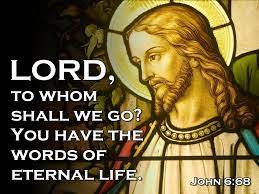
As a result of this intolerable language some  of them choose to leave him.  In a similar way today so many people find the words of Jesus to be intolerable language as many people have got up and left their faith behind them and some may never return again. No one who accepts that Christ is the Son of God has any difficulty in believing that he left us himself in the Eucharist. He promised to give his body and blood in the Eucharist as an everlasting memorial to be our spiritual nourishment and our means of offering an acceptable  sacrifice to God every time his body and blood are made present by the words of the priest. He fulfilled that promise at the Last Supper. He gave to his Apostles and their successors the power to repeat this act of divine love when he said: “Do this in memory of me.” When Simon Peter answered Christ’s challenge will you too go away?”  he spoke not only for his fellow Apostles he also spoke for us when he said “Lord to whom shall we go? You have the words of eternal life. and we believe; and we know that you are the Holy One of God.”

We are the people who really believe that Christ was the incarnate Son of God. Peter made his act of faith before he was fully convinced of the divinity of Christ, but he already knew that Christ was close to God and spoke nothing but the truth. We have the proof of Christ’s divinity which Peter and the Apostles later got, he gave them the bread of life and he went to the cross and rose again it certainly was intolerable language for some people. We also have the witness of the early Christians whose belief in Jesus  the bread of life was at the very centre of their Christian lives as it should be the centre of ours.   We can trust that what Jesus taught is true, even if we do not fully understand how it could possibly be. Many people who became saints died for their belief in Jesus; hopefully we can live our faith fully, even in times of doubting some doctrine or even the wisdom or actions of some of those in the Church.  So with all the doubting and faith filled people wherever they are we say “Lord to whom shall we go? You have the words of eternal life.” and we believe; and  we know that you are the Holy One of God.”

The Feast of the Assumption

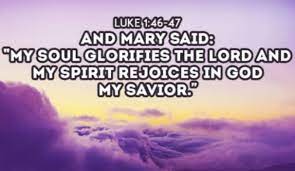
Here we are at the 15th of August  as we celebrate the Assumption of Our Lady into heaven. Our Gospel Reading for this Sunday  shows us that Mary’s faith found expression in prayer as she went to visit Elisabeth Our faith also finds its expression in prayer as we listen to the great evening hymn of praise and thanksgiving the Magnificat.  The Magnificat has occupied an important place in the Liturgy of the Church since the fourth century, the canticle is taken from the Gospel of Luke (1:46-55) where the events of the Visitation of Mary to her kinswoman Elizabeth are recorded. Elizabeth, who was pregnant with John the Baptist at the time, greeted Mary with the phrase “Blessed art thou amongst women,, and blessed is the fruit of thy womb.” Mary responded with this canticle. Every time  we pray the Magnificat we encounter a wonderful model of Christian spirituality in Mary our mother, who according to the Second Vatican Council is “a model of the Church in faith, charity, and perfect union with Christ” (Gaudium et Spes, 63).

Mary’s faith expressed in the Magnificat reached out to others in love and it reached out to God in prayer. If our faith finds expression in love, it will also find expression in prayer. In her prayer, Mary comes before the Lord as his lowly servant, ready to receive from God all the great things that God wants to give. Mary teaches us that when we pray we always come before God with open hearts ready to receive all God has to offer us and there is so much on offer. Mary’s prayer also shows another side of her faith. It shows us that her faith is one  that hungers for God’s justice to become a reality on earth. She speaks to us about a God who pulls down the mighty from their thrones and lifts up the lowly, she tells us about a God who works to fill the hungry with good things and sends the rich away empty.  The Assumption celebrates Mary as one who not only shows us the glorious destiny that awaits us at the end of our life’s journey but also how we are to travel on that journey as disciples of the Lord. Mary Our Mother was  born to be the first and perfect disciple, unstained by Original Sin.

We who want to be disciples of the Lord, look to her as our guide in this life, learning from her example especially that of faith in God and what he wanted her to do be the mother of his Son as well as the mother to all who share the catholic faith. The Assumption is God’s crowning of His work as Mary ends her earthly life and enters eternity.  The feast days of the Church are not just the commemoration of historical events; they do not look only to the past. They look to the present and to the future and give us an insight into our own relationship with God. The Assumption looks to eternity and gives us hope that we, too, will follow Our Lady to heaven when our life is ended.  So let us renew ourselves with Mary as we celebrate the  Assumption  as we pray the words of the Magnificat giving glory to God for all he has done for us.

19th Sunday of Ordinary Time

Jesus is the Bread of Life – John 6:35 – ScriptureWay – Whitney V. Myers -  ScriptureWay

This Sunday we hear Jesus telling the Apostles that he is the bread of life. The Gospel reading deals with a doubting audience, and at times we  are also members of that doubting audience. The people who heard Jesus were shocked and critical of his claim to have come down from heaven as the Bread of Life. Despite the miracles they had witnessed, and the words of wisdom they heard preached with such convincing authority, they could not take the extra step to accept His claim. Many people these days are also unable to make that extra step on their faith journey. We, on the other hand  are able to take that extra step because our Christian faith has come to us from Jesus, passed down through the generations of those who went before us.

We know where he came from, we know where we are going and we know how to reach that destination. The personal faith that we have means that “God out of the abundance of his love, speaks to us as a friend and lives among us as  the living bread which came down from heaven.  The Gospel lesson for this weekend tells us that we can’t live our lives by ourselves as we search for answers when we have doubts.  We find Jesus who is the answer to the doubts we have through the teachings of the church and through our communion with him through the eucharist the bread of life.  When we gather at the Eucharist we bring ourselves and our needs in prayer to God. We bring ourselves to God because God is with us and continues to be with us in good and bad times through the sacramental life of the Church and through the Eucharist in particular.

When we see the Eucharistic Bread, we believe that it is Jesus who is there before us:  such is the faith we have in the Eucharist the bread of life.   In our day-to-day lives we are empowered to be imitators of God’s love and we are asked to pass that love on to those around us.  So, at the end of each day, when we give thanks for all of our blessings, most of all, we give thanks to God for the presence of Jesus in our lives and the lives of those who are around us as we remember that Jesus is the bread of life.

Post Navigation