Fullerton T

RELIGION LITURGY AND LIFE

Archive for the category “Life”

19th Sunday of OrdinaryTime

In the first reading the prophet Elijah is on the run from the anger of King Ahab and his wife, Jezebel.  He finds refuge in a cave on Mount Horeb where God reveals himself to Elijah not through earthquake, wind or fire, but rather through a gentle breeze – the breath of God.  The subtlety of God’s presence is so gentle it could easily be missed by those expecting great signs and wonders.

In the second reading Paul, familiar with the teaching of his former Jewish faith and converted by his encounter with Christ on the road to Damascus, struggles to understand why his Jewish brethren have not also understood ‘the truth’ that guides him. Perhaps his anguish is heightened because he was accused of turning away from his Jewish faith to preach to the gentiles.

The gospel reading this Sunday is all about Jesus’s walking on water but if you look beyond the walking on water this story is really about trust and faith in God. We have no problem identifying with Peter, he is so like us. He is confident one moment and then, when things get difficult and he realizes that he has bitten off more than he can chew, he falls apart. By then it is too late and he needs help and that is when Jesus offers peter his hand.  and he acknowledge Jesus as the Son of God. Life is like that, we start something like a new job, college, marriage, or a project to help others, but then it gets complex and beyond what we are capable of. We are sinking, we are drowning. Not an uncommon experience in so many situations in life and in the way we deal with them. God doesn’t always give us an immediate cure or a fast solution when we bring ourselves in prayer for others or for ourselves to God. God, through Jesus, is not distant from our problems. Jesus shows us that when he reaches out a hand to Peter and to us, he is companion with us in the storms of life.  

At times we may well be floundering, like Peter, but Jesus reaches out to help us, to rescue us. What better analogy could there be of our own lives and relationship with Jesus. We live messy lives, we doubt and we lack faith but nevertheless we are still moving towards the Lord. This Sunday we are reminded that we should   listen for God in quiet moments and trust Him in hard times. Elijah found God in a gentle whisper. Peter walked on water but sank when he doubted. Jesus saved him, showing that God does not abandon those who call out for help and that include all of us today.

17th Sunday of Ordinary Time

This Sunday is the Seventeenth Sunday in Ordinary Time and the World Day of Grandparents and the Elderly. We give thanks to God for our Parents and grandparents and all they mean to us today. Last Monday in Dublin as part of the Parable Tour Father Mike Schmitz spoke at the National Stadium with 1600 young people attending.  Before the event A special was Mass organized by the Irish Bishops’ Conference’s Council for Evangelization, Catechetics and Pastoral Renewal and was celebrated by Bishop Fintan Gavin, Bishop of Cork and Ross. Many people attended the Mass and the next day when I watched Father Schmitz speak on YouTube there was something real and honest in his words, as he encouraged those who may be uncertain in their faith not to wait until they have all the answers before taking the next step. He said  “To anyone standing on the edge of faith  uncertain, hesitant, or searching  the invitation is not to have all the answers before you begin. Throughout Scripture, we see that obedience often comes before understanding. “Mary is a fantastic example of this.  The Archangel Gabriel appears to her and says, ‘You are going to be the mother of the Messiah.’  She then asks, ‘How can this be?’  He gives her a clarifying answer and she says,  ‘Let it be done to me.’ “He does not give her understanding;  He does not give her a plan;  He does not give her a roadmap.  He simply gives her enough information to take the next step.  That is the invitation for every one of us.  God always gives us enough light and enough information to take the next step, and we can trust Him with that next step.”

The readings for this the 17th Sunday  help us see what is truly valuable. They remind us that wisdom, faith, and God’s kingdom are worth more than anything else we could ever own. These gifts bring life, joy, and strength when we seek them with open hearts. In the First Reading God tells Solomon to ask for anything he wants. Solomon asks for wisdom to rule well. God is pleased and gives him great wisdom, more than anyone before or after him. In the Second Reading we are told that God works for good in the lives of those who love Him.  He calls people, makes them right with Him, and gives them glory. He shapes them to be like His Son.   

In the Gospel reading Jesus tells us that The kingdom of heaven is like a hidden treasure or a rare pearl so valuable that people give up everything to have it. When its great value is recognized, one gladly does all that is necessary to obtain it. Being members of the Kingdom means sharing our knowledge of it with others.  To truly believe in Christ means leading other people to the same knowledge by what we say and do; for secret faith is no faith at all. We should be happy to bring out of the house that is our life all kinds of treasures to share with our neighbors. We know life and service in the reign Jesus is proclaiming, will require sacrifice.  But these parables encourage us to take the plunge, they tell us, “It is worth whatever you must change, or give up.” But these treasures are not physical things but spiritual attitudes and otherwise that are virtues like love and justice and truth and hope and so on. What we bring out from our treasure store are the values of the Kingdom, the attitudes of Jesus and the knowledge of the one true God. God loves us just the way we are, but He refuses to leave us that way. He wants us to become treasure for other people so that they can discover the faith which is the pearl of great price the treasure hidden in the fields of our hearts.  

 In the life and ministry of Jesus many people experienced the Kingdom through their encounter with him which brought dignity, love, forgiveness, release from illness, disability, guilt, shame and even death.  Jesus made present the reign of God’s grace for people in all kinds of need.  While we are sometimes overwhelmed by the experience of the presence of God within our hearts, more often we experience the reign of God’s grace through others. These people, like Jesus, somehow make present, make real the presence and action of God especially but not only in our moments of need but in every good or bad situation we might find ourselves in.  God always gives us enough light and enough information to take the next step, and we can trust Him with that next step.” The big question for us today is are we prepared to make the next step on our journey in faith and trust?

16th Sunday of \Ordinary Time

This Sunday is the 16th Sunday of ordinary time as the summer continues to go by at breakneck speed. Our first reading from the Boof of Wisdom is taken from a long passage in which the author sings the praises of God and all the things he has done for his often-ungrateful people. Justice, mercy and forgiveness are the qualities the Lord shows towards us, and by inference these are the qualities which in us most reflect the glory of God that we should show to other people. In the Second Reading these verses from Romans follow directly on from last Sunday’s reading. Paul is very aware that to talk of the distinction between the ‘unspiritual’ and the ‘spiritual’ is all very well, but in practice we sometimes find ourselves literally ‘lost for words’ when we try to pray. This doesn’t matter; Paul assures us. If we are alive with the Spirit we can be assured that God knows what we cannot express. 

In the Gospel we hear the story is the parable of the seed and the weeds. In this parable Jesus recognized good’s co-existence with evil. He also held out the hope that the Kingdom would right all wrongs. I think that there is the potential in each of us to be either wheat or darnel that is good and bad. We need to ask ourselves who are we called to be in a world where weeds and seeds grow side by side.  Should we hide from the messiness and make faith a private personal relationship with God? Should we insulate ourselves – sharing with those we think are worthy of our love, deciding who is worthy? Where is God in all this concern, worry and judgment?  If we pray about these three questions and our problems and those of others, we will see God is there in the middle of everything and his hand will guide us and as a result we will be the seeds that flourish and not the weeds that die.  Jesus used parables to challenge his audience to think, and he uses the parables in today’s world to challenge all of us. In truth and charity, we must speak to others and teach them about the great responsibility they have to choose to be weeds that die or seeds that flourish. All of us have the power to freely choose Him or to reject Him. May we see the seeds of the Kingdom of Heaven grow and flourish in our midst.

Today, as we look at our present situation, we can still detect weeds in ourselves. Rather than being overcome by discouragement, the parable proposes a note of hope. After all, good seed has been planted in us and is growing. The burden of the struggle is not ours alone. Our calling then is to participate as best we can in building up a world where God is King! God will decide on its membership, not us and he will guide us along the roads that lead to Salvation and he will help us to be the seeds that flourish instead of being the weeds that die.  

15th Sunday in Ordinary Time

This Sunday we hear the Gospel story of the sower who went out to sow the seed. This parable really is about the seed of faith with Jesus the sower and you and me as the soil on which the seed that is the word of God lands. In the First Reading from the prophet Isaiah, the Lord’s word is likened to rain that nourishes the earth, promising that it will accomplish its intended purpose without returning empty. in the Second Reading saint Paul tells us that Current sufferings are minimal compared to the future glory awaiting God’s children. All creation yearns for this liberation and shares in the anticipation of redemption.

In the Gospel Jesus shares a parable about a sower who scattered seeds, symbolizing the spreading of God’s word. The seeds fell on different types of soil, representing various responses to the message. As the early church faced opposition and a seeming lack of success, the parable must have given encouragement to the church at its beginning as a promise of fruit not yet visible to them. Jesus is speaking to a large crowd. They may be listening to what he says, but as it is today some will listen and others will leave what he is saying behind and go their own way. He is realistic as he seems to randomly cast his words out upon the crowd. Often that wee seed of faith may take root many years after it has been planted and today, we see many people returning to the faith or coming to the faith for the first time after someone or some event in their lives planted that first seed with others helping to nourish the seed helping it to grow. Many of the details in the parable are about wasted effort and lost seed. Sometimes, we wonder if all our efforts are worth it when things are falling around us. Very often things that happen in our lives don’t seem to be the way we might want them to be, but when we look at the problems with eyes of faith, we see that things around us are the way they are meant to be for the good of everyone.

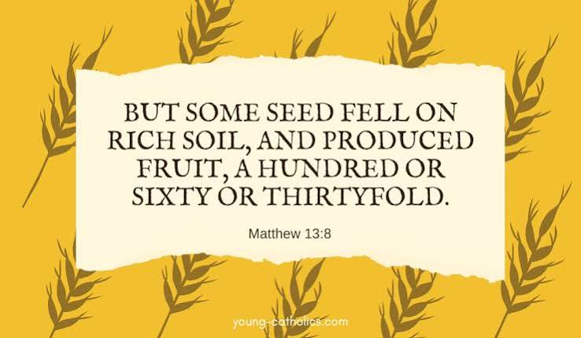
Nobody really knows what’s beneath the surface of the soil we cast the seed of the word of God upon. Who knows the potential of good soil? Do good and poor soil both exist in the same person I think that it probably does much in the same way that a person can do good or be bad. Is there something we might say that will land on the interior good soil in a person and bear the “hundredfold, or sixty or thirtyfold” Jesus promises? who knows only God knows. While the gospel parable begins with and spends time on hardships and failure it ends in surprise and abundance. What was the source of this abundance?  We look to what Isaiah told us today in the reading about the fertile, life-giving nature of God’s Word. Our God is a God of surprises, and our faith is also filled with so many surprises as well. Despite any discouragement we might feel because our efforts in many things seem futile and draining, we put our trust in the one who speaks to us a living word who sows the seed. The seed represents the Good News of the Kingdom, so by inference, the sower is Jesus himself. The message of Jesus may not always be welcome especially in our modern world were faith and religion are constantly under assault by those who oppose the faith-based outlook on life. That said we still have to sow the seed of faith by what we do and say and then we leave the rest up to God.

The efforts we make are never wasted and we don’t always see the fruit of the seed that is sown or the work we do. We are reminded that God’s plan is certain. His words nourish us, even when even when there is hardness of heart in life. Through the parables we know that we are being offered something good we could never get on our own, the love of a gracious and lavish God who is not stingy in showing us the signs of that love to his people.

14Th Sunday in Ordinary Time

Well, here we are trying to get into the holiday mood as the school’s close and the people go on holiday. It is a time when things get quieter with less traffic and fewer people around. It is a good time to get things done that we wouldn’t get the chance to do with all the hustle and bustle going on around us. The readings show Jesus as a humble and peaceful king. God cares for the weak and tired. Jesus invites people to trust him and find rest in his gentle way. In the First Reading from Zechariah The prophet says a king will come to Jerusalem. He will be good and bring victory. But he will also be humble, riding on a donkey. He will bring peace to all nations. His rule will reach everywhere. In the Second Reading from Romans, we are told that if God’s Spirit lives in you, you belong to Christ. God will give you life through his Spirit. Do not follow sinful ways. Live by the Spirit, and you will have life.

One of the most wonderful things about Jesus is his special love for ordinary people ­ like us with all our faults and failings. It comes out in a particular way within the two statements that he makes in this Sundays Gospel reading. The first is in his prayer to God: ‘I bless you, Father, Lord of heaven and earth, for hiding these things from the learned and the clever and revealing them to mere children.’ The second is in his Invitation to all of us: ‘Come to me, all you who labour and are overburdened and I will give you rest.’  Why did he say this to us? The answer comes across very clearly so many times in the gospels and may be summed up in one word COMPASSION. We see Jesus’s compassion in the plight and tears of the widow of Nain: ‘Don’t cry,’ he says to her, before bringing her son back to life. He is moved with compassion at the plight of a leper begging for help (Mk 4:41), he shows compassion for two blind men sitting at the side of a road and pleading for mercy (Mt 20:29-34), and he shows compassion for the crowd of people with nothing to eat (Mk 8:2) the feeding of the five thousand then took place. In each case he responds to the suffering people he sees with the love, compassion that shows the compassionate care and love of God the father.

 So, in the here and now of our daily lives are we on the side of Jesus, that is the side of compassion, kindness, help, healing, and mercy? Or on the side of the scribes and Pharisees who are among us even today and they are fierce, fault-finding, heartless, critical, and merciless people without compassion. Will we take our cue from their cruel, insensitive judgments and actions? Or will we take our inspiration from what we see in Jesus, and his compassionate outreach to the poor and the broken: when he said, ‘Come to me, all you who labour and are overburdened and I will give you rest’. These words are a clear invitation for us as we are invited to see that God’s care is close and simple. He is faithful and merciful, leading with kindness. This is also an invitation for us to live a life of simplicity. Happiness does not that having more is better instead it means being content with what we have. Jesus invites us, “Come to me!” And He waits for us so let us take up our rest for our hearts are restless until they rest in him.

13th Sunday of Ordinary Time

The 13th Sunday in Ordinary Time brings us readings that speak about welcome, faith, and commitment. Each passage reminds us that following God changes how we live. It calls us to trust his promises, live the new life he calls us to follow, and place Him in our hearts. We are reminded that faith touches both big choices and small actions. To follow Jesus is to place him at the centre and to live with open hearts. Every gesture of love becomes part of our call as disciples. In the First Reading A woman of rank in Shunem offers hospitality to the prophet Elisha. In gratitude, Elisha promises her a son, despite her husband’s advanced age. In the Second Reading St Paul tells us that through baptism, we join Christ in His death and resurrection, signifying our new life. As Christ is free from death, we too, should live free from sin, and for God.

In the Gospel story, we are reminded that the priority of faith in the early church demanded radical consequences. At that time extended closely-knit families formed the basis of society, a choice for a follower of Christ could mean a rejection of the family’s faith and values. Jesus reminded his followers that the Christian life involved many risks and one could not compromise or hide these risks away a believer could not placate his or her family if the cost threatened faith. The people of the day thought that No, faith could involve such an extreme choice. Either the relationship with family took priority or the relationship with Jesus took the number one slot it seemed that both could not go together.  Even though they had only a vague idea then of what he meant, when the time came, they remembered Jesus words and gladly suffered imprisonment, hardships, and finally martyrdom for Christ.  This shows how the resurrection of Christ, and the descent of the Holy Spirit on them, changed them from worldly weaklings into fearless heroes. They had become convinced that Christ was the Son of God their saviour who had come on earth to bring all men to heaven. Through time they came to realize how unimportant, the few years of the earthly life that we have were compared to the eternal life to follow. 

Today, there are still those who are suffering martyrdom for the faith because they obey God rather than man. We can help them to persevere, by our prayers. We ourselves, who are free from any overt persecution, must show our gratitude to God for being allowed to practice our religion openly and without fear. We have many opportunities in our daily life to reach out to others, to be a welcoming presence and a sign of God’s love in the world especially where we live let us not be afraid to take these opportunities when they arise and show how much our faith means to us right in our time and place.

12th Sunday of Ordinary Time

This Sunday we celebrate the 12th Sunday in ordinary time. In the first reading, Jeremiah’s lament is about his treatment at the hands of his adversaries. However, since his message comes from God, he is convinced of the rightness of his cause and of God’s ultimate vindication of his servant. In the second reading we hear that Paul was the originator of what came to be called ‘the doctrine of original sin.’ He was writing to Christians of Jewish background who had been brought up to believe it was their obedience to the Law that justified them in the sight of God. But sin ruled the world before the giving of the Law and, Paul insisted, it was faith itself the gift of God rather than the law that justified them, set them free as today it sets us free as well.

The  Gospel message is quite simple Jesus tells us not to be afraid He does not disguise the truth that his disciples will be confronted by those who threaten, bully and intimidate others into submissive agreement. What our Lord said to His Apostles applies to all Christians including you and me in the practice of our faith. So today we think of all of those who have given us an example by living their lives in faith. These may be parents’ family members or people we have known we all have people who have shown us the way of faith. So as faith filled people Jesus teaches us that our only source of freedom and strength is the goodness of our heavenly Father the goodness that comes through Jesus himself. Furthermore, the discovery of this goodness carries with it the solemn obligation to pass on one’s blessings on to the people around us as we show our concern for others. Our world is full of meaningless hype and glitter, but the only truth that will prevail is the truth taught by Jesus passed down to us in faith. The courage ordinary Christians need today is often quiet and steady rather than dramatic and overpowering. Most believers will not face prison or martyrdom, but they do face pressures that test their faith every day.

It takes courage to remain honest in a dishonest environment, to forgive when resentment feels easier, to defend the dignity of the poor and forgotten, to remain faithful in marriage and family life, and to continue praying when God seems to be silent. We also need the courage not to be ashamed of the faith we profess. In many places, we are tempted to keep religion private, avoiding any mention of hope, mercy, justice, or the Gospel for fear of criticism or rejection. Jesus’ words, “Do not be afraid,” are spoken precisely for moments like these. He reminds us that we belong to God and are precious in God’s sight. Our world often admires power, success, and self-sufficiency. But Christian courage will always be different. It is the courage to remain compassionate in a harsh world, truthful in a dishonest world, hopeful in a despairing world, and faithful in a distracted world. Jeremiah’s words from the first reading become our prayer: “Sing to the Lord, praise the Lord, for he has rescued the life of the poor.” The believer’s faith finally rests not in human strength, but in confidence that God remains faithful through every trial that may be thrown at us. May we remain faithful in every situation we may find ourselves as God remains faithful to us.

11th Sunday of Ordinary Time

I am sure many people out there reading this are aware of what happened in Belfast at the beginning of this week. I live just a few minutes’ walk from where this attack took place and as I was leaving home on Tuesday morning there was a heavy feeling of hopelessness in the air. But there is also a sense of we must do something to stop this happening again and we must ask ourselves how many times this will happen before we do something to rectify the situation. This is a problem that the politicians and the governments need to solve and they really should stop and listen to what the people are telling them as many feel that they are being left behind. It is the people on the ground politicians and local people who need to come together to sort out the problems of our time which include immigration and all the associated issues that arise from it. We pray for Stephen Ogilvie, who sustained devastating injuries in the brutal and horrific attack on Monday evening as well as praying for his family and for peace in our country.

The Scripture readings for this Sunday are all about the great compassion Jesus has for the crowd who were his followers. In the first reading the Israelites arrive at Mount Sinai, where God speaks to Moses and tells him to convey a message to the people. God reminds the Israelites of how He delivered them from slavery in Egypt and declares that if they obey His commands and keep His covenant, they will be a treasured possession and a kingdom of priests. In the second reading, Paul tells us God showed His love for humanity by sending Jesus Christ to die for our sins while we were still sinners. Through Jesus’ sacrifice, we can be reconciled with God and receive the gift of eternal life. In the gospel, we hear how Jesus cared for the people and sent his disciples to do the same. Jesus wanted to bring the Kingdom of his Father to them, so he set out to heal them, and sent the apostles out to do the same in his name. His aim was to bring them the peace of God, to help them by healing their worries, their sickness, their embarrassment at being lost sheep without a shepherd as God was always the shepherd in Israel. When he called the twelve apostles he was making a New Israel, a new set of twelve tribes, as a permanent healing body, to make sure that the Kingdom of the Father and its peace and generosity would always be available to everyone everywhere.  He was not setting up a group of leaders, instead he was appointing his own helpers in spreading God’s Kingdom.  Do we make it our business to spread the Kingdom of God? Are we labourers in the vineyard, trying to bring God’s peace and healing to all the people of God? All of us are made in the image of God, and he gave us the task of following on his creative work. And then we are all called to follow Jesus, we are all called to make his message known to all people, those around us as well as the people at large.

Like the chosen people of Israel, we are counted a kingdom of priests, a consecrated nation. We are called to minister to the people in our own time, taking responsibility for our own mission.  No one can tell us exactly where and when we are to respond to Jesus’ call. We will just have to look out and see and hear the way Jesus did. And through our baptism, that is what we are being prompted and empowered to do. As Blessed John Henry Newman wrote: He called us first in baptism; but afterwards also; whether we obey his voice or not, he graciously calls us still… Abraham was called from his home, Peter from his nets, Matthew from his office, Elisha from his farm, Nathanael from his retreat. The call that Christ makes to us takes us onwards, It is a call to be the church of the future just as the Apostles were called to be the Church of the future at its beginning. Jesus’ mission is to the lost sheep. It is his desire and endeavour to bring together, those he pities, those he looks on with love.

Today we pray for each of us: “Help us see what you want of us, help us not settle on being just occasional Christians, but “full time Christians.”  Give us sensitive sight, your eyes, for the world. Through the words of the Gospel may we hear again our own call to be emissaries of God’s love and bearers of Good News. May we allow the kindness and compassion of God to touch our own lives and the lives of those around us wherever we are.

PENTECOST

The Ascension

This Sunday we celebrate the Ascension: this is the day when Jesus returns to the Father in heaven. There seems to be a contradiction in Jesus leaving as he assures us that he is staying with us when he said know that I am with you to the end of time. Jesus is going to heaven, but it is not a farewell because he is with us today right where we are through all the ups and downs we have in 2026. He is with us in a particular way through the Holy Spirit and through the signs of bread and wine and the sacramental life of the church. We celebrate the Risen Lord Jesus as he returns to the Father the same Riesen Jesus who belongs to everyone who accepts him as the beloved son of God.

In the First Reading from  the Acts of the Apostles we are reminded about the death of Jesus, his resurrection and how the risen Lord met with the disciples, Jesus told them, you will receive power when the Holy Spirit has come upon on you, and you will be my witnesses in Jerusalem and… to the ends of the earth. And when he had said these things, as they were looking on, he was lifted up, and a cloud took him out of their sight.’ In the second Reading Paul prays that God, the Father of glory, ‘give you the Spirit of wisdom and of revelation in the knowledge of him, having the eyes of your hearts enlightened, that you may know what is the hope to which he has called you.’ For Paul, the resurrection of Jesus is the foundation of his faith and of all his missionary endeavors, and it is the risen Christ ascended into glory who is ‘the head over all things to the Church, which is his body, the fullness of him who fills all in all.’ This Gospel reading is all about the future it is also about us in the here and now of today, and what we are doing to make disciples of all the nations in 2026. Simply put where do we fit in when we hear Jesus telling us to make disciples of the nations and do we recognize him as being with us now in May 2026. In today’s gospel, Jesus has little to say, but he is definite about what he has to say. This is in sharp contrast to the fact that, even at this last minute, some of his disciples still doubted.

The disciples did what he told them to do. He asked them to meet him on the mountain, and they did that. Like any gathering of people, their feelings were varied. Some of them worshipped him, while some of them still doubted him. Jesus didn’t seem to have any great problem with that, because he knew that, when the Spirit came, all of those doubts would be ended. It would seem, indeed, that he was in a hurry to take his leave of them, maybe he was so that the second part of his plan of salvation could get underway. The mission of the apostles was simple to understand; difficult to carry out. It was to teach others all that Jesus had taught them. Just as he asked his disciples to obey him, they were to ask that others should obey his directions and instructions also, which is so hard in the world of today.  The programme of redemption and salvation that began at Pentecost must continue from generation to generation, until the end of time and here we are in 2026 talking about the ascension. With all the changes in the church and in society, the two things that have not changed are Jesus the Son of God, and every word of his message. Again, we ask ourselves what we are doing to make disciples of all the nations realizing that Jesus and his message is always new for each generation. May the Lord give us faith when we struggle, courage when we hesitate, and hearts open to the power of the Holy Spirit. so that salvation will reach the ends of the earth.

Post Navigation