Fullerton T

RELIGION LITURGY AND LIFE

Archive for the month “November, 2021”

First Sunday of Advent
First Sunday In Advent

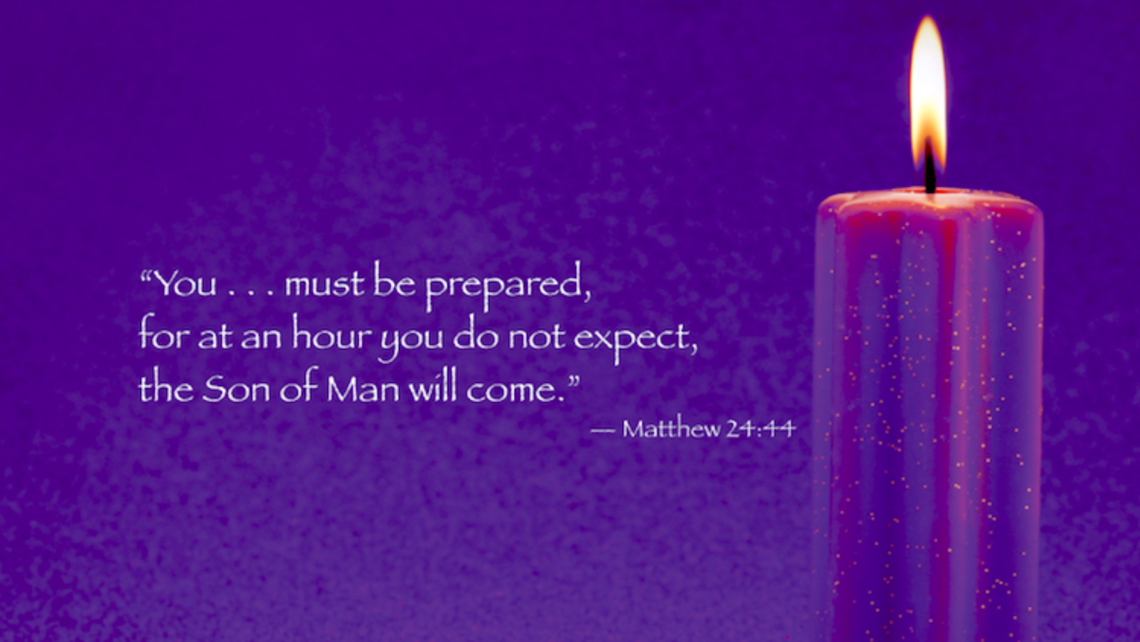
Here we are at the beginning of another Church year, as we continue to live with COVID 19 the last 2 years have been some going as we hope to see better days in the year ahead. we pray in a special way for the African Nations who are affected by the current COVID variant . This weekend we have a change of colour and a change mood we go from the green of Ordinary time to the Purple which symbolizes the penitential season of Advent. We also light the first purple candle on the advent wreath and place the symbols on the Jesse tree. Advent is the season that brings us back to the ancient longing of the human race for the coming of one who would bring  liberation from sadness and the fulfillment of perfect peace to this world. The word Advent derives from the Latin word meaning coming. The Lord is coming may the heavens rejoice and earth be glad.

During Advent we recall the history of God’s people and reflect on how the prophecies and promises of the Old Testament were fulfilled.  At the beginning of each church year we are reminded that Jesus the Christ is present as a person to us.   The prophet Jeremiah foretold the day when God would send his Messiah King  to “execute justice and righteousness in the land” (Jeremiah 33:15). Jesus is the fulfillment of this promise and every promise which God has made. In these short verses in the Gospel, Jesus described the beginning of God’s final initiative. He would give signs of warning across the sky, cause anxiety on earth with violent sea storms, and shake up the heavens. Today we would explain this scientifically as eclipses, meteor showers, and the result of storm systems. The ancient people attributed to God’s intervention in the order of the cosmos.

God would shake things up and so he does today as we look at Pope Francis and the way he challenges us as individuals and as members of the Church.  People of Jesus time would grow anxious because their faith systems and rituals failed.  But, Christians were to rejoice. Their Savior was close at hand! Now, their world view and lifestyle would be vindicated. Luke presents this time as a time of hope filled anticipation. Through great power and glory, the Son of Man would come and free his followers. Unlike the anxious people of the world, the Christian people were to anticipate the end in hope. During Advent, we are invited to prepare our hearts for the coming of the Lord – to wait in joyful hope as we prepare for the annual celebration of his birth. So now let us go forth in peace and hope to prepare over these next few weeks to meet the Lord at Christmas.
The Feast of Christ the King

cross-clipart-christ-is-king - Abiding Word Lutheran Church

Every time we complete the cycle of the liturgical year, there is a seamless blending from the old year into the new year: so this week we hear of the King who is to come, next week, we begin a New Church Year with  the Season of Advent. This feast affirms that Christ is King, that he is Judge, that he is Ruler of the kings of the earth. By his own words we know that this is true, as he stands before Pilate and says, “Yes, I am a king.” But his kingship is different: it is not of the same kind as earthly kings, whose empires fade and pass away. His kingship is eternal, and holy lasting until the end of time. Through his love for us, we share in this sovereignty – this holiness – as priests and kings who “serve his God and Father”. We end our year in simple, awe filled praise of the One who is, who was, and who is to come ‑ the Almighty.  The theme of the kingship of Christ should not be misunderstood. Jesus is not king in an earthly sense. The acclamations of the crowds on Palm Sunday and the enthusiastic endorsement of the disciples that Jesus is the Messiah might mislead us. Jesus is king; Jesus is Messiah, because he is the anointed one of God, who comes to do the will of God and he invites us to do the same.

 For the evangelist John, Christ’s kingship is revealed above all on the cross. In the dialogue with Pilate in the Fourth Gospel Jesus points Pilate in the right direction: his kingdom is not an earthly one. He came ‘to bear witness to the truth’. Those who seek the truth are members of his kingdom, which our liturgy today describes in the Preface as ‘a kingdom of truth and life, a kingdom of holiness. We remember that The Kingdom of God exists in every home where parents and children love each other. It exists in every region and country that cares for its weak and vulnerable. It exists in every parish that reaches out to the needy. The Kingdom of God   happens whenever someone feeds a hungry person, or shelters a homeless person, or shows care to a neglected person. It happens whenever we overturn an unjust law, or correct an injustice, or avert a war. It happens whenever people join in the struggle to overcome poverty, to erase ignorance, to pass on the faith. The Kingdom of God is in the past in the life and work of Jesus of Nazareth passed on to us through the generations; it is in the present in the work of the Church and in the efforts of many others to create a world of goodness and justice here and now; it is in the future reaching its completion in the time  to come when all things will be made new..

May we build the kingdom of God where we are called to be in the here and now of our lives and living. We don’t know how many people witnessed the death of Jesus in Jerusalem. We know that some of those who did were delighted to have him out of the way at last. Others were heartbroken at the death of a truly good man and the shattering into pieces of a dream for something better, a new world order in which love and service would triumph over oppression and hatred. The majority probably just went about their business and reflected that really it is wiser just to keep your head down and say nothing. We can be sure that nobody there on Good Friday  thought they were witnessing the death of Christ the Universal King and I am sure they did not think that we would be celebrating Christ as our King over 2000 years later. Jesus and his kind of kingship have to be learned and not in palaces nor in schools of diplomacy but among the poor and needy and those whom the world has forgotten and there are many forgotten people out there. We remember that our king is the servant of the poor and we only belong to his court when we become servants of the poor and those who need us.

May all of us take up the challenge that the feast of Christ the King gives us. That challenge is to reach out to others showing them that the ways of Jesus are what we as Christians are really all about as we go about our daily lives.

33rd Sunday of Ordinary Time

This Sunday as we head towards  the end of the Liturgical Year we listen to Jesus’s words concerning the end times. The vision of the future in the Gospel Reading for this weekend doesn’t look very appealing. The bad news is delivered first of all. Jesus imagines a time of terror and trouble and persecution. People will be betrayed and handed over to the authorities. There will be wars and earthquakes and famines. Jesus says, “These things must happen.” Then there will be cosmic upheavals: “the sun will be darkened, the moon will lose its brightness, the stars will come falling from heaven”. After this catalogue of disaster there is the good news. Jesus looks beyond the time of distress to the final time, when the Son of Man will gather the scattered people of God to himself. Jesus sees beyond suffering and persecution to a future of peace with the father in heaven.  God does not call us to be anxious, but he calls us to confidence in the message we hear in the gospel and proclaim in our lives that we remain in his light. Christ remains our high priest who has offered himself for the forgiveness of our sins. God knows what it is to be human.

The apocalyptic prophecies of the Hebrew and Christian Scriptures are a cautionary tale even for us today. Even though the forces of wickedness take control, God is still the Lord of the Universe and all that is in it. These narratives are meant to provide us with hope to stay the course, to hold fast to the faith that resides in our hearts and souls. That faith is the foundation of our charity and provides our spirits with the energy that is hope. It may sound like a fluffy non relevant thing to speak of faith residing in our hearts. The experience of the Jews, in this period a couple of hundred years before Jesus, is an inspiration. Our hearts pretty much dictate our actions. It is the movement of our hearts that provides the energy to take on overwhelming odds and preserves us through all the struggles. It is the overwhelming power of what resides in the heart that provides us with wisdom, understanding, counsel, fortitude, knowledge, piety, and fear of the Lord. If our hearts are right, then our lives are based on the Truth that is God’s creative love. If our hearts are empty of that love, we tend to get overwhelmed by threatening despair and hopelessness. The Lord calls us to stay awake amidst the distractions of life, so that we will recognize him when he comes again. St. John of the Cross wrote, “When evening comes, you will be examined in love” (Sayings, 60).

We prepare for the day of Christ’s coming by recognizing him in our brothers and sisters and by knowing him through  his word and sacraments. False securities and shallow guarantees will not sustain us in times of testing. God alone must be our hope as he has been for many people over the time of the COVID19 Pandemic and so many other troubled times. God’s ways must be our ways, so that when our securities and misplaced confidences fail us we can turn our eyes to God’s saving light and he will show us the way.

32nd Sunday in Ordinary Time

This weekend at the beginning of the month of November we remember the Souls of all our families and friends who have died. Throughout November we think of all those who have gone before us in faith and we pray that we will meet them again in heaven when we get there.

The scribes in This Sundays Gospel need more than a defence counsel, for Jesus is putting his case for the prosecution and the scribes do not have much of a defence. The scribes were expert lawyers, who interpreted and applied the written Law through a complicated system of traditions. Jesus makes a series of charges against the scribes and what they are actually doing.  He criticises their habit of wearing distinctive clothes, which marks them as different from others. He criticises their habit of taking the places of honour at religious and civil functions. He criticises their habit of long-winded prayers, that are for  their immediate audience to hear  and not directed  to God. Finally, he denounces their practice of exploiting the widows by living off their savings.  

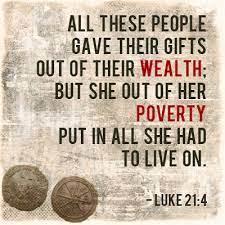
The gospel story goes on to tell us about the poor widow who went along to the treasury and how she puts in two of the smallest coins in circulation. In the arithmetic of the kingdom the widow’s offering is worth more than all the other contributions put together. The others who have given money give from their surplus, the widow gives everything she has. That is the key point in this reading she gave everything she had the widow’s action follows immediately on Jesus  critique of the scribes who profit from their status within their communities . The Gospel story about the widows contribution to the treasury is a good lesson in having a proper perspective of oneself and what you are doing or not doing. Her humility is praised, as an honest thanks giving to God for all she has and all she is. This should encourage us to try and stretch our resources rather than seeing the giving as an obligation or an after thought, certainly giving from the heart rather than for show is a good and noble thing. And that is really what we should be about giving from the heart recognising that we need to be like the widow of the gospel who gave everything she had. So many people in positions of power can easily fall into the pretence of high office. When that occurs, they are no longer open to hearing and seeing the needs of their people.  

Jesus hopes that his own disciples will take their cue from the example the widow gave  and not from the scribes who were hungry for all the status and honour that they could get. Jesus hope for us is  that we, his followers, will also take the example of the widow and be equally generous with our own resources. We are called to give our time, our talent, our understanding. We are asked to give not just from the abundance of all we have but to give from our hearts. Like the widow, we might feel that we have nothing much to give; but it’s that kind of giving that counts with Jesus. May we not be afraid to be like the widow in the Gospel who gave all she had.

Post Navigation