Fullerton T

RELIGION LITURGY AND LIFE

Archive for the month “January, 2023”

4th Sunday in Ordinary Time
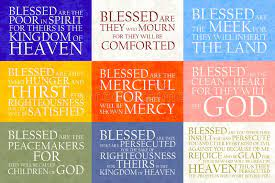
This week we have been taking part in Catholic Schools week, over these days we have been celebrating what it means to be a catholic  schools. We pray for our teachers, parents, grandparents and the young people  that make up our school communities where we are. The Gospel text for this weekend is the story that  we know as the ‘Beatitudes’. The beatitudes introduce Jesus’ teaching about the kingdom, discipleship, the true meaning of the Law and true righteousness (virtue), interior disposition of the heart against external fulfilment of Law, trust in God and keeping the Kingdom as the focus of the disciples life. In the ancient languages of Aramaic and Greek, the statements of blessedness are an exclamation of surprise and applause. “Oh, Blessed the poor in spirit.” This is acclamation, a shout of praise. The first Beatitude strikes the keynote for the seven Beatitudes that follow.  The decisive word in this first Beatitude is the word, poor.

The poor are called ‘blessed’ and ‘happy’ because God’s compassionate gaze rests on them. The poor in the Bible are the humble people  who bear a burden on their shoulders. They are given God’s favour and because of this they are  identified as just, meek and humble of heart. All kinds of attitudes are included in the eight beatitudes. The poor the weak, the gentle, those who mourn, the merciful, the pure in heart, the persecuted and the peacemakers. These eight blessings stand at the head of the Sermon on the Mount, pointing out eight ways in which we can welcome God into our lives. They are ways of living out God’s blessing. The first and the last knit them all together with ‘theirs is the kingdom of heaven’. Those who are called “blessed” or “happy” in these beatitudes can hardly be described as fortunate or lucky in the eyes of the world: the lowly, the mourners, those deprived of justice, those who are persecuted and abused. In structuring the beatitudes in the way he does, Matthew is not offering a programme that leads to worldly happiness; instead, he is describing what happens to Christian disciples when the kingdom of God breaks into their lives and our broken world.  The beatitudes speak of a variety of experiences that disciples undergo as a result of following  Jesus message. The result of this involvement might appear to the world as senseless suffering, but Jesus heaps loads of blessings on those who struggle to love and live the truth of the Gospel in their own time and place. Because of who he is Jesus will change us and others will change because they see the change that he makes in us. Without the person of Jesus, Christian discipleship is meaningless.

We are people of the beatitudes when we show the attitude of the beatitudes when we stand for the truth, for the marginalized, for the alien, for the victims of war, for the victims of  economic and political systems that serve only the capitalist when they should serve everyone.  We are stronger when we show that there is another way and that way is the way of blessedness that is proclaimed in the beatitudes. In that blessedness we remember the poor, the weak, the gentle, those who mourn, the merciful, the pure in heart, the persecuted and the peacemakers we who are the people of god inheritors of the Apostles are called to pass that blessedness on to those around us so the Kingdom of God will be theirs.
3rd Sunday of Ordinary Time

The Sundays of Ordinary Time lead us through the three years of Christ’s public ministry. Every Sunday we listen to the word of God in the Readings at Mass. Throughout the whole year we see the message of salvation placed before us as the scriptures tell us about the message of salvation. From the Angel at the annunciation to the birth of Jesus in Bethlehem. From the temptation of Jesus to the Last Supper in the upper room. From  the Cross of Good Friday and the resurrection from the tomb on Easter Sunday to Pentecost when the Church began with the Holy Spirit coming down on the Apostles. This the story of salvation and we are part of that story wherever we are today . We began last week with his identification as the Lamb of God by John the Baptist and this week we hear how he called the Apostles to follow him.

In our Gospel story  this Sunday we hear about Jesus calling Andrew, Simon, Peter, James son of Zebedee and his brother John to follow him. As Jesus travelled around Galilee, he built up a following. Biblical scholars speculate that the Galileans would network and form groups around social, economic, or religious issues. Even though the Romans put down revolts with brutal efficiency, large Jewish protests did influence  official decisions especially at the local level. There certainly  was strength in numbers. Part-time fishermen like Peter Andrew, James and John would easily leave their daily tasks, if the group they joined promised to protect and enhance their way of life.  Proclaiming the Kingdom was a message with political undertones for Jews and Jesus quickly amassed an audience. When Jesus heard that John the Baptist had been arrested, he left Nazareth and went to Capernaum. Herod Antipas was ruler of this territory. It is here that Jesus goes to take up the dangerous mission of John, to proclaim the coming of God’s kingdom.

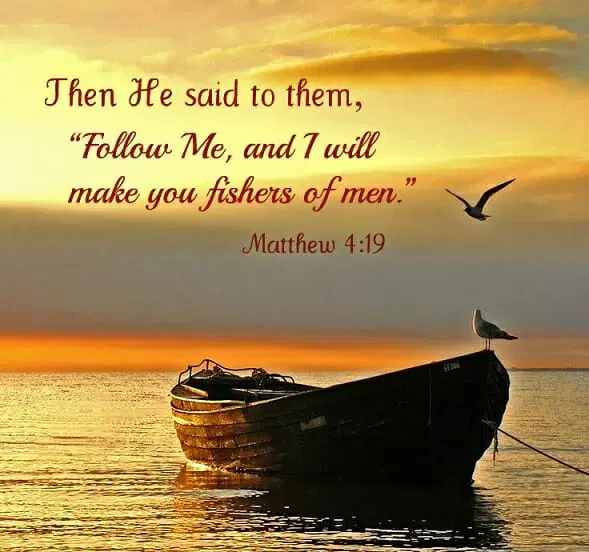
Jesus then proceeds to call Peter, Andrew, James and his brother John to follow him as disciples. Through Jesus, what has been spoken through the prophet Isaiah is at last fulfilled: “. . . the people who walk in darkness have seen a great light, God manifests Himself as ‘The Light’ that disperses the darkness and then the joy and happiness became real in Jesus presence amongst them. He is the promised light that has come into their  midst.  The light that shines brightly marks God’s first merciful and free step towards humanity. This gospel story is not just an echo from the past it is very much for us today as it was long ago. Are we listening to Jesus saying to us today, “Come follow me and I will make you fishers of men?” We are totally free to accept or refuse the  invitation for us to take up the vocation that is there for us.  Some people are called to the Priesthood, or Religious Life, others to marriage, or to the single life there are many other vocations in life all of them are  different and yet they are all calls that we are given and accepted freely. 

Each person had their unique role at the beginning of Jesus ministry  just as each of us have a unique role to play now. The fishermen abandon both their work, and their family ties. Something momentous is happening in their lives and they see the Call of Jesus as just that, a momentous event in their lives that they can’t ignore. It was amid the preoccupations of the day that the Lord called his disciples, and he called them by name. So the question to be asked of each of us is are we prepared to take up the call to be fishers of men where we are? Being fishers of men does not necessarily mean that we leave our families and our lives behind though many take up this part of the challenge.  As followers of Jesus the challenge for us is to be an example of faith in all we do and say and as a result of this we will be fishers of men because people out there will see how we live our lives and will want to follow us to see where we are going and when we get there all of us will find the lasting things of great value that are the things of God and his Church.

SECOND SUNDAY OF ORDINARY TIME

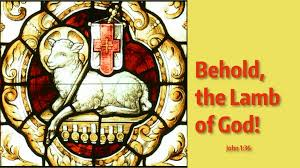
The lights of Christmas Epiphany and the start of the new year have all faded and are now a distant memory. As our lives grow more pressured, more tired, and more restless, perhaps more than anything else we long for “ordinary time,” quiet, routine and space away from the hectic pace of daily life and all that goes on within it. We’ve come from last Sunday’s feast of the Baptism of the Lord to the second Sunday of  ordinary time. In  our first reading for this Sunday Isaiah speaks about the task of the Messiah. He calls him a ‘servant’ of the people who will bring light and salvation not only to the tribes of Israel, but to the ends of the  earth. In The Gospel reading we hear  the words of John the Baptist the man who went before the Lord as his herald “Behold, the Lamb of God, who takes away the sin of the world!”  We know these words, so well for we hear them in Church when we are just about to receive the Body and Blood of Christ during the eucharistic celebration. 

The first Christian communities saw a clear difference between John’s baptism that immersed people in the river Jordan  and Jesus’ baptism that communicated his own Spirit, to cleanse, renew and transform the hearts of his followers. Without that Spirit, the Church would simply close up shop and die, but that spirit of Jesus has been the guiding light for over 2000 years right up to this present moment. Only the Spirit of Jesus can put truth and life into today’s Christianity and lead us to recover our true identity, leaving the  paths that lead us further and further away from the Gospel and what it teaches behind. Only that Spirit of Jesus can give us light and energy to light up the fire of renewal within  ourselves and the people around us  so that we can also become Christ’s authoritative witnesses in the world. Our baptism links us to Jesus as well as  the long line of his followers throughout the ages who believe in Jesus as  the Lamb of God and that his death and resurrection is the source of new life for all people. This is our inheritance born of them and we  are called to be, “a light to the nations”  like God’s servant in this Sundays first reading from Isaiah. The Love of God  is  made real to us through Jesus his Son, let us share our belief in Jesus and what he teaches with each other and everyone else we meet. We do that by living or trying to live a Christian life through  what we do and say. When we do that we will be able to say with John the Baptist that Jesus is the lamb of God that takes away the sin of the world, the Chosen One of God.’ Let us follow him.

Baptism of the Lord

This weekends  feast of the Baptism of the Lord marks the end of the Christmas season and the beginning of the Churches Ordinary Time. The first reading today foretells the coming of a messiah who will bring forth justice for the nations, firmly leading them from darkness to light: We are told that” He does not break the crushed reed, nor quench the wavering flame, until He establishes justice on the earth.” As Jesus began his mission, He must have been aware of this prophecy of Isaiah. He must, have been excited and a little fearful at beginning His great mission. Has journeyed to the banks of the Jordan, where a crowd surrounds a man in strange attire his cousin John the Baptist. In the Gospel we hear that Jesus beholds His own cousin with whom He had played as a child. They meet in a solemn moment as all see John stare, then greet Jesus warmly. And Jesus asks John for baptism! John protests that’s for sinners!”, and Jesus, seeking full solidarity with  humanity, urges John, “Give in for now.” And John does! As the water is poured over Him, the Spirit descends from the sky.

From the sky come the same words Isaiah had proclaimed hundreds of years before are heard again: “This is my beloved Son. Listen to Him!” And Jesus, rising up from the waters, assumes the role of Prophet of justice, truth, and love. He begins to gather other men and women who can share His mission. Just as Jesus entered the Jordan to be baptized, so he enters our scene of darkness and confinement in our lives today. He is the one promised to us in the prophet Isaiah, the one who will “bring out prisoners from their prisons.” He comes to those hidden places that keep us locked up. He goes to the imprisoned areas of our lives and our restricted ways of behaving which we sometimes excuse by saying, “That’s just the way I am.” Rather than be on the side-lines, Jesus comes down into the dark places where we are.  He helps us face the shadows and hidden places and leads us out  just as God promised he would do for us through the prophet Isaiah. Jesus’ baptism reminds us today that, through our own baptism, we are united to him. Most of us rarely, if ever, think about our baptism. Through our baptism we died with Christ and thus have been reborn into a whole new life ( Romans 6).  We, the baptized, are incorporated into the body of Christ.

We are called and enabled to imitate Jesus, whom Paul says, “went about doing good.” We don’t need a detailed rule book in order to know how we should act in each situation of our lives, for in baptism, we have the companionship of the Spirit of Jesus who is our wisdom, impulse and help to do good. Our role as baptized Christians has some of the characteristics of St. John the Baptist in that we also called by what we say and do  to prepare the way for Christ, not only in our own lives, but in the lives of others. We do this by the example we give of how we live our own lives of faith.  The church rejoices at the baptism of a person into the church as well as into their own unique relationship with Jesus, as they are sealed and marked as Christ’s own forever. Take a moment and reflect on where your own baptismal journey has brought you.  How has Jesus led you to use your talents and gifts for righteous actions? What has been joyful for you on this journey? Then look around at our sisters and brothers in faith, and give thanks that together we  can celebrate our life in Christ as we look forward to further adventures in the life of faith in 2023.

Post Navigation