Fullerton T

RELIGION LITURGY AND LIFE

Archive for the month “July, 2023”

17th Sunday of ordinary Time
Here we are at the last weekend of July and the summer holidays are now at the half way stage. I’m sure there are many parents out there wondering when will the long holidays end it will be no time until the beginning of the new school year.The readings for this Sunday are about the wisdom of God which is very different from the wisdom of the world. Biblical wisdom is about everyday life; it concerns practical matters and guides us in living a godly life. Anyone who is  familiar with the bible will know the unique qualities of this wisdom. A person of wisdom may not be the most intellectually brilliant person in the room. When the bible speaks of a wise person, a wisdom figure like Solomon, or a prophet, it presents a person who is closely tuned into the things of  God. The wise one and God have a strong and intimate relationship and the recipient of wisdom is characterized by very practical, everyday knowledge that enables him/her to live an ethically upright life.

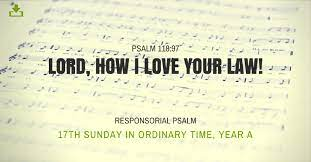
The first reading recalls how Solomon requested the gift of understanding instead of material goods or power. The psalm reminds us that God’s commands are more precious than gold. The second reading tells us to work for God’s purpose and that is not always what we want for ourselves or those around us. In this Sundays Gospel we hear the story of the treasure hidden in the field . The kingdom of heaven is like a treasure buried in a field or a pearl of great price. When its great value is recognized, one gladly does all that is necessary to obtain it. The kingdom of heaven is also like a net that collects all sorts of fish. Just as the useless fish are thrown away, at the end of the age the wicked will be rejected. To be members of the Kingdom means to share our knowledge of it with others. To truly believe in Christ means leading other people to the same knowledge by what we say and do; for secret faith is no faith at all. We should be happy to bring out of the house that is our life all kinds of treasures to share with our neighbors. But these treasures are not physical things but attitudes that are virtues like love and justice and truth and hope and so on. The things that  we bring out from our treasure store of faith are the values of the Kingdom and the knowledge of God the father. God loves us just the way we are, but He refuses to leave us that way. He wants us to become his treasure for other people so that they can discover the faith which is the pearl of great price the treasure hidden in our hearts.
16th Sunday of Ordinary Time

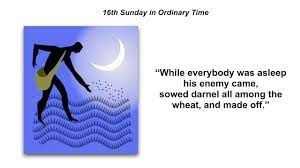
This weekend  we hear the reading  from the first section from Chapter 23 of St. Matthews gospel, the story is the parable of the darnel in the field the seed and the weeds.  In the parable of the wheat and weeds, Jesus recognized co-existence of good with evil. We  often say ‘wouldn’t life be easier if everything were black and white’ as if there are ‘totally good people’ and ‘totally evil people’.  Of course life is never that simple.  We need to ask ourselves who are we called to be in a world where weeds and seeds grow side by side and we often find it hard to distinguish the difference between them.  We are called to be the body of Christ the Church which is a church of Saints and sinners a Church of Seeds and Weeds a church that lives in a world in which very little is black and white. As people of faith  we have to constantly ask ourselves  3 questions :  Should we hide from the messiness and make religion a privatized personal relationship with God?   

Should we insulate ourselves – sharing with those  we think are worthy of our love, deciding who is worthy? Where is God in all this concern, worry and judgment?  If we pray about  these three questions and our problems and those of others we will see god is there in the middle of everything and his hand will guide us and as a result we will be the seeds that flourish and not the weeds or the darnel. Jesus used parables to challenge his audience to think and he uses the parables in our world of today to  challenge you and me and make us think as well. The images and symbols in the Gospel Parables allowed for various interpretations, depending upon the audience and their circumstances. To help relieve anxiety among his persecuted followers, Jesus told this parable as a story about good and evil. Obviously, Jesus recognized good and evil lived together in his time as we recognize the same today. But, when Jesus made that co-existence part of God’s Kingdom, he must have shocked his own followers. How could God allow such evil in the world? Shouldn’t God act to save his people?

Why did he delay? These are questions that were asked in the time of Jesus and we still ask ourselves the same questions these days.  The message of the parable is something that Jesus lived throughout his ministry. He reached out to all sorts of people, mixing with priests, crooks, scribes, politicians, children, tax collectors. Religious separatism was something Jesus refused to advocate, making it his business to seek out and save the lost.  The Pharisees, those whose very name means “the separated ones”, criticised him for associating with the wrong crowd. But Jesus knew that all communities are a mixture of the good and bad, the crooked and the good. And, further, that it isn’t always easy to tell which is which. God ‘s perfect love for us shows itself in the gift of our free will. We have the power to freely choose Him or to reject Him. Let us Choose the Lord that we may have life and live it to the full.  

15th Sunday in Ordinary Time

This Sunday we hear the Gospel story of the sower who went out to sow the seed. For me the story  is really about the seed of faith with Jesus the sower and you and me as the soil on which the seed that is the word of God lands. As the early church faced opposition and a seeming lack of success, the parable must have given encouragement to the first preachers and members of the early church a promise of fruit not yet visible to them. Jesus is speaking to a large crowd. They may be listening to what he says, but as it is in 2023 some will follow him  and others will leave it all behind and go their own way. He is realistic as he seems to randomly cast his words out upon the crowd. What he says will not seem to bear fruit – not straight away. Often that wee seed of faith may take root many years after it has been planted and today we see many people returning to the faith or coming to the faith for the first time after someone or some event in their lives planted that first seed with others helping nourishing the seed and helping it to grow.

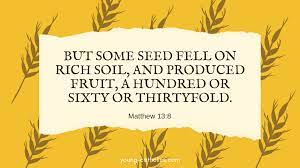
The bulk of the details in this story are about wasted effort and lost seed.  But if we stop for a moment and think about it anything done for God in faith is never lost.   Very often things that are happening  in our lives don’t seem to be the way we want  them to be but when we look at the problems with eyes of faith we see that things around are meant to be for the good of all despite our problems . We also  get the strength to  deal with the problems that go on through and in faith. Nobody really knows what’s beneath the surface of the soil we cast the seed of the word of god upon. Who knows the potential of the good soil? Do good and poor soil both exist in the same person I think that it most probably does much in the same way that a person can do good or be bad. Is there something we might say that will land on the interior good soil in a person and bear the “hundredfold, or sixty or thirtyfold” Jesus promises? While the gospel parable begins with and spends time on hardships and failure it ends in surprise and abundance. What was the source of this abundance? We look to what Isaiah told us today in the reading about the fertile, life-giving nature of God’s Word.

Despite any discouragement we might feel because our efforts on God’s behalf in many things seem futile and draining, we put our trust in the one who speaks to us a living word who sows the seed. The message of Jesus may not always be welcome especially in our modern world were faith and religion are constantly under assault by those who oppose the Catholic faith based outlook on life. That said we still have to sow the seed what we do and say and then we leave the rest up to God. The  efforts we make are never futile and we don’t always see the fruit of the seed that is sown. Let us remember that tall oaks from little acorns grow.  

14th Sunday in Ordinary Time

One of the most wonderful things about Jesus has been and continues to be his special love for ordinary people. It comes out in a particular way in the two statements that he makes in this Sundays Gospel reading. The first is in his prayer to God: ‘I bless you, Father, Lord of heaven and earth, for hiding these things from the learned and the clever and revealing them to mere children.’ The second is in his Invitation to all of us: ‘Come to me, all you who labour and are overburdened and I will give you rest.’ Why did he say this? The answer comes across very clearly so many times in the gospels, and may be summed up in just one word – COMPASSION. Remember the plight and tears of the widow of Nain touches his heart to the core: ‘Don’t cry,’ he says to her, before bringing her son back to life.

He is moved with compassion at the plight of a leper begging for help (Mk 4:41), for two blind men sitting at the side of a road and pleading for mercy (Mt 20:29-34), and for a crowd of people with nothing to eat (Mk 8:2). In each case he responds to their sufferings with the power, love, compassion that is the  care of God freely given through Jesus his Son. All through the gospels, we sense the surge of compassion rising within his heart. He is not moved by the grandeur and beauty of the great Temple buildings (Mk 13:1-2), but by the generosity of a poor widow who puts her last coin  into the Temple treasury to assist others (Mk 12:41-44). When everyone else around him is jumping for joy about Jairus’ daughter come back to life, Jesus is concerned that she be given something to eat (Mk 5:42-43).

Also in the second reading we are called to lead spiritual lives that is lives enlivened by our faith in God and what is taught by the Church inspired by the Holy Spirit. Those who have the Spirit of Christ dwelling within them belong to him and will have life. The passage urges believers to live according to the Spirit and put to death the deeds of the flesh, for those who live according to the flesh will not inherit eternal life. Today we see so many people constantly searching for new idols and these idols are so easy to find, We live in  a world which has left the path marked out by God a world where so many have little or nothing at all and the few have so much. To be a Christian and to have the light of faith to guide our steps in the neo-pagan darkness of today’s world, is a gift, and a blessing. So, the big question for each and everyone of us has to be whose side are we on?

Are we  on the side of Jesus, that is the side of compassion, kindness, help and healing. Or on the side of the scribes and Pharisees who are  amongst us even today  and they are fierce, fault-finding, heartless, critical, people without much compassion. Will we take our cue from their cruel, harsh, and insensitive judgments and actions? Or will we take our inspiration from what we see in Jesus, and from his touching  compassionate outreach to the poor and the broken. We are called to bring the message of Jesus into our own lives as well as the lives of those around us. It is a message of compassion and understanding that todays world needs to hear.  Let us remember the words of Jesus as we go out into the world   ‘Come to me, all you who labour and are overburdened and I will give you rest.

13th Sunday of Ordinary Time

Here we are at the start of July and the beginning of the summer holidays. Here in Northern Ireland where I am the schools will be closed for the next 2 months and by the end of that time the parents will be ready for the asylum. So these days spare a thought for all those parents out there who are wondering what they will do with the youngsters over the next few weeks. We were lucky as we were able to  go to the country and the cousins and many friends were there so times were great during the summertime for us but the summer holidays can be a difficult time for many families who mightn’t have the opportunity for a holiday this year so we remember them in our thoughts..

In the First Reading through the woman of Shunem we learn that in our search for God, practicing hospitality is important, for it can be the occasion of a blessing from God through the person we are dealing with at that moment. In our Gospel story we are reminded that  the priority of faith demanded radical consequences for early Christians as they took up their crosses to follow Jesus. At that time extended closely-knit families formed the basis of society, a choice for a follower of Christ could mean a rejection of the family’s faith and values. Jesus reminded his followers that the Christian life involved many risks and one could not compromise or hide these risks, a believer could not placate his or her family if the cost threatened faith. Even though they had only a very vague idea then of what he meant, when the time came, they remembered Jesus  words and gladly suffered imprisonment, hardships, and finally martyrdom for Christ.  

This shows how the resurrection of Christ, and the descent of the Holy Spirit on them, changed them from worldly weaklings into fearless spiritual heroes. They were convinced that Christ was the Son of God their saviour who had come on earth to bring all men to heaven. Today, too, there are still those who are suffering a lingering martyrdom, worse than quick death on the scaffold, because they obey God rather than man. We ourselves, who are free from any overt persecution, must show our gratitude to God for being allowed to practice our religion openly and without fear. We may not be able to preach, or teach the truth of the faith in the same way as priests deacons or religious do but we can help all those who are doing so by our prayers and our actions in living our lives according to our Catholic faith. This Gospel highlights for us the importance of hospitality in the Christian life.

To welcome another in Jesus name is to extend hospitality to Jesus himself. We have many opportunities in our daily life to reach out to others, to be a welcoming presence and a sign of God’s love in the world especially where we live let us not be afraid to take these opportunities when they arise.

Post Navigation