5th Sunday of Easter
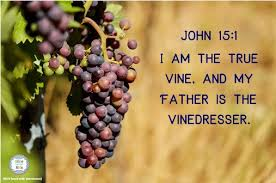
This Sunday we hear the gospel story of the Vine and the Vinedresser. Jesus uses the Old Testament image of the vine and branches to help his disciples to understand the closeness of their relationship with him and the necessity of their maintaining it. They are not simply teacher and disciples. Their lives are mutually dependent as close as a vine and its branches. In fact, in using this image, Jesus is explaining to them and to us what our relationship with him should become. The first reading, taken from the Acts of the Apostles, testifies to the abundance of spiritual fruits yielded by the apostles because of their close bond with the risen Lord. The reading tells us how the Lord pruned the former fanatical Pharisee, Saul of Tarsus, who had persecuted the Church, to produce a fruit-bearing branch called Paul the zealous Apostle to the Gentiles, a man now entirely dedicated to the proclamation of the Gospel. Even Paul’s forced return to Tarsus for a brief period is an example of God’s pruning of the vine to bring forth a greater harvest, namely, the mission to the Gentiles.
In today’s second reading, John, in his first letter to the Church, explains that only if we remain united with Christ by putting our Faith in him and drawing our spiritual strength from him, will we be able to obey God’s commandments, especially the commandment of love. In our Gospel this Sunday we hear the story of the vine and the vinedresser of course Jesus is the vine and the Father is the vine dresser and we are the branches of the vine. If we remain in him with him in us we will produce much fruit. The sound of the pruning shears does not sound very pleasant, in fact, it sounds quite threatening. From the time of Moses, the Hebrew people thought of their nation as a vine which God had taken from Egypt and transplanted into Palestine. There in the fertile valleys the nation thrived and grew, as does a vine that is well tended. Every vine dresser knows the importance of pruning away branches that will not bear fruit. Those branches rob the vine of its vitality and diminish the amount of grapes produced Of course, we are using the language of analogy here; we are not talking about a harvest of actual grapes. When Jesus says I am the vine’ he is clearly meaning a vine of a heavenly order. The fruit, is therefore surely also of a heavenly order. We realise that the harvest is one of souls for heaven.
Our task is in fact to continue the work of Christ in the world. In order to know what to do we must look at his life and imitate him as best we can. He taught the truth, he spoke words of comfort, he healed the sick, he brought sight to the blind, he spent much time in prayer in communion with the Father. And ultimately he laid down his life for our salvation. We must find ways to translate his actions and his words into our actions and our words We are meant to live in the peace and joy of the Easter gospel not in fear and uncertainty. “Without me you can do nothing,” Jesus tells us. But with him we can do everything. If we remain in his love, we can ask anything of the Father in his name and it will be given to us. The life of faith in Christ and what he teaches us is a gift freely given and accepted by we also have the freedom to reject the life of faith and the love of Christ. God calls us through Jesus his Son to make His message real in the world he asks us to make his actions and words our own as we bring His Love to the world wherever we are within it.
 Fullerton T