Fullerton T

RELIGION LITURGY AND LIFE

Archive for the month “June, 2024”

13th Sunday in Ordinary Time
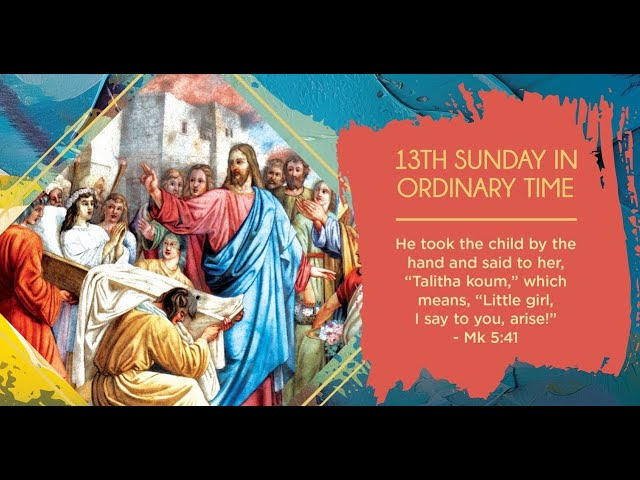
The readings for the 13th Sunday in Ordinary Time show us that God wants nothing but life and goodness for us. The first reading explains that God desires life not death for us, God created life and intended it to be eternal. The second reading tells us that God wants an abundance of good things for all of his children.  We should strive to excel in generosity, following Christ’s example. We are called to  Share all we have in order to create equality ensuring everyone’s needs are met.  

In the Gospel reading we hear about the woman who had the hemorrhage and we also hear about the official’s daughter. Whilst the stories are about the faith of the people involved they are also about the mercy of Jesus towards  them both. Jairus, the synagogue official and loving father of a ‘desperately sick’ daughter, is convinced that if  Jesus would place his hands on her ‘to make her better and save her life’ she will surely recover. The unnamed woman, suffering for twelve years from a condition for which she has gone from one doctor to another, has one last hope. She is convinced that ‘if she can touch even the hem of his clothes’, she will ‘be well again’ and then she was able to get near to Jesus and touched his garments. The poor woman and Jesus know that healing power has gone forth. Jesus turns around, inquiring who is the one who had touched him. Fearfully, the woman admits that she is the one. Jesus immediately calms her fear, telling her to go home in peace, for she is healed.

Then, He proceeds to the house of Jairus, where He learns that the little girl has died. Quieting all the commotion going on He goes in with the child’s parents as well as Peter, James, and John Taking the hand of the girl, He brings her from death to life, ordering that some food be brought to her. This gospel reading speaks of two things the faith and mercy. So, the story of the woman and Jairus daughter is also our story. When we are afraid; when we face death, we can feel Jesus’ touch, as the girl felt Jesus’ hand in hers we feel his hand in ours.  Jesus has shown that, in his hands, we are imperishable. Jesus responds to desperate need with love, empathy and compassion. He shares our pain and our burdens. He boldly shatters prejudice and breaks conventions. He is not afraid to enter the place where death seems to have its way and breaks in open with his light. Over the last few Sundays Mark has been showing us how God’s grace is at work through the person of Jesus.

Last Sunday In the calming of the storm Mark insisted that it is necessary to have faith in Jesus in order to enter into the Kingdom. As we navigate the challenges of our daily lives, we are asked to reflect on Jairus’s response. How will we choose to act? Will we, like Jairus, turn to Jesus in faith, trusting in the wisdom and faith we have received from God? Remember, faith and wisdom are not meant to be hoarded but shared. Just as wisdom aids others in finding answers for their present lives, faith offers the promise of eternal life. Therefore, we are called to embrace the wisdom and faith we have received and, in turn, generously share them with those around us as we go forward.
12th Sunday in Ordinary Time

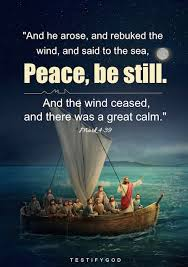
The readings for the 12th Sunday show us God’s power and our need to trust Him. In the first reading, God reminds Job of His control over the sea. He set boundaries for the waters and commands the waves. This shows God’s authority over creation. Even the mighty sea, which can be so powerful and frightening, obeys God’s commands.  Our gospel reading for this week is all about being Calm amid the storms of life that sometimes come our way. The context of this passage is the calming of the storm when Jesus rebuked the wind and said to the sea, ‘Quiet now! Be calm!’ And he says the same to us now in all our trials ‘Quiet now! Be calm!  Jesus understood that all would be well even if he and the disciples perished or if the storm subsided. Mark’s original audience was a community undergoing persecution. Their leaders had been martyred and, they questioned what was happening to them. The church was undergoing internal strife as they struggled to bring Jews and Gentiles into their new Christian community.  Mark’s church was hardly sailing on calm waters not unlike our church today.

Jesus’ previous parables of sowing, growth and harvest showed God’s control over the land. This passage also shows that God is in charge and has control over the chaos we often see and hear about exemplified for us today by the calming of the storm.  Jesus asks the disciples in the midst of the storm, why are you so frightened and why do you have so little faith. He could be saying the same thing to us today as many lack faith in God and mankind.  Amongst all the hurt and devastation in our lives Jesus changes the darkness that is in our daily lives into the sunshine of everlasting life, and replaces our distress with comfort and peace. When we don’t know the best way forward or the best way out Jesus gives us peace of mind and heart to make the right decision. At such a crossroads of life, we can ask him, ‘Lord, what road should I take what way should I Go?’ The best way will become so much clearer, and bring us calmness and peace as well as the knowledge of a decision well made.  We have so many things to occupy our minds these days with all the things that are going on in  our world.  If we stop and look around us we see the signs of Jesus in people trying their best to look after others, to provide meals and shelter, to keep themselves and their loved ones safe, to work for peace in the midst of conflict to bring comfort and to pray.  The disciples’ fear during the storm teaches us about our own fears and who we should trust. We often feel overwhelmed by life’s challenges and there are many. But Jesus shows us that He is greater than any storm. We remember that Jesus is with us in the good times and bad as a gentle calming presence as we go through the storms of life that affect all of us from time to time and we should trust him to be our helper and guide as we go forward.

11Th Sunday in Ordinary Time

This weekend we celebrate the 11th Sunday of ordinary time The readings for the 11th Sunday in Ordinary Time Year B are filled with images of growth. In the First Reading –  from Ezekiel the Lord promises to take a shoot from a cedar, plant it on a high mountain, and make it a great tree where birds will find shelter.. In the Second Reading – from 2 Corinthians 5:6-10: We are told that we walk by faith, not sight, aiming to please the Lord. We will be judged by Christ for our deeds. In the Gospel  we hear once again the story of the mustard seed. Jesus seemed especially fond of using parables. Parables are meant to leave the hearers wondering. They are not straight-forward answers to questions. They are food for thought. By using parables Jesus is trying to engage his listeners at a deeper level. He wants his teaching to seize their hearts. He wants them to discover the truth of what he is saying for themselves. It is part of the business of conversion – coming to see with new eyes

The faith that we have handed down to us through the generations is represented in this Sundays Gospel by the mustard seed and our faith is something that all of us need to nourish When the seed that is the Word of God takes root within us the Kingdom grows.  We are called upon hearing the Word to meditate upon it in prayer so that it may take root in us and bear fruit in joy and hope.  We are usually helped by books, and Christians do not want for them: the Sacred Scriptures, particularly the Gospels, liturgical texts of the day or season, writings of the spiritual fathers, works of spirituality, the great book of creation, and that of history the page on which the ‘today’ of God is written. (CCC 2705) The Kingdom of God is like a tiny seed within each of us. It’s a strong seed, like those that push their way through the hard ground  in order to grow toward the light. Sometimes we nurture it and have expectations. Sometimes our expectations are fulfilled, sometimes not. Other times, we don’t know how, but we find ourselves bearing the fruits of joy, compassion, peace, generosity, faith-fullness, gentleness with thanksgiving for the wonder of it all.  

Then we know our growth is a partnership with god the father and, while we can care for the seed, we can’t make it grow or flower or reproduce on our own. The parable of the seed growing of itself which we hear this Sunday shows us that there is an almighty power working with and for us.  Our part is to do a good job preparing the soil of our hearts and minds as we  sow the seed. When we think of the small beginnings of Jesus’ ministry in Galilee to the spread of his message throughout the world, we appreciate the vast growth from the small mustard seed that has taken place over the years. We have reason to rejoice that the kingdom still attracts and welcomes so many different people as they respond to the mustard seed of faith that someone has planted for them. So let us rejoice and be glad for the lord has done great things for us in our time and place  and helped us to nurture and grow our own faith.

10th Sunday of Ordinary Time

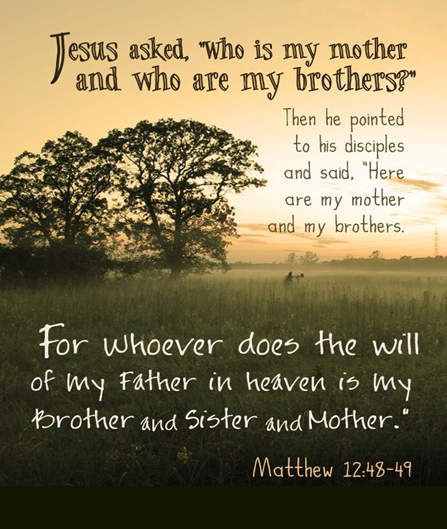
After the great feasts of Pentecost, Holy Trinity ,Corpus Christi and the Sacred Heart we now go back to Ordinary Time. The themes for the 10th Sunday include sin and redemption, God’s mercy and justice, hope and faith, the power of God’s Word, the challenges of discipleship, and the concept of the spiritual family. In the   First Reading from Genesis God confronts Adam and Eve after they eat from the forbidden tree. They blame each other and the serpent, who is then cursed by God.  Then in the Second Reading  from Corinthians  Saint Paul; tells us We speak from faith, confident that as God raised Jesus, He will also raise us. Despite physical decline, our spirits are renewed, with a focus on eternal, unseen glory.Our Gospel story for this Sunday is all about the Family of Jesus and their attempt to take control of him.  When  Jesus asks the question who is my Mother and my brothers he puts everything in its place. In one move, Jesus replaced his personal family and friends  with the family of God the Church and that is the people who did the will of God, his Father. Jesus is not disowning his family; he is acknowledging the relationship between himself and the Father and that bond is greater than the physical bond of family and homeplace.

Jesus establishes a new family, no doubt hoping that his own relatives, like everyone else, will come to accept him for who he is the son of God our saviour. Clearly his relatives like so many others have trouble accepting the change that Jesus has undergone from becoming a village carpenter to a mighty prophet who proclaims the kingdom of God his Father. Jesus has to face that misunderstanding and rejection. It is part of the cross he has to bear. Allegiance to the Father and by implication to his Son transcended ties of the country you come from and the family you belonged to. The Kingdom of God was above any social structure. Hence, social expectations over behaviour, even behaviour that challenged the status quo of the leaders, was also superseded. Family ties, social roles, and religious pecking orders were meaningless. Their  problem, and ours  lies in the  expectations we have. What do we expect others to do? What do we expect God to do? How do we react when God or others don’t meet our expectations? More important, how do we react when God or others CHALLENGE our expectations?  These days there are many different challenges to us as members of god’s family I believe that faith will prevail but the faith of the future will be different but in many ways will remain the same. The gospels are always challenging and calling us to a better way of life as members of the body of Christ his family.

We will become his brothers and sisters if we do the will of God. Doing the will of God may alienate us from our family and all the people we know and the things we cherish, but Jesus always points us towards a more important relationship the relationship we have through faith with the Father.  As we go forward there will be many challenges to us in our personal lives and our lives of faith. If we are true to the faith we profess each time we say the creed then we can say that we are the brothers and sisters of Jesus doing the will of the father as we face the challenges of being people of faith wherever we live in the world.

Post Navigation