Fullerton T

RELIGION LITURGY AND LIFE

Archive for the month “August, 2024”

22Nd Sunday in Ordinary Time
This week the schools have re opened after the summer break and we begin the season of Creation that runs until the beginning of October. During the month we give thanks for our world and all the good things within it that are god given gifts remembering that we are called to use them wisely for the good of everyone.  The readings for this Sunday tell us to be wary of those things which lead us to sin and remind us that we must really follow Jesus in our hearts. In the first reading Moses instructs Israel to strictly follow God’s laws to demonstrate wisdom and receive life and land. God’s closeness and just laws set them apart from other nations. In the Second Reading we hear that all good actions and perfect gifts come from God, who is unchanging. We are called to embrace His word, act on it, and care for those in need.

In the Gospel Jesus is accused of flouting sacred tradition. Religious officials from Jerusalem and local Pharisees want to know why Jesus permits his disciples to disregard the unwritten tradition of the elders. The problem is that the disciples do not wash their hands before they eat. The complaint is not that the disciples ignore good hygiene, but that they ignore the tradition of ceremonial washing. In doing this they are numbered among the unclean. Jesus does not dismiss the Law but he condemns its misuse. The Pharisees were certainly guilty of misusing the Law by placing heavy burdens on the shoulders of the people. The ritual hand washing before eating has its origins in the common sense practice of washing one’s hands before eating a meal, something any sensible person would do. But by the time of Jesus this custom had become incorporated into the Law, it had become much more elaborate and was accompanied by prayers as a way of consecrating the whole day and all one’s actions to God. This is fine and good, but it should not become a burden or become a reason for accepting some people and rejecting others, depending on whether they observed these prescriptions or not. Jesus cuts through all of this and turns it around and accuses the Pharisees of honouring God with lip-service while their hearts are far from him.

 Jesus sees the true purpose of the Pharisees, he knows that they are there to build a case against him.  Jesus points out that nothing that goes into a man can make him unclean, it is what comes out of him that makes him unclean. Jesus goes to the very core of the matter and tells us that it is not whether we fail to perform this or that act that makes us evil but the desires of our heart. It is our heart that we have to look at to see whether we conform to God’s laws or not. The law of God forbids all those things that set people against each other: theft, murder, greed, etc. The positive command of God’s law is “to serve God in each other,” to walk blamelessly, do justice, walk humbly with our God and to not harm one’s fellow-man. Let us try to do this in the days ahead as we go forward as gods people.
21st Sunday or Ordinary Time

In the First Reading this weekend  Joshua challenges Israel to choose who they wanted to serve, the gods of their ancestors or the gods of the Amorites Joshua tells them that he will serve the Lord  and the people reaffirm their commitment to the Lord, recalling His deliverance and protection. In the Second Reading  from Ephesians we hear about how Christ’s love guides marital roles: wives respecting husbands as the church respects Christ, and husbands loving wives as Christ loves the church, symbolizing unity and sanctity. In this Gospel reading, Jesus puts the choice to His apostles of following Him, or of leaving Him that is also the choice he gives to all of us as well.

Jesus did not give an easy remedy for the doubts his disciples had in reaction to his words, nor did he water-down impact those words had on them. After hearing Jesus’ teaching on the bread of life, many of the people find Jesus’ language intolerable how could anyone accept it. As a result of this intolerable language some  of them choose to leave him.  In a similar way today so many people find the words of Jesus to be intolerable language as many people have got up and left their faith behind them and some may never return again. No one who accepts that Christ is the Son of God has any difficulty in believing that he left us himself in the Eucharist. He promised to give his body and blood in the Eucharist as an everlasting memorial to be our spiritual nourishment and our means of offering an acceptable  sacrifice to God every time his body and blood are made present by the words of the priest. He fulfilled that promise at the Last Supper. He gave to his Apostles and their successors the power to repeat this act of divine love when he said: “Do this in memory of me.”

When Simon Peter answered Christ’s challenge will you too go away?”  he spoke not only for his fellow Apostles he also spoke for us when he said “Lord to whom shall we go? You have the words of eternal life. and we believe; and we know that you are the Holy One of God.” We are the people who really believe that Christ was the incarnate Son of God. Peter made his act of faith before he was fully convinced of the divinity of Christ, but he already knew that Christ was close to God and spoke nothing but the truth. We have the proof of Christ’s divinity which Peter and the Apostles later got, he gave them the bread of life and he went to the cross and rose again. We also have the witness of the early Christians whose belief in Jesus   was at the very center of their Christian lives as it should be the center of ours.   We can trust that what Jesus taught is true, even if we do not fully understand how it could possibly be.

Many people who became saints died for their belief in Jesus; hopefully we can live our faith fully, even in times of doubting the actions of some of those in the Church.  So today we say Lord, You have the message of eternal life” and we believe; and  we know that you are the Holy One of God and we will follow you.

20th Sunday in Ordinary Time

The first reading this weekend tells how Wisdom has built a house and invited the foolish (those who are not yet wise) to feast on the food that is her teaching Wisdom has spread a table of choice food and drink. She has invited the all of us to the feast. Those who eat the bread and drink the wine of Wisdom perceive God’s saving action and understand the life to which they are called as God’s own people. In the Gospel, the dialogue between Jesus and the people continues. This time they are arguing about how Jesus could possibly give them his flesh to eat. Jesus insists that if they don’t eat it they will not have life in them and they will not have eternal life.

The receiving of this gift from god becomes the acceptance and acknowledgment of the Lord’s care for us and thus, ultimately, the nourishment we need to continue the journey.  There is one concrete way that the Lord helps us to make this connection that is by providing the Eucharist the bread of Life.   In the bread and wine offered at Mass  the risen Lord makes himself present.  While the priest invokes the words of blessing (thus acting as the instrument of Christ or “in persona Christi”), the conversion of the bread and wine into the blood into the Body and Blood of Christ remains the work of God through the working of the Holy Spirit. The offer to partake in the “living bread” is God’s offer of unity with Christ and his followers.  When we receive communion we don’t receive an inanimate object.  This is Jesus the son of God we receive . The One Who Is who was and will be in the future. When we receive communion we take within ourselves the dynamic, powerful presence who speaks to us through the life He has given us.  How great is our God. He has found a way for each of us to have continual, intimate encounters with Him.

Let us pray, for those whose access to the Gift of the Eucharist or Blessed Sacrament is not so easy whether they have left the faith or perhaps they might be struggling with it or for many they may not yet found it as we remember that Jesus has said ‘I am the Bread of life he who comes to me will never be hungry.’   This Sunday we are invited to have faith in Christ’s presence among us; we are challenged to believe that we really can live in him, and he in us. The more often we accept the invitation to communion, the more we will understand its meaning. Let us pray, for those whose access to the Gift of the Eucharist or Blessed Sacrament is not so easy whether they have left the faith or perhaps they might be struggling with it or for many they may not yet found it as we remember that Jesus has said ‘I am the Bread of life he who comes to me will never be hungry.

19th Sunday in Ordinary Time

The readings for the 19th Sunday in Ordinary Time demonstrate that God sustains us despite everything that is going on. In the First Reading Elijah, overwhelmed, sought death in the wilderness but was sustained by an angel with food and water, enabling his journey to Horeb the mountain of God.  The Second Reading  tells us to a avoid behaviour that grieves the Holy Spirit. Instead, we should be kind, compassionate, and forgiving, just as God forgave us. We  are called to lead lives of love as we follow Christ’s example. The Gospel reading deals with a doubting audience, and at times we  are also members of that doubting audience.

The people who heard Jesus were shocked and critical of his claim to have come down from heaven as the Bread of Life. Despite the miracles they had witnessed, and the words of wisdom they heard preached with such convincing authority, they could not go the extra step to accept his words and deeds. We, on the other hand  are able to take that extra step because our Christian faith has come to us from Jesus, passed down through the generations of those who went before us. We know where he came from, we know where we are going and we know how to reach that destination our heavenly homeland. The personal faith that we have means that “God out of the abundance of his love, speaks to us as a friend and lives among us as  the living bread which came down from heaven.  All of us have doubts when it comes to our faith and we search for answers to our questions.  When we search we find Jesus who is the answer to our doubts.

Through the teachings of the church and through our communion with him through the eucharist we understand who Jesus is and we also understand his message.  When we gather at the Eucharist we bring ourselves and our needs in prayer to God. We bring ourselves to God because God is with us and continues to be with us in good and bad times through the sacramental life of the Church. When we see the Eucharistic Bread, we believe that it is Jesus who is there before us:  such is the faith we have in the Eucharist.    So  today we give thanks for all our blessings, families, friends and all that we have and hold dear. We also give thanks to God for the presence of Jesus in our lives as we remember that Jesus is the bread of life. The food for our journey that comes from the God who sustains us and loves us and is there for us as a friend, a  helper and a guide.  

We pray for peace as there are many communities and countries at war with one another. From Ukraine to the Holy Land and even on our local streets where racism has reared its ugly head. And so we pray: God of peace, you are peace itself; a divided heart cannot find you, a violent mind cannot welcome you. Grant that we who are one in heart may hold fast to the gift of peace and that those who are divided may forget their strife and come to know your gift of peace. Through Christ our Lord

18th Sunday in Ordinary Time

In the First Reading for the 18th Sunday from Exodus the Israelites complained of hunger, so God promised to send bread from heaven and meat at dusk. God sent them manna from heaven as food demonstrating His power and care for all of them. In the second reading from  Ephesians we are told to Discard your old ways and renew your mind St Paul tells us not to continue to live the aimless life the pagans live. He then tells us that we should be renewed by the spiritual revolution, embracing a new self, crafted in righteousness and holiness, as taught by Jesus Christ.

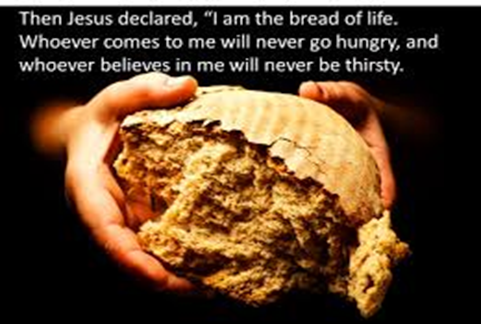
Our focus in In the  Gospel reading is food for the body that is bread and food for the soul that is Jesus the Bread of life. Jesus tells the people that they are only following him because they have enjoyed the food that physically satisfies them; they should work, he says, for the food that leads on to eternal life. The one thing which earns this food is believing in the one God has sent. To be nourished by Jesus one must have faith in him. This implies a personal relationship with Jesus. Once this personal relationship has been established everything else finds its proper place and true purpose.  The Galileans promptly ask Jesus for a sign to aid their belief in him  a sign like the manna their fathers ate in the desert. Jesus points out that it was God, not Moses, who sent  the manna from heaven and  he compares himself to the God who now gives them the real bread from heaven. Jesus declares that he himself is the bread come down from heaven.

Whoever believes in him will never be hungry. Yet there are so many people in our world who suffer from physical and spiritual hunger.  I think that these days with all the possibilities for so many things we need to be the bread of life for all those who are out there who have lost the faith or those who are searching and many people are. What does it mean to be the Bread of Life to others? It means two things: Feeding the hungry through our work with and donations to organisations that bring physical relief  to the people who need it in the world. It also means that we are a light of faith to others showing that God the Father sent Jesus from heaven to be our spiritual food, our strength, our hope, and our joy as we live our lives as Christians. There are so many people in the world that are hungry for the bread of life that Jesus tells us about in this Gospel Reading and the question for us today is how will we feed their hunger so that they can make the choice to accept this great gift of God as we have done?

Post Navigation