Fullerton T

RELIGION LITURGY AND LIFE

Archive for the month “July, 2025”

17th Sunday of Ordinary Time

As we continue our journey during the year of Hope we pray for peace in the war torn places in the world. our readings for this Sunday encourage us to pray and ask God for good things and he always answers but not in the ways we might want. In the First Reading God tells Abraham He will check on Sodom and Gomorrah’s sin. Abraham asks God to spare the city if innocent people are found and ten innocent people are found, and God dopes not destroy the city. In the second reading  we are told that In baptism, we were buried and raised with Christ. The reading goes on to say that God forgave our sins, cancelled our debt, and made us alive with Christ by nailing our sins to the Cross.

 In  this Sundays Gospel  one of the disciples, having seen Jesus at prayer, asks him to teach them how to pray. In response to this request Jesus teaches them how to pray in the words of the our Father. He also encourages them to be unwearied in their prayer because the Father who loves them will hear their pleas. My experience of praying to god for something is that we often get the thing that we pray for not when we think we need it but when god knows that we really need it.  The greatest example of prayer that has been passed down to us through the generations is the Mass. Each time we gather as a community of believers to take part in the Mass we reaffirm our belief that God is made incarnate in Jesus his Son. We also bring all our intentions with us and we leave them for god to answer in his own time. Persistence in prayer is a worthwhile exercise because the God we believe in is not some sulky, withdrawn figure who is unmoved by what he hears and sees remember that our God is with us who knows us and gives us what is good. The message of Jesus in the our Father is that our God is one who cares for us as well as concerned about us and those who are close to us.

The most important part of our human life is what we become through faith in the will of God the Father. When things don’t go the way they should, we benefit from our prayers. Think of Jesus in the Garden of Olives. He prayed what was coming his way would not happen. He also added he would abide by God’s will when he said Abba, Father let it be done as you not I would have it. If we continue to look for the will of God we will grow, despite the good and  bad things that come our way we will know that God is for us our  refuge and our strength in all things. As we reflect on the readings this Sunday we are invited to engage in prayer with boldness and trust. Like Abraham, we are encouraged to pray constantly for others, persistently asking God for what is good and just, even if we do not understand why things happen the way they do especially in our world today.  Like the disciples in the Gospel, we are taught to pray with confidence, knowing that our Father will give us what we need for us to live as faithful hope filled children of God.

16th Sunday in Ordinary Time

The readings for this Sunday have a focus on hospitality. What are some ways we can provide hospitality for others? Do we only care for their physical needs or do we also take the time to listen to them as St benedict says with the ear of our hearts?  In the First Reading  The Lord appeared to Abraham, who welcomed three visitors with hospitality. One of them promised that Sarah would have a son within a year. In Second Reading  Saint Paul tells the Colossians I suffer for you to share Christ’s afflictions and reveal the mystery of Christ in you, our hope of glory.In our Gospel reading this Sunday we hear all about Martha and Mary. On his way to Jerusalem, Jesus led his entourage into the village to call at  the home of Martha. As the good host, she served them but, her sister, Mary, sat listening to Jesus.

Martha tried to shame Mary into helping with the work but Jesus would have none of it. Instead, he praised Mary’s choice when he said leave her alone for she has chosen the better part.  Martha loved Jesus as much as Mary did, and it is clear that he treasured them both. Her mistake was in not trying to find out how Jesus wanted to be entertained, while visiting her house. Her sister senses that when Jesus comes on a visit the last thing he wants is to have people fussing over how to feed him. So, while Martha makes the greater housekeeping effort, Mary understands better what is expected of her by him. Her contemplative intuition grasps instinctively the real reason for Jesus’ visit.  He is there not to receive but to give, not to be served but to serve. He has something he needs to say and the one thing necessary is to listen to his voice. There is a whole theology of contemplation in this gospel reading, on how to receive the Lord’s visit. It starts off from the basis that, no matter who our visitors may be, there is always something to be learned, something from them. When Jesus comes to us he wants to talk to us in the quiet of the evening or the freshness of the morning, in the quietness of  our hearts and he wants to share with us the Word that brings salvation. He comes to us in the quiet moments not because he needs us but because we need him.

We too can be “distracted with all the serving;” we also “worry and fret about so many things.” As a result of all the worry and wonder we may, like Martha, miss the better part, for all of us the one thing that is necessary, is to listen to the Word of God with the ear of our hearts in the quiet moments of life. let us not be afraid of being like Mary and be attentive to what Jesus is telling each of us today. Let us listen again to what god is saying to us in the quiet and still moments of our lives and we will be surprised by what we hear for we will know that we  have chosen the better part like Mary in the Gospel.

15th Sunday in Ordinary Time

This Sunday we celebrate the 15th Sunday of Ordinary Time. In our First Reading  Moses told the people that God’s commandments are not beyond their reach; they are close and in their hearts, ready to be followed with all their heart and soul. In the Second Reading Christ shows us God, created everything, holds everything together, leads the church, and reconciles all things through his death on the cross. In our Gospel reading Jesus is asked the question ‘who is my neighbor” and this is a good question to ask ourselves in the current situation of Immigration with the resulting opportunities and problems that arise . 

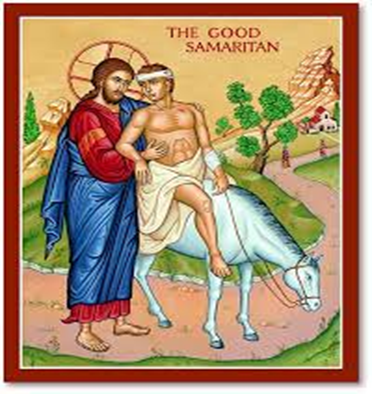
When I was a youngster your neighbors were the people that lived next door to you or those who lived in your street or road they were the families you would go to when you ran out of milk or sugar to borrow some or to share the news about the people and happenings in the area. Sadly this is not the case today as we live in a world where you might not know your neighbour or who they are.  The Gospel story tells us about the Good Samaritan it is a story that all of us are familiar with.  It was the Samaritan who stopped with the man who was lying on the side of the road it was the Samaritan who was moved with compassion to help him. The Priest and the Levite walked on and passed by on the other side of the road because they felt that it was beneath their dignity to help the man when they should have been doing exactly that. Our Gospel story tells us what we should be doing in 2025 to show our love for our neighbors. First, it tells us that we must be willing to help even if others brought trouble on themselves for whatever reason. Second, our concern to help others must be practical. And lastly, our love for others must be as wide and as inclusive as God’s all encompassing love for us.  

We remember that God excludes no one from his love and care. At all times we must be ready to do good to others just as God is good to us we must be good to others. Jesus not only taught God’s way of love, he also showed how far God was willing to go to share in our suffering and to restore our wholeness in life and happiness. Jesus overcame sin, suffering, and death through his victory on the cross on Good Friday. True compassion not only identifies and empathizes with the one who is in pain, it also takes that pain on in order to bring freedom and restoration.  Our world is moving towards ways of doing things that hurt more and more people time after time instead of restoring them. We are in this world so we cannot pretend that it’s got nothing to do with us for it has everything to do with us as we are Christians. In these days with a lot of turmoil and confusion going on around us the words  of the first reading ring in our ears obey the voice of the Lord and we ask ourselves what is the Lord asking us to do? We are being asked to reach out in order to show friendship to our neighbors and those who have come to be our neighbors as migrants from other countries.

At the end of the Gospel Jesus askes the Lawyer Which of these three, do you think, proved himself a neighbor to the man who fell into the brigands‘ hands?’ ‘The one who took pity on him’ the lawyer replied. Jesus said to him, ‘Go, and do the same yourself.’ And he says exactly the same to us today here and now in 2025, so let us go now and do the same.

14Th Sunday in Ordinary Time

The 14th Sunday in Ordinary Time invites us to reflect on themes of peace, joy, and discipleship. The readings remind us of God’s blessings, our call to share the Gospel, and the hope we find in Christ and his message. The readings also highlight God’s gift of peace. Jesus tells His disciples to bring peace wherever they go, showing that peace is central to Christian life. This is so necessary for all of us in our very troubled world where so many countries and people are at war with each other. In the First Reading  from Issiah we hear about the joy and comfort that the Lord will bring to his people, using metaphors of a nursing mother, a comforting mother, and a flowing river. The Lord promises to extend peace to his people like a river, and his people will rejoice and be glad, with their hearts flourishing like grass.

In the Second Reading  from Galatians we are told that The cross of Christ is important as the means of salvation and new life for believers. Paul declares that he will boast only in the cross of Christ, which has made him a new creation, and he encourages the Galatians to avoid the false teachers instead urging them to embrace the new creation in Christ. This Sunday’s Gospel tells us about Jesus appointing the 72 others and then sending them out in pairs to the towns he was going to visit. As he gives his missionary instruction Jesus is under no illusion about the territory compared to the wolves roaming around, his own crowds are like lambs. He tells the 72 to lead the radical lifestyle of the wandering preacher who must face homelessness and renunciation of family and property. When they enter a house they should bless it with peace. The Gospel also tells us about the practical things to direct the seventy-two as they proclaim the Good News of the Kingdom. Jesus told them to carry no purse, no haversack, and no sandals. Proclaiming the Good News of the Kingdom and rebuilding community life are two sides of the same coin. One does not exist and cannot make sense without the other there is a clear urgency about the task in hand with urgency in his voice Jesus says, “Start off now”. On their return the disciples were delighted that their mission has actually worked!  

Their joy demonstrates that the people welcome the word of God and that the word of God is their real resource for mission. There will be a time of crisis with the wolves roaming around and currently we seem to be  living in a time of crisis with so many things that are wrong in the world.  Jesus speaks to us to reassure us and tells us to hold on to all that is good. The Gospel, of course, is not about an historical 72 people being sent out. It is about the mission of every disciple of Jesus. Spreading the message of the Gospel is always done by winning over hearts and minds through the example what we say and do. The fullness of life is the message and the mission of Jesus  who empowers us in our time and place to work in his name to build up the kingdom.  Real rejoicing is not to be had in the conversion of great numbers of people, but in knowing that we  have done the will of God. Our mission where we are today  is to proclaim to others the hope that is in the good news of salvation so that the world will believe May our hearts be open to his words! May our hearts direct our minds! And may our minds direct our hands in the work of the Lord as we go forward in faith and hope.

Post Navigation