Fullerton T

RELIGION LITURGY AND LIFE

Archive for the month “August, 2025”

22nd Sunday in Ordinary Time
The   readings of the 22nd Sunday in Ordinary Time  bring us a strong message about humility. Jesus reminds us not to seek praise or high places. Instead, he shows us that real honour comes when we embrace the humble life. Those who exalt themselves up will be brought down, but those who stay low will be raised up by God. In the First Reading   we are told that we should be humble in all we do, and you will be loved. Seek wisdom, avoid what is beyond you, and give alms to atone for sins. No matter how great or good we might be all of us are called to behave humbly for the Lord accepts the homage of the humble. In the Second Reading we are told that You have come to the heavenly Jerusalem, where angels and the righteous gather, and Jesus mediates a new covenant with his powerful, redemption. This reading contrasts Mount Sinai and Mount Zion. Sinai was the place where the Old Covenant was made. Zion stands for the New  Jerusalem that is the goal of the Christians pilgrimage also called the journey of our lives.

In this weekends Gospel Jesus teaches us about humility, advising guests to take the lowest place and hosts to invite those who cannot repay. He promised that those who humble themselves will be exalted and will be rewarded at the resurrection. Often there is more meaning to what Jesus is saying than just the first impression of the words He speaks. That is the way of today’s statement about the exalted being humbled and the humble being exalted. It is easy to repeat Jesus’ words and to even think we understand them and how we should apply them in our lives, but we must remember we have a tendency not to see ourselves and the reality of our lives as other people see them often slanting things for our advantage.  Jesus’s message in this gospel reading is the unconditional giving of oneself and one’s time and resources and it needs to be done willingly according to Jesus’s direction rather than to further one’s own motives seeking to get what you want for yourself as those who were seeking the best seats were doing.  Being humble is not something we do, instead It is something we are, something we learn through living fully with our successes and our failures, and never forgetting our dependence on God.   St. Augustine once said, “Humility is the foundation of all the other virtues; hence, in the soul in which this virtue does not exist there cannot be any other virtue except in mere appearance.” Without humility, our compassion is small; our love and  care, condescending.

Humility and a humble life means we have an acceptance of our real selves which is why it is so hard for us to achieve.   Jesus reminds us not to seek praise or high places instead he asks us to  be humble people who sit at the lowest place remembering that the lowly will be exalted because of their humble service for God and one another. As we continue our hope filled pilgrim  journey to the Fathers house let us pray that we will remain humble in all we do and say as we take to heart the words of Jesus in this gospel reading for this Sunday.

21st Sunday in Ordinary Time

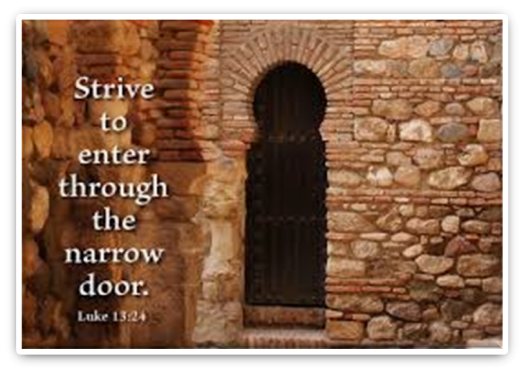
 In the first Reading  from Isaiah The Lord gathers people from all nations to see his glory and spread it among the people They will bring offerings and some will become priests and Levites. For Isaiah, a faithful band of witnesses will announce the news of God’s restoring love and invite all people to Jerusalem to see the manifestation of God’s power and fidelity. In the Second Reading  from Hebrews God disciplines those he loves, just as a father disciplines his children. We endure trials a they will later bring righteousness and healing. In this Sundays  Gospel Luke tells us about the door policy of the kingdom of God and how there is no such thing as automatic membership. While Jesus is making his way to Jerusalem, someone asks him about the number of those who will be saved. Rather than speculate about the arithmetic of salvation, Jesus gives practical advice about the present time:  “Try your best to enter by the narrow door, because, I tell you, many will try to enter and will not succeed.” Those who wait until the door is shut try knocking, the householder will regard them as strangers. Thus, they are distressed because they are being excluded, the people in the story “prove” they are part of the group by saying “We ate and drank with you, and you taught in our streets.”  Jesus is not impressed with this type of superficial acquaintance: people who eat and drink in the same restaurants and bars, read the same papers, watch the same TV programmes, don’t always  share the same commitment to God.   Through Jesus we come to know the faithfulness of God. For us, Jesus is the “sign” of God’s faithfulness. The God who raised Jesus from the dead offers us that same new life through him.

Pope Saint Paul VI said in his famous encyclical, “Evangelii Nuntiandi” that people listen more to witnesses than to teachers. Pope Paul was also right  when he said that the most convincing messengers of our faith are those who speak from their experience of God they are viable witnesses. Perhaps, they were sick and God healed them, or gave them strength and endurance for the trials of life. Today we are called to be authentic witnesses to the Gospel message. Our lives must be changed by our faith in Jesus. We are given the gift of faith  and we are asked to nurture that gift and help it grow. So let us not be afraid to change the things in our lives that we need to change in the light of faith remembering to give thanks for  the gift of faith that gives us the hope  that we will be able to enter through the Narrow Door.

REFLECTION AS WE PRAY FOR PEACE IN GAZA

Throughout the Catholic Church in Ireland on Sunday 24th August we have  being asked to pray for peace in Gaza. There seems to be no real concrete way for the ordinary man in the street to contribute to the peace efforts but that is not true . Here in Northern Ireland we began the journey into our Peace Process then after a lot of hope filled prayer this process began to have results with ceasefires and then on the 22nd May 1998 the Good Friday agreement was signed. I am sure you are asking yourself wherever you are reading this what has this got to do with Gaza and peace there. It has a great deal to do with Gaza and peace because if you do not bring the waring factions and countries together to find some sort of common ground you will have little or nothing you will only continue the war with all its horrible consequences and there will be a day of reckoning for those who did and said nothing.

The reflections of older Germans who lived through the era of Hitler and the Holocaust serve as a sobering reminder. Many questioned their own actions or lack of action  during those dark years, asking themselves whether their ignorance was wilful or simply a matter of indifference. The burden of conscience is one they carried to their graves, knowing more could have been said and should have been done. We  must consider what our response will be and what future generations will say about our response to the violence that is currently taking place in Gaza. Considering what is going on there currently will we be able to say that we did all we could, that we prayed for peace, and that we rejected the violence and the injustice that is going on all sides? Or will we admit to sympathising with it, justifying it, or simply turning a blind eye saying it doesn’t concern me so why should I bother? As individuals, especially those who identify as Christians, we hold a profound responsibility to be men and women of peace doing all we can to promote and maintain peace.  The teachings of Christ emphasise the importance of bringing peace into every home and heart. If peace is not welcomed, it returns to us but it is our duty to continue offering it. The peace of Christ spreads only through our  personal willingness to accept and share it.  This is the vocation of every believer: to regard all people as brothers and sisters, reconciled through Christ who sacrificed himself for the world on the cross.

The real question for us a we pray for peace in Gaza is can we move out of our comfortable lives and say what needs to be said and do what we has to be done for the powerless masses of people in Gaza who face injustice and war everyday. In praying and working for peace we may have to suffer in some way  because we profess the name of Jesus.  It could simply be that we will be ignored by many people dismissed by those who consider themselves more worldly wise. But we take courage from those on the margins who, in the footsteps of Jesus have challenged the structures of intolerance and war.  Ultimately, our responsibility and our call  is clear: to be people of peace, to reject violence, and to live the values of the Gospel  in our lives. We must not allow ourselves to become complacent or indifferent to what is going on but instead, we should act as agents of peace and reconciliation wherever we are. In doing so, we contribute to the possibility of peace in our communities and across the world. Recently the Latin Patriarch of Jerusalem, Cardinal Pierbattista Pizzaballa said  the pain and dismay at what is happening is great. Once again we find ourselves in the midst of a political and military crisis. We have suddenly been catapulted into a sea of unprecedented violence.  The hatred, which we have unfortunately already been experiencing for too long, will increase even more, and the ensuing spiral of violence will create more destruction. Everything seems to speak of death.  Yet, in this time of sorrow and dismay, we do not want to remain helpless. We cannot let death and its sting (1 Cor 15:55) be the only word we hear. That is why we feel the need to pray, to turn our hearts to God the Father. Only in this way we can draw the strength and serenity needed to endure these hard times, by turning to Him, in prayer and intercession, to implore and cry out to God amidst this anguish.

This Sunday we turn to God in prayer for Gaza for the relief of the suffering of its people that those hardened hearts may turn away from the violence and become people of peace. In Down and Connor diocese where I live in Ireland our Bishop issued a pastoral letter suggesting that we might do some of  the following during the day of prayer for peace in Gaza Light a candle in your family home or local parish church; attend Mass, spend time before the Blessed Sacrament; pray the Rosary; make some small personal penance or sacrifice, so that the light of hope will radiate out from the island of Ireland for peace, for Gaza and for the future of its people. As we Pray for Gaza and the end of the conflict there we remember all the other conflicts that are ongoing at the moment as we rededicate ourselves to pray for peace in Gaza and the world. We pray that the peace of Christ that passes all understanding will dwell in our hearts and souls so we may see the hope that his call holds for us.

20th Sunday in ordinary time

The Gospel Reading for the 20th Sunday in Ordinary Time  is not easy to hear. Jesus speaks clearly and the words of Jesus are there to afflict the comfortable and comfort the afflicted. He says He did not come to bring peace, but fire. He warns that even families will be divided because of Him. His words are bold and direct. In the first reading, he is thrown into a cistern for speaking the truth. People wanted him gone. But God sends someone to help him. Jeremiah did not stop trusting God, even in the mud. The second reading from Hebrews reminds us to keep going. We must stay strong. We should look to Jesus, who faced the cross. He did not give up. Neither should we despite the conflict and suffering that we see going on in the world. Today throughout the world many people are suffering as a result of conflict especially in Gaza and Ukraine as well as other places. We continue our prayer for peace this weekend.

In the gospel reading for this Sunday Jesus says, “I have come to set the world on fire and how I wish it were already blazing.” Jesus is ready and willing to face the hardships that lie ahead. Jesus’ words must have unsettled the people who heard them the first time. It doesn’t sound like Jesus meant that the practice of our faith should make us comfortable, guarantee harmony or tranquility. Indeed, as he predicted, belief in him would cause the most severe conflict, even in the close-knit-family world of his Mediterranean followers and this conflict continues today in many places throughout the world especially in the Holy Land. Jesus has a task to complete and will follow it through, despite the threats to his personal safety. Jesus refers to his fate as “a baptism with which I must be baptized.” He sees his passion as a baptism which he will accept and which will set a fire upon the earth here we are in 2025 talking about the fire that Jesus lit that could not be extinguished that is the fire of faith. When our lives get difficult, for any reason perhaps running low on the resources of spirit, mind and Soul at critical moments, we are tempted to think that the Holy One is asleep behind a closed door. When the truth is that Jesus is with us looking after us in our times of suffering and need.

The faith that Jesus calls his followers to is a faith that leads us to reflect a faith and hope filled life. It is much easier to follow from a safe distance and not be challenged and changed by faith in God. It is very easy to let the bitterness of others take us over but Jesus went to the Cross to overcome all the hatred and bitterness that we see around us even now in 2025. Today we are invited to lead lives less dominated by greed possessiveness and hatred. As I said at the beginning of this piece the words of Jesus are there to afflict the comfortable and comfort the afflicted and they are a direct challenge to all of us. Faith was not easy at the beginning of the Church and isn’t easy now the martyrs of faith throughout history bear witness to this. If we stop and look around us even now there are people who are prepared to give everything they have including their lives in defense of the faith.  Deciding to follow Jesus is not easy and we have to work at it for anything that is worth doing or being part off will never be easy.  We are called to follow were God leads us and he will do the rest for nothing is impossible to God our father who journeys along with us throughout our lives in the good bad and sad  times and he gives us the faith based certainty that enables us to continue our journey in faith hope and love.

19th Sunday in Ordinary Time

This Sunday we continue our prayer for peace in the world. The pictures and the stories of starvation coming out of Gaza are a constant reminder of the need for peace of heart, mind and soul. With  the current state of the world we  pray  that  the politicians will come together to work for peace. The readings for 19th Sunday advise us to be prepared for we do not know when our time to move from this world to the next will come. Spiritual readiness is the theme for this Sunday and we should ask ourselves are we prepared for our lives in the world to come.    In the first Reading  from Wisdom the ancestors had foreknowledge of the Passover, giving them courage. The salvation of the just and destruction of foes were awaited. The Responsorial Psalm tells us that the righteous are urged to rejoice in the Lord. The people chosen by God are blessed, and the Lord’s gaze is upon those who respect Him. They await His mercy and protection.   In the  Second Reading   from Hebrews Abraham’s unwavering faith in God’s promise led him to a foreign land, where he and his descendants flourished.

This Gospel reading begins with some of the most beautiful of Jesus’ words: “There is no need to be afraid, little flock, for it is your Father’s good pleasure to give you the kingdom. These particular words fear not little flock are so full of meaning especially these days when there is so much fear and distrust around in many different countries and spheres of life. The words of our Lord should make us all sit up and take notice. He has taken us into his household. He has made us his “little flock.” We are invited guests in his house rather than just being mere servants. Jesus also warns us that we must always be busy about our vocation and there are many vocations in life. We also remember the reason why he invited us into his home. We are Christians, we are members of his Church, God, through Christ’s Incarnation, has put us on the road to heaven. He is always there with us helping us along the way.  We don’t know in advance what God may do with us and our own oftentimes selfish plans a friend of mine always said that Man proposes and God disposes in other words the will of God will happen no matter what we might want or do.  To those who have faith, all things are possible there is an  old saying that faith moves mountains but we should keep on climbing  and it certainly is true.

Faith helps us to rely on the infinite power of God, not on our own limited power. We don’t know when personal circumstances will put us to the test. But we do know that our lives will be a success if we set our hearts and minds on values that go beyond all the goods and chattels of this world. Our faith, is leading us onward, always pointing to something still to come, and at the end of our pilgrimage on earth we will find where our true treasure is and that is in heaven with the Father in his house. The gospel words do not fear little flock are a call for us to place our trust in God and he will help us when we come to the trials and tribulations of life especially these days when the world seems to be  in turmoil.  The Holy Year of Hope encourages us to remain hopeful, even in the face of adversity. Again and again, the Gospel assures us: we need not fear the future. Instead, we are called to place our hope and trust in God our refuge, our strength, our help, and our shield. In doing so, we journey together, trusting that God’s love will see us through all of life’s trials and lead us to our eternal home.

18th Sunday in Ordinary Time

The readings for 18th Sunday in Ordinary Time are a warning for us not to become too attached to worldly goods and temporary pleasures. Detachment from the things of this world and enriching our spiritual lives is really what  need to be doing. In the first Reading – The preacher declares everything meaningless. Working hard only to leave the results to someone else is futile. Life is full of pain and worry, and this is also meaningless. Psalm 90  offers a prayerful response to the fleeting nature of life. The psalmist does not despair but turns to God, asking for wisdom, compassion, and blessing. In the Second Reading  Paul urges the Church to set their hearts on what is above. The letter to the Colossians emphasizes the full sufficiency of Christ. This reading reminds us that our life in Christ is a new reality.

Earthly attachments and sinful habits are part of the old self, which must be left behind. Paul calls the community to live out their baptismal identity in practical ways. This reading shifts the focus from earthly gain to spiritual renewal of oneself and the community. The gospel is the story of the rich man who foolishly stored up his wealth for a future that he thought would be in his own hands instead the future was in the hands  of God.  Luke  tells us the man is foolish for his planning and for believing that he was immune to life’s tragedies. The lesson of this Sundays parable is obvious and it is perhaps as difficult to put into practice.  To be in this world and not of it, to collect the necessary goods of this world by honest labor and yet remain detached from them, to possess but not be possessed by the worldly riches we may have, this is an ideal to which our weak human nature responds very reluctantly. However some Christians, do respond to the challenge. They earn and use the goods of this world for the good and wellbeing of everyone, while at the same time they keep God’s laws and earn spiritual wealth putting their riches into their spiritual bank. Some renounce the right to possess the things of this world, by entering religious life taking on the vows of poverty, chastity and obedience. Thus they free themselves to devote their whole time and energy to the service of God and neighbor trough living the spiritual life.

Many people own the world’s goods in order to provide for themselves and their families, but, while so doing they never let their temporal possessions come between them and their spiritual life. To do this is not easy, but God’s grace is always available to help the willing heart.  The message of the Jesus is one of hope, and compassion, it is not the achievement of great influence or wealth, it is not the power over others that prove our greatness in gods eyes.  What proves our greatness is the humble service freely given to those who need the help and friendship we offer them . The last sentence of the parable is stark and clear: Do not store up treasure for yourself, but seek to be rich in the sight of God. That means that we “Seek the Kingdom of God. As Christians we know that the values of this world do not last and that they cannot bring true fulfillment. A successful life in God’s eyes is not about storing up material treasure for ourselves  but about being a source of spiritual treasure for others. In this Holy Year of Hope, we are called to renew our trust in God’s wisdom and embrace the path of spiritual generosity. That means that we use our time, talents, and resources to benefit others, knowing that in doing so, we enrich our own lives with real meaning and joy. `

Post Navigation