Second Sunday of Advent
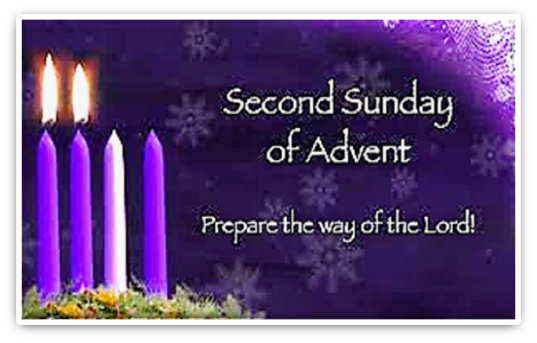
This year as we light the second purple candle on the Advent Wreath the 2nd Sunday of Advent points us to something new. Isaiah speaks of a branch growing from Jesse’s stump. It is a sign of hope. God is doing something fresh. The old ways are ending. A peaceful king will come. Justice and harmony will grow again. In the First Reading (Is 11:1-10). The reign of David was the high point in the history of Israel. But his successors failed wretchedly. Still, the hope remained that a future king would succeed where his predecessors failed. Here Isaiah foretells that even though the family tree of Jesse (David’s father) has been reduced to a mere stump, nevertheless from that stump a new shoot will spring. He goes on to sketch a portrait of the true king’. In the Second reading (Rom 15:4-9). Paul sees Jesus as the one through whom God fulfilled his promises. He highlights the value of hope.
The scriptures show that those who hope refuse to give up. By urging us to treat others in the same friendly way Christ has treated us, the reading continues the theme of peace and harmony of the First Reading. The Gospel for this Sunday brings the powerful prophetic voice of John the Baptist to centre stage with his urgent summons to conversion. His programme for reform seriously rattled the complacency of the Pharisees and Sadducees who ventured out into the desert to hear him preach. The God he proclaimed is a God who refuses to be controlled or tamed, a God whose presence is one that both consoles and makes radical demands of those who follow him. We hear about John the Baptist the lords herald who said that there is one who is to come after me and I am not worthy to take the sandals of his feet. John’s task was to go before the lord announcing the coming of Jesus and to point to him when he came. John was called to reawaken a sense of expectation among the people who had grown tired and distant from God. John was called to bring renewal to institutional expressions of religion which, at the time, had become fossilized into external ritual without meaning. John attracted thousands to come out into the desert to see him. Tradition sees the desert as the place where God speaks to the heart of his people.
It is from this solitary place of spiritual combat, the desert bordering the Jordan, that John appears “with the spirit and the power of Elijah” (Luke 7:17). By his word and his baptism with water, john called the children of the covenant back to the Lord their God as he calls us to come back to the Lord our God today. The figure of John serves as a warning, to all Christians, of our need to draw our strength from Christ alone, rather than identifying with the cultural patterns or the Fads and fashions of the time, which come and go. The Church is here in the present as it has been in past times to proclaim and live out the message of Jesus in every generation in season and out of season whether people like it or not. The Church is not there in any way to be inward looking. The people of God, you and I included are called to constant renewal, looking outwards to tear ourselves away from conventional expectations, attitudes and superficial things and centre ourselves completely on God. In every age the church must become like John the Baptist, it must be the uncomfortable reminder of how we must allow the truth of Jesus to break into our lives to enlighten the darkness that can enter our lives or the life of the Church. As the journey of Advent continues, as we prepare to celebrate the nativity of Christ, John the Baptist’s call to conversion sounds out in our communities.
It is a great and pressing invitation to open our hearts and souls to welcome the Son of God who comes among us to make the kingdom of God real to all of us. Johns call for repentance and renewal challenge us to move beyond mere words or fleeting emotions, urging us instead to seek genuine transformation in our lives. His example serves as an enduring reminder that true faith requires courage, humility, and the willingness to put God’s purpose above personal ambition. John’s life highlights the importance of integrity and moral conviction, even when such values come at a great personal cost. His steadfastness in the face of adversity and his readiness to speak truth to power continue to inspire believers to stand firm in their faith and to act with justice and compassion. In a world often marked by power and self-interest, the witness of John the Baptist remains a beacon, calling each of us to prepare a way for the Lord in our own hearts and communities. Let listen with renewed faith and hope to John the Baptists call this Advent.
 Fullerton T