Third Sunday of Advent
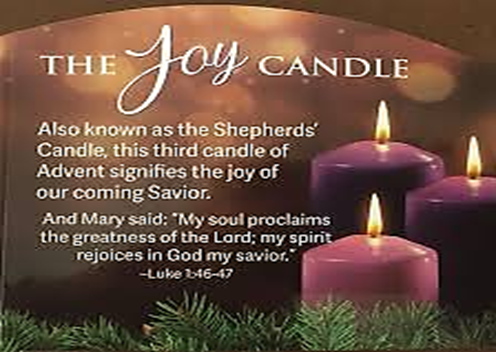
The third Sunday of Advent is also known as Gaudete Sunday. The term Gaudete refers to the Entrance Antiphon, “Rejoice in the Lord always again I say rejoice for the lord is very near.” Rose vestments are worn in many churches to emphasize our joy that Christmas is near, and we also light the rose candle on the Advent wreath. In many places the Parishes celebrate Bambinelli Sunday when the Children are asked to bring the baby Jesus Crib Figure to get a special blessing and then they place the baby Jesus in the Crib on Christmas Morning. As Christmas draws near, the Church emphasizes the joy which should be in our hearts over all that the birth of our Saviour means for us or all that it should mean for us, especially in our world where so many have little or nothing at all.
The readings for this Sunday are full of life. Isaiah tells us the desert will bloom. James encourages us to wait with patience. Jesus reminds us of the signs that God’s kingdom is near. These words give strength to those who are tired or uncertain and in our world these days there are many people who are tired of the present and uncertain about the future. In the First Reading –Isaiah tells us that the desert will bloom and rejoice. God will strengthen the weak and bring justice. The blind will see, the deaf will hear, and the saved will enter Zion with joy. In the Second Reading – James tells us to be patient for the Lord’s coming, like a farmer waiting for crops. Strengthen your hearts, avoid complaining, and follow the example of patient prophets. All four Gospels testify to an important truth: that John the Baptist stands at the beginning of the Gospel. He is the one who marks the end of the time of waiting and the beginning of the new age in Jesus. He is the last of the great prophets, the one who came after a long period when no prophet spoke to the people. John the Baptist has an unusual address as he lived in the wilderness. But that was the traditional place associated with the growth of Israel’s religion. It was in the desert that Israel first met God, and the story of the people’s wanderings through the wilderness became the story of their growth from crisis to settlement in the promised land.
In the desert the people were tested, and later, when they failed God, they were told that they would be taken back into the desert where God would speak again to their heart (Hosea 2:16). In today’s gospel we meet John the Baptist in prison, sending his disciples to ask Jesus, “Are you the one who is to come, or should we look for another?” This is a poignant moment in the gospel. John was the fiery prophet who had proclaimed the coming of the Messiah. Jesus had come, but he doesn’t seem to be what John expected. John sounds like he is wrestling uncertainty; might even be wondering if he had gotten God’s message right. He lives in a state we know as well: between promise and fulfilment; between what has begun in Christ and what we still await and hope. John voices our own questions in Advent when we ask, “Lord, where are you? Are you really present at this time in our world with all that is going on within it?” The delay in God’s promises being fulfilled can cause us to wonder if God and the kingdom are near. That is our Advent question and besides raising the question we are also invited to listen to Jesus’ gentle reply. Here is the answer Jesus gives to John’s disciples about himself. “The blind regain their sight, the lame walk, lepers are cleansed, the deaf hear, the dead are raised hands the poor have the good news proclaimed to them.”
Jesus does not argue or explain. He points to what’s happening: healing mercy and transformation. Aren’t those signs of God’s kingdom? Advent faith invites us to look for those same signs. They may be small and hidden, or right before our eyes, hard to miss. These signs announce to us to God’s saving power is still at work among us. Do we not see? How can we participate in them? We note the beatitude in today’s gospel, “Blessed is the one who takes no offense at me.” This is an Advent challenge because God’s ways can surprise or unsettle us. We can’t stumble when Christ comes to us in a form we do not expect in the poor, and suffering, in the slow process of grace. Faith means trusting that even when we do not see everything clearly, God’s promises being fulfilled. John the Baptist is a reminder to us that even the prophet of fiery conviction struggles to understand how God is working. Like him, we too may wonder: where is God’s kingdom? Why does it seem delayed when the world needs it to come in its fullness? We wait with hope in our hearts for the culmination of all things in Christ and the prayer that is on our lips is ‘thy kingdom come!’ As we continue our Advent journeys let us prepare the way for the Lord in our own lives remembering that in the words of the psalm the lord keeps faith forever and he won’t let us down. Gaudete Sunday gives the strength for the present and hope for the future as we look forward to Christmas.
 Fullerton T