Fullerton T

RELIGION LITURGY AND LIFE

Archive for the category “Faith”

16th Sunday of Ordinary Time
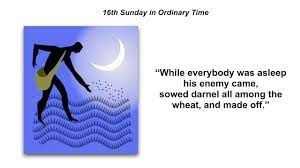
This weekend  we hear the reading  from the first section from Chapter 23 of St. Matthews gospel, the story is the parable of the darnel in the field the seed and the weeds.  In the parable of the wheat and weeds, Jesus recognized co-existence of good with evil. We  often say ‘wouldn’t life be easier if everything were black and white’ as if there are ‘totally good people’ and ‘totally evil people’.  Of course life is never that simple.  We need to ask ourselves who are we called to be in a world where weeds and seeds grow side by side and we often find it hard to distinguish the difference between them.  We are called to be the body of Christ the Church which is a church of Saints and sinners a Church of Seeds and Weeds a church that lives in a world in which very little is black and white. As people of faith  we have to constantly ask ourselves  3 questions :  Should we hide from the messiness and make religion a privatized personal relationship with God?   

Should we insulate ourselves – sharing with those  we think are worthy of our love, deciding who is worthy? Where is God in all this concern, worry and judgment?  If we pray about  these three questions and our problems and those of others we will see god is there in the middle of everything and his hand will guide us and as a result we will be the seeds that flourish and not the weeds or the darnel. Jesus used parables to challenge his audience to think and he uses the parables in our world of today to  challenge you and me and make us think as well. The images and symbols in the Gospel Parables allowed for various interpretations, depending upon the audience and their circumstances. To help relieve anxiety among his persecuted followers, Jesus told this parable as a story about good and evil. Obviously, Jesus recognized good and evil lived together in his time as we recognize the same today. But, when Jesus made that co-existence part of God’s Kingdom, he must have shocked his own followers. How could God allow such evil in the world? Shouldn’t God act to save his people?

Why did he delay? These are questions that were asked in the time of Jesus and we still ask ourselves the same questions these days.  The message of the parable is something that Jesus lived throughout his ministry. He reached out to all sorts of people, mixing with priests, crooks, scribes, politicians, children, tax collectors. Religious separatism was something Jesus refused to advocate, making it his business to seek out and save the lost.  The Pharisees, those whose very name means “the separated ones”, criticised him for associating with the wrong crowd. But Jesus knew that all communities are a mixture of the good and bad, the crooked and the good. And, further, that it isn’t always easy to tell which is which. God ‘s perfect love for us shows itself in the gift of our free will. We have the power to freely choose Him or to reject Him. Let us Choose the Lord that we may have life and live it to the full.  
15th Sunday in Ordinary Time

This Sunday we hear the Gospel story of the sower who went out to sow the seed. For me the story  is really about the seed of faith with Jesus the sower and you and me as the soil on which the seed that is the word of God lands. As the early church faced opposition and a seeming lack of success, the parable must have given encouragement to the first preachers and members of the early church a promise of fruit not yet visible to them. Jesus is speaking to a large crowd. They may be listening to what he says, but as it is in 2023 some will follow him  and others will leave it all behind and go their own way. He is realistic as he seems to randomly cast his words out upon the crowd. What he says will not seem to bear fruit – not straight away. Often that wee seed of faith may take root many years after it has been planted and today we see many people returning to the faith or coming to the faith for the first time after someone or some event in their lives planted that first seed with others helping nourishing the seed and helping it to grow.

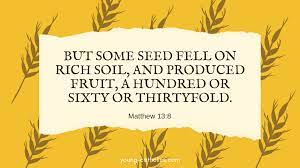
The bulk of the details in this story are about wasted effort and lost seed.  But if we stop for a moment and think about it anything done for God in faith is never lost.   Very often things that are happening  in our lives don’t seem to be the way we want  them to be but when we look at the problems with eyes of faith we see that things around are meant to be for the good of all despite our problems . We also  get the strength to  deal with the problems that go on through and in faith. Nobody really knows what’s beneath the surface of the soil we cast the seed of the word of god upon. Who knows the potential of the good soil? Do good and poor soil both exist in the same person I think that it most probably does much in the same way that a person can do good or be bad. Is there something we might say that will land on the interior good soil in a person and bear the “hundredfold, or sixty or thirtyfold” Jesus promises? While the gospel parable begins with and spends time on hardships and failure it ends in surprise and abundance. What was the source of this abundance? We look to what Isaiah told us today in the reading about the fertile, life-giving nature of God’s Word.

Despite any discouragement we might feel because our efforts on God’s behalf in many things seem futile and draining, we put our trust in the one who speaks to us a living word who sows the seed. The message of Jesus may not always be welcome especially in our modern world were faith and religion are constantly under assault by those who oppose the Catholic faith based outlook on life. That said we still have to sow the seed what we do and say and then we leave the rest up to God. The  efforts we make are never futile and we don’t always see the fruit of the seed that is sown. Let us remember that tall oaks from little acorns grow.  

14th Sunday in Ordinary Time

One of the most wonderful things about Jesus has been and continues to be his special love for ordinary people. It comes out in a particular way in the two statements that he makes in this Sundays Gospel reading. The first is in his prayer to God: ‘I bless you, Father, Lord of heaven and earth, for hiding these things from the learned and the clever and revealing them to mere children.’ The second is in his Invitation to all of us: ‘Come to me, all you who labour and are overburdened and I will give you rest.’ Why did he say this? The answer comes across very clearly so many times in the gospels, and may be summed up in just one word – COMPASSION. Remember the plight and tears of the widow of Nain touches his heart to the core: ‘Don’t cry,’ he says to her, before bringing her son back to life.

He is moved with compassion at the plight of a leper begging for help (Mk 4:41), for two blind men sitting at the side of a road and pleading for mercy (Mt 20:29-34), and for a crowd of people with nothing to eat (Mk 8:2). In each case he responds to their sufferings with the power, love, compassion that is the  care of God freely given through Jesus his Son. All through the gospels, we sense the surge of compassion rising within his heart. He is not moved by the grandeur and beauty of the great Temple buildings (Mk 13:1-2), but by the generosity of a poor widow who puts her last coin  into the Temple treasury to assist others (Mk 12:41-44). When everyone else around him is jumping for joy about Jairus’ daughter come back to life, Jesus is concerned that she be given something to eat (Mk 5:42-43).

Also in the second reading we are called to lead spiritual lives that is lives enlivened by our faith in God and what is taught by the Church inspired by the Holy Spirit. Those who have the Spirit of Christ dwelling within them belong to him and will have life. The passage urges believers to live according to the Spirit and put to death the deeds of the flesh, for those who live according to the flesh will not inherit eternal life. Today we see so many people constantly searching for new idols and these idols are so easy to find, We live in  a world which has left the path marked out by God a world where so many have little or nothing at all and the few have so much. To be a Christian and to have the light of faith to guide our steps in the neo-pagan darkness of today’s world, is a gift, and a blessing. So, the big question for each and everyone of us has to be whose side are we on?

Are we  on the side of Jesus, that is the side of compassion, kindness, help and healing. Or on the side of the scribes and Pharisees who are  amongst us even today  and they are fierce, fault-finding, heartless, critical, people without much compassion. Will we take our cue from their cruel, harsh, and insensitive judgments and actions? Or will we take our inspiration from what we see in Jesus, and from his touching  compassionate outreach to the poor and the broken. We are called to bring the message of Jesus into our own lives as well as the lives of those around us. It is a message of compassion and understanding that todays world needs to hear.  Let us remember the words of Jesus as we go out into the world   ‘Come to me, all you who labour and are overburdened and I will give you rest.

13th Sunday of Ordinary Time

Here we are at the start of July and the beginning of the summer holidays. Here in Northern Ireland where I am the schools will be closed for the next 2 months and by the end of that time the parents will be ready for the asylum. So these days spare a thought for all those parents out there who are wondering what they will do with the youngsters over the next few weeks. We were lucky as we were able to  go to the country and the cousins and many friends were there so times were great during the summertime for us but the summer holidays can be a difficult time for many families who mightn’t have the opportunity for a holiday this year so we remember them in our thoughts..

In the First Reading through the woman of Shunem we learn that in our search for God, practicing hospitality is important, for it can be the occasion of a blessing from God through the person we are dealing with at that moment. In our Gospel story we are reminded that  the priority of faith demanded radical consequences for early Christians as they took up their crosses to follow Jesus. At that time extended closely-knit families formed the basis of society, a choice for a follower of Christ could mean a rejection of the family’s faith and values. Jesus reminded his followers that the Christian life involved many risks and one could not compromise or hide these risks, a believer could not placate his or her family if the cost threatened faith. Even though they had only a very vague idea then of what he meant, when the time came, they remembered Jesus  words and gladly suffered imprisonment, hardships, and finally martyrdom for Christ.  

This shows how the resurrection of Christ, and the descent of the Holy Spirit on them, changed them from worldly weaklings into fearless spiritual heroes. They were convinced that Christ was the Son of God their saviour who had come on earth to bring all men to heaven. Today, too, there are still those who are suffering a lingering martyrdom, worse than quick death on the scaffold, because they obey God rather than man. We ourselves, who are free from any overt persecution, must show our gratitude to God for being allowed to practice our religion openly and without fear. We may not be able to preach, or teach the truth of the faith in the same way as priests deacons or religious do but we can help all those who are doing so by our prayers and our actions in living our lives according to our Catholic faith. This Gospel highlights for us the importance of hospitality in the Christian life.

To welcome another in Jesus name is to extend hospitality to Jesus himself. We have many opportunities in our daily life to reach out to others, to be a welcoming presence and a sign of God’s love in the world especially where we live let us not be afraid to take these opportunities when they arise.

12th Sunday in Ordinary Time

The readings for the 12th Sunday in Ordinary Time are a call to trust in God. In the first reading Jeremiah refuses to be intimidated by terror from every side. That doesn’t mean that the terror doesn’t get to him it means that he has no intention of allowing the terror to dictate who he is or what he does. Jeremiah has been abandoned by all his friends who now try to discredit him. He is thrown into prison for his preaching, and the army council threatens him with death if he doesn’t change his tune. But Jeremiah refuses to be bullied into agreement because he believes that “the Lord is at his side, a mighty hero”. What keeps Jeremiah sane amidst all this persecution is the profound belief that God cares for him. And, less spiritually, the frank hope that God will clobber all his enemies in good time! The message of the Gospel is quite simple Jesus tells us not to be afraid. Jesus encourages His disciples to fearlessly proclaim His teachings, assuring them that whatever is hidden will be revealed and their actions will be brought to light.

 He does not disguise the truth that his disciples will be confronted by those who threaten, bully and intimidate others into submissive agreement. He emphasizes that the apostles should not fear those who can harm the body, but rather fear God who holds ultimate authority over both body and soul, and promises that those who acknowledge Him before others will be acknowledged by Him in return Not only does Jesus want his disciples to refuse to submit to the merchants of death, he tells them not to be afraid of them: “Do not be afraid of those who kill the body but cannot kill the soul.” What our Lord said to His Apostles applies to all Christians including you and me in the practice of our faith where we are today. By the very fact of fully living our faith day and daily we are apostles. So today we think of all of those who have given us an example by living their lives in faith. These may be parents family members or people we have known we all have people who have shown us the way of faith. So as faith filled people Jesus teaches us that our only source of freedom and strength is the goodness of our heavenly Father a goodness that is comes to us through Jesus himself as well as through people we know.

Our world is full of hype and glitter, but Jesus tells us here and now the same thing he told His apostles: “Do not be afraid. “Whoever acknowledges me before men, I will acknowledge before my Father in heaven. Whoever disowns me before men, I will disown before my Father in heaven.” Jesus wants to us understand that with God there is no such thing as a nameless, faceless individual as we are all part of gods family and our names are carved in the palm of gods hand. Like Jesus, Jeremiah and the disciples, knew all about persecution and rejection. If we allow fear to silence us how will the Good News of Jesus Christ ever be heard in the world? If we don’t speak, who will? If we don’t act, who will? As St Francis of Assisi said, ‘Preach the Gospel at all times. When necessary use words’. This means that by the way we lead our lives and the things we say and do for others the people around us will see we are the Christians we are called by Christ to be.

11th Sunday of Ordinary Time

The Scripture readings for this Sunday are all about the great compassion Jesus has for the crowd who were his followers. In the first reading the Israelites are reminded that God led them out of Egypt. The psalm tells us that God cares for us. In the second reading, Paul tells us that God proves His love for us because Christ died for us. In the gospel, we hear how Jesus cared for the people and sent his disciples to do the same. Jesus wanted to bring the Kingdom of his Father to them, so he set out to heal them, and sent the apostles out to do the same. His aim was to bring them the peace of God, to help them by healing their worries, their sickness, their embarrassment at being lost sheep without a shepherd as God was always the shepherd in Israel. When he called the twelve apostles he was making a New Israel, a new set of twelve tribes, as a permanent healing body, to make sure that the Kingdom of the Father and its peace and generosity would always be available to everyone everywhere.  

He was not setting up a group  of leaders, instead he was appointing his own helpers in spreading God’s Kingdom.  Do we make it our business to spread the Kingdom of God? Are we labourers in the vineyard, trying to bring God’s peace and healing to all the people of God? All of us are  made in the image of God, and he gave us the task of following on his creative work. And then we are all called to follow Jesus, we are all called to make his message known to all people, those around us as well as the people at large. Like the chosen people of Israel we are counted a kingdom of priests, a consecrated nation. We are called to  minister to the people in our own time, taking responsibility for our own mission. This is a matter for all of us. As Blessed John Henry Newman wrote: He called us first in baptism; but afterwards also; whether we obey his voice or not, he graciously calls us still… Abraham was called from his home, Peter from his nets, Matthew from his office, Elisha from his farm, Nathanael from his retreat. The call that Christ makes to us  takes us onwards, It is a call to be the church of the future just as the Apostles were called to be the Church of the future at its beginning.

Jesus  mission is to the lost sheep. It is his desire and endeavour to bring together, those he pities, those he looks on with love. So today Through the words of the Gospel may we hear again our own call to be emissaries of God’s love and bearers of Good News. May we allow the kindness and compassion of God to touch our own lives and the lives of  those around us wherever we are.

Corpus Christi

This Sunday we celebrate the feast of the Body and Blood of Christ also known as Corpus Christi. In many places throughout the world the Feast of Corpus Christi would have been celebrated last Thursday but we in Ireland and many other places in the world  celebrate this feast on the weekend after Trinity Sunday.  The first reading tells us that the Israelites were told to remember how God led them through the wilderness and provided for them, emphasizing that they should not live by bread alone, but by every word that comes from God’s mouth. It warns against forgetting God and becoming proud in their own abilities and possessions, as it was God who brought them out of slavery in Egypt and gave them abundance in the Promised Land. 

In the Gospel  Jesus teaches about the necessity of consuming His flesh and blood to gain eternal life. Jesus explains that His flesh and blood are real food and real drink, and those who eat and drink them will abide in Him and have eternal life. When we see the Eucharistic Bread, we believe that it is Jesus who is there before us.  We are in the presence of the one who rose from the dead at Easter, The Church teaches that the Eucharist is “the source and summit of the Christian life.” (CCC 1324) This means that, because Christ is really, truly and substantially present in the Eucharist, we recognize that all the graces we enjoy as Catholics come from this great Sacrament, and all we aspire to, the fullness of the life of God, is contained in this Sacrament. Gathered at the Eucharist we bring ourselves to God.

We bring prayers for our needs and the needs of others to church because they raise our hope in the power and love of God to help us in our needs.  We have this hope because God is with us and continues to be with us in good and bad times through the sacramental life of the Church and through the Eucharist in particular.  Because of God’s faithfulness, we present our needs, give thanks, and offer sacrifice.  The celebration of Corpus Christi is there to remind us that the great gift of the Eucharist is a both a gift and a mystery. Jesus is present with us in a way that is really beyond our understanding. We take Him into ourselves when we receive communion. We are united to his sacrifice on the Cross for all of us when we pray the Mass in its fullness. We come into His Presence whenever we are in Church where the Eucharist is reposed in a tabernacle or exposed on the Altar.

Over the centuries By following in our Lord’s footsteps, many Christians have made great sacrifices, for their faith. Then as now, it begins with each of us  humbly asking God to show us the way to go and to provide the strength needed to follow in his footsteps. This strength we need to follow Jesus comes from the Eucharist the Bread of Life. We feed on the “living bread” that is Jesus and then, we are called to go out to be the living bread for others  as we show  what it means to be a follower of Christ  to the people where we are.

Trinity Sunday

From Ash Wednesday to Easter Sunday we journeyed through the 40 days of Lent. From Easter Sunday until Pentecost we enjoyed the 50 days of the Easter Season and we  now come to the part of the Churches Year that is called Ordinary Time. This weekend we celebrate Trinity Sunday which is all about the triune god Father, son and Holy Spirit. We remember that the Father is equal to the Son and the Son is equal to the Spirit three in one and one in three we hear this in the breastplate of St. Patrick. The 4th century St Patrick, with a brilliance that we Irish are justly celebrate found in the three leaf shamrock rising from the one stem an image of the Trinity. The feast of the Trinity goes back to 12th century England and St Thomas a Becket, Archbishop of Canterbury. Historians say the great Thomas celebrated a Liturgy in honor of the Trinity in his cathedral. So the observance was born. In the 14th century, the feast came to be observed by the universal Church. 

We open each Liturgy especially the Mass by invoking the Trinity. We also close Mass and other liturgies by calling upon those same 3 people Father Son and Spirit  to bless us  as we go out into the world.  Throughout the Christian world many people young and not so young will be received into their faith communities  through Baptism in the name of the Trinity. The Christian belief that God is a trinity helps underscore how rich the mystery of God is and how our experience of God is always richer than our concepts and language about God. In intellectual terms, God remains a mystery. For people of faith, God is known not by the mind, but by the heart. That is what spirituality and mysticism are about – exploring our experience of God.  In the first reading God is proclaimed as a God of tenderness and compassion, slow to anger and rich in mercy; a God who walks with his people.  St. Paul’s words in the second reading are born out of his belief that, having been made in the image and likeness of God, Christians must always act in the image and likeness of God.  

When the Church celebrates the Feast of the Most Holy Trinity, it is an attempt to summarize the whole mystery of our God into one day.  This is not just a “theological feast” but a feast which should speak to us of this simple fact of faith: the Father loves us, has revealed that love in his Son, and has called us into a relationship sustained by the Spirit. It is our joy that, as baptized members of the Church, we can share in that divine life and love as children of God.  God has chosen us, and we are his own people, just as he chose the people of Israel long ago. Each Trinity Sunday, we only scratch the surface of this great mystery of our faith.  In gratitude and faith, let us begin and end every prayer with greater faith and reverence as we invoke the Blessed Trinity when  we say “In the name of the Father, and of the Son, and of the Holy Spirit. Amen.”

Pentecost Sunday

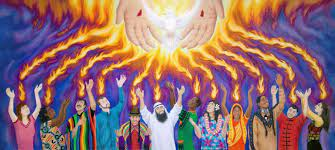
This Sunday We celebrate the great feast of Pentecost and it takes place 50 days after Easter Sunday, marking the end of Eastertide. We hear in the account from the Acts of the Apostles how Jews from all over were gathered in Jerusalem to celebrate the Jewish feast. It is recorded that 120 people, including Mary and the Apostles were in the upper room where they had seen Christ after his resurrection. They had been told by Jesus  just before he ascended, to wait there to receive ‘what the father has promised, power from on high’ His holy spirit. On Pentecost Sunday the sound of a mighty wind filled the room, witnesses saw what looked like tongues of fire resting on each person’s head and despite being from different parts of the world they could all communicate and understand to each other Pentecost is the birthday of the church

With the feast of Pentecost the seven weeks of Easter have come to an end, Christ’s Passover is fulfilled with the outpouring of the Holy Spirit, manifested, given, and communicated as a divine person: of his fullness, Christ, the Lord, pours out the Spirit in abundance.  In the Gospel reading, Jesus, gives the apostles the power to forgive and reconcile those who sin. By the time John wrote his gospel, Jewish Christians had been excommunicated for their belief in Jesus. Ostracized and socially persecuted, some Christians reacted in fear, while others boldly proclaimed the gospel. The First Christians needed a sense of stability, a sense of serenity and peace. Through the words of Jesus, “Peace” was John’s prayer for his readers as it is for us as we listen to this gospel reading. With the sight of Jesus, fear turned into great joy. Anxiety turned into relief. Desperation turned into vindication. Most important, a lack of spiritual direction turned into a sense of deep spiritual grounding.

The divine presence stood close to them and with the divine presence came peace.  We too have the divine presence with us  in the Blessed Sacrament and it brings Joy and spiritual grounding to all those who come and Jesus says to each and every one you are welcome. We can’t ignore the problems that are there for ourselves and those around us. Most of the time, the problems just don’t go away by themselves very often we need to stop and pray through the problems as well as thinking them through.  Gathered at the Eucharist we bring our prayers to God. We each have our own needs. Family and friends may be sick.  Kids need work. The person who has been in our lives for so long has died.  We bring these and all our concerns in prayer to church because they remind us of our need and they raise our hopes in the power of God made real to every generation through the Holy Spirit.  

Through the Holy Spirit our relationship with God produces fruitfulness, satisfies our longings, and brings us serenity and peace. Because of God’s faithfulness, we give thanks, offer sacrifice, and once again present our needs as we remember the presence of God with us in all our lives.  As we encounter people who are different from us, whether in language, culture, or background, the Holy Spirit will give us the words and the wisdom to share the Good News with them. In today’s world, we are called to be ambassadors of Christ’s love, reaching out to all people with compassion and understanding. We must be willing to listen to their stories, to learn from their experiences, and to share the Gospel in a way that speaks to their hearts. So on this feast of Pentecost, let us renew our commitment to the Holy Spirit and ask for the grace to be open to the Spirit’s guidance in our lives.

Ascension

Over our lives we have seen or we will see the departure of so many people, Perhaps it is a son or daughter leaving for university or maybe it was someone leaving to go to another country on the other side of the world or the hardest departure of all someone close to us dying. Our lives are made up of so many different times and places of leave-taking and that is what Ascension is really about Jesus leaving the Apostles to return to the Father. The Apostles must have felt awful as  Jesus  told them and us go therefore make disciples of all the nations and know that I am with you yes to the end of time. This Gospel reading is all about the past the present and the future. It is about ourselves in the here and now of today, and what we are doing to make disciples of all the nations in 2023 or at least making disciples of those around us perhaps our families and friends.

In this gospel reading Jesus has little to say, but he is definite about what he has to say when he speaks. This is in sharp contrast to the fact that, even at this last minute, some of his disciples still doubted. The disciples did what he told them to do. He asked them to meet him on the mountain, and they did that. Like any gathering of people, their feelings were varied. Some of them worshipped him, while some of them still doubted. Jesus didn’t seem to have any great problem with that, because he knew that, when the Spirit came, all of those doubts would be ended. It would seem, indeed, that he was in a hurry to take his leave of them, so that the second part of his plan of salvation could get underway. The mission of the apostles was simple to understand; difficult to carry out. It was to teach others all that Jesus had taught them. Just as he asked his disciples to follow him, they were to ask that others should follow him which was so hard then and especially hard in the world of today.

The programme of redemption and salvation was to begin at Pentecost and continue from generation to generation, until the end of time.So many things have changed in the Church and society over the years especially in more recent times. However two things that have not changed are Jesus himself and his message as they are always new for each generation. The message of Jesus is ignored by many people inside and outside the Church for their own reasons. The essential message of God and Jesus his Son have never changed up to now and I don’t think that the message  will ever change. Again and again we need to ask ourselves what we are doing to make disciples of all the nations realizing that Jesus and his message are always new for each generation. May we be heralds of the message of Jesus this Ascension as we go forward with faith.

Post Navigation