Fullerton T

RELIGION LITURGY AND LIFE

Archive for the category “Faith”

6th Sunday of Easter
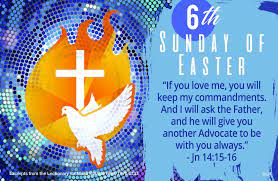
This Sunday is the 6th Sunday of Easter it doesn’t seem that  long since we celebrated Easter Sunday as we  head towards Ascension and Pentecost which take place over the next 2 weekends. The second reading is one that I always love to hear as It speaks of us having reverence for God and that we should always be ready to give an explanation to anyone who asks about the reason for our hope, the reading goes on to tell us to give our answers with gentleness and reverence. What is the answer for our hope simply put the reason for our hope is Jesus Christ the Son of God the Father. If we live for Christ, we will be criticized and many people over the centuries lost their lives for their defence of the faith. Would we be able to stand up and tell those around us the reason that we have for the hope that is within us today? Would we be prepared to stand up for the faith that so many have turned their backs on and point towards Jesus Christ the reason for the hope that we have both these questions are hard  to answer for people of faith in the world we find ourselves these days.   

In The Gospel for this Sunday Jesus promises to ask the Father to send us the “Paraclete,” or “Advocate.” The word “Paraclete” literally means “one called alongside” indicating one who accompanies another.  This can refer to a Lawyer who intercedes for another in a lawsuit, a helper who encourages, or a companion who gives comfort. The Paraclete, or advocate, is the Spirit of Truth, the Holy Spirit. Jesus is preparing his disciples for his Ascension, his going back to the Father. When he finally leaves He doesn’t leave his followers a detailed plan.  Instead, he promised them and he also promises us the Holy Spirit, who will never leave our side. This is why he says “I will not leave you orphans.”  The Spirit is with us to open our hearts and minds to the fullness of the truth of Jesus’ words, and the commandment he gives to “love one another as I have loved you.”  If we share our faith with courtesy and respect for others who might not hold our belief  or those who no longer practise their faith. then we will find that they will show respect for the things we hold dear as we stand up for the faith we profess wherever we are.

The one thing that will remain as it has up to now is the reason for our hope who is Jesus Christ who is with us in all our troubles in life whatever they are. As we look around us we may come across people who may be considered to be outsiders who are the least likely to join us in prayer.  But here they are and they are part of us! We cannot ignore them, especially if they, like the Samaritans, show signs of the Spirit’s life that is the life of faith in what they are saying or doing. We welcome and respect one another whether we are in Church every week or not; No one is  less in God’s eyes, nor should anyone  be in ours. Peter calls us today to “good conduct in Christ.” What better conduct can we do as a Christians, than be a community of Christ’s disciples as we move forward together in faith. God the Father is merciful and full of compassion. He is our source of life and of the longings of our hearts and our hearts are restless till they rest in him It is through the Holy Spirit that we are drawn into the life of Faith so we can rest in him. May we always be open to the transforming power of the Holy Spirit in our lives, and may we be bold witnesses to Christ in the world where we are.
5th Sunday of Easter

In this Sundays  first reading, we see how human the first Christians were. Some were Palestinian Jews, while others were gentiles of Greek origin. Tensions were bound to arise since each group had different ways of thinking and acting. Once out in the open, the complaints become an opportunity for development, and the decision is made to give the non-Jewish community greater authority and more participation in the running of the Church at its beginning. The second reading, from the First Letter of St. Peter, uses the image of “stone” or “rock.” Peter, referring to Isaiah’s prophecy, tells us that God the Father long ago had established His Son, Jesus, as the “cornerstone, chosen and precious.” Peter, with warm and welcoming tone, urges us to come with hope and trust to the living stone of salvation, and there to become ourselves a holy temple. Then comes a warning. Just as many have rejected this rock of salvation, so too, if we attempt to bypass Christ, then we will ourselves stumble and fall.

Peter quotes Isaiah as his authority for referring to Christ as a stumbling block to those who reject Him. The Gospel is taken from the wonderful farewell address of Jesus to His apostles at the Last Supper. He is helping them get ready for his suffering and death. For the apostles this was a huge reversal from the adulation of the entrance into Jerusalem on Palm Sunday to the despair of the Cross on Good Friday. Remember when he asked them whether they would leave him, along with the rest of the crowd? Now it is he who is leaving. They are stunned. Peter’s reply at that time would be appropriate even now. “Where will we go? You have the words of eternal life” (Jn 6:67-8) Jesus tells them as he tells us now. “Do not let your hearts be troubled. You have faith in God, have faith also in me.” The straightforward meaning of this directive is, you know how to trust, you do it with God. Use that same trust with me.  This trust in Jesus and in God  is also what we are called to these days. Jesus speaks to us not at us.   His word is proclaimed to us through the readings from scripture as well as in lived example of others in the community where we live.  

We come to Church week in week out to hear the Word and receive Jesus in Holy Communion.  We come to share the joys and sufferings of all the community in faith gathered together as gods people.   We don’t stay in Church all the time as the hard pew might well become the soft bed.  We have duties and obligations to family, work and the communities where we live.  We are asked to  take the Word of God into that life with all its short comings when we are told to go in peace.   When we’re confused about decisions we should make, Jesus Himself will show us the Way. When we don’t know what is true and what is false, what is right and what is wrong, the Holy Spirit through the Church and its members will enlighten us.  When we are drawn into false pleasures that promise us life, Jesus will bring us back to real living and the joy of that life through the power of His love. As we walk along the roads of life these days when so much is wrong in the world at large let us take up the call of Jesus the cornerstone  of the church to trust in him and he will not let us down.

4th Sunday of Easter Good Shepherd Sunday

The Fourth Sunday of Easter is often called “Good Shepherd Sunday” because no matter what reading cycle we are in, the Gospel always focusses on the image of Jesus as the Good Shepherd. The image of a caring shepherd, which was formed within an ancient agricultural society, remains valid even today. It speaks of the intimate closeness and tenderness of Christ’s relationship with each one of us individually.  The shepherd knows his sheep, and the sheep their shepherd. Complete trust is implicit. The first reading gives us insight into how the early church was struggling with the opening up of the good news to the Gentiles, leading to diversity in the make-up of the communities, much as we have in parishes today.  Antioch, where Paul and Barnabas were preaching, was home to a military garrison, so conversion of the soldiers promoted the spread of the good news as they were stationed throughout the Roman Empire.

The Gospel today makes some sweeping claims eternal life promised for his sheep, and total protection from anyone who would seek to snatch them away.  It finishes up with the declaration that Jesus and God are one. The Latin root word for shepherd is pastor, and it is from this root that spring the church terminologies and concepts of pastoral care and roles within faith communities.  These roles imply a duty of love and care.  Besides that the Shepherd-King was an ancient image of God used by the Hebrew people. This year, the Gospel reading talks about Jesus as the ‘gate of the sheepfold’, that is, Jesus is the one through whom we truly enter into the fold of God. The reading implies that those who get into the sheepfold some other way bring only disaster and destruction. Those who enter the fold through Christ, the Good Shepherd, will be safe, will be led to good pasture. The parable of the Good Shepherd has many consoling truths and promises for people of every century, including ourselves in the twenty first. That mixture of tenderness and toughness, care and self-sacrifice, is one that summarises Jesus own practice of leadership.

It is not a leadership of detachment and defensiveness; rather, it is a leadership of physical involvement and self-sacrificial love. In the good shepherd’s foolish extravagant love, his own life matters less than that of his sheep as we know Jesus gave up his life for us on the cross on Good Friday. When we think of Jesus as our Shepherd, we also need to think about being good shepherds to other people. The good shepherd challenges our own way of leaving people behind remember that Jesus also said “I have come to seek out and save the lost.” All of us know people who have wandered away from the Church, who have lost their sense of belonging, who feel they have no community to belong to.  How will they know they are welcome back if no one tells them? How will they be helped back if no one offers to make the journey with them shepherding them back to the sheepfold? The story of the good shepherd gives us the opportunity to be good shepherds to those around us and its up to us to take up the challenge. This Sunday also  marks the celebration of the World Day of Prayer for Vocations instituted by Pope Paul VI in 1964.The theme this year will be “Vocations: grace and mission ”. In his message for the day, Pope Francis explains that there is no vocation without mission. Today we remember those who were shepherds for us as we pray for more people to take up the call of priesthood or religious life continuing the mission of Jesus in our own time and place, as we continue our journey in the steps of the Good Shepherd who calls out to all of us follow me.  

Third Sunday of Easter

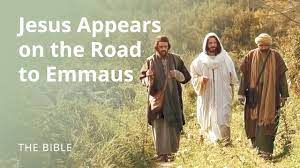
We gather this weekend after the solemn celebration of Easter and Divine Mercy Sundays, We also remember that the celebration of Easter continues until the coming of the Holy Spirit on Pentecost Sunday and then Easter Time ends and the paschal candle is placed near the baptismal font. This Sunday’s gospel recounts Jesus appearance on the evening of Easter Sunday  to two disciples who were going from Jerusalem to Emmaus, their life with Jesus had come to an abrupt end as all seemed to be lost.  For in the past few days Jesus, their beloved Leader, friend and Teacher, had been arrested, tried, sentenced, tortured and killed. Now they are feeling that without his presence, his inspiration his support and encouragement, they simply cannot go on.   They are so disappointed and disillusioned about what had happened  that they have even decided to leave the Church, the community of his followers they are walking away from it all. Slowly but surely they are putting Jerusalem and the other disciples behind them.

They are heading for the village of Emmaus, to start a new and different way of life. And there Jesus was walking along the road with them as they were talking about what had happened in Jerusalem in the days before and how the authorities had put Jesus to death. Jesus explained all the passages of scripture that were about himself but it was only at the breaking of the bread that they recognized him later in the day. They then went back to tell the apostles that they had seen the Lord and told their story and how they recognized him at the breaking of the bread. The Emmaus story is the story of the church it is the story of you and me as the two disciples represent all of us who claim that we are Christians with all our doubts and disagreements our joys and sorrows. We come together in faith each Sunday in answer to a call, often a quiet murmur from the recesses of our hearts in which Jesus calls out to us saying come to me you who are weary and overburdened and I will give you rest.  We are searching just as the companions on the road to Emmaus were and they were weary from all that had happened to them often times we are also  weary from the things that happen to us. 

In the scriptures we find the explanation and understanding of events and relationships which have shaped the faith of so many people  over the long  years of the churches history. Our faith is lived out in the real world, the world of family, work, recreation, politics and economics as well as many other things. We don’t live in two separate worlds one spiritual and the other secular.  Those who would have us believe that we can separate our lives into two compartments are mistaken as faith and life go together.p  It is the application of scriptures to the events of our own lives and times that reveal that God is walking with us and maybe even working through us. But with all and in everything it is in the breaking of bread that we recognize Jesus the Son of God who is with us on our journey. It is in the sharing of the Bread of life that we are made one with each other and with Christ.  Our faith grows and our relationship with God and his people unites us in bond of love.  We are formed into one Body, the Body of Christ.   We are on this journey in fellowship with one another  being led by Jesus who calls out to us to follow him from the Cross of Good Friday as well as from the empty tomb of Easter Sunday. 

As we grow in faith, we are led to understand those past events as experienced yet again in our time and place.  The Risen Lord uses so much gentleness with us! He doesn’t oblige us to ‘believe’ but He offers us the means  that enable us to judge based on the measure of our own hearts. As St Augustine wrote in the opening of his Confessions ‘our hearts are restless until they rest in you’  As we recognize Jesus in the breaking of the bread may we be joyful agents of conversion of one another.   As we show the caring face of the Church those who need us wherever they may be.

Second Sunday of Easter

The great Easter feast of last Sunday began the Church’s fifty-day celebration of the Resurrection  The Gospel of each Sunday is a meditation on Jesus as the resurrected Christ, made known in the scriptures and the breaking of the bread, the bearer of life in all its fullness, our way, truth and life, pledge of God’s love. Many people think that Easter begins and ends on Easter Sunday but it doesn’t stop there, the celebration of the season of Easter goes on for 50 days and ends on Pentecost Sunday. I wonder what the Apostles would think if they were to come down to us these days and find that we are celebrating the Death and Resurrection of Jesus that took place 2020 years ago, they would be amazed especially as they thought everything was over with the Crucifixion on Good Friday. In this Sundays Gospel reading the Apostles were still huddled together behind locked doors, mulling over the shocking experience from the week before when all seemed to be lost but as we know all was not lost.

Then Jesus appeared  to them and assured them that He was alive. His message must have troubled them as well when he told them: “As the Father has sent me, so I am sending you.”  In the same way as the apostles were sent out we are sent out to bring his message of  mercy  and love to other people. Then of course there is doubting Thomas who heard the witness of the those who saw Jesus but, like so many of us today he wanted more proof. Jesus says to Thomas, “Have you come to believe because you have seen me?  Blessed are those who have not seen and have believed.” That is a great  quote for us, who have not “seen” the risen Christ in person as the disciples did. We have come to believe though we have not seen him in the flesh but he is with us in the midst of our communities.  When Jesus says to the Apostles Peace be with you the Peace he is talking about is much more than the lack of conflict.  True peace, gives us happiness, since it is built on trust in God and one another.  The gospel tells us how Jesus gave his followers peace because they trusted him.

In spite of the scepticism of Thomas and so many others, throughout history Jesus  offers us the same peace of heart mind and soul.  The terror of Gethsemane and Calvary were necessary to defeat the terror of every person, the terror of the emptiness, isolation, and alienation that is the effect of death. With the crucifixion and the resurrection death is not an abyss of emptiness, uncertainty, or alienation from truth, goodness, and beauty.  After Jesus’ masterful work by taking on suffering, terror, and death itself, death is transformed into a way from life on earth to eternal life. Jesus’ life death and resurrection encourage us and give us the energy through the Holy Spirit to be a community of people who have unconditional love for one another and other people. As Christians we live in the world and are commissioned to lift it up from death into resurrected life  here and now by what we do and say. In that work as Christians we grow, we become complete, we discover and amplify our own and our communities relationship with the Lord. As we celebrate Divine Mercy Sunday we remember the joy, the hope, the grief and the anxieties of the people in our time those we know and those unknown to us and we bring them to the merciful Lord. Let us not give up on our efforts, as small as they seem, to bring peace into our families, workplace, classroom and community. May all of us be witnesses to the love  and mercy of the Gospel as we try to bring the caring face of God’s mercy to the people wherever we are today.

Easter Sunday

Holy Saturday is a day to pause and take stock, all is quiet as we wait watching by the tomb, after the great liturgies of the last few days and the fasting of the forty days of Lent we are Quiet in the  reflective mood that is part of Holy Saturday. Holy Saturday gives us  a chance to think about all that we are and what we should be as Christians while we wait and watch for the resurrection. While  we  wait we think about the  betrayal, suffering and death of Jesus as we look forward to his resurrection when we hear the cry he is risen.

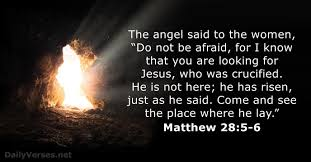
The Easter Vigil is the most distinctive liturgy of the Christian year, as we celebrate our life in the risen Christ during the Vigil. In the expanded readings we recount the history of God’s saving actions in the lives of his people.We add new members to the Body of Christ in the sacrament of Baptism and we renew our own baptismal vows. Then in the Eucharist, we celebrate our membership of the Church, the Body of the Risen Christ. On Good Friday we celebrated Jesus life giving death on the Cross but today we stop and reflect on our own personal faith journeys. The Easter celebration is an invitation to come out of darkness of life and the way we live it into the light of the risen Christ. In that light we see him and recognise each other as brothers and sisters in the Lord. It is that light which summons us to leave the darkness of our lives behind and all of us have some of those. As a  result of Jesus conquering death on the cross nobody can be written off as a lost cause ever again. Year after year when we celebrate Easter we hold as holy the memory of God’s great act in raising Jesus from the dead. We believe that God’s graciousness will be extended to ourselves and that our own death will not be the final word.  Our faith and our hope is that we will participate in Jesus resurrection on the last day. But a question raises itself: is our faith in the resurrection limited to remembering Jesus’ resurrection and hoping for our own on the last day? What happens between times? What about today? The resurrection of Jesus is a proclamation that this outcast from Galilee is the beloved Son of God who cannot be held in the darkness of death because he was raised by God his father. The truth that God raised Jesus from the dead gives hope and help to all those who want that miracle repeated in the midst of life. All of us believe that God’s work continues not least because we believe Jesus’ words: “I am the resurrection and the life he who believes in me will never die.” Our celebration of the Easter Season begins with our celebration of the Resurrection of Jesus on Easter Sunday  and continues for 50 days until Pentecost  and then it resonates throughout the rest of the year: full of gratitude for Christ’s passion, with joy in his resurrection and, strengthened by the Spirit, we continue our Christian journey this Easter time.

HOLY THURSDAY

Lent has ended and now we begin the Holy Week Triduum. The word Triduum is the Latin for three days of Holy Thursday, Good Friday and the great Easter Vigil on Holy Saturday night. The Church celebrates one liturgy each day. We should not think of the liturgies of Holy Thursday, Good Friday and the Easter Vigil as three separate events, all three form part of one single extended liturgy. In fact at the end of the Mass on Holy Thursday there is no dismissal and blessing instead we accompany Jesus to the Altar of repose that represent the garden of Gethsemane . In the same way there is no formal beginning and end to the Good Friday liturgy.  This three-day liturgy concludes with the solemn blessing at the end of the Easter Vigil or at the morning Mass on Easter Sunday.

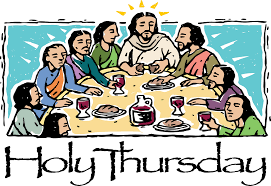
Holy Thursday is all about the priesthood and the institution of the Eucharist at the last supper. On the Morning of Holy Thursday, there is only one mass celebrated in a Diocese (Although the Chrism Mass may be celebrated earlier in the week). All the priests gather around the Bishop and the people of God to renew their commitment to priesthood. Also at this Mass the oils of Chrism, Catechumens and the Oil of the Sick are blessed by the bishop, these holy oils will be used in the Baptisms, Confirmations and anointing of the sick in the local parishes over the next 12 months. The theme running throughout this day is one of humble service that is service of God and his people.  The Evening Mass commemorates the Last Supper again the theme is service and sacrifice both of these are aspects of the same mystery.  The scene in the upper room is not your usual friendly night out. There is something about the host which makes this meal different.  We see Jesus on his knees as one who demonstrated the parable of his kingdom: that in his upside-down world, the king was servant, and the person  who ministered to the other was master and king.

And whatever belonged to the creed of power and greed  had no place in Jesus Gospel of love and service . He gave them the most costly gift he could give: the gift of himself. It was at this moment that Jesus identified himself for ever with bread and wine. He gave his followers more than food for thought; he gave them himself. In the same way in 2023 we receive Jesus in the form of Bread and wine from the hands of our priests. All these acts of self-giving service are the same act – that of the Son of Man who came ‘not to be served, but to serve, and to give his life as a ransom for many and he did that for  us all those years ago as well. May we take up the mantle of humble service giving a helping hand to others and not counting the cost to ourselves. Many people over the years have given much at great personal cost and have not failed in their example of humble service and that for me  is what  Holy Thursday is all about  Humble service for others and not being afraid of being the presence of Christ no matter what the cost is.  Jesus has shown us that it is worthwhile to pay the price for who we are and for what we stand for as his followers; it is worthwhile to pick up our bill for having fellowship with him.

The liturgy on Holy Thursday is a meditation on the essential connection between the Eucharist and Christian love expressed in serving one another. Christ is not only present in the Eucharist but also in the deeds of loving kindness offered to others through us. We are the ones who make ‘real’ the presence of Jesus in every smile, kind word and loving action. On Holy Thursday the Lord invites us again to copy what he has done for us and that is to serve others as he did when he washed the feet of his followers on that first Holy Thursday evening. 

Palm Sunday

On ash Wednesday we placed the ashes on our foreheads as a sign of our humility as we began our Journey for Lent and now six weeks later on Palm Sunday we remember Jesus entrance into Jerusalem on a donkey as the people raised their voices in joyful acclamation as they sang hosanna to the Son of David.  As we move from the Hosannas of Palm Sunday to the Upper room on Holy Thursday and then to the denials of peter and the Cross of Good Friday when all seemed to be lost. And then we come to the Resurrection when all that seemed to be lost on Good Friday was redeemed and renewed. So now we stop and reflect for a moment on how we began our journey on Ash Wednesday and where we are now as we approach the life changing and life giving events of Holy Week.  The entrance into Jerusalem is one of the very few events in Jesus’ life which is mentioned in all four gospels.  It is the only time that Jesus accepts and encourages public acclaim as Messiah. 

He even goes as far as organising his entrance by telling the disciples to go and fetch the donkey.  The key moment in God’s plan of salvation is about to begin and Jesus knows exactly how it will unfold as he knew and understood what the will of the father would mean for him. The first reading from Isaiah, speaks of a courageous and obedient messiah-figure, who says, “I have set my face like flint” against the beatings and scourging that lie ahead, “knowing that I shall not be put to shame.” The second reading from Philippians reminds us of Jesus’ total emptying of His divinity in order that He might identify Himself with the lowest criminal being led to His execution, “obedient to the point of death, even death on a cross.” And the reading continues but God raised him high and gave him the name above all other names. We move towards the heavenly Jerusalem because Christ himself made the journey to the Cross for us and now he offers to make it with us here and now in 2023. The full drama of the Gospel  begins with the crowd’s fickle acclamation of Jesus as King. It reminds us of our own fickle response and our lack of courage in responding to His love and truth.

 Palm Sunday and Holy Week are about Jesus suffering for our inadequacies and our own sins. This week is a time for us to understand what we are really like, and to find that the only remedy for our pain and our fears is love. Our journey during Holy Week is a journey about god’s love for all of us that is manifest in the cross of Good Friday.  May the passion story inspire all of us to try to imitate in some small way the all loving all forgiving Jesus who went through betrayal to death and finally to resurrection for us so that we will have life and have it to the full.  In just three years of his life, Jesus set in motion a change in the hearts of thousands, then millions, then billions of people. Just three years of walking around healing the broken, freeing person’s enslaved spirits, bringing hope, purpose, and meaning to the poor. Those “poor” included people with wealth, with power, with influence. But mostly it includes us ordinary folk who live with pain, suffering, anxiety, failed relationships, fears of inadequacy, lives lived on a hamster wheel in pursuit of wealth, power, influence, and accumulation. The Church leaves us in no doubt on Palm Sunday that we have now set out on the solemn journey of Holy Week. How will we mark this journey in the coming days? Will we let it pass by with little interruption to our normal routines? Or will we prayerfully walk with Jesus through Holy Thursday to the cross of Good Friday and then to the Feast of Easter.  It is up to each one of us to make up our minds how we will celebrate the great events of Holy Week that are at  the heart of all we believe in 2023.

5Th Sunday of Lent

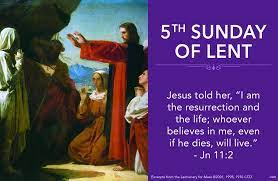
We are now at the 5th Sunday of lent as we look towards Palm Sunday and Holy Week. And, as the drama intensifies in the tension between Jesus and the Pharisees, so too, our personal struggle to overcome the weak spots in our spiritual armor should also “heat up.” There’s so little time remaining before our well-deserved Easter joy! As usual time has just flown in it seems to me that it has been no time since we celebrated the feast of Christmas  and  that was three months ago!!  Time waits for no one is certainly a saying that is so true. I hope that Lent hasn’t served to mire us in guilt and shortcomings. Instead  the Sundays of Lent give us the opportunity to look at where we have been, where we are and where we need to go  as we listen to the Word of God. The prophet Ezekiel tells us God intends to “open your graves and have you rise from them.” And again, as John puts it:  Jesus is “the resurrection and the life.” And we see this especially in the Gospel which is a pointer to the resurrection of Jesus on Easter Sunday. It seems a bit strange to have this gospel on the Fifth Sunday of Lent . It seems to be clearly about the resurrection and yet we are still plodding through Lent and have to get through Good Friday before we get to Easter and the joy that is there waiting for us.  Beneath the layers of theology in today’s Gospel reading, John tells us that Jesus had some very good friends.  Some people followed Jesus for what he could do for them.  But Martha, Mary and Lazarus seem to be  the type of people that would “sit around the table with a glass of good wine and share the daily life” kind of friends. The kind of friends whose faces “light up” with  arms open wide when you meet them. The kind of friends who will witness your execution and stay with you when others run away. They are the friends you are one in spirit and mind with.  This sort of friendship brings life and joy, to individuals and to communities.

It seems to be another good image of Church – Jesus surrounded by people who love him and each other, working together to bring life to others. Martha and Mary both say the same thing when they meet Jesus, “Lord, if you had been here my brother would not have died.” When Jesus tells Martha, “Your brother will rise,” she professes faith that he will rise, “in the resurrection on the last day,” Then she professes her faith in Christ as “the Son of God, the one who is coming into the world.” But neither Martha nor Mary express faith that Jesus will resuscitate their dead brother. In fact, when Jesus orders the stone removed Martha says, “Lord, by now there he will smell, he has been dead for four days.” Do you notice that Jesus doesn’t work some miracle to remove the stone from Lazarus’ tomb? He asks others to do it for him. When that barrier is removed, Jesus calls Lazarus forth to life. The gripping drama of the rising of Lazarus points towards Jesus as the Lord of Life and prepares us for the celebration of our sharing in His Life at Easter. this Gospel is also a call and a command for all of us  to stop and consider if we are in a tomb, the tomb of a faithless life and if so, it asks us to hear the voice of the Lord calling us to shore up our courage and to come out of the tomb. The Gospel calls us to walk to the Lord and then to walk with the Lord as he shows us the way. As we go forward on our Good Friday journey to Calvary, we should not fear the power of evil that so clearly fuels the plotting of the Pharisees. All evil in this world will have a short life. We need fear only our own weakness and vulnerability, our own false selves. From the deadness of our sinfulness and fears, we need to open our ears and our hearts to hear Jesus calling us to come into a new life. How loving and compassionate is our God in the person of Jesus! He wept over Lazarus, wept over Jerusalem, he weeps over those killed through terrorism and war, through famine and disease, and-weeps when we fail to forgive one another.

In these days of continued wars, terrorism, and ethnic hatreds, may we reflect on the truth that Jesus had to give his own life that we might have life and have it to the full. Lent may be winding down, but there is still time for us to receive the sacrament of penance.  There is still time left for our Lenten Spiritual Spring cleaning. There is still time for us to be at peace with ourselves and with our Lord.  May we appreciate more each day that we are privileged to share with Jesus in his continual work of bringing the world from darkness to light, from hatred to forgiveness, and from death to life. We ask God today for the courage to walk away from that which is killing us and to walk towards the Light. We ask the Lord for the courage to walk towards the voice that is saying, Lazarus, Come out which in turn is asking us to come away from all that entombs us to  the everlasting love of God. 

4th Sunday of Lent +


This Sunday has a particular place among the Sundays of Lent. In Advent we had Gaudete Sunday, so in Lent we have a Sunday commonly called Laetare Sunday. The word laetare comes from the Latin and it means rejoice; this Sunday is a day of joy. Even the vestments may be different as the celebrant has the option to wear rose vestments instead of the purple of lent. Our gospel for this weekend  is  about the blind man, in this story we have another example of God’s choice, one which confuses the religious leaders of the day. John’s beautifully crafted story tells how a blind man comes to see the light in Jesus, both physically and spiritually. When Jesus’ disciples first see the blind man they presume that his affliction is a result of sin. But Jesus sees in the blind man something else: this roadside beggar who has always inhabited a world of darkness will be the one to display the work of God and point to who Jesus really is. If we are to really see clearly, we need to let Jesus heal us of our blindness  and open our eyes as He did the man born blind in this weekend’s Gospel.  This is a challenging gospel story for all of us even today because so many people are spiritually blind.

It is possible that the places and things we think we are seeing clearly are not as clear as they should be.  Remember that the ones, who were 100% sure they knew what was going on, the Pharisees, were blind to God. They were religious experts, like many other experts they missed the truth staring them in the face. The one who is turning their world upside down was the Son of God who was trying to open their eyes. There are many things that raise questions and upset our routines these may be the very places God is trying to open our eyes and give us the vision to set things right for our lives. The story of the blind man getting his  sight gives us an opportunity to pause and ask ourselves:  How well do I see? Do I see what is really going on in my life? Has the road I have taken made me lose my way?  Are things happening to me that make me trip up and stumble like a person walking and groping around in the dark? We need to ask ourselves: what is blurring our spiritual vision these days? What’s dulling our appreciation of life and gods place within it? As we remember the Blind spots in our own lives we also remember that faith always remains a choice we make that helps us to see with great clarity of vision. When we choose to trust in God and believe in what he reveals to us, we exercise our freedom to believe.  Our minds and wills freely cooperate with God’s grace.

Faith is not and can never be an act coerced by God or others. Faith in God and each other is a journey which takes along many roads and the road we are called to follow during Lent is the road that leads us to Jesus the light of the world at Easter. The question we should ask ourselves is this: will we continue to be blind or will we let our faith in God heal the blindness of our lives and our world so that we may rejoice in the Lord at Easter and there after as we continue our lives of faith.

Post Navigation