Fullerton T

RELIGION LITURGY AND LIFE

Archive for the category “Faith”

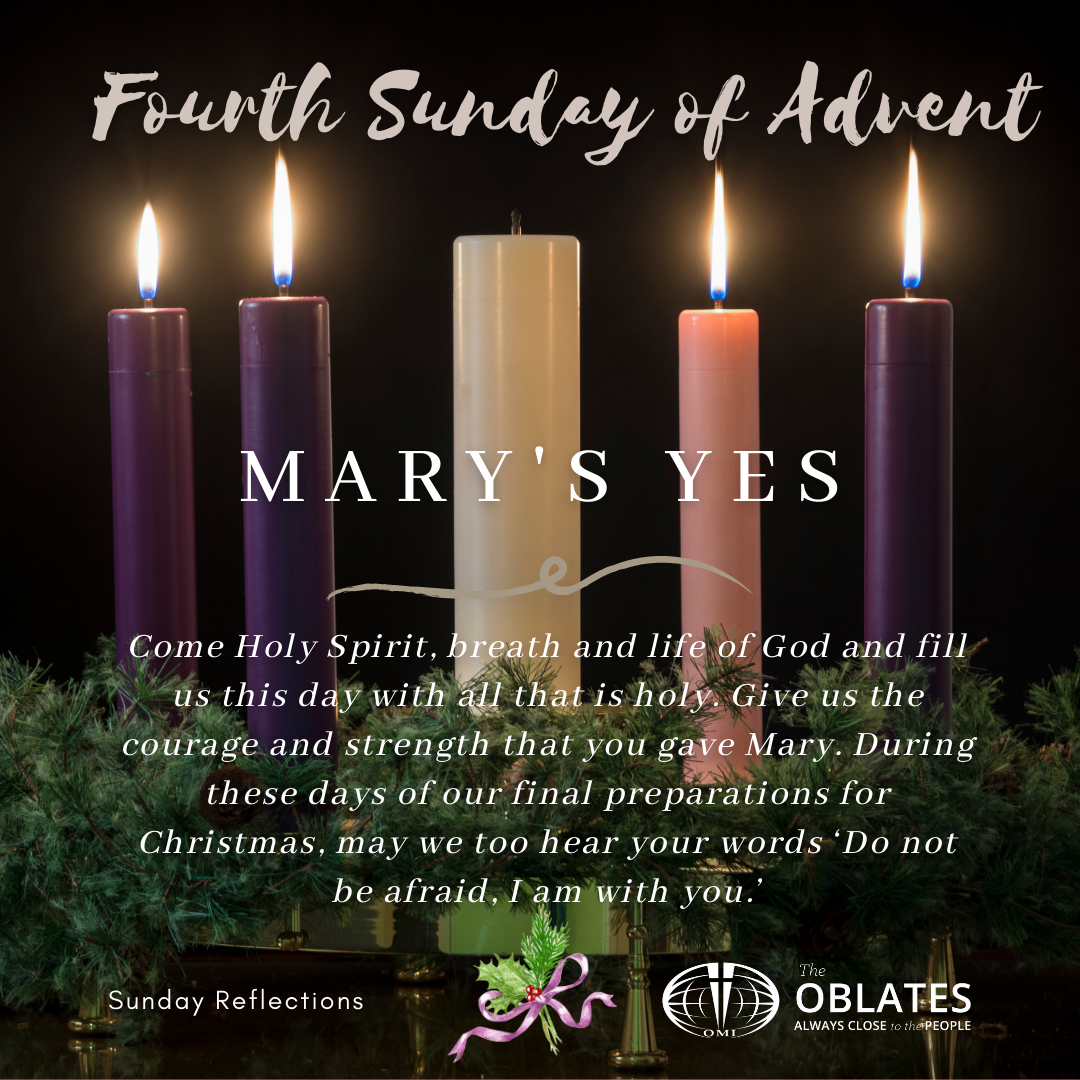
4th Sunday of Advent

Sunday December 20th 2020: Read Br Michael's Gospel Reflection -

The final Sunday of Advent draws us closer to the celebration of the Christmas mysteries. Christmas is almost upon us: yet are we ready in the true sense of the word remembering that Jesus is the reason for the season? Christmas we are told is a time for many things  yet for all of us it is a time of stress and pressure with all the extra things that need to be done and covid adds another dimension in terms of what we should or shouldn’t do.  For many it is a time when we are fearful that the children won’t be disappointed or that there will be tension in relationships or there will be a breakdown in the ceasefire with the in-laws.  And on top of all this there is a feeling of guilt for feeling like this when we should be happier that we are. Now in the midst of the preparations we meet Mary and her cousin Elisabeth in our Gospel reading for this weekend. Mary, who herself had been prepared for the coming of the Messiah.

She has received the angel’s greeting, and his strange news, and has accepted her role in God’s plan. Now she hurries to her kinswoman, Elizabeth, who herself bears John the Baptist in her womb. John, alerts us to the presence of the Lord, as he leaps for joy in his mother’s womb. His joy is that God has kept his promise, and is with his people.  That two women were chosen to play such a role in the story of salvation is remarkable, as women were often marginalized in the society of their time. In all of these events we see the great mission that Mary undertook as a privileged instrument in the hands of God. Mary is not only the mother of the source of grace; she is the very model of what a Christian heart should look like. We look to Mary to see our fullest Christian dig­nity. In Lumen Gentium 68, Vatican II describes our contem­plation of Mary as an act of entering our own deepest mystery, catching a glimpse of what we shall be at the end of our faith journey.

Over the next few days the journey to Christmas will have many pressures for everyone especially those who are worried or afraid about so many things.  Mary in her calm gentle way encourages us to trust in God’s word and to believe in God’s promises as she did. If we believe and have trust in God as Mary did then all the problems that might arise will assume their proper perspective and we will get through them and come out the other side wondering why we got so worried in the first place.

3rd Sunday of Advent

Third Sunday of Advent Facebook Cover and Images - Cycle C - Embedded Faith

This weekend we celebrate Gaudete Sunday which translates as rejoicing Sunday and we light the pink candle on the Advent Wreath also in some places the vestments may be a rose colour.  In the readings for this Sunday both John the Baptist and Paul share one belief: that the Lord is very near. God’s nearness didn’t act as a threat to them, but gave them a infectious  source of joy that no one could take away. Their joy in the closeness of God gave an edge to their preaching and teaching exhorting others  as well as ourselves to prepare the way for of the lord; it also gave them a vision to see the far side of disaster; it moved them to draw others into that sense of joy. None of them was enclosed in his own joy each moved out going round in the hope his inner joy would be caught by the people of their time and place and many people were caught by the joy they had to pass on to them. The picture of John the Baptist as a man of joy is not one you hear about very often. John is usually portrayed as a lonesome figure, with a weird wardrobe and weirder diet remember the hair shirt and the locusts and honey he ate,. But John who rants and raves at anyone with ears  to hear was a character who intrigued people and as a result they would seek him out and follow him. People don’t journey into the wilderness just to get insulted; people don’t become disciples for the wardrobe and diet. Here was a man who cared nothing at all for comfort, money or fame, who could not be bought, and who would speak the truth without fear. In John people could see something of God. John spoke to the people in words they understand when he told them exactly what they should be doing.  

John made such a deep impression that word goes around that he might be the Christ. Again, that expectant feeling is a measure of John’s effect on people around him. John did not  claim to know who the Messiah was going to be instead he tells the people that he is not that person. That role is for someone else, someone greater and more powerful than he was. And as we know that person was Jesus the Son of the Father. We are called to be joyful witnesses to Jesus but as we know with all that is going on around us these days that is not easy especially with the ongoing COVID pandemic and all it has brought to us. There many things in the way’s of the World that continue to block the presence of the Lord from us. Once again we are reminded that It’s time for us to prepare the way for the Lord so that we will be able to welcome him into our lives our hearts and our homes when he comes at Christmas.  

As we celebrate our rejoicing and light the pink candle this weekend are we prepared to open our hearts and minds to the fact that the Lord is near and pass on the joy of St. Paul and John the Baptist on to the people around us by the way we live our lives

2nd Sunday of Advent

2nd Sunday Advent 2020 – Darwen Catholic Parishes

This Sunday we light the second purple candle on the Advent Wreath and we hear the gospel story of John the Baptist the voice in the wilderness. John was called to be the herald of the Lord calling the people of his time to  repentance John the Baptist plays a prominent role in all the gospels, but particularly in Luke. John hears the word in the desert then he tells the people throughout the whole Jordan region to prepare the way for the Lord make straight his paths. The Jordan was important place in the faith life of the Jewish believers. After their desert wanderings the people crossed over the Jordan river into the promised land. They left behind slavery, came to know God in the desert and were finally prepared by God to cross into new life. All the readings share a marvellous insight: people begin to change when they are encouraged to see the best in themselves, not when they are asked to dwell with the worst in themselves.Blessed John Henry Newman reminds us that “Advent is a time of waiting; it is a time of joy because the coming of Christ is not only a gift of grace and salvation but it is also a time of commitment because it motivates us to live the present as a time of responsibility and vigilance. We all need help and encouragement to leave behind all the things that have become destructive in our lives. We need help in thinking about ourselves differently, and imagining the good effect that will have on others. We have to take time during advent to reflect what kind of person God wants us to be, what God’s plan is for us as we prepare the way for the Lord. We need to have faith in the future, to see the power of God working in the change that Jesus brings to us and through us to others. In this Gospel passages John calls all of us to a better faith filled life. This  means the necessity, of an industrious, living ‘wait’ as we prepare the way for the Lord pruning away all that hinders us from making him welcome when he comes at Christmas .

As we continue our  advent  journey we need to stop and  ask ourselves what are we waiting for. Are we waiting for the razzmatazz and presents that the secular part of Christmas bring or are  we preparing for the greatest gift from God to us that is  his Son, Jesus the light in the darkness who John the Baptist foretold when he said prepare the way for the lord make straight his paths.

First Sunday of Advent

First Sunday In Advent

Here we are at the beginning of another Church year, as we continue to live with COVID 19 the last 2 years have been some going as we hope to see better days in the year ahead. we pray in a special way for the African Nations who are affected by the current COVID variant . This weekend we have a change of colour and a change mood we go from the green of Ordinary time to the Purple which symbolizes the penitential season of Advent. We also light the first purple candle on the advent wreath and place the symbols on the Jesse tree. Advent is the season that brings us back to the ancient longing of the human race for the coming of one who would bring  liberation from sadness and the fulfillment of perfect peace to this world. The word Advent derives from the Latin word meaning coming. The Lord is coming may the heavens rejoice and earth be glad.

During Advent we recall the history of God’s people and reflect on how the prophecies and promises of the Old Testament were fulfilled.  At the beginning of each church year we are reminded that Jesus the Christ is present as a person to us.   The prophet Jeremiah foretold the day when God would send his Messiah King  to “execute justice and righteousness in the land” (Jeremiah 33:15). Jesus is the fulfillment of this promise and every promise which God has made. In these short verses in the Gospel, Jesus described the beginning of God’s final initiative. He would give signs of warning across the sky, cause anxiety on earth with violent sea storms, and shake up the heavens. Today we would explain this scientifically as eclipses, meteor showers, and the result of storm systems. The ancient people attributed to God’s intervention in the order of the cosmos.

God would shake things up and so he does today as we look at Pope Francis and the way he challenges us as individuals and as members of the Church.  People of Jesus time would grow anxious because their faith systems and rituals failed.  But, Christians were to rejoice. Their Savior was close at hand! Now, their world view and lifestyle would be vindicated. Luke presents this time as a time of hope filled anticipation. Through great power and glory, the Son of Man would come and free his followers. Unlike the anxious people of the world, the Christian people were to anticipate the end in hope. During Advent, we are invited to prepare our hearts for the coming of the Lord – to wait in joyful hope as we prepare for the annual celebration of his birth. So now let us go forth in peace and hope to prepare over these next few weeks to meet the Lord at Christmas.

33rd Sunday of Ordinary Time

This Sunday as we head towards  the end of the Liturgical Year we listen to Jesus’s words concerning the end times. The vision of the future in the Gospel Reading for this weekend doesn’t look very appealing. The bad news is delivered first of all. Jesus imagines a time of terror and trouble and persecution. People will be betrayed and handed over to the authorities. There will be wars and earthquakes and famines. Jesus says, “These things must happen.” Then there will be cosmic upheavals: “the sun will be darkened, the moon will lose its brightness, the stars will come falling from heaven”. After this catalogue of disaster there is the good news. Jesus looks beyond the time of distress to the final time, when the Son of Man will gather the scattered people of God to himself. Jesus sees beyond suffering and persecution to a future of peace with the father in heaven.  God does not call us to be anxious, but he calls us to confidence in the message we hear in the gospel and proclaim in our lives that we remain in his light. Christ remains our high priest who has offered himself for the forgiveness of our sins. God knows what it is to be human.

The apocalyptic prophecies of the Hebrew and Christian Scriptures are a cautionary tale even for us today. Even though the forces of wickedness take control, God is still the Lord of the Universe and all that is in it. These narratives are meant to provide us with hope to stay the course, to hold fast to the faith that resides in our hearts and souls. That faith is the foundation of our charity and provides our spirits with the energy that is hope. It may sound like a fluffy non relevant thing to speak of faith residing in our hearts. The experience of the Jews, in this period a couple of hundred years before Jesus, is an inspiration. Our hearts pretty much dictate our actions. It is the movement of our hearts that provides the energy to take on overwhelming odds and preserves us through all the struggles. It is the overwhelming power of what resides in the heart that provides us with wisdom, understanding, counsel, fortitude, knowledge, piety, and fear of the Lord. If our hearts are right, then our lives are based on the Truth that is God’s creative love. If our hearts are empty of that love, we tend to get overwhelmed by threatening despair and hopelessness. The Lord calls us to stay awake amidst the distractions of life, so that we will recognize him when he comes again. St. John of the Cross wrote, “When evening comes, you will be examined in love” (Sayings, 60).

We prepare for the day of Christ’s coming by recognizing him in our brothers and sisters and by knowing him through  his word and sacraments. False securities and shallow guarantees will not sustain us in times of testing. God alone must be our hope as he has been for many people over the time of the COVID19 Pandemic and so many other troubled times. God’s ways must be our ways, so that when our securities and misplaced confidences fail us we can turn our eyes to God’s saving light and he will show us the way.

32nd Sunday in Ordinary Time

This weekend at the beginning of the month of November we remember the Souls of all our families and friends who have died. Throughout November we think of all those who have gone before us in faith and we pray that we will meet them again in heaven when we get there.

The scribes in This Sundays Gospel need more than a defence counsel, for Jesus is putting his case for the prosecution and the scribes do not have much of a defence. The scribes were expert lawyers, who interpreted and applied the written Law through a complicated system of traditions. Jesus makes a series of charges against the scribes and what they are actually doing.  He criticises their habit of wearing distinctive clothes, which marks them as different from others. He criticises their habit of taking the places of honour at religious and civil functions. He criticises their habit of long-winded prayers, that are for  their immediate audience to hear  and not directed  to God. Finally, he denounces their practice of exploiting the widows by living off their savings.  

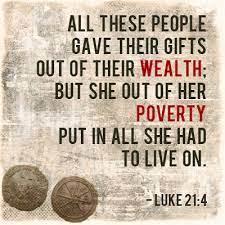
The gospel story goes on to tell us about the poor widow who went along to the treasury and how she puts in two of the smallest coins in circulation. In the arithmetic of the kingdom the widow’s offering is worth more than all the other contributions put together. The others who have given money give from their surplus, the widow gives everything she has. That is the key point in this reading she gave everything she had the widow’s action follows immediately on Jesus  critique of the scribes who profit from their status within their communities . The Gospel story about the widows contribution to the treasury is a good lesson in having a proper perspective of oneself and what you are doing or not doing. Her humility is praised, as an honest thanks giving to God for all she has and all she is. This should encourage us to try and stretch our resources rather than seeing the giving as an obligation or an after thought, certainly giving from the heart rather than for show is a good and noble thing. And that is really what we should be about giving from the heart recognising that we need to be like the widow of the gospel who gave everything she had. So many people in positions of power can easily fall into the pretence of high office. When that occurs, they are no longer open to hearing and seeing the needs of their people.  

Jesus hopes that his own disciples will take their cue from the example the widow gave  and not from the scribes who were hungry for all the status and honour that they could get. Jesus hope for us is  that we, his followers, will also take the example of the widow and be equally generous with our own resources. We are called to give our time, our talent, our understanding. We are asked to give not just from the abundance of all we have but to give from our hearts. Like the widow, we might feel that we have nothing much to give; but it’s that kind of giving that counts with Jesus. May we not be afraid to be like the widow in the Gospel who gave all she had.

MISSION SUNDAY 2021

Homilies and Occasional Thoughts: World Mission Sunday: Rediscovering our  Identity!

This Weekend we celebrate the missionary effort of the Church throughout the world. All of us know someone who as a priest, nun or lay person have gone to bring the message of Jesus to the far ends of the earth and we pray for all of them.  Our Gospel reading is all about Blindness or should I say spiritual blindness as all of us can be blind to the call that god gives us. In our Gospel story Christ walks along the streets of the ancient city of Jericho. With his disciples and a great crowd following him, our Lord is leaving the city and Bartimaeus the blind beggar calls out to him: “Jesus, Son of David, have pity on me.” Bartimaeus, though blind, could see. His instincts were sharper than a new razor blade. The divinity of Jesus had come across to him in waves. But those  around and about him, who enjoyed good vision, were blind to the Son of Man and what he was. Helen Keller who was blind and deaf said, “The most beautiful things in the world can’t be seen or even touched. They must be felt with the heart.” It is possible for good people to spend their days searching but never finding their spiritual hearts.

Spiritual blindness often prevents people from perceiving the way a follower of Jesus should live. We are not compelled to accept the mission of God to transform the world after the pattern that Jesus gave us and many people have chosen to go out to bring the message of Jesus to the world. We must not listen to  the loud voices that would silence us and many of those voices are deaf  to the Spiritual voice of the heart of faith. The gift we seek is the ability to capture the vision of a new creation brought about by a faith filled community of people both those around us and those who by their lives have shown us the road to take. The disciples, on the road with Jesus, must have thought of themselves as part of the “in crowd,” the way James and John did when they asked Jesus to give them seats of power in his kingdom  in last Sundays Gospel. While they were physically close to Jesus, they were a long way from understanding and taking his message on board. The blind beggar, with nothing but a cloak, was exactly the kind of person Jesus noticed and invited to come close while those with Jesus still didn’t get it  and as a result they were not his true followers on “the way.” God wants us to say in the silence of our hearts, “Lord that I may see.”

 Jesus wants our prayer like that of Bartimaeus to come from a sincere heart that asks not only for the gift of sight so that we can see the world around us, but also for the gift of seeing – of seeing the truth, or the lack of it in the depths of our being, and then taking the action necessary to reverse our blindness. Bartimaeus saw Christ with the eyes of faith and  a faith filled heart. So we must look and see Jesus with eyes of faith so that we may be able to see more clearly what we have to do as people of faith to lead others to Jesus and what he teaches this mission Sunday as we go forward together into the future.

28th Sunday of Ordinary Time

28TH SUNDAY IN ORDINARY TIME YEAR B (David Nkong Fomanka's blog)

This Sunday we hear the Gospel story of the Rich man and Jesus invitation for him to give everything to the poor and  follow him.  Besides being a very interesting story, this Sunday’s Gospel gives rich spiritual advice for us. To put it simply, God is worth more than anything else in our lives. Jesus looks on the rich man with love; he wants this blameless enthusiast to become one of his disciples. So the challenge is made: “There is one thing you lack. Go and sell everything you own and give the money to the poor, and you will have treasure in heaven; then come, follow me.” The cost of Christian discipleship is heavy for this prospective disciple as there has been a heavy cost for many throughout the history of the Church. The man in the gospel must renounce the security and the prestige that wealth brings him; when he sells everything he owns, he must not give the money to his family or friends, but to the poor. If he does this he will have treasure in heaven. That treasure will be his new security. The sorrowful departure of the would-be disciple that Jesus loved is one of the most touching scenes in the Gospel. He is too attached to what he has to become what Jesus asks him to be.

 When he goes, and we hear no more of him, Jesus turns round to tell his disciples how hard it is for those who have riches to enter the kingdom of God.   For us today Jesus asks the same question do you want to follow me and many have done that but for others the call has been accepted but it was just too hard to follow the path of Jesus and they have left the faith behind. All of us have many riches that have been given to us by God Family, faith, friends are just a few example of gods goodness to all of us would we leave everything to follow Jesus that is another question. Instead I think that we are called to follow Jesus in our world were we are by trying to be faithful to what Jesus teaches us as we pass his message on to others by the things we do and say that is a hard thing to do in the world especially when people put their own slant on the message of Jesus using it for the own not always good ends.  This Gospel text is reassuring but challenging. Sacrifice for the sake of the Kingdom is an essential requirement of those who wish to truly follow Christ. The Christian follows a difficult path in life but it is the  journey of life with a destination. And the destination is nothing other than the Kingdom of Heaven so let us take up the challenge to follow Jesus as we go forward.

27th Sunday in Ordinary Time

MARRIAGE IN GOD'S ORIGINAL PLAN. HOMILY FOR THE 27TH SUNDAY IN ORDINARY TIME  (YEAR B) Rev. Fr. Boniface Nkem Anusiem Ph.D.. | Fr Bonnie's Reflections

Our readings for this weekend  set the ideal of God’s purpose and plan for creation and marriage.  In the Catholic Church, marriage is a sacrament. A sacrament is the presence of God, the most powerful presence of the Lord possible in this world. In the sacrament of Baptism, God is present giving the Life of the Trinity to the baptized. In Penance God is present through his Son giving his forgiveness to the penitent. In the Eucharist, the Son is present nourishing the communicant and uniting him in an intimate way to the Divine Presence as Jesus is offered to the Father for us. In the sacrament of marriage, Jesus is present uniting the love of the husband and wife. Marriage, according to Genesis, was always meant to be a joining of man and woman in one flesh, in one heart, and in one spirit. It all begins with caring about the other. It all begins with a sense of respect and dignity for the other. It all begins with each contributing to the Then follows a walking together, side-by-side, holding hands and confronting whatever would seek to divide. The effect of all of this  is a growth in love. In that growth of love there comes to each an understanding of the magnificence of God’s love for us.

 Marriage is a sacrament, a making present the Son of God who sends us God’s Spirit. That Spirit unites us, makes us whole. Contentions and disagreements become not a divider but a pathway to greater union. There are many people who are in various forms of civil partnership and I am not going to knock them for not following what marriage is all about in the sacramental sense. The people involved in Civil  partnerships  have made a commitment to their partners and we need to show respect for the commitment that is there while being true to why we think so much of the Catholic idea of marriage and what it stands for.  The “rit of divorce” in the Gospel Reading for this Sunday was there to protect the woman from being discarded arbitrarily without any possibility of survival in a society where she could not work or support herself.  How does our society and our Church actually treat and those who find themselves as unable to keep the “happily ever after” scenario?  Togetherness for life certainly remains the ideal both for Jesus and his followers.  But our Church community has to face the reality  that many marriages break down, and some of the victims of a broken marriage feel a deep longing for a new life partner and a new start.

 But this raises an acute question for the Church community: Can there be only point-blank black and white refusals there is much debate around all of this as there has always been as this is not the black and white issue many people would like it to be. I have been blessed in seeing so many people getting married and many others celebrating the 25th 50th and even the 60th anniversaries of their marriage commitments. But many people will tell you that their married lives were not always a bed of roses. Married life, like any human endeavour, requires effort, work, and discipline. The exchange of vows is  only the beginning of a life together it is not the high point. The term “partner” should be taken literally as true marriage means that the 2 people work together in partnership. Whenever marriage is celebrated and respected, there is peace, joy, and Love. So today we pray for a proper understanding of what marriage means in the catholic sense as we acknowledge the goodness that are there in other forms of partnerships that are more normal these days than in the past.

26th Sunday in Ordinary Time

Opening the Word - FORMED

Few of us go through life without joining some kind of group or club. Joining a particular group, religious, political or social, can enlarge our world and introduce us to new people and new possibilities. It can help us to move within a relatively secure network of relationships. That sense of belonging is important to our identity: membership is proof of how others accept and recognise how we see ourselves. Rejection is a clear signal of disapproval and this is what this Sundays Gospel reading is all about rejection. The man in the Gospel who was healing in Jesus name is put before us as the example of someone who was rejected because he was not one of the apostles. The disciples consider Jesus their own personal treasure and they want keep him for themselves.

The Apostles seemed to have been an ambitious group last Sunday we heard them arguing over who was the greatest among them.  This Sunday they complain that they saw someone who was not part of their group performing a healing in Jesus’ name. If there had been laws  concerning  copyright at the time I think the Apostles would have copyrighted Jesus name and the power that went along with it. I can just imagine them licensing the use of Jesus’s name and then asking “How many times do you want to use Jesus’s name that will cost so much. How many times do you want to cure someone in his name that will be so much more”. They felt they were privy to Jesus that is to say he was the apostles and no one else’s, it’s as if Jesus was a rock star and they are his agents, with exclusive rights over what he does and says. What they really wanted was a tidy little religious box, clearly in their control but they hadn’t factored in Jesus and what he had been sent into the world to do and the fact that they were not in control God the Father was.

They forgot how compassionate he was, remember Jesus compassion for others never ran out and wasn’t limited to a few people or those who had the proper disposition to receive it.  There was plenty for everyone in terms of Love and Compassion  then as there is now. Jesus is the visible face of the God that we can’t see and yet we believe; we believe in the God who wants to speak words of love and joy to everyone, not just a few; who wants to reach out and touch all those broken in mind body or spirit, not just those who carry the right credentials. After they see Jesus crushed on the cross and later, when he rises from the dead, the apostles finally get the message and understand what had happened to them as a result of their involvement with Jesus. Then they would do exactly what we are doing right now, retelling the stories about Jesus as they set out to continue to write the story without restrictions or limits of any kind. When they went out to continue the story they would have been speaking and acting in Jesus’ name, not just to a select few, but for everyone they met, or came to them in any need. In Jesus’ name they opened the eyes of the blind, cured the cripples, and gave the people a sense of something special, the great love that God has for them. At first they got it wrong, but when they learned what it meant to speak and act in Jesus’ name they knew that everything was possible for them and that meant they were able to share the message of Jesus with the people of the world.  In our world today we often forget that faith is not about the chosen few but faith is for everyone who accepts it as a gift from God freely given and accepted as such. We need to understand  that we don’t always get it right and remember that everything is possible to those who have faith in Jesus Christ the Son of God and the message he proclaims and that is the  message of the compassionate love of God the father for all people regardless of who they are or where they are in the world.

We are called to take up the challenge to be messengers of Jesus in our daily lives sharing the compassionate love of god with those we meet wherever we are.

Post Navigation