Fullerton T

RELIGION LITURGY AND LIFE

Archive for the category “Faith”

14Th Sunday in Ordinary Time

The 14th Sunday in Ordinary Time invites us to reflect on themes of peace, joy, and discipleship. The readings remind us of God’s blessings, our call to share the Gospel, and the hope we find in Christ and his message. The readings also highlight God’s gift of peace. Jesus tells His disciples to bring peace wherever they go, showing that peace is central to Christian life. This is so necessary for all of us in our very troubled world where so many countries and people are at war with each other. In the First Reading  from Issiah we hear about the joy and comfort that the Lord will bring to his people, using metaphors of a nursing mother, a comforting mother, and a flowing river. The Lord promises to extend peace to his people like a river, and his people will rejoice and be glad, with their hearts flourishing like grass.

In the Second Reading  from Galatians we are told that The cross of Christ is important as the means of salvation and new life for believers. Paul declares that he will boast only in the cross of Christ, which has made him a new creation, and he encourages the Galatians to avoid the false teachers instead urging them to embrace the new creation in Christ. This Sunday’s Gospel tells us about Jesus appointing the 72 others and then sending them out in pairs to the towns he was going to visit. As he gives his missionary instruction Jesus is under no illusion about the territory compared to the wolves roaming around, his own crowds are like lambs. He tells the 72 to lead the radical lifestyle of the wandering preacher who must face homelessness and renunciation of family and property. When they enter a house they should bless it with peace. The Gospel also tells us about the practical things to direct the seventy-two as they proclaim the Good News of the Kingdom. Jesus told them to carry no purse, no haversack, and no sandals. Proclaiming the Good News of the Kingdom and rebuilding community life are two sides of the same coin. One does not exist and cannot make sense without the other there is a clear urgency about the task in hand with urgency in his voice Jesus says, “Start off now”. On their return the disciples were delighted that their mission has actually worked!  

Their joy demonstrates that the people welcome the word of God and that the word of God is their real resource for mission. There will be a time of crisis with the wolves roaming around and currently we seem to be  living in a time of crisis with so many things that are wrong in the world.  Jesus speaks to us to reassure us and tells us to hold on to all that is good. The Gospel, of course, is not about an historical 72 people being sent out. It is about the mission of every disciple of Jesus. Spreading the message of the Gospel is always done by winning over hearts and minds through the example what we say and do. The fullness of life is the message and the mission of Jesus  who empowers us in our time and place to work in his name to build up the kingdom.  Real rejoicing is not to be had in the conversion of great numbers of people, but in knowing that we  have done the will of God. Our mission where we are today  is to proclaim to others the hope that is in the good news of salvation so that the world will believe May our hearts be open to his words! May our hearts direct our minds! And may our minds direct our hands in the work of the Lord as we go forward in faith and hope.

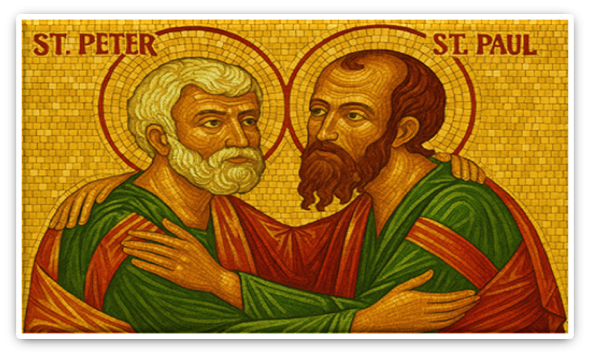
Saints Peter and Paul

This Sunday June 29 is the feast day of Saints Peter and Paul. These were the two men that  God used to spread the gospel and lead the early Church despite terrible persecution. In the Gospels Peter stands our as apostle who most frequently took  the initiative when they were with Jesus. The Acts of the Apostles portray him as the undisputed leader of the early Church, undergoing enormous hardships and fearlessly facing persecution for the sake of Christ. He was a man of action. He spent his last years in Rome, where tradition tells us he was martyred during the persecution of Nero, in 64 0r 65 AD. St Paul who was well versed in rabbinical learning, at first persecuted the Christians, he has a vision of Christ on the road to Damascus which changed his life. After three years in solitary retirement in the dessert of Arabia , he plunged into a life of intense missionary activity, Tradition says that the was martyred in Rome around the year 67.

The Jews of Jesus’ time were not a free people. They lived under harsh Roman occupation. Yet they held fast to the belief that God would send a king to liberate them a Messiah who would overthrow their oppressors and bring justice and peace to the world. They had waited a long time, trusting in God’s promise. But no one knew exactly who the Messiah would be, what he would be like, or when he would come. Many expected a warrior-king who would lead a revolt against the Romans. Others hoped for a religious reformer who would purify the Temple and restore true worship. Some even claimed to be the Messiah, but the Romans quickly eliminated them, and their followers scattered. In the First Reading  from the acts of the apostles  we are told that Herod imprisoned Peter to appease the Jews. With the Church praying fervently for Peter, an angel appeared, shining light into his cell. Unchained, Peter followed the angel past guards, through self-opening gates, to freedom. In the Second Reading we hear that Paul, seeing his end was near, tells us  I’ve run the race, I have kept the faith. A crown of righteousness awaits me. The Lord gave me strength, protection, and he will guide me to His heavenly Kingdom.

In the reading from Matthews gospel  Jesus asks His disciples about the people’s opinions regarding His identity. Simon Peter declares that Jesus is the Christ, the Son of the living God. Jesus acknowledges Peter’s revelation, affirming that upon him, whom He calls Peter, to be the rock that he will build His Church on, and the powers of death will not overcome it. Jesus entrusts Peter with the keys of the Kingdom, granting him authority to bind and loose matters on earth and in heaven. Jesus then asks the disciples, “But, who do you say I am?” It is Peter who adds to the title ‘Son of Man’ by recognising Jesus as ‘the Christ, the Son of the living God’. Jesus names Peter as a happy man. This same Peter whose faith faltered when he was buffeted by the wind and waves of change now shows his openness to God and recognises Jesus for who he is. But this is not the end of Peter’s story. There are ups and downs in his response, as we see that in Matthew 16:21-23 when this ‘rock’ of faith becomes a ‘stumbling block’ to God’s purpose.  In spite of that, Jesus names Peter as the ‘rock’ on which he will build the church. Throughout the centuries Peter is our Holy Father the Pope , Peter the fisherman was the first pope and pope Leo is his successor as the living embodiment of Peter the  rock of faith who is called to build up the church in 2025.

Peter and Paul so different in background and temperament each met Jesus and responded in faith to what they heard and saw. Both Peter and Paul show us how to be courageous in sharing our faith. They faced prison, hardship, and death because they loved Jesus and wanted others to know Him. Their courage encourages us to think about how we live our faith. Do we share it with others? Do we trust God when things get hard?  Peter’s job at the beginning of the church is the same  as it  is today for Pope Leo that is to use the ‘keys of the kingdom’ to unlock the reign of God’s grace and send it out into the world. Are we prepared to be his coworkers where we are right now ? This Holy Year is all about hope often times we feel hopeless and helpless when we see all that is going on in the world around us. Our Prayer and support for one another and our faith leaders is always important.  Our hope filled prayer is that we will be courageous like Peter and Paul as we live and share our faith as they did at the beginning of the Church.

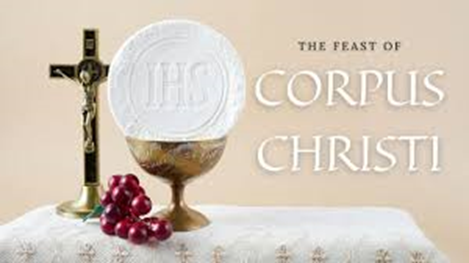
Corpus Christi

As  we gather for the feast of Corpus Christi we remember all those places at war this weekend sadly we add Iran to the list of countries at war. With all that is going on it would be very easy to loose hope or at least be a lot less hopeful that things will improve but I am reminded of the saying that hope springs eternal. Even though things seem to be hopeless for so many we have to continue our prayer for peace and not loose our hope.  Our prayer for peace as well as praying for the leaders of the nations to have the wisdom to do the right thing are indispensable and we have to keep on praying  especially in the current world situation.  

In the First Reading  Melchizedek, king of Salem and priest of God, brought bread and wine and blessed Abram. Abram gave Melchizedek a tenth of everything. In the Second Reading Jesus instituted the Eucharist at the Last Supper, saying the bread is his body and the cup is the new covenant in his blood, to be done in remembrance of him. In the gospel we hear the story of the feeding of the five thousand. The reading and the feast itself are filled  with the richness of faith. Jesus fills us with nourishing food both spiritual and physical. Then we are sent out to proclaim the good news of God’s kingdom to all around us, in doing this we provide spiritual food for others through the Word of God and the Eucharist. The Eucharist  is the sacrament of thanksgiving. When we see the Eucharistic Bread, we believe that it is Jesus who is there before us in the real presence such is our faith in the Blessed Sacrament. The Church tells us that the Eucharist is “the source and summit of the Christian life.” (CCC 1324)  

At the Eucharist God sees our hunger and feeds us through Word and Sacrament. Remember, the crowd in our gospel story was first taught, healed and then fed. Their hungers were both spiritual and physical . Now it is our turn, as well-nourished disciples, to find ways to address the physical and spiritual needs of the people we have noticed along the way who may be hungry. These needs can seem overwhelming. But, as with the bread and fish in the gospel story we take what the Lord has given us and give it freely to others. He will do the rest and all will be satisfied. The eucharistic meal is also a promise: one day we will sit at the banquet feast where there will be no more hunger,  no more illness and our satisfaction in God will be complete.  Corpus Christi is the solemn commemoration of the institution of the Eucharist on the first Holy Thursday in the upper room.  It is the Church’s act of homage and thanksgiving to Christ, who by instituting the Holy Eucharist gave us the members of the Church the body of Christ our greatest treasure.

The  feast of Corpus Christi celebrates the enduring sign of Christ’s presence with us personally in the Bread and Wine. It also celebrates Christ’s presence with us in the community of faith where we are. The Eucharist is our sacrament of communion, not only with Christ and God, but also with all those called into the Christian faith. Our communion binds us to one another in a sacred union of mind and heart with Jesus the Son of God our hope in an often times hopeless world.

TRINITY SUNDAY

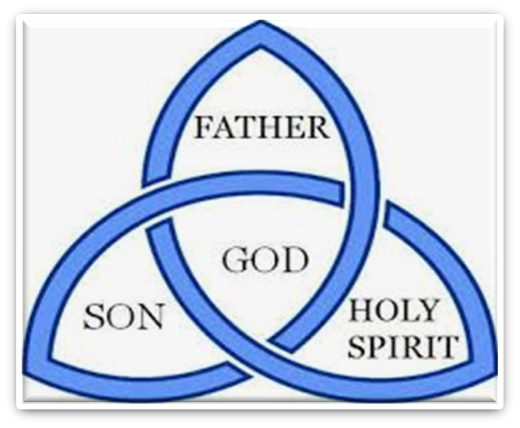
One week after the end of the Easter season on the feast of Pentecost we celebrate the feast of the Most Holy Trinity. The reality of the Holy Trinity is, of course a mystery. But mysteries can be talked about. Mysteries have clues that our minds can grasp. But a mystery remains a mystery unless and until we look at it in its totality. However when it comes to God we simply cannot comprehend the total reality of God, Father, Son and Holy Spirit. Mysteries of one sort or another make up a good portion of our lives. Science has its mysteries, as does philosophy, as does psychology, as do other intellectual disciplines. They all have much within them to challenge our minds and our intellectual capacities. All of them contain unknown things that move us to seek out the answers within the mystery.

The Feast of the Trinity is unique in that the focus of our celebration is not an aspect of the history of salvation, but reflection on the nature of God as it has been revealed to us as Christians. This weekend  we celebrate and reflect on our relationship with God and what our Creator and Redeemer has done for us. The scriptures remind us of our God’s graciousness and we rejoice in the God who has acted so mightily and lovingly on our behalf.  The feast of Holy Trinity goes back to 12th century England and St Thomas a Becket, Archbishop of Canterbury. Historians say the great Thomas celebrated a Liturgy in honor of the Trinity in his cathedral. In the 14th century, the feast came to be observed by the universal Church. The first reading this Sunday is from the book of proverbs. Its description of the creation of the world is evidence of Wisdom. God’s wisdom declares it was created first, before the earth and oceans. Present during creation, it rejoiced beside God, delighting in the formation of the world and mankind. This writer sees creation as well put together in a functional manner only a Creator with great wisdom could have done such an intricate, complex, complicated job that creation was. In the second reading from Romans we are told that we are Justified by faith, we are at peace with God through Jesus, and rejoice in hope. Our sufferings produce endurance, character and hope that is  filled with God’s love through the Holy Spirit.

The gospel presents Jesus speaking to the disciples. He spent three years teaching them, demonstrating how to grow in love with one another in their small but ever-expanding community.  The reading  also speaks of the power of presence and the power of the name. Ancient people placed great weight in presence; the way someone dressed and acted spoke of social power. Ancient people also chose names carefully; they believed a person’s name defined their strength of character. Both outward presence and inward character are part of the disciples’ experience. When the followers of Jesus  saw the resurrected Lord and heard his command to go out to  the whole world, they saw for themselves the Trinity in action. The feast of the Holy Trinity invites us to contemplate the mystery of the trinity God the Father Son and Holy Spirit 3 divine persons united as one.  In faith hope and gratitude, let us pray with greater faith and reverence  when we say “In the name of the Father, and of the Son, and of the Holy Spirit.

PENTECOST SUNDAY

Ascension

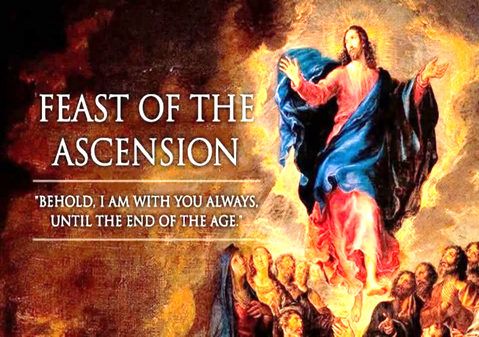
This weekend we celebrate the ascension. In this feast we celebrate Christ ascending into heaven and then taking his seat at the right hand of the Father. Our lives are made up of so many different times and places of leave-taking and that is what Ascension is really about Jesus leaving the Apostles to return to the Father. Jesus has called the ragged, group of disciples, scattered after his crucifixion, back to himself to form them, fragile and doubtful as they were, into a community for mission to go out into the world  in the name of God.

The Apostles must have felt awful as  Jesus  was leaving them even though he told them that I am with you yes to the end of time.  In the First Reading  Jesus instructed the apostles to wait for the Holy Spirit the paraclete and then ascended to heaven to the right hand of the father. In the Second Reading : we are told that Christ entered heaven to appear before God for us, sacrificing himself once to remove sin. We are called to  trust and approach God with sincere hearts, holding firmly to the hope that is within us. This Gospel reading is all about the past the present and the future. Jesus has little to say, but he is definite about what he has to say when he speaks. The disciples did what he told them to do. He asked them to meet him on the mountain, and they did that. Like any gathering of people, their feelings were varied. Some of them worshipped him, while some of them still doubted.

Jesus didn’t seem to have any great problem with that, because he knew that, when the Spirit came, all of those doubts would be ended. The redemption and salvation off the world was to begin at Pentecost and continue through the generations, until the end of time. It would seem, that he was in a hurry to take his leave of them, so that his plan for  our salvation could get underway. The mission of the apostles was simple to understand; difficult to carry out. It was to teach others all that Jesus had taught them. Just as he asked his disciples to follow him, they were to ask that others should follow him as well which was so hard then and especially hard in the world of today. Over the years so many things have changed in the Church and society. However two things that have not changed are the person of Jesus himself and his message as they are ever old and always new.

At  Easter and in  the weeks since we have been remembering the great events that have brought salvation to the world as we proclaim that Jesus is alive and  with us where we are in 2025. The feasts of the Ascension and Pentecost help us to realize that we are part of a long tradition of faithful faith filled disciples. All of us have our faults and failings, but our call is to be faithful witnesses to Jesus and what he teaches us. As a result of the actions we take and the things we say the people around us will know that we are followers of Jesus who are called to be the hope filled presence of God in the world today.

6th Sunday of Easter

This weekend we celebrate the 6th Sunday of Easter and soon we will celebrate Ascension and Pentecost Sunday. At the council of Jerusalem Paul and Barnabas receive endorsement of their policy of admitting Greeks and other pagans to the Church without requiring them to observe the law of Moses. Paul sees clearly that Christs coming means freedom for us. We are no longer bound by restrictions and laws if we observe the commandment of Jesus to love, Love God and others. The love of Christ will be the light illuminating our whole lives.  

In the First Reading from Acts the Apostles decided not to burden Gentile believers with the Jewish law and what it required from them instead they asked them to avoid certain things.  In the Second Reading  from the book of Revelation we are told that the angel showed John Jerusalem, shining with the glory of god. It had twelve gates and foundations named after the tribes of Israel.  In the Gospel we continue to read the Farewell Discourse as Jesus makes a number of promises to the disciples. Throughout John’s Gospel Jesus speaks about his boundless affection for the Father and the disciples. Another favourite theme of John is that, just as the Father and Jesus abide together in love, they will also come to abide in the heart of the disciple. Jesus does not speak these words in the sense of foretelling the future, but rather to prepare the disciples for their daily ‘remembering’ of, and making his words and actions present, in their own lives. Jesus promises to send the Holy Spirit to the apostles as the advocate.  

Although Jesus had spoken to the Apostles and told them many different things, he knew them well and realized that they wouldn’t remember everything he said Jesus also knew that they would have to endure many struggles, difference and disagreement.  The Apostles would not see eye to eye on everything; they would have different memories of Jesus; they would emphasise different things. In the conflicts that would arise they would have to put their faith to work.  That is why he told them that the Advocate, the Holy Spirit, whom the Father will send in his name, will teach you everything and remind you of all I have said to you. These words are a direct pointer towards Pentecost and the gifts that the Holy Spirit would bring to them as well as us.  We don’t have the physical presence of Jesus with us the way his first disciples did when he talked with them around the table at the Last Supper, washed their feet, and gave them his reassuring promises. His farewell to them was a real farewell he was going, he would no longer be with them. But he assured them and us that he is present in a different way, through his gift of the Holy Spirit.

Jesus also promised the Apostles Peace  ‘A peace that the world cannot give.’ Sometimes we mistake this peace for our idea of quietness or tranquility, but the peace the Jesus gives is a peace that can be found even in the midst of turmoil. This peace is not something we can manufacture ourselves by our own power. It’s a gift that comes from Jesus, who doesn’t want to lose touch with us. Jesus chose his followers to carry out God’s plan of salvation. He chooses us today to do the same, he gives us a personal stake in the Kingdom of God.  We remember the great gift that the Holy spirit is it is the breath of God that unites us. If we keep on trusting in the presence of the Spirit of God in our lives we will have peace in the midst of any personal, family, or community turmoil that comes our way as well as someone who will keep us going along the right Road !

5th Sunday of Easter

This weekend we pray for Pope Leo as he begins his ministry as our Holy Father with mass on Sunday morning to inaugurate his ministry as the successor of Peter. We pray the Holy Spirit will guide him in his leadership of the Church as our shepherd and Father in faith. We also stop and say a prayer for all those who are doing exams over the next few weeks. Our world puts great store on education and often forgets the pressure that this puts on our young people especially at exam time. We pray that they may be inspired to do their best and know that there are people out there family, friends, teachers and lecturers who value them no matter how good or bad  the exam results might be.

On this fifth Sunday of Easter, the scripture readings continue to describe the growth of discipleship and the conditions for the Kingdom of God. Membership in the Kingdom comes about by becoming members of the Church. The term church comes from the Hebrew word Qahal. It comes from a verb meaning called together. So, the Church is a group of people who gather together in faith, hope and Joy. In the First Reading from the acts of the apostles we hear that Paul and Barnabas revisited cities, encouraging disciples and explaining hardships they would endure for the  kingdom of God. They appointed church leaders, entrusted them to the Lord, and shared their mission success in Antioch, emphasizing God’s outreach to non-Jews. In the Second Reading John describes a new heaven and earth, with the old gone. He sees a splendid New Jerusalem and hears God proclaim His eternal dwelling with people, erasing all pain and making everything new. In this Sundays Gospel Jesus calls us to a new way of living when he tells us to love one another as I have loved you.  At one level this is a simple call to love, at another it is a big challenge for us with all that we see going on in our world. This means that we should love as Jesus loves, in order show the face and heart of Christ to a war torn hurting world.

 The love Jesus speaks of seems to be narrow and restrictive. He is addressing his disciples when he says, “love one another.” This love may seem insular and applicable just to an inner circle of his followers. But this is not the case as Jesus wants us to be united with him and one another in love today right where we are. Jesus’ command to love one another is central to Christian life. He taught this lesson at a time when He knew He would be betrayed. Instead of focusing on His own troubles, Jesus emphasized the importance of loving others as he loved them. This teaches us that love should be the foundation of our relationships, even when life gets difficult. Helping and supporting one another in our faith and life journeys means being there for each other through both good and bad times. It means offering a listening ear, a helping hand, and a kind word. By doing this we follow Jesus’ example and build a community rooted in love and care. By loving and supporting one another, we live out the true essence of our faith and strengthen the bonds of faith within our communities. We are called as pilgrims of hope to build and  become that community of love showing the love of God to those around us especially during this Holy Year and at all other times as well.

4th Sunday of Easter

This weekend we pray  a prayer of thanksgiving to God for our new Holy Father Pope Leo 14th.   We pray that he will be a good shepherd for us as we follow Jesus united as one family of God with the Holy Father our bishops, priests, deacons, religious and the people of God throughout the world.  The fourth Sunday of Easter is also known as Good Shepherd Sunday it is the day when we pray for vocations to the priesthood and religious life. In the time of Jesus, a shepherd usually had responsibility for about fifteen or twenty sheep whom he accompanied day and night. Both shepherd and sheep got to know each other. The shepherd was responsible for keeping the flock together and safe, for leading it to good pasture, for binding up wounds. The sheep depended on the shepherd for life.

We Christians believe that Christ is our shepherd, leading us to the fullness of life.  We may find this language of ‘sheep’ and ‘shepherds’ strange, but beneath the imagery is our belief that God is a gentle, caring and just shepherd of the flock.   In the First Reading  from the Acts of the Apostles Paul and Barnabas preached to Jews and Gentiles, then facing jealousy and persecution they  continued to spread the good news that word of the Lord is. They left Antioch, filled with joy and the Holy Spirit because of what happened there. In the Second Reading  from Revelation we hear that John saw a great crowd from all nations worshiping before God’s throne. They are protected and led by the Lamb, who wiped away every tear from their eyes. In the Gospel Jesus tells us My sheep hear my voice; “I know them, and they follow me. Our challenge today is to tune in to the voice of Christ asking us to know, love and follow Him. In our world of instant communications we listen to the voices of so many others.  But do we listen to the voice of Christ, who speaks to us through Prayer, Scripture, the Sacraments, nature, and other people?   The image of the shepherd cannot be separated from the way that the shepherd actually cares for his own sheep. Jesus the good shepherd challenges us not to leave the lost sheep behind: Jesus said “I have come to seek out and save the lost so that all may be saved.”   

All of us know people who have wandered away from the Church, who have lost their sense of belonging, who feel they have no faith community to belong to. How will they know they are welcome back if no one tells them? How will they be helped back if no one offers to make the journey with them?  The good shepherd asks us to make the journey with them as people who have listened to his voice calling us to follow him. Jesus the Good Shepherd is for all of us  and we should listen to his voice amidst the trials of our daily lives. Many of the voices we listen to in so many places in the world claim to speak for the good of everyone, but they lead us astray and disappoint us but our Faith and Hope in Jesus does not disappoint. Pope Francis once said, “that with Jesus life becomes richer and that with him it is easier to find meaning in everything. The Gospel of the Good shepherd is a  hope filled call for  us to follow Jesus the loving shepherd who seeks out the lost sheep and rejoices when they are found .

CONCLAVE 2025

Tomorrow morning in St Peters Rome the Mass for the election of the new pope will take place at 10am local time during that mass we pray that the Holy spirit will inspire the Cardinal Electors to elect the pope. Later in the day  the Conclave to elect a successor to Pope Francis will begin at 5pm when the Cardinals will process from the Pauline Chapel into the Sistine Chapel. There they will take the oath to maintain the secrecy of the conclave under pain of excommunication. Then everyone else who is not an elector will leave when the master of ceremonies declares extra omnes which means all those who are not allowed to remain must leave. Then a Cardinal will give a reflection on what they are about begin and the first ballot will take place. Many people have said they want a more Conservative or a more Liberal pope but it doesn’t work that way as people want what they think is good for everyone else.

The way it works is that all of us should pray that the Holy Spirit will inspire the Cardinals to elect  the Pope who will be a source of unity and a bridge builder within the Church.

O God, eternal shepherd,

who govern your flock with unfailing care,

grant in your boundless fatherly love

a pastor for your Church

who will please you by his holiness

and to us show watchful care.

Through our Lord Jesus Christ, your Son,

who lives and reigns with you in the unity of the Holy Spirit,

one God, for ever and ever.

Post Navigation