Fullerton T

RELIGION LITURGY AND LIFE

Archive for the category “Faith”

Saints Peter and Paul
images (59)


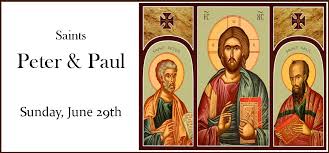
This Sunday we celebrate the feast of two of the greatest saints of the Catholic world, Saints Peter and Paul. Simon Peter, the fisherman, strong and sturdy of build with thick curly hair (as we know from an early medallion), was outgoing, generous, and impetuous. Paul, the intellectual, was thin-faced and balding, with deep-set piercing eyes.

The question Jesus puts to Peter in our Gospel reading is one he asks each us of today who do you say I am, who do we say Jesus is? At various times in our lives our response will differ, depending on the circumstances that confront us. During our broken times we might need Jesus to be our healer. When we must stand up for our faith against the actions or views of others we want Jesus to be the strong one for us. When our prayer feels dry and our perseverance in faith threatened as often times they will, Jesus must be “living water” in our desert. When we must be constant for a troubled member of our family Jesus, “the living bread,” must be our nourishment. Thankfully Jesus isn’t just a plaster statue, Jesus is the concrete sign and reminder to us of our “living God.”

Jesus is with us when we are broken and weak, he is with us when we stand up for our faith and he is with us when our prayer life seems dry he is the water in the desert of our daily lives. He is also the constant who is with us and our families in good times and in bad.  What brings us together this Sunday and every Sunday isn’t what binds other individuals into a community. It isn’t our common ancestry, race, language, nationality or economic sameness though these may well be important. The common thread drawing us is our shared faith in God and one another. With Peter we profess Jesus as “the Christ, the Son of the living God.” We may express that in different languages and varied cultural expressions but, in one way or another, we proclaim the same thing: Jesus is our Lord, the Son of the living God.
Today’s episode is a key turning point in Matthews gospel. Jesus praises Peter’s response as one of a true disciple who understands Jesus’ uniqueness and importance. Was Matthew trying to show how insightful Peter was? No, because while Jesus affirms Peter’s response, he also names how Peter came to it. It was a gift of God.  We celebrate Peter and Paul, our great heroes of faith. But we remember that is not how they started out. Through these very limited humans God has done a great thing. Once they expressed their faith, God could begin building the church of those who witness in Jesus’ name. Like Peter and Paul all of us are required to witness to Christ and some may even have to give their lives in his name. Jesus is at work in the church, building us up, healing our wounds, helping us resist the forces of sin and death. Jesus assures us that  the church, built on the faith Peter will prevail against all the evil the world can throw against it and here we are over 2,000 years later expressing the faith that Peter expressed all those years ago when he said ‘You are the Christ the Son of the living God.’


Corpus Christi


79AA94E9


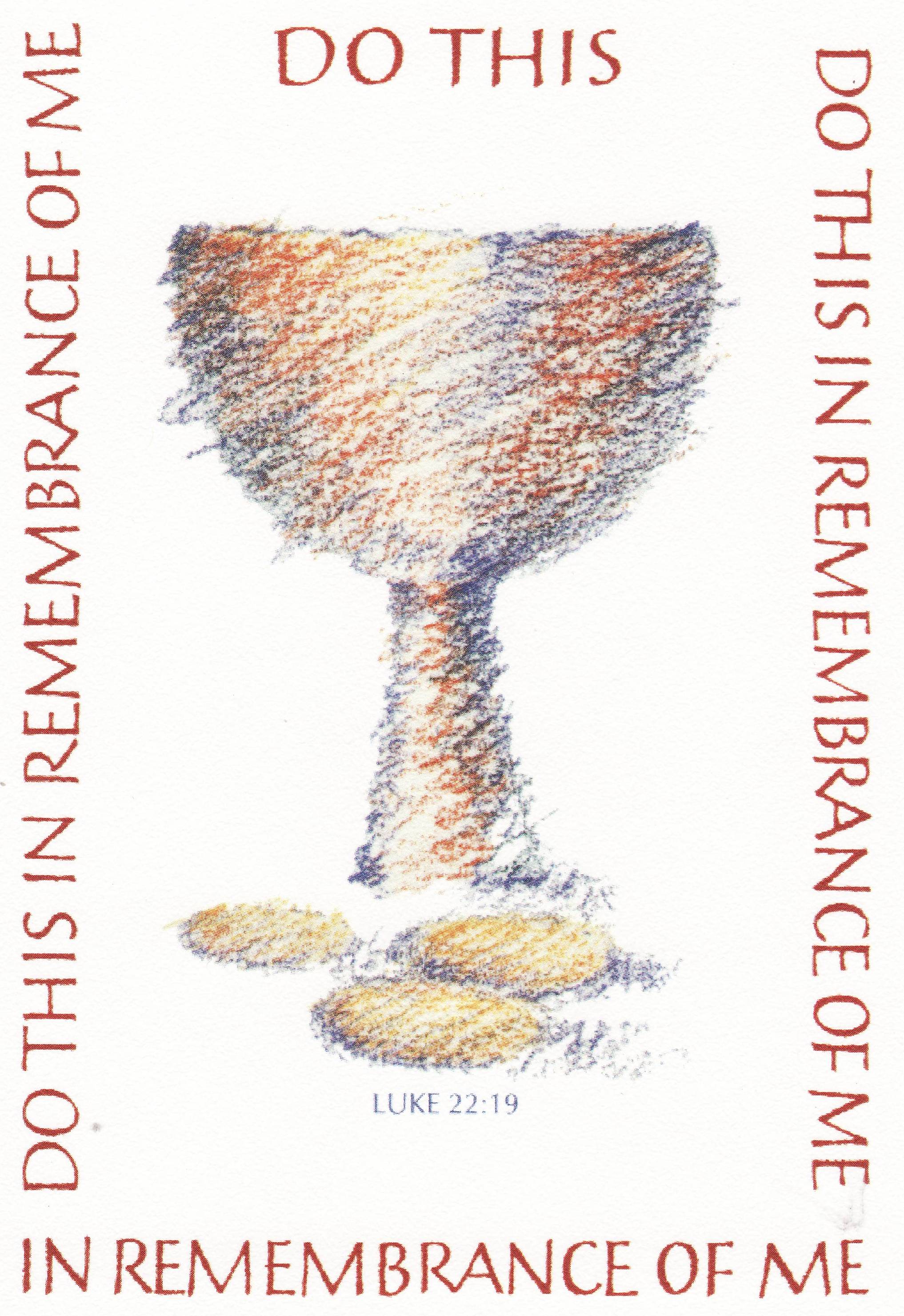
This Sunday we celebrate the feast of the Body and Blood of Christ also known as Corpus Christi.In many places throughout the world the Feast of Corpus Christi would have been celebrated last Thursday but we in Ireland and many other places in the world  celebrate this feast on the weekend after Trinity Sunday.  When we see the Eucharistic Bread, we believe that it is Jesus who is there before us:  such is our faith in the Eucharist.  We are thus in the presence of the Resurrected One, He who has conquered death and who is now in Heaven, in the Glory of the Father!  The Church teaches that the Eucharist is “the source and summit of the Christian life.” (CCC 1324) This means that, because Christ is really, truly and substantially present in the Eucharist, we recognize that all the graces we enjoy as Catholic Christians come from this great Sacrament, and all we aspire to, the fullness of the life of God, is contained in this Sacrament.

Gathered at the Eucharist we bring ourselves and our prayers to God. We each have our own needs. People we know may be sick. we know people who need work but cant find it. The person who has been in our lives for so long has died.We bring these prayers for our needs and the needs of others to church because they raise our hopes in the power and love of God. We have those hopes because God is with us and continues to be with us in good and bad times through the sacramental life of the Church and through the Eucharist in particular.

Our relationship with God has produced fruitfulness, satisfied our longings, and brings us peace of mind and spirit. Because of God’s faithfulness, we give thanks, offer sacrifice, and once again present our needs. Sadly, in our modern world we are witnessing the institutionalization of moral decay. The legalization of abortion and same-sex marriage have dire consequences for the family, the core component of any society. In order to survive with faith intact and to live the truths of faith, Christian men and women today must fight against the idolatries of career, money, materialism, in short, “having it all.” Of all the things we “have” do we place first that which alone will last? So many people have chased after fame, only to have it elude their grasp. Others have given all in search of wealth only to find they had purchased many things but were dissatisfied without the “pearl of great price”. Some have burned themselves out pursuing pleasure divorced from authentic love and then fallen into the dark despair that emptiness and loneliness bring.And some have triumphed over the world by giving body and soul for the one thing necessary: the Lord Jesus Christ.

Today we celebrate the greatest gift our Lord has left us: His Body and Blood in the Eucharist or in Latin, “Corpus Christi” By following in our Lord’s footsteps, Christians over the centuries have sacrificed greatly, in a labor of love, for their faith, their Christian way of life and their families. Then as now, it begins with each individual humbly asking God to show the way and to provide the strength needed to follow in His footsteps. This strength comes from the Eucharist the Bread of Life which is the body of Christ.


TRINITY SUNDAY 2014


This weekend we celebrate Trinity Sunday which is all about the triune god Father, son and Holy Spirit. When my Father was alive he  often had a small tin of oil which was called three in one oil and it reminded me what the trinity was about  that is three divine persons in one. The Father is equal to the Son and the Son is equal to the Spirit three in one and one in three we hear this in the breastplate of St. Patrick. The 4th century St Patrick, with a brilliance that we Irish are justly celebrate found in the three leaf shamrock rising from the one stem an image of the Trinity..


The feast of the Trinity goes back to 12th century England and St Thomas a Becket, Archbishop of Canterbury. Historians say the great Thomas celebrated a Liturgy in honor of the Trinity in his cathedral. So was born the observance. In the 14th century, the feast came to be observed by the universal Church.  The belief in the Trinity goes back to the New Testament. There it is mentioned about forty times.
We open each Liturgy especially the Mass invoking the Trinity . We close Mass and so many other liturgies by calling upon those same Persons (Father Son and Spirit)  in blessing us as we go out into the world. Throughout the Christian world infants will be received into our faith communities  through Baptism in the name of the Trinity

Trinity Sunday is the day when we stand back from the extraordinary sequence of events that we’ve been celebrating for the previous five months—Advent, Christmas, Lent, Holy Week, Easter, Ascension and  Pentecost  it is the day when we  are asked to rub the sleep from our eyes and discover what the word ‘god’ might actually mean. 

How do we understand the Trinity? We don’t! God, by definition, is ineffable, beyond conceptualization, beyond imagination, beyond language. The Christian belief that God is a trinity helps underscore how rich the mystery of God is and how our experience of God is always richer than our concepts and language about God.

The doctrine of the Trinity affirms God as loving and knowing, giving and receiving. We profess that God could not be God without the “other” (the Son) and the eternal bond of their relationship (the Spirit).

 
While some may think that the doctrine of the Trinity is negotiable, it is actually central to our faith. If we lose it, we lose all we are. Moses’ personal God, “merciful and gracious, slow to anger, rich in kindness and fidelity,” emerges in St. Paul as the interpersonal Trinity that models true human relationship. Thus Paul prays: “The grace of the Lord Jesus Christ, the love of God and the fellowship of the Spirit be with you all.” When the Church celebrates the Feast of the Most Holy Trinity, it is an attempt to summarize the whole mystery of our God into one day. This is not just a “theological feast” ` but a feast which should speak to us of this simple fact of faith: the Father loves us, has revealed that love in his Son, and has called into a relationship sustained by the Spirit. It is our joy that, as baptized members of the Church, we can somehow share in that divine life and love which is the Trinity – becoming children of God. God has chosen us, and we are his own people, just as he chose the people of Israel long ago.

Each Trinity Sunday, we only scratch the surface of this great mystery of our faith. In gratitude and faith, let us begin and end every prayer with greater faith and reverence “In the name of the Father, and of the Son, and of the Holy Spirit. Amen.”


Pentecost Sunday

images (57)


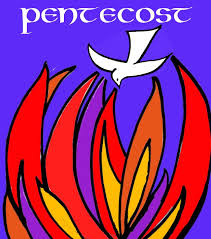
This weekend we finish the season of Easter with the celebration of Pentecost that is the birthday of the Church. This Sunday’s celebration is about the coming of the Holy Spirit the Advocate to the Church at its beginning.Our readings from scripture call to mind a universal need for a rekindling of the gifts of the Holy Spirit as well as a renewal of peace.  St. Paul in today’s reading explains: “There are different kinds of spiritual gifts but the same Spirit; there are different workings but the same God who produces all of them in everyone.

In the Gospel, Jesus, knowing that human nature is still weak, gives the apostles the power to forgive and reconcile those who sin. It is God’s mercy working through His bishops and priests down through the ages to ourselves in our own time and place! Our Holy Father, Pope Francis has, just returned from Palestine and Israel and on Sunday he will host the leaders of Israel and Palestine in a time  of prayer at the Vatican.  He has shown immense courage in outreach for peace and new unity between the Roman Church and the Orthodox who split from the Church of Rome nearly a thousand years ago. We can’t ignore problems  that arise in our lives and, most of the time, they just don’t go away by themselves very often we need to stop and think things through. That said praying through the problems seems to be the most reasonable solution to getting through them as many people will tell you prayer helps a great deal in any situation.  

As we reflect on the Word of God  this Sunday, let us ask for the specific gifts of the Spirit that will be helpful to us at whatever point in our journey we find ourselves.  Let us rejoice when we receive an abundance of gifts and graces.  May the peace of the Lord reign in our hearts!  Come, Holy Spirit!

Ascension Sunday June 1st 2014

A51CD69D


In some dioceses this feast was celebrated on Thursday of last week but in most places we celebrate the Ascension on the ` 6th Sunday of Easter. The words of the Gospel for this weekend strike me ‘go therefore make disciples of all the nations and know that I am with you yes to the end of time. This Gospel reading is all about the future it is also about ourselves in the here and now of today, and what we are doing to make disciples of all the nations in 2014. Simply put where do we fit in when we hear Jesus telling us to make disciples of the nations and do we recognize him as being with us now in June 2014. In today’s gospel, Jesus has little to say, but he is definite about what he has to say. This is in sharp contrast to the fact that, even at this last minute, some of his disciples still doubted. The disciples did what he told them to do. He asked them to meet him on the mountain, and they did that. Like any gathering of people, their feelings were varied. Some of them worshipped him, while some of them still doubted. Jesus didn’t seem to have any great problem with that, because he knew that, when the Spirit came, all of those doubts would be ended. It would seem, indeed, that he was in a hurry to take his leave of them, so that the second part of his plan of salvation could get underway.

The mission of the apostles was simple to understand; difficult to carry out. It was to teach others all that Jesus had taught them. Just as he asked his disciples to obey him, they were to ask that others should obey his directions and instructions also which is so hard in the world of today. The programme of redemption and salvation must continue from generation to generation, until the end of time. With all the changes in the church and in society, the two things that have not changed are Jesus himself, and every word of his message. The Message and the Messenger have never, and never will change. Again we ask ourselves what we are doing to make disciples of all the nations realizing that Jesus and his message is always new for each generation may we be heralds of joy of the Ascension as we place the message of Jesus before others by the way we live our lives in the Joy of the Gospel. 

5TH SUNDAY OF EASTER

imagess


In today’s world where news is reported instantly as a glimpse of the culture, being held accountable seems to be one of the most uncomfortable situations to find yourself in.  It is one to which people often respond with defensiveness rather than genuine self-evaluation.  Most people, it seems to me, just do not like being wrong or admitting having done something in error and I include myself in that. Unfortunately, we often stick to our own perspective and then voice strong denial even when evidence shows us (and everyone else) that the truth is something completely different to what we thought.  Politics is often an unpleasant testimony to that smugness and that arises when we think that our point of view is always right even when it’s wrong. On the other hand, sometimes we seem to know the truth “way down deep in the heart of our being” even though the current evidence does not bear it out and we act on that positive conviction that comes from the heart.  

We must also remember that the search for truth is not a search for you and me to become more important than the next person and certainly not more important than God:  only God is all powerful.  How do we genuinely and unwaveringly search for Truth and stay humble and accountable along the way?  How do we follow the voice of Jesus, the Good Shepherd,  and not the voices of the strangers or even our own selfish one, the “thieves and robbers” of whom Jesus speaks in our Gospel reading for this Sunday?

The Gospel reading for this Sunday is a story about Jesus and the disciples. He is helping them get ready for his suffering and death. For the apostles this was a huge reversal from the adulation of the entrance into Jerusalem on Palm Sunday to the despair of the Cross on Good Friday. Remember when he asked them whether they would leave him, along with the rest of the crowd? Now it is he who is leaving. They are stunned. Peter’s reply at that time might have been appropriate now. “Where will we go? You have the words of eternal life” (Jn 6:67-8) Jesus helps them. “Do not let your hearts be troubled. You have faith in God, have faith also in me.” The straightforward meaning of this directive is, you know how to trust, you do it with God. Use that same trust with me.

This fifth Sunday of Easter tells us that Jesus speaks to us not at us.  His presence is in the word proclaimed in the Assembly of the people of god gathered together in Church.  His word is proclaimed to us in the readings from scripture as well as in lived example of others in the community where we live.  We come to Church week in week out to hear the Word.  We come to share the joys and sufferings of all the community gathered together.  We receive the Body and the Blood of the anointed one, the Christ, risen from the Tomb.  We hear the word while we work in the world through those around us. We don’t stay in Church all the time as the hard pew might well become the soft bed.  We have duties and obligations to family, work and the communities where we live.  We take the Word and Work of the assembled people of God into that life with all its short comings.  

The Word of God stays with us because through the death and resurrection of Jesus we receive the Spirit of God  Jesus breathed on the disciples. This breath of the Risen One imparted the Spirit to them and to us.  We are released from sin that harms our spirits and blocks our ears. The Word of God is available to us: we should  open our ears and listen.As the Good Shepherd puts it in the gospel, we will no longer be at risk of either being lost or stolen away by thieves and bandits. On the contrary!  He is both our Good Shepherd and the gate that swings open to bring us to green pastures and a magnificent banquet. So, in fact, the light of the Risen Christ, the one whom Peter today calls ‘the shepherd and guardian of your souls’ will be shining on us and on all whom we love.

When we’re confused about decisions we should make, Jesus Himself will show us the Way. When we don’t know what is true and what is false, what is right and what is wrong, the Holy Spirit through the Church and its members will enlighten us. And when we are drawn into false pleasures that promise us life, Jesus will bring us back to real living and the joy of that life through the power of His love. As we walk along the roads of life let us take up the call of Jesus In the gospel to trust in him and he will not let us down.

DIVINE MERCY SUNDAY


HE HAS RISEN


Today we celebrate the Second Sunday of Easter more recently known as Divine Mercy Sunday. We also celebrate the canonization of Pope John the 23rd who was known as the pope of the second Vatican Council who opened the doors and windows of the Vatican to let the light of renewal into the Church and pope John Paul the 2nd who was known as the Pilgrim Pope as he travelled the world proclaiming the Gospel to the nations.

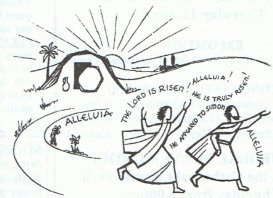
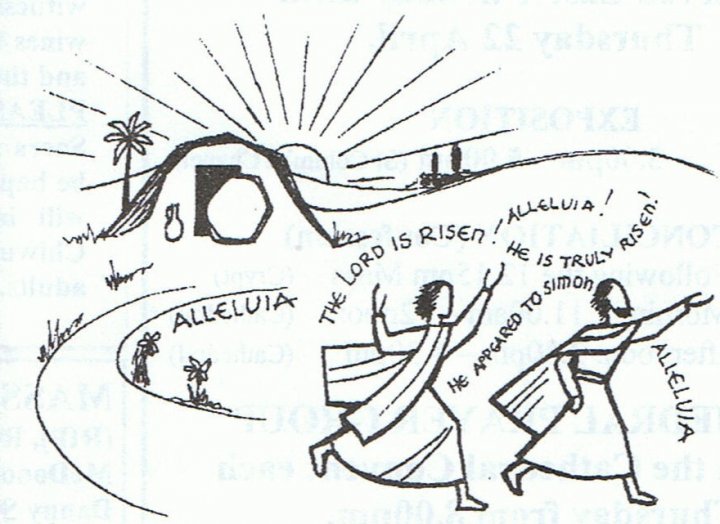
The Easter season has the most exciting Scripture readings of the year. They take us from the empty tomb of Easter Sunday all the way to the coming of the Holy Spirit at Pentecost. On Easter Sunday, the Apostles huddled in fear in the empty room. They weren’t so sure that the women’s report that Jesus had risen was believable. They weren’t singing for joy! Now, a whole week has gone by. They still felt “rocky” about their future.Thomas wasn’t the only one who had doubts about Jesus I think so many were doubtful then as so many are doubtful right here and now. The Apostles were still huddled behind locked doors, pondering the shocking experience of the week before when all seemed to be lost. Jesus had broken through those doors to assure them that He was alive. And His message must have troubled them: “As the Father has sent me, so I send you.” in the same way we  are sent out in the Joy of the Gospel to bring his message to other people wherever we are.
As Pope Francis directs us, we must courageously reach out in the joy of the Gospel to so many doubters among us, and assure them of the great mercy of Jesus, His great love for them. Our world is hurting as So much because of the many evil things that are happening within it. We pray this weekend  through the intercession of the Churches two new saints  John Paul II and Blessed John XXIII that we will be witnesses to the joy of the Gospel as evangelizers and witnesses to the Resurrection to the people of our time and place as Christians in our own communities.


John Paul II and Blessed John XXIII 

EASTER


HE HAS RISEN


The cross is empty now Jesus lies in the tomb and everything around us is still.’ The heavens and the earth cry out with longing for the sinless one who is not to be found, if we stop to think for a moment we remember that Jesus died and rose again on the third day. We wait, as mourners beside a grave, unsettled, ill at ease, almost not knowing what to do with ourselves. The Church has only one thing to do today: to pray through the emptiness of Holy Saturday. Holy Saturday then is the day when we experience watching and waiting at the tomb as we await the celebration of the Resurrection which we celebrate in the Easter Vigil and the season of Easter. The Jewish people have been celebrating Passover annually for thousands of years, commemorating the night in which God brought them out of slavery in Egypt to begin the journey to the promised land.

At the Last Supper, Jesus also celebrated the Passover but gave it a new meaning. No longer a remembrance of passing from slavery to freedom, but through his own passion, death and resurrection we too pass from death to life with him. Until the fourth century, Easter was the only feast of the Church’s year, and to this day it remains the most important. As the Catechism says: “Easter is not simply one feast among others, but the ‘Feast of feasts’, the ‘Solemnity of solemnities’.”

Every Sunday Eucharist echoes the Sunday of the Resurrection and Easter. It can seem that once Easter Sunday has passed Easter is finished, but the’ celebration continues for fifty days. The next Sunday of Easter day  is traditionally known as Low Sunday or Dominica in Albis (White Sunday) which refers to the white baptismal garment of the newly baptised. Divine Mercy Sunday is a new feast also celebrated on this day. This year it has the added significance because on this day Pope John 23rd and Pope John Paul the second will be canonized (made saints). Divine Mercy Sunday comes almost as an opportunity in which anyone who missed out on celebrating the mercy of Christ in Holy Week has another chance. After forty days we celebrate the feast of the Ascension of Christ who returns to the Father to send us the Holy Spirit.

We spend the nine days between the Ascension and Pentecost praying for the Spirit like Mary and the apostles in the Upper Room. On the fiftieth day (which is the literal meaning of the word “Pentecost”) Easter ends. On that day “Christ’s Passover is fulfilled in the outpouring of the Holy Spirit” (CCC 731). Our celebration of Easter resonates throughout the rest of the year: full of gratitude for Christ’s passion, joy in his resurrection and, strengthened by the Spirit, we continue our Christian journey in faith hope and Joy.

Copy of images (48)


PALM SUNDAY

images (46)


Today we begin what I think is the best week in the whole liturgical year. Centuries ago it was called the “Great Week”. Nowadays we call it “Holy Week” and we begin with Palm Sunday. This year we stop to think again about what Holy Week means to us as individual people as a community and we also stop and think about Pope Francis apostolic letter  The Joy of the Gospel and how it impacts the way we celebrate Palm Sunday and Holy Week and how we celebrate our liturgy and our lives in general. In many ways the two main themes of today are happiness and sorrow, and these themes  also come into play on Holy Thursday, Good Friday and Easter Sunday.
On ash Wednesday we placed the ashes on our foreheads as a sign of our humility as we began our Lenten Journey and now six weeks later on Palm Sunday we remember Jesus entrance into Jerusalem on a donkey as the people raised their voices in joyful acclamation as they sang hosanna to the Son of David, Blessed is he who comes in the name of the Lord.  The Passion narrative of Matthew emphasizes the great humility of Jesus, the King.

It’s the only Gospel to tell us in detail of what happened in Jerusalem at the hour Jesus gave up His Spirit — the sanctuary veil torn in two, the earth quaking, rocks split, dead saints rising from their graves and entering Jerusalem. It’s the fulfillment of all the prophecies of thousands of years before.  It also tells us more fully of the betrayal by Judas, the denial of Peter, the hearings before Caiaphas and Pilate — the awful scourging by the Roman soldiers, the thorny crown jammed upon His weary head, the whip cutting slashes into His flesh, the blood running down His shoulders and back, the cursing by the crowd, the nails tearing through His hands, the thud of the cross into the ground. As He hangs on the Cross, He cries, “I thirst!” How that cry echoes down the centuries as a reminder of His search for our love. But what does Palm Sunday really mean to you and me? What does it mean to us as Christians in the year 2014, a big question indeed with no small answers.

Lent Palm, Sunday and Holy week taken as a whole give us  the opportunity to look hard at ourselves and see exactly where we are going and perhaps were we should be going. We have always to remember that Jesus came to take away our sins and to point us in the right direction that is towards our father in heaven and all that is good.  We need to remember that Christ came to serve and give his life as a ransom for many as a result of this  he points us in the right direction.

Christ took our sinful ways on himself because of his love for us  It is important that we who say we are Christians accept the truth about ourselves that truth  may not always be good and then in our acceptance of the truth we will be able to look at the Cross and recognise the love of God our Father in the man on the cross.

Let us remember that  Pope Francis tells us that in his letter that The joy of the gospel fills the hearts and lives of all who encounter Jesus. Those who accept his offer of salvation are set free from sin, sorrow, inner emptiness and loneliness. With Christ joy is constantly born anew…  The great danger in today’s world, pervaded as it is by consumerism, is the desolation and anguish born of a complacent yet covetous heart, the feverish pursuit of frivolous pleasures, and a blunted conscience.

Now is the time to say to Jesus: “Lord, I have let myself be deceived; in a thousand ways I have shunned your love, yet here I am once more, to renew my covenant with you. I need you. Save me once again, Lord, take me once more into your redeeming embrace”. How good it feels to come back to him whenever we are lost!… God never tires of forgiving us; we are the ones who tire of seeking his mercy. Christ, who told us to forgive one another “seventy times seven” (Mt 18,2) has given us his example… Time and time again he bears us on his shoulders (Lk 15,5). No one can strip us of the dignity bestowed upon us by this boundless and unfailing love. With a tenderness which never disappoints, but is always capable of restoring our joy, he makes it possible for us to lift up our heads and to start anew. This week  and indeed throughout the whole of our Lenten Journey that will soon finish we have been given  the opportunity to renew ourselves in heart, mind, body and soul and see where we should be going.May the passion story that we hear on Palm Sunday and again on Good Friday inspire all of us to try to imitate in some small way the all loving all forgiving Jesus who went through betrayal to death and finally to resurrection for us so that we will have life and have it to the full. 

Over the next few days may we prepare with greater intensity for the Easter Triduum Holy Thursday, Good Friday and  Holy Saturday and then we will really be able to enjoy the Easter feast which we have been preparing for since Ash Wednesday.


HW

5th SUNDAY OF LENT

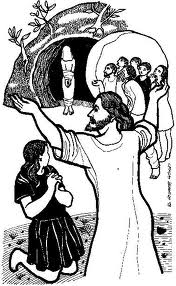
LAZARUS COMES OUT OF THE TOMB

LAZARUS COMES OUT OF THE TOMB


Well here we are at the 5th Sunday of lent as we look towards Palm Sunday and Holy Week. Just a couple of weeks left. And, as the drama intensifies in the tension between Jesus and the Pharisees, so too, our personal struggle to overcome the weak spots in our spiritual armor should also “heat up.” There’s so little time remaining before our well-deserved Easter joy! As usual time has just flown in it seems to me that it has been no time since we celebrated the feast of Christmas  and  that was three months ago!!  Time waits for no one is certainly a saying that is so true. I hope that Lent hasn’t served to mire us in guilt and shortcomings. Instead the Sundays of Lent give us the opportunity to look at where we have been, where we are and where we need to go  as we listen to the Word of God. If we were listening we would have heard what we hear again today through the prophet Ezekiel. God intends to “open your graves and have you rise from them.” And again, as John puts it: Jesus is “the resurrection and the life.” And we see this especially in the Gospel which is a pointer to the resurrection of Jesus on Easter Sunday. It seems a bit strange to have this gospel on the Fifth Sunday of Lent . It seems to be clearly about the resurrection and yet we are still plodding through Lent and have to get through Good Friday before we get to Easter and the joy that is there waiting for us.

Beneath the layers of theology in today’s Gospel reading, John tells us that Jesus had some very good friends.  Some people followed Jesus for what he could do for them. But Martha, Mary and Lazarus seem the type of people that “sit around the table with a glass of good wine and share the day and daily ins and outs of life” kind of friends. The kind of friends whose faces “light up” with arms open wide when you meet them. The kind of friends who will witness your execution and stay with you when others run away. They are the friends you are one in spirit and mind with.

This sort of friendship brings life and joy, to individuals and to communities. It seems to be another good image of Church – Jesus surrounded by people who love him and each other, working together to bring life to others. Martha and Mary both say the same thing when they meet Jesus, “Lord, if you had been here my brother would not have died.” When Jesus tells Martha, “Your brother will rise,” she professes faith that he will rise, “in the resurrection on the last day,” Then she professes her faith in Christ as “the Son of God, the one who is coming into the world.” But neither Martha nor Mary express faith that Jesus will resuscitate their dead brother. In fact, when Jesus orders the stone removed Martha says, “Lord, by now there will be a stench, he has been dead for four days.”

Jesus doesn’t work some miracle to remove the stone from Lazarus’ tomb? He asks others to do it for him. When that barrier is removed, Jesus calls Lazarus forth to life. The gripping drama of the rising of Lazarus points towards Jesus as the Lord of Life and prepares us for the celebration of our  coming out of the tomb and sharing in His Life at Easter. 

But this Gospel is about more than this friendship. It is also a call and a command for all of us  to stop and consider if we are in a tomb, and if so, it asks us to hear the voice of the Lord calling us to shore up our courage and to come out of the tomb. The Gospel calls us to walk to the Lord and then to walk with the Lord as he shows us the way.As we go forward on our journey to Calvary, we should not fear the power of evil that so clearly fuels the plotting of the Pharisees. All evil in this world will have a short life. We need fear only our own weakness and vulnerability, our own false selves. From the deadness of our sinfulness and fears, we need to open our ears and our hearts to hear Jesus calling us to come into a new life.

How loving and compassionate is our God in the person of Jesus! He wept over Lazarus, wept over Jerusalem, he weeps over those killed through terrorism and war, through famine and disease, through murders and rapes- and-weeps when we fail to forgive one another.In these days of continued wars, terrorism, and ethnic hatreds, may we reflect on the truth that Jesus had to give his own life that we might have life and have it to the full.

Lent may be winding down, but there is still time for us to receive the sacrament of penance. There is still time left for our Lenten Spiritual Spring cleaning. There is still time for us to be at peace with ourselves and with our Lord. May we appreciate more each day that we are privileged to share with Jesus as Christians in his continual work of bringing the world from darkness to light, from hatred to forgiveness, and from death to life.We ask God today for the courage to walk away from that which is killing us and to walk towards the Light. We ask the Lord for the courage to walk towards the voice that is saying, Lazarus, Come out which in turn is asking us to come away from all that entombs us to  the everlasting love and mercy of God. 

Post Navigation