Fullerton T

RELIGION LITURGY AND LIFE

Archive for the category “Life”

CHRISTMAS 2016

latest-religious-christmas-cards-hd-images-pictures

As we come to our celebration of Christmas this year the world is such a different place. In the UK referendum the people unexpectedly voted for the Brexit. Then a few short months later the USA voted unexpectedly for President Trump how the world has changed and of course the world is constantly changing. We are all panicking about what might or might not happen in the places where we live and how the world events will impact on us and our families we will have to wait to see how everything turns out. Preparing for Christmas is often a very tense time with extra hours at work, standing for hours on the queues at the shops as the craziness goes on around us. For a great number of  people Christmas is not all it seems as they deal with the stresses of not being able to provide a good time for the members of their families. Or for many they may find themselves refugees in foreign countries.

As we think of our own families we also spare a thought for  the poor, the neglected, the lonely, the victims of disaster and war.  Now after all the preparations and fuss of recent days we have time to think about Christmas and what it is all about, time to ponder on the fact that the birth of the Baby Jesus is the supreme manifestation of God’s love for humanity. Our salvation came in the messiness, poverty, and the weakness of ordinary human life that is to say our ordinary often times messy lives. Jesus was born in a stable not a great palace or mansion he was welcomed by the shepherds this hardly seems like a very auspicious beginning for the dawn of salvation! Yet, we have hope because Jesus was born into the Family of humanity with all its messiness. Christ came and brought new hope and transforming joy for all. In the middle of our own dark nights of pain and anguish, God comes and transforms them into “holy” nights of his peace.

Amid the noise and clamor that that are part of our lives, the voice of God speaks to us in the “silence” of our hearts. The first news of God’s coming to us does not go to the wealthy or those in high political or religious positions but to the  lowly shepherds, who had no wealth, power, or privilege by any standards they were a scruffy bunch. God to whom all riches belong wants to be sure that the poor and lowly are the first to hear about the arrival of the messiah. The shepherds used to being left alone during their long, dark nights in the fields where they watched over their flocks were terrified at the appearance of the angelic mes­senger surrounded by the glory of God.  Who told them Do not be afraid; for behold, I proclaim to you good news of great joy that will be for all the people. For today in the city of David a savior has been born for you, who is Christ the Lord” (Luke 2:10-11).The angel’s message to the shepherds is also for us in the here and now of today It simply states the good news of the birth of the Son of God into our lives. During these days of  celebration we will have occasion to sing as the angels did long ago, “Glory to God in the highest!” At this time when we celebrate the birth of “a saviour who has been born for us”, the One who is “Wonder- Counsellor and Prince of Peace,” the One who is “a great light”  we welcome the opportunity to put aside our cares and worries for a short while in order to bask in the joy of the season, and give Glory to God as we celebrate the birth of Jesus Emanuel who is God with us. Now with Mary and Joseph with the shepherds and Angels Let us take this story and the news of great joy into our hearts and let the joy and peace flourish within us as we pass this joy on. Let us be thankful for the light that is Christ the light of the world.  Let us hold this simple story of Jesus birth in the Manger in our hearts throughout the year whatever ups and downs it may bring.

FOURTH SUNDAY OF ADVENT

DDEA6629

This weekend we come to the last Sunday of the Advent season. In our churches we light the last purple candle as well as the other three leaving the last candle the white one for the first Mass of Christmas Day. It’s only in this last week before Christmas that we begin to hear about the “Christmas story” itself. For the past weeks we have been preparing ourselves to greet the Lord, when he comes. Now we prepare to remember how he first came, by listening to the prophecies of his coming, and by hearing of the events before his birth. At Christmas we will concentrate on the simplicity and poverty of Our Lord’s birth: how human he was, born of a young woman, not in luxurious comfort, but in the discomfort of a stable. That shows him as one of us, the human side of “Emmanuel.” God enters into our world: it’s a world where plans don’t always work out and where people have to adjust to the reality presented to them. Joseph was betrothed to Mary; he had his plans. Mary’s pregnancy turns his world and plans upside down. Instead of exposing her, he “decided to divorce her quietly.”

He was a “righteous man” and he will protect Mary from being publicly dishonored. He is not vengeful and, though wronged, displays mercy. Joseph, “took his wife into his home after the angel appeared to him in a dream. The world God chose to enter was not only one of poverty, hard labor and political and military oppression but, from the beginning, messy – even while the child was still in his mother’s womb. God took a big chance being born among us. Surely there must have been neater options for God, to make the savior’s path and work a bit smoother. But who has a “smooth path” through life anyway not many if anyone has it easy. It’s good to know that Emmanuel, “God with us,” chose to be with us people of the world and living in the messiness of the world. God is with us in our daily lives with all the ups and downs! Christmas with the child in the manger with Mary and Joseph with the angels and the shepherds challenges us to enter into an intimate relationship with God who is Love itself. We are challenged to keep on trusting that we will receive love, and keep on receiving love, from God and others.


THE FEAST OF CHRIST THE KING

download

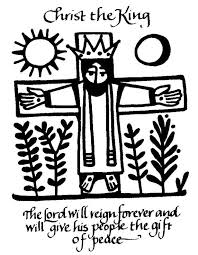
This Sunday we celebrate the last Sunday of the year with the feast of Christ the King. This feast was established by Pope Pius XI in 1925, to remind us that our allegiance was to one who exercised power not by force or might, but by love and service for others. The gospel reading for this Sunday is part of the passion that we read on Palm Sunday the scene opens as Jesus hung on the cross between two condemned criminals. Jesus had uttered his famous words of forgiveness “Father, forgive them, for they know not what they do” and his last possession his clothes had been gambled away by the guards. Jesus had nothing to look forward to but death and the scene ends with one of the thieves asking Jesus to remember him in his kingdom. Jesus reply was the beautiful words “today you will be with me in paradise”. The “good” thief acknowledged he and the other criminal were rightly condemned for their acts by legitimate authority.

But Jesus was unjustly condemned by an authority which had no jurisdiction over him. Later when the disciples interpreted Jesus’ life and ministry they applied Isaiah’s image of the Suffering Servant to him,  the servant who was like a lamb led to slaughter; who bore our infirmities so that we could be healed and raised up. From the cross and through the power given us by the Holy Spirit, we are able to respond to hatred with love; forgive when we have been offended and serve those who cannot return the favour these are just a few of the ways Jesus gives us his power and shows us how to use it for the sake of his Kingdom and the good of all. While this gospel closes the liturgical year, it is not the end of the story. Here we are over 2000 years later thinking about the cross as well as Jesus’ promise of life given to the thief. The kingdom of God is a kingdom where everyone is valued and no one is left out. The cross is evidence that God, in the person of Jesus, really does care about each of us. God cares about both thieves in the gospel not just the one who acknowledged his sin.

God cares so much for us that he wants to share in every part of our lives. He knows our pain, the anguish that comes from living in an imperfect, often hate filled world. He embraces it as a standard, a light that demonstrates his unconditional love for each and every one of us. The kingship of Christ has nothing to do with triumphalism or lording it over other people. Jesus is no victor entering the city at the head of tanks, leading rank upon rank of infantrymen there is no fly-past with jets or other warplanes nor is there a great flotilla of warships or boats. The King we celebrate this weekend is the Son of God who walks the dusty roads of our daily lives finding the weak, the ill, the oppressed, the ones whose hearts are wounded, the ones whose minds are confused by the bright lights of materialism and the things that they see going on around them. Jesus finds all kinds of people as he journeys with us along the dusty roads, he finds ordinary folk as well as the elite, the powerful as well as the weak and he invites all of them and all of us to walk his way as we prepare to begin another Church Year with the advent season.Are we prepared to take up the challenge to start walking down the road that leads to salvation as we end this liturgical year and begin anew?

33rd SUNDAY IN ORDINARY TIME

images

Well here we are at the 33rd Sunday of ordinary time we are near the end of the liturgical year as well as that we are at the end of the year of Mercy.  These days we live in very uncertain times, things in the world at large are very different with the election of Donald Trump as president of the USA. As the saying goes what a difference a week makes. So what does our Gospel for this Sunday tell us, This gospel reading from Luke is there to help us to be honest with ourselves as we go forward to the feast of Christ the King and then on to Advent as it talks about the end times. This weekend Luke’s gospel places Jesus in the temple. Those around him were marvelling at the temple, the stone carvings, the offerings of the people to God were a source of amazement. Jesus threw cold water on their thoughts about the great temple. When people commented on its  glory Jesus prophesied that doom and gloom would come from their spiritual slumber. Jesus also stated that there will come a time when the temple with all its glory will lie in ruins, its magnificence gone and the place a place of desolation. To the crowd around him who heard what he said this was inconceivable.

The temple was the hinge of Jewish life, something solid to hang onto in hard times. Naturally they wanted to know when it would happen. Jesus didn’t give them or us a date or time when this would happen. Jesus also assured his followers of divine help of God when the time of trial came. Those people who have the courage to live the Way of Jesus are often questioned, interrogated, and abused because they are following Jesus. They give witness by how they live their daily lives and many persecuted people have given their lives in so many places in recent times. In these first 16 Years of the twenty first century we are faced with terrible inequity of living standards in many countries. For many people there is the awful crushing experience of being left out, being left behind. Many people don’t want to understand the pain and isolation that comes from being excluded from so many things for instance exclusion from education and healthcare these are just two examples of people being denied opportunities for a better life there are many more and there are many people around and about us who are afflicted and Jesus came to comfort them in what he did and what he said.

How are we responding to the issues of our time as we look towards the future this weekend wondering what that future holds for us as we think about this we also remember that the words of Jesus in the Gospels are there to afflict the comfortable and comfort the afflicted! None of us have the answers if we had the answers, I don’t know that we would be any better than we are. This weekend when we think about the end times in the scripture we pray for one another, for faith that endures, a faith that perseveres, and a faith that lasts till the very end of the doom and gloom of the dark night that we sometimes have to go through until we come to the light of Christ!

32nd SUNDAY IN ORDINARY TIME


32_4c


In the course of his public ministry Jesus came across many people who had differing opinions about his message. This Sunday we hear about the Sadducees they accepted Roman rule and customs as a trade-off for retaining the power they had. The worldly influence of led them to be religiously conservative. Unlike the Pharisees, they accepted the written Law of Moses and rejected the authority of oral tradition. In our Gospel story they attempt to ridicule the resurrection of the dead by recalling the Mosaic Law on levirate marriage. The Sadducees develop an example to the point of absurdity in giving the example of seven brothers each of whom marries the same woman, but each of the brothers dies childless. None of the brothers has proved husband in terms of producing an heir: in that case, whose wife would the woman be in the resurrection?

In his reply Jesus makes it clear that there is no comparison between human life, shared by all, those who are children of God. Jesus makes the distinction between two ages and two peoples: the people of this age who live a life peculiar to this time, and those who are resurrected from the dead into a new age. The tightly wound arguments of the Sadducees and of Jesus present an interesting contrast. The Sadducees pointed to an ordinance in the Law to prove the absurdity of a popular belief. Jesus countered by refusing the key issue in their argument the afterlife was an extension of present life. Then, he proceeded to fuse the belief in the resurrection with the revelation of God to his people.Through his argument Jesus reveals something of his own image of God – a God who keeps his promise to his faithful ones even when they die. Jesus does more than argue that case he leads by example when the time comes he himself becomes the argument. He undergoes death on Good Friday and then he experiences the glory of resurrection on Easter Sunday when God the Father refused  to let death have the last word. The risen Jesus is the greatest argument against the Sadducees and their idea of religion and faith. Death has been overcome and sin need not dominate our lives. We may not have the plans for the arrangements of the next life, but what we do know is that we have the hope of God’s promise to us that He will rescue us from the darkness of the shadow of death and lead us into the light of Christ in our heavenly homeland.

NOVEMBER

untitled

During the month of November we remember those who have died. In the parish where I live we as a community celebrate a Mass for the bereaved remembering all those who have died during the year and their families are invited to attend. During the Mass the names of those who have passed on will be read out and a family member will come forward to light a candle in their memory. Also for the whole month of November the remembrance book in which the names of those who have died over the past year will be inscribed will be on a table in the Church and the candle will be lit near this book during every Mass. We also keep up the venerable tradition of the November Dead List in which we list the names of our dead friends and relations and the lists are placed in the church for the month of November and we remember all those people as well. Goodness is not limited to any age of history: neither the past nor the present has a monopoly on saints because all of us are called to be saints and we find that most if not all the saints were also sinners!!

We are related to those who went before us, those who linked their belief to those who went before them. We are part of that chain of holiness we are a small part of the marvellous company of heaven that is the believers who have gone before us. We are not abandoned to our own devices; we have our ancestors in faith the saints who are blessed in heaven. In John’s vision he sees “a huge number, impossible to count, of people from every nation, race, tribe and language”. Among them are counted people who know us and love us Who we are is what we have been given. Our faith also educates the hope we share that we will return to the source of life, the God of all beginnings. Death is not a door into the dark, it is a dark door which opens into the light. Those we have loved and all the faithful departed have passed through that door, and during the month of November we pray for their eternal peace and joy. During November we hold holy the memory of all the faithful who have been called to return to God. We bless God for the many ways they have enriched our families, our communities, our life of faith. We pray that as we remember their names before God, they will remember us. The faith and love that bound us together with them in life still binds us in their new life. We pray that their prayers will support our own hope as we continue our journey in faith. Our journey is the road that will take us to eternal joy of the heavenly kingdom.                                      

31ST SUNDAY IN ORDINARY TIME

images-5

This weekend our gospel story tells us about Zachaeus the Tax Collector. The tax collectors in Jesus time were despised because they were seen as enforcing the tax system of a foreign country. It seems that Zacchaeus was a small man who was anxious to see the person that all the fuss was about; personally I think he was looking for something more in the spiritual sense as he climbed up into the branches of the sycamore tree to get a look at Jesus as he passed by.  Zacchaeus put his dignity and the prestige of his position on the line when he scrambled up the tree Jesus saw him and he saw his willingness to accept the message of salvation. The story of Zacchaeus encourages us to seek and find Jesus in our daily lives.  Sometimes we need to let go and climb up the sycamore tree of faith to a different level to see the Lord as he passes by .  

All of us have a role to play in the ongoing work of building up the kingdom of God in our own place.  Our task is to bring love and care to all the people we encounter whoever they may be.  If we ignore people and bring them down to our own sometimes self-centered level we end up being the thorns and weeds that are removed from the harvest and cast into the fire as rubbish. We come to worship in our churches each week to get a better glimpse of Jesus as our Faith is the “tree” we climb. Our hope is that Jesus will  give us a clearer view of where he is in the midst of the issues and struggles we face day and daily. We’ll stay in this “tree” where we meet the Lord each Sunday but just for a short while, then we will climb down to return to our daily lives. The final verse in today’s Gospel can help us interpret many other stories about Jesus. His key mission was “to seek out and save what was lost.” Jesus wants to come to the lost and confused parts of our lives. The parts we cover up and want to forget and there are so many dark places in people’s lives these days for so many reasons.

Jesus wants to make a home with us in the very places we have closed up and locked away. He knocks on the door of our hearts and invites us to let him in to change what we have given up on and so many people have given up on Faith and all it entails in recent times. He knocks on the door to bring out into the light the broken and discarded parts of our lives that need healing and Love. In the days ahead may we be like Zacchaeus not afraid to go out into the world climbing the tree to look for Jesus and not be afraid to bring his message to the people of our time.

Mission Sunday 2016

download-7

This Sunday we celebrate Mission Sunday. Since 1926, the Church has remembered its universal mission during the month of October. On Mission Sunday, we celebrate the work of all missionaries throughout the world. We thank God for them, for all who support them in our own countries and we unite ourselves in prayer with them and with the communities with whom they work. So many men and women  have gone to foreign lands to bring the faith of our fathers to those who might not have got the faith otherwise. We think of all the members of the religious orders such as the Columbans, Mill Hill Fathers, St. Patrick’s Fathers the Medical Missionaries of Mary and all the other religious orders who along with the Lay Missionary movements like Viatores Christi who have brought Christ and his message to the far flung corners of the world. This Sunday celebrates the great missionary spirit that has brought the faith to all corners of the world since the Apostles first missionary Journeys .

Mission Sunday gives us the opportunity to acknowledge all those missionary men and women who left everything in order to bring the faith to the ends of the earth with love of god and his people in their hearts. In his message for Mission Sunday Pope Francis says “As they travel through the streets of the world, the disciples of Jesus have a love without limits, the same measure of love that our Lord has for all people. We proclaim the most beautiful and greatest gifts that he has given us: his life and his love”. This year the mission Sunday theme is ‘Every Christian is a missionary’ all of us are called to pray that the Lord of the harvest will continue to inspire many people to join the missionary orders and bring the joy of the Gospel to those who haven’t heard the Good News of the Gospel.

29th SUNDAY OF ORDINARY TIME

download-6

In our Gospel for this Sunday Jesus tells us about our need to pray and not to lose heart when we don’t get what we pray for straight away. Over a long period of time many people have prayed for various things for example family concerns for healing of body mind or spirit or whatever. Some people ask me why god is not answering their prayers straight away in the here and now of the present moment and I tell them that their prayers will be answered when God in heaven sees that they really need whatever they have been praying for. My own experience is that we often pray for things and don’t get them straight away but we get the things we prayed for when we really need them. Remember that Rome was not built in a day: No great work can ever be achieved without long and patient effort and this is the same for us in our prayer lives work of patient persistent prayer will yield results as God helps us to get through all our problems large and small and gives us some surprises along the way.

Remember the saying that nothing is impossible for those who have faith and if our faith is the size of mustard seed it can move mountains.  The prayer in today’s gospel is the prayer of petition. If our prayers are always prayers of petition, we run the risk of being selfish and self-centered; except, of course, when the prayers of petition are for others. Like one of the ten lepers in last weeks gospel, we ask, and then when our prayers are answered, we return to give thanks to God. When we meet the judge and the widow in this Gospel passage we meet them at a crisis point. We have no case history for the widow but we do for the judge. He is a hard man who isn’t influenced by religious principle or by public opinion. Both justice and compassion are absent from his dealings with the widow. She has no influential friends to bring pressure on the judge and she has no money to bribe him: all she has is the justice of her cause and her own persistence.

Jesus encourages us to be persistent in our prayer and never lose heart. We live In an age where we have become accustomed to instant results we are impatient with what appear to be endless delays in god’s response to us. The danger is that we give up too quickly, that we rest our case too easily and move on. We have to be persistent; we have to invest time in our beliefs and persistent prayer will help us to do this. Through this parable, Jesus teaches us the need for perseverance in prayer. This perseverance develops our trust and confidence in God. It helps us to  to realize how weak we are when left to ourselves. It keeps us close to God, as we learn how dependent we are on His generous love. If we would realize that God is perhaps closer to us than we realise when we think He is forgetting us for he never forgets us!

28TH SUNDAY OF ORDINARY TIME

28c_4

This Sunday in our Gospel Reading we hear the story of the ten Lepers and their lack of gratitude. This is one of many such examples of ingratitude that occurred during Christ’s public ministry, most of those he cured forget to thank him. In today’s incident there was one who had the decency to return and thank his benefactor, and he was the one least expected to do so,. This pleased our Lord and led Him to remark on the ingratitude of the others. “Were not all ten made whole, where are the other nine?” This Gospel story is not only about the Lepers it’s also about our lack of gratitude for the many good  things that we have in our lives given to us by God. When we were youngsters growing up we were taught to say, “Thank you” by our parents when they gave us a sweet or whatever, when we didn’t we would be dutifully reminded, “What do you say?” and of course we said the magic words ‘Thank You.’

All the lepers showed great faith and confidence in Jesus’ power to heal but only one of them said thanks. They had not heard Him preach nor had they seen any of His miracles. They lived in isolation camps because of the leprosy, yet they believed the reports they had heard.  The nine lepers were appreciative of what Jesus had done; we don’t know, why they didn’t bother to show their gratitude to Jesus. We can only look to ourselves to ask why we are often reluctant to say thank you for all the things we have. There is seems to be great deal of awkwardness surrounding the attitude of gratitude and saying thank you. Personally I find that to be thanked means more to me than being given a gift for a task just done. Whatever the reason for our own ingratitude, we know that it diminishes us and those who help us. All of us have reasons to give thanks for so many things yet very few turn to the Lord with words and hearts expressing our thanks for all the wonders he has done for us in our lives.  We need to ask ourselves today, “Am I really grateful for God’s constant love? Or do I just take Him for granted?”

Do we have the attitude of gratitude which thanks god and those around and us for their goodness to us.  When we gather each Sunday we come to join God in the midst of the assembly with gratitude in our hearts. We give praise and thanks to God and we thank God for all those who have given us their help. May all of us have the attitude of gratitude for all the good things that we have in our lives which means that we are thankful for all that we are and all that we have.

Post Navigation