Fullerton T

RELIGION LITURGY AND LIFE

Archive for the category “LITURGY”

3rd Sunday of Lent

Last Saturday I spent the day at Holy Cross Benedictine monastery in Rostrevor with other members of the Order of Malta. The monastery is up the Kilbroney Valley in County Down, a lovely place on a cold but sunny day that Saturday was.  As I was waiting on my friend to bring me back home I sat on a bench and behind me was a running stream it reminded me of the lines from the Psalms, near restful waters he leads me to revive my drooping spirit. This is what Lent is really about. It is a call to take the time to come apart in some way  and leave  the day to day lives we lead behind for a time and let the lord revive our spirit so that we can enter more fully into the life of faith that we are called to at Easter as well as every other day in the year.

 In the First Reading  from Exodus God gives  the Ten Commandments to Moses and they tell us to  worship god, avoid idolatry, respect His name, observe the Sabbath, honour parents, and refrain from murder, adultery, theft, lying, and coveting other peoples goods. These commandments are the basis of living the life  that God wants for us as people of faith. The Response to Psalm is you have the message of eternal life O lord.Your laws Lord energize and awaken us, and your principles and commands guide us in truth, showing us that you are the way the truth and the life. Your eternal statutes bring justice and enrich our lives. In the Second Reading  from the 1st letter to the Corinthians the Jews demanded miracles and the Greeks were looking for wisdom. They were told What we proclaim is Christ crucified and that  was  a stumbling block to Jews and seemed to be complete  foolishness to Gentiles who did not understand it. Yet, for all those who respond to the call of faith Jesus embodies God’s power and wisdom, and that surpasses our own understanding and strength. This Sunday’s gospel reading  puts Jesus’ knowledge of our human nature so clearly: He really knew what was going on in the hearts and minds of those around him. He knew what they thought. He saw what they did to the Temple. The Temple was supposed to be a place were you would celebrate the spiritual presence of God in the world. As we hear in the reading  the people changed the Temple into a marketplace when it should have been a quiet place of spiritual encounter.  Jesus knew that people would see the signs that he worked, the miracles he performed, but would refuse to see and hear the messages behind the signs and the miracles that were there if front of them.

Instead they would see him as a wonder worker, a superman, a good show and Jesus wasn’t about any of that. The portrait of Jesus in today’s Gospel is a world away from the storybook caricature of Jesus, the meek and mild figure he lost his temper as he drove the money lenders out of the temple after seeing what they were doing there.  Our faith is not about a good show instead it is about our relationship with God and with one another. Jesus shows us  what real love is as he went on to die on the cross for us on Good Friday.  Our dying to ourselves during Lent is an identification with the power of Christ crucified. Our calling, then, is to be strong in faith as we look forward to Easter. God gives us signs both people and places as anchors of faith. But, we must trust the Lord enough to cut ourselves free from our anchors and allow him to guide us through the rough currents of life. Are we prepared to do this during our Lenten journey to Easter and beyond as we live our daily lives as people of faith?

2nd Sunday of Lent

In the first Reading this Sunday God tested Abraham’s faith by asking him to sacrifice Isaac, his beloved son. At the moment of sacrifice, an angel stopped him, providing a ram instead. Abraham’s obedience led to God’s promise of countless descendants and blessings for all nations. The responsorial Psalm tells us that Despite despair, we recognize that the Lord values His faithful. Freed from our  burdens, we offer thanks and fulfil our  vows publicly, choosing to dwell in God’s presence. The second reading tells us that If God is for us, no one can oppose us. He gave His Son for us and will freely give us all things. God declares us righteous, and Christ intercedes for us, ensuring no condemnation. In the Gospel reading we hear about the transfiguration of Jesus. Jesus, accompanied by Peter, James, and John, underwent a miraculous transformation on a secluded mountain, where his appearance became dazzlingly white. There, Elijah and Moses appeared and conversed with Him.

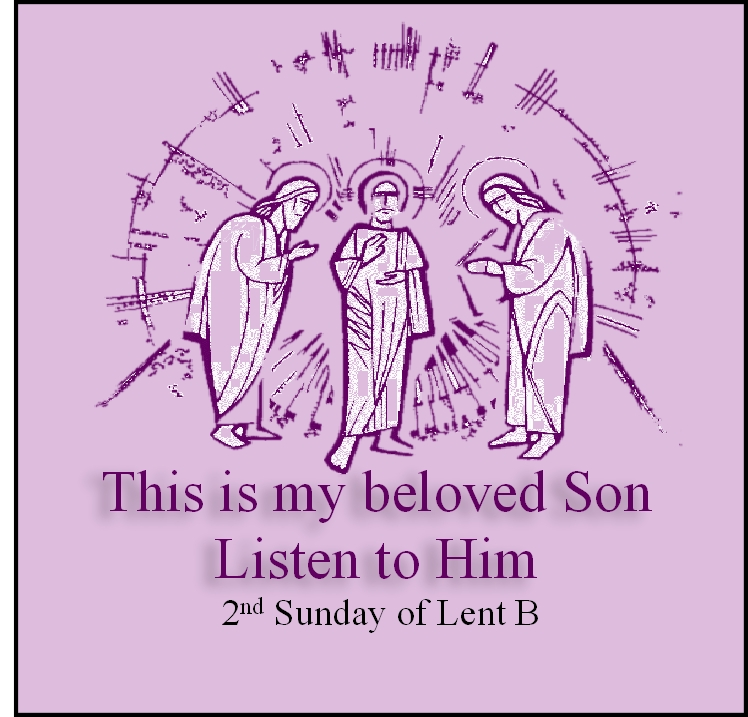
Overcome by the moment, Peter suggested building shelters for them and we hear the voice of the father identifying  Jesus as “my beloved Son.”  the God who speaks to the disciples on the mountain directs all of us  to Jesus and tells  us, “Listen to him”. Our journey during lent is a journey of listening to scripture as the  readings tell the story of faith.  Mountains were  always seen places of retreat and encounter with the divine. Moses and Elijah are no strangers to mountain encounters with God. They met God on the mountain, but struggled to make God’s plan a reality back down among the people. Moses, the lawgiver and Elijah, the prophet, symbolized the rich religious tradition of the Jewish people. It is Through them, that tradition is in dialogue with Jesus. The voice from the cloud identifies Jesus as “my beloved Son.” Jesus invites all of us to make a journey throughout our lives. Our faith should be an exciting journey from birth right until we get to the pearly gates when we die. During Lent Repent, and believe the Good News is our call to take up the spiritual journey as we explore the great depths of God’s love for us as we climb the mountain of the Lord.

We, like the disciples, periodically need to go to a quiet place, our own private “mountain top.” There we find some quiet time to listen to Jesus through his Word. We could do that by ourselves, by setting aside a few minutes each day to read and meditate on the scriptures. The god who speaks to us through the scriptures directs all of us to Jesus that same voice of God  who spoke to the apostles on the mountain also  instructs us  to “listen to him” may we listen to  what he is saying  to us in the quietness and not be afraid to do what he asks of us this Lent. Then we will be more able to enter fully into the great events of Holy week and Easter when they come around in a few short weeks refreshed and renewed by our Lenten journey.

1St Sunday of Lent 2024

After the ashes of Ash Wednesday comes the hard work and commitment of the next 6 weeks. Our gospel story for this weekend tells us about Jesus going out into the wilderness where he was tempted by the devil in the wilderness.  God asks us to undertake this time of renewal and that is why we have the penitential season of Lent. Why do we have Lent every year? Why penance? Why fasting? Why almsgiving? What does that have to do with us? If we take our faith seriously then Lent, penance, fasting and almsgiving have a great deal to do with all of us. The readings for the 1st Sunday of talk about  God who is faithful even when we wander away far from him. The first reading is about God establishing a covenant with Noah, his descendants, and every living creature, promising no future floods will destroy all life. The bow, set in the clouds, symbolizes this perpetual covenant, a reminder to God and humanity of this promise.   The psalm reminds us to be faithful as we ask the Lord to teach us  his ways, trusting in his salvation. We remember His mercy and love, as He shows the paths of righteousness to those who follow His ways.

The second reading connects the story of Noah to the sacrament of Baptism. It emphasizes Christ’s suffering, death, and resurrection as the ultimate act of reconciliation between humanity and God. Baptism is presented not merely as a ritual cleansing but as a profound commitment to live in accordance with God’s will, empowered by Christ’s victory over death.  In our Gospel this weekend  Jesus asks for such significant changes from those who have heard him preach. After he was baptized by John, he spent time in the desert and underwent temptations. He was tested and accompanied by the Spirit came out strong and determined. Jesus announces the coming of the reign of God and he invites others who hear him to commit their lives fully to God and God’s ways. He preaches  “Repentance” which requires change of mind and heart. He doesn’t want some superficial or cosmetic change.  He isn’t asking for a few minutes, hours, weeks, or months of our time which, when completed, we can return to our previous ways of living. Perhaps we have given up wine or desserts for Lent.

Then we hope to hang on till Easter when we can pop the cork and slice the Easter cake. No, repentance isn’t just for a part of the year. It is a full-time, on-going commitment to change and be changed by God. We are called to turn away from whatever distracts us from God and to return to the embrace of the One who is infinite love. Such total change can easily be left for a more “convenient time.” We say we will start a more serious pursuit of God later on  after we finish school, when we have a family, after retirement, “When I’ll have more time to give to prayer and good works.” But Jesus is speaking in the in the here and now of the present moment, he is  not speaking about something that will happen in the future. ” Lent is a grace filled time when we will receive the help we need to turn our lives towards God. We are invited to reflect  on God’s faithfulness, the significance of baptism, the importance of repentance and conversion. So now as we begin Lent we are invited to recommit ourselves to God. Let us ask ourselves whether we are open to be really changed as gods people so we will be able to enter more fully into the great ceremonies of Holy Week and Easter.

6th Sunday in Ordinary Time

This Sunday we celebrate the 6th Sunday of ordinary time which is also the feast day of Our Lady of Lourdes. We remember in a special way all those who are sick and infirm for whatever reason and we pray for their healing. Then on Wednesday we begin the Holy Season of Lent with the ashes and we hear once again the call to repent and believe the good news as we begin Lent for 2024. It is a time when we reflect on our spiritual lives and how we can renew themIn the first reading the Lord told Moses and Aaron what to do about potential leprosy, this  required priestly examination and, if confirmed, the person concerned was declared unclean. Afflicted individuals had to signify their condition by their appearance, vocalize their unclean status, and live in isolation, highlighting the seriousness with which leprosy was treated. The treatment of lepers, as spelled out in the Book of Leviticus today, seems harsh. But let’s not demonize the Israelites. With little understanding of the cause of leprosy, but noticing its awful consequences on the bodies of its victims, the community was frightened of contagion. To keep themselves and their families safe they isolated the sufferers.

In the Second Reading  from Corinthians St. Paul tells us  that In everything, even in eating and drinking, we should aim to honour God. He tells us to avoid causing offense by what you do and say and seek the good of many for salvation. Today we too are called to follow the  example of St. Paul as he followed Christ’s own example so should we. In the Gospel for this weekend  the  leper’s plea for healing was met with Jesus’ compassionate touch and affirmation, leading to immediate cleansing. Despite Jesus’ directive for discretion and adherence to Mosaic law for verification, the healed man publicized his miracle, complicating Jesus’ public ministry. Our Gospel story is about much more than just the healing, it is about the faith that the leper had in Jesus. It is also about the faith we have in Jesus.  After he heals him Jesus tells the man to be silent. The man is to go first to the priests and go through the ritual cleansing prescribed in Leviticus (14:1ff.)  Maybe the priests would ask the man how he was cured and then they would hear about Jesus. Who better to give witness to Jesus than someone whose life has been changed by him? Who better to witness to the strength, joy, encouragement, hope and direction that Jesus gives than one who has been transformed by him? Do we allow ourselves to be transformed by the compassion and words of Jesus in order to show his compassion to others?

The man who Jesus cured proclaimed and spread the word and he brought others to faith even though he was told not to tell anyone. Word of Jesus power preceded him and the people brought all those who needed healing to him. In  fact so many people came from every place in Galilee that Jesus could not travel in the open for fear of the crowd. Aware of our need for healing, we, too, can take the initiative by approaching Jesus. We will be met with compassion and love. We can be restored to our rightful place as beloved sons and daughters. We, too, can tell the story of what God has done for us in our lives. May we share the healed man’s enthusiasm to make known the goodness and the love of God. Next Wednesday with the Ashes  and the call to be faithful to the Gospel we begin the season of lent with all the opportunities it provides for renewal of our spiritual lives.  Let us pray for a spirit of understanding and renewal as we journey through Lent to the celebration of Holy Week and Easter so that we can say with the psalmist Lord you are my refuge and you turned my distress into the joy of salvation.

5th Sunday of Ordinary Time

The readings for this Sunday ask us to reflect on Jesus’ power to heal us, both physically and spiritually. In the first reading, Job laments that he is experiencing so much misery and despair that he find’s that is just too hard to keep going. But then in the  psalm we are reminded  to “Praise the Lord, who heals the broken hearted” as he gives us the strength to go on. Paul’s reflections in the second reading on his role as an apostle underscores the theme of selfless service and sacrifice. His commitment to preaching the Gospel without seeking personal gain highlights the Christian call to serve others whenever they need our help and not to look for anything in return. In the   Gospel reading Jesus comes to Peter’s house, he finds that Peter’s mother-in-law is sick, and he heals her. The whole town hears of her healing and rushes all their sick to Peter’s house. The house is surrounded, and so is Jesus. Now, all of a sudden, Jesus seems to have become a one-man hospital the man who heals all their ills. He is so besieged that he can’t even pray in the house. He has to head out into the countryside secretly in the dark of morning. When his absence is detected, his disciples go looking for him. when they find him, they tell him “Everybody is looking for you!”

When the people of Capernaum saw Christ they saw man of power amongst them; when we see Jesus with the eyes of faith we realise  that he  is the Son of God our saviour who came on earth in order to make us the family  of God. We know who Jesus really is and we know the full meaning of his mission. We see that mission completed by his death on the cross and his resurrection. By his death he conquered death by his resurrection he opened the gates of heaven for us and he shows all of us his followers the road we must take to get to those gates. The road we have to take is not easy and many people have chosen other roads that lead in other directions . But we  believe that there are people  like us  out there looking for Jesus and they are finding and following him and as a result of their witness we follow Jesus as well. Jesus is alive in our midst through the lives of faith we have together. He is our way, our truth and  our life. Turn our backs on him, and our spirits, minds and hearts, might just shrivel up and die for lack of spiritual nourishment. We have come to know that the things of God are built on solid foundations of the rock of faith instead of the things of the world that are built on sand and have no lasting value.  The interaction between Jesus and those he heals, as well as the actions of the disciples, highlight the theme of community as we make our Christian journey.

It shows how faith is lived and experienced within the community, and how the community of believers plays a role in supporting, nurturing, and participating in the mission of the Church  as it brings the faith to others. We are challenged to look beyond the surface, to see the deeper spiritual significance of Jesus’ life and actions, and to embrace our particular role in continuing his mission in the world today. As we reflect on our mission within the church we are invited to deepen our relationship with God and to recommit ourselves to bring his message to the people wherever we are in this troubled world.

4th Sunday in Ordinary Time

Over the past few days we have been celebrating Catholic Schools week. We  have taken the time to think about the good that has come from our schools. We have also taken time to thank god for our school teachers and our parents who in our homes are our first teachers. But as we thank God for our schools and our teachers we remember that  learning is a lifelong experience of so many things. THE readings for the 4th Sunday in Ordinary invite us to recognize Jesus and grant him authority in our lives. Moses was the prophet for his time and for the needs of his people. In the first reading, Moses foretells the coming of a mighty prophet. Who are the Moses-like prophets for this time for us and our needs? Who do we trust and follow? Whose words and examples direct our minds to Jesus the word of God the authority of the Father? The second reading from Corinthians discusses the states of married and unmarried life, highlighting how the unmarried can focus more directly on pleasing the Lord. This theme of undistracted devotion is relevant to understanding different vocations and the ways they can lead to holiness.

In this Sundays  Gospel we hear about the authority of the Lord to cast out demons and devils. The gospel  reading is taken from Marks gospel . As Jesus begins to teach in Capernaum. The people are spellbound because he spoke with authority, not like the scribes. A man comes to Jesus who is in the hand of an evil power and Jesus makes the devil come out of the man. The bystanders are amazed because Jesus has such authority.  What do we mean when we speak about the authority of the Lord? What do we mean when we talk about authority in general? What ways do we exercise authority in relation to those around us? What ways do we exercise the authority of the Lord as Christians?  The word authority comes from the Latin word auctoritas.  The basic meaning of this Latin word is creator, the word author also comes from this word. In general, authority is intimately connected with its source that source is the person who gives another the authority to do something so the authority that Jesus has comes from his Father.  God’s love for everyone is declared to us in the scriptures. God speaks with us there.  The message is clear: If we are God’s we are to care about and for each other and that includes the refugees, the abused, the poor, the ill, and the mentally challenged.

It means Everyone everywhere! Jesus, entire public life was about compassion and mercy. He despised arrogance, fought hypocrisy, and he believed the heart was stronger than the law. He brought God’s mercy and compassion to the earth and in the process brought us forgiveness from our self-interest, our scapegoating, our manipulation of frayed emotions, and our insecurity in the face of diversity of language, race, nationality origin, or whatever We are truly prophets when we stand for the truth, for the marginalized, for the alien, for the victim of war, for the victims of capitalism that serves only the capitalist. We are surrounded by many voices claiming authority – in media, in politics, in our communities. How do we recognize the true prophetic voice? The key is do those voices follow the teachings of Christ and the Church. The challenge for all of us is to discern and hear the voice of God, to speak and live our faith authentically, and to orientate our lives towards our faith so that other people may believe what Christ teaches and take up his request to follow as we are following  him.

3rd Sunday in Ordinary Time

Every time we pick up a newspaper, or turn on the radio or TV these days  we are confronted with bad news, much of it of a very distressing nature. It leaves us numb and helpless when many parts of the world are waring with each other as we realise that we cannot do a lot about what is going on we continue to pray for peace in our world. This weekend the readings talk about good news. The prophet, Jonah, in the first reading took a little time to answer God’s call in fact he only did so the second time around. The first time, Jonah packed his bags and ran away to sea in order to escape God’s wishes. However, God did not give up. Jonah was given a second chance and when he accepted the call, he preached with such faith that the people of Nineveh repented. Mark’s gospel times Jesus’ proclamation of the gospel with John the Baptist’s imprisonment by Herod. It was like passing a baton to the next runner in a race. John’s work was completed: he had prepared the people for the Christ.

His preparation accelerated the expectations that the Messiah was coming soon. Repentance was needed to prepare minds and hearts to receive the Messiah. Even so, repentance was thought to be something of the mind, of the will. Just clearing the landscape of the trash of sin did not completely prepare a person to receive and follow Jesus.  It is interesting to note how Jesus begins his ministry by announcing good news that “The kingdom of God is at hand. Repent and believe the good news”. What is this good news? Essentially it is that we can come back to the father’s house like the prodigal Son, where a welcome instead of  judgement awaits us: The Good Shepherd has arrived. His stated aim is ‘”to seek out and to save the sheep that· are lost”  In the Gospel Jesus went to Galilee, preaching God’s imminent kingdom and urging repentance and belief in His message. By the Sea of Galilee, He called Simon and Andrew, fishermen, to follow Him and become ‘fishers of men.’ They promptly did. Next, Jesus summoned James and John, who also instantly left their father and work to follow Him.

This  illustrates the compelling nature of Jesus’ call. That meant they were to get up and leave family and friends to go out into the world to proclaim the good news of salvation.  We too are called to follow Jesus right where we are today. We are called to repent and to encourage others to do the same.  Like Jonah and Peter, we have to make many decisions. sometimes these affect the whole direction of our lives and the lives of others.   Whether we are like Jonah or like Peter in our in the way we make our decisions it is important for all Christians to realise that God is always there. He is waiting for us to accept his challenge to change our lives. As Jonah demonstrates, the story isn’t over yet. That all-important decision to answer the call of Jesus to follow Jesus may be made  right now today or even tomorrow. For every day is a new beginning, every day is brimming over with opportunities to start afresh.  So let us join Jesus in his mission so that others may believe the good news of salvation and hear the call follow me.

2nd Sunday in Ordinary Time

This Sunday we return to Ordinary Time with the Christmas and new year festivities a now distant memory. Our readings for the second Sunday in ordinary time are all about how god is calling his people. In the first reading we read about ‘Samuel’s Call’. Three times he hears God calling but thinks it is Eli a Temple priest and goes to him. Eli finally understands that it is God calling Samuel and tells him that next time he hears the voice to say, “Speak, Lord, your servant is listening”. The reading concludes with the thought that God dwelt with Samuel and that he spoke in God’s name. In this Sunday’s Gospel the apostles asked Jesus “Where do you live”? his reply was the invitation for them to “Come and see”.  As well as the Apostles all of us  are invited and welcome to  come and see where Jesus lives as well as what’s going on in our Faith Communities. When we accept the invitation of Jesus we have to ask ourselves why do we come and what do we seek? The early disciples of Jesus must have asked themselves those same questions.  They lived in a culture that distrusted anything new.  

We also  live in a culture that distrusts many things especially faith and all it represents.  The people in this gospel story are like you and me they are people looking and searching for God. Like the disciples we are seekers who want to find Jesus and stay or at least try and stay him. John’s disciples were seekers and it is late in the day for them as the gospel tells us. “It was about the tenth hour around four in the afternoon,” when the disciples received their invitation from Jesus. They need rest from their search and Jesus is offering it to them. The “four in the afternoon” possibly refers to the beginning of the Sabbath the next day.  The disciples spend time with Jesus, they are transformed. One of the disciples, Andrew, is so moved by his encounter with Jesus that he immediately goes to find Simon his brother and tells him, “We have found the Messiah”. Andrew’s response is a beautiful example of evangelization. He cannot keep the good news to himself; he feels compelled to share it with others. This is a reminder for us that encountering Christ should lead us to share the joy of the Gospel with those around us.  Simon, upon meeting Jesus, is given a new name, Cephas, which means “rock.”

This renaming signifies the mission that Jesus would give him, to be the rock upon which he will build his Church.  Just as the disciples were transformed by their encounter with Jesus, we too are invited to open our hearts to him, to seek him with sincerity, and to respond to his call. It is not a passive following to which we are called. This is about making room for him in our hearts and our lives, becoming the living embodiment of the Gospel.  May our encounter with Jesus and what he teaches us deepen our faith, transform our lives, and inspire us to be witnesses of his love in the world wherever  we are.

The Baptism of the Lord

On the Sunday that follows the Epiphany of the Lord, the Church commemorates the baptism of Jesus and  the beginning of his public mission in the world.  Jesus began his mission, like any Christian does, by being baptized by one of those who are charged with representing him on earth.  John the Baptist is indeed the figure of the Church at its beginning, and he is the one who resembles Christ, and represents him among the people of his time.  When John the Baptist baptizes, he told the people that there was someone coming after him and he was not good enough to undo the strap of his sandals.  The Baptism of the Lord emphasizes our incorporation into God’s family through baptism, mirroring Jesus’ own baptism.  The first reading discusses being formed and called by God. The psalm highlights themes of peace, water, and salvation, integral to the baptismal experience. The second reading reflects on the start of the Good News with Jesus’ baptism.

 The Gospel vividly recounts Jesus’ baptism by John the Baptist in the Jordan, symbolizing the beginning of His ministry and our own spiritual journey through baptism. Many of us have been to a baptism but none of us remember the time we were baptised unless we were an adult who was baptized at the Easter Vigil or at another time. The beginning of the messianic work of Jesus is marked by the moment of his baptism in the Jordan. We remember that John the Baptist foretold Jesus  coming and he is acclaimed on earth by John and Jesus links himself to John by being baptized by him. Jesus is acclaimed from heaven by the voice of the Father and the presence of the Spirit.  Most of us rarely, if ever, think about our baptism. Through our baptism we died with Christ and have been reborn into a whole new life (Romans 6). We, the baptized, are made a part of the body of Christ. We are called to imitate Jesus, whom Paul says, “went about doing good.” We don’t need a detailed rule book in order to know how we should act in each situation of our lives, for in baptism, we have the companionship of the Spirit of Jesus who is our wisdom, our help and our guide to do good. The baptism of Jesus is a moment of special grace in the story of our salvation. Not only did the Son of God join us in our human condition but the Father and the Spirit were seen and heard to be present with him by the banks of the Jordan. At Jesus’ baptism, the voice heard from heaven identifies him as God’s beloved son. Our baptism also identifies us as beloved sons and daughters of the father. The Church teaches that baptism leaves a “mark” on us which can never be removed. No matter what we do, that mark is always with us. This gospel about Jesus and his baptism by John is the beginning of a purpose filled journey, which, through our own baptism, each of us is asked to travel. It is a journey and the purpose for us is to try and live our lives as people of God enlivened by the Holy Spirit so that others will be inspired to follow Christ by seeing the lives we lead as baptised people who believe in Jesus the Son of God and what he teaches us.

Epiphany

On January 6th  we celebrate the three wise men and their visit to Jesus, as we know they brought gifts of Gold Frankincense and myrrh valuable gifts indeed. As we reflect on the Magi and their gifts we should also reflect on humble start of the church: Jesus was born in a stable as there was no room in the inn. Jesus gave us the Eucharist at the Last supper in the upper room . There he told his apostles as he tells us today do this in memory of me when he blessed the bread and wine he said this after washing the disciples feet remember the Master of the household did not wash the feet of anyone.  Jesus died on the Cross with two thieves one on each side of him no Gold frankincense or Myrrh there just the words of the thief when he said  Jesus remember me when you come into your kingdom. The Magi from the east, guided by a star, sought the newborn King of the Jews in Jerusalem, unsettling King Herod and the city.

Informed by religious leaders about the prophesied birth in Bethlehem, Herod deceitfully instructed the magi to report back after finding the child. Following the star, the magi reached Jesus, worshiping Him and offering gifts. They returned home by another way to avoid Herod. In the gospel reading for this feast the Wise men represent the “mystery” of the son of God made manifest in human life by becoming one with us and like us. By their very nature they are seekers, people who came looking for the “king of the Jews.” Where would they find this royal child? Not in the courts of the powerful, like Herod. He was an example of how those in power would react to the gentle one who would draw all people into his kingdom. Jesus was not born in a mighty city, nor was he an heir to a powerful ruler. Instead, he was born  in Bethlehem. it was a backwater in the eyes of those of Herod’s court and the religious leaders in Jerusalem.

We, like the wise men, will find Christ among the “least.” and this is the message, that lies at the heart of our gospel for today. The call of the Savior is given  to each of us. What do we hear? Will we believe what we hear and see as the Wise men did? we are not going to be able to bring Gold Frankincense and Myrrh to the Lord instead we bring the priceless gift which is our faith and belief in Christ the Son of God. Our faith in Jesus enables us to bear witness to him as a light for all the nations. Like the wise men we come to worship the one we have found in the manger and then go out and share with everyone out there the treasure we have received kneeling at the crib like the wise men

Post Navigation