Fullerton T

RELIGION LITURGY AND LIFE

Archive for the category “LITURGY”

32nd Sunday of ordinary time

This weekend we have our annual day of remembrance when we remember all those who died in the first and second world wars. Remembrance Sunday reminds us of the need to pray without ceasing for peace in the world especially these days with the ongoing wars in the Holy Land and Ukraine.  The theme of our readings this weekend is not marriage though the Gospel story is about the bridegroom and his attendants. Instead the readings point us towards something very different that is the gift of Wisdom. The first reading  taken from the Book of Wisdom cites watchfulness as the key to a faithful understanding of wisdom according to St. Bernard wisdom lights up the mind and instils an attraction to the divine.  The author of the Book of Wisdom reminds us that we have one unfailing presence to guide us through our lives that is Wisdom. We are told Watch for her early and you will have no trouble; you will find her sitting at your gates. She is “resplendent and unfading;” always there for those who seek her out. The Gospel story for this Sunday is about an oil crisis in the Middle East it tells us about the five bridesmaids who didn’t buy extra lamp oil they were foolish because they weren’t prepared for the late arrival of the bridegroom.

On the other hand the story flags up the wisdom of the five wise bridesmaids who were prepared for the late arrival of the bridegroom as they went out and bought more oil for their lamps. Their wisdom wasn’t extraordinary, but eminently practical. It is true that it is near impossible, to estimate the quantity of oil necessary to keep a lamp lit as we await the bridegroom for an unknown length of time! In this story the Lamp is our faith and how we live our faith is the oil. This Gospel calls us to seize the moment and direct our lives guided by the wisdom that God gives us through the life and teachings of Jesus. What we experience is the routine of work, school, and various activities, rushed family meals, television, shopping, visiting elderly parents, friends and family, church services, etc. It can feel so predictable. But the routine of our daily lives  can also be shattered by the unexpected and sudden demands life puts on us and our loved ones. Will we be ready to respond? It depends on how well we have tended to our “oil” supply. If we have squandered it by neglect, or missed opportunities to get more oil for our lamps then when we look for backup in a moment of crisis, like the bridesmaids we may be left with the sound of the slamming door being locked as the bridegroom tells us I don’t know who you are you are too late.

Only those who were ready went in with the bridegroom to the wedding. When God calls us, will we be ready? The disciple needs to remain alert, vigilant and prepared for the ‘day of salvation’ by continually growing in a faithful and loving relationship with God. This loving relationship with God bears fruit in good works for neighbours. That is what it means to be hearers of the Word of god who take what they hear to heart. The Bridegroom comes when we least expect his presence. The encounters we have with the Lord are frequent. But it takes real wisdom – our flasks of wisdom filled – to see the Lord. We need light to see and the flasks that fill our lamps provide that for us. It is a light that frees us of the need to prove ourselves. What are the results when we seek and discover Wisdom bit by bit in a lifetime, the result is we become whole and at peace. Wisdom will find you if you are not too busy with something else. Wisdom will find you if you allow your mind to be open to the newness she might suggest you try. Wisdom and what she offers is one wonderful way God revives, saturates, and renews our parched, lifeless, and whirlwind lives with the abundance of blessings. So let us rejoice in the gift and blessing that wisdom is for us.

31st Sunday in ordinary time

Once again we remember all those who are in the War torn parts of the world as we continue our prayers for peace in so many places especially in Ukraine and the Holy Land. At the start of November as we begin the month of the Holy Souls we remember the faithful departed members of our families, friends, fellow parishioners as well as those who have no one to pray for them  may they rest in peace in the kingdom of God. The Religious leaders do not come off too well in this Sundays first and Gospel readings.  Jesus is not accusing them of not knowing their religion. They knew it very well. They were even good at teaching it to others; it is just that they didn’t practice what they preached. In the gospel for this Sunday Jesus warns against this kind of leadership. The atmosphere of hostility towards the religious leaders is evident in this Gospel reading. The scribes and Pharisees are presented as bad examples of religious leadership. Jesus is presented as engaging in violent caricature, arousing the crowds to condemn the scribes and Pharisees. It is a tense and angry scene in which Jesus makes sweeping generalisations: “Everything they do is done to attract attention…”.

Obviously, there were many scribes and Pharisees who were upright and good holy men. Matthew is warning against attitudes and practices which are not peculiar to any religious group they could apply to anyone at any time even to us today. The scribes and Pharisees happen to serve as useful examples especially since at the time of writing they represent the style of leadership Matthew is opposed to within his church. Authority in any organisation, the Church included, is meant to be a gift and used well. It is meant to be shown in loving service in  support of others, not in domination and control. It’s just not good enough to make people simply comply and obey. People may do that on the outside, while on the inside they are seething with rage and resentment which always boils over. The challenge for all Christian people is to get others onside, to win their hearts and minds, to persuade and convince them that following Jesus is the right thing to do. Again and again in his teaching Jesus insists that we must not dominate, lord it over, or oppress others! He teaches over and over again that God invites and calls us to follow him! He teaches us that the greatest in any group are those who love and serve the others! Jesus challenges us to go along the way of humility because, whether we are mindful of it or not, as baptised Christians we represent Christ in the world today.

Jesus challenges all who believe in him because he has high expectations of us as he expects us to be servants not masters.  Even though the Gospel for this Sunday is addressed to the religious leaders of Jesus’ time, it is also addressed to all of us who call ourselves disciples of Jesus who are followers of the way. We must be willing to put everything behind us that prevents us from living in the humble way that Jesus modelled for us.  The true way of life for  any Christian must reflect the life of Christ.  With Christ as our teacher we learn the ways of wisdom and love. We learn how to live, not by the values of the world, but by the values of the Spirit of god. So today as we reflect on the various things that are going on in our own lives and the world let us remember that we are called to be the humble face of Jesus where we are and  not be afraid to pass the good news of the gospel to those we meet when we get the chance wherever we are in the world.

30th Sunday in Ordinary time

Well here we are at the 30th Sunday of ordinary time as we are fast approaching the feast of Christ the King (34th Sunday) and then we begin all over again with the Advent Season. As I write this Israel is about to invade Gaza. Thousands have died on both sides, and thousands more will die from violence, hunger, destroyed hospitals, missiles etc. We pray for peace in the Holy Land as well as Ukraine and we remember all the other places and people who need our prayers and the peace of God at this time wherever they are in the world.

The first reading from Exodus this Sunday speaks to us of immigrants. They call them “aliens in our midst.” The listing includes all other people who live on the margins of society. The first reading also warns against mistreating strangers, widows and orphans and talks about the proper conduct of loans and pledges. The warning comes from God’s lips. It’s not just a nice piece of social philosophy; it is the demand of living our faith. It means that true faith, as Jesus teaches it, is about being in loving relationship with God and other human beings. Often, we think of those who are poor as being less than human. We confirm those thoughts by avoiding contact, with them. Yet as sons and daughters of God we are directed to welcome those persons and seek to support them. Avoidance and alienation is contrary to that. Speaking badly about them is contrary to the dignity and worth that God uniquely creates in the people they are. The Pharisees in the Gospel Reading for this Sunday are all out to get Jesus because he had silenced the Sadducees.

In an attempt to do this they asked him this question Master, which is the greatest commandment of the Law?’ Jesus said, ‘You must love the Lord your God with all your heart, with all your soul, and with all your mind. Many people say that as they grow older their relationship with God becomes much more central in their life. There is a sense in which we could say that it takes a lifetime of practice to love God with all our heart, soul and mind, to live the first commandment, putting God before all else.  To direct throughout our lives God has given us guidelines, the Ten Commandments. So many people in the modern world have decided to turn away from God and from spiritual things.  The passage is addressed to us as individuals in our various vocations it is also addressed to us as the Church of our time.  The Pharisees and the Sadducees represent the fragmentation which Jesus rejected. The demanding nature of the law of love is stressed in the final verse of the Gospel passage for this Sunday: “On these two commandments love of God and neighbour depends all the Law and the Prophets. Jesus left a crucial last testament to each of us: “Love one another as I have loved you.” Religious rituals are meant to be ways of reflecting on, savoring, remembering, celebrating and expressing that love. Sometimes they just end up as ‘empty’ rituals, when love has been replaced by fear, or when love is absent.

The Kingdom of God is not some far off place, but the moments when God’s life breaks into the human story. Those moments bring love, wisdom, grace, compassion, generosity, forgiveness and peace. Those practiced in the things of God recognise God’s presence most of all in loving relationships. In our “e-connected artificial intelligence” computerised  world existence, the words of Jesus in this Sundays  Gospel are especially challenging: to love with our whole heart and soul and mind requires us to “unplug” all our devices and distractions and be there  for one another, to engage one another as our loving God is engaged with us. love in action will change us and our surroundings. All we need to do is  to try and live like Jesus did. we should take one step at a time toward our creator and our fellow human beings and this will provide us with great reward.  And we should not worry where we are going, for God’s Spirit will lead the way along the road that leads to salvation and the destination we will arrive at is eternal life.

29th Sunday in Ordinary Time

This weekend we have Mission Sunday the day when we celebrate the missionary effort of the church in the world. In 1926, Pope Pius XI decided the Church needed a special day on which to pray for missionaries, and to renew her commitment to the missions. Today, World Mission Day is celebrated  in Ireland in October, as a sign of support and solidarity for missions and missionaries everywhere All of us will have heard of someone who has joined one of the missionary orders such as Columbans, Mill Hill Fathers, St. Patricks Fathers the Medical Missionaries of Mary there are many  other missionary religious orders who along with the Lay Missionary movements have gone out into the world to bring the message of the Gospel to the ends of the earth.  As we celebrate the churches missionary effort and the people involved in it we also remember the ongoing wars in the world especially in Ukraine and the Holy Land and the need to pray for peace in the world.

This Sundays  Gospel  passage is built around the saying in verse 21, “Give back to Caesar what belongs to Caesar and to God what belongs to God”. It is a “wisdom saying” and the passage invites us to enter into it with our feelings. Its truth should touch us so deeply that we are filled with humility as we realise that we do not live up to it  as individuals, as Church and as communities when we put Cesar before God.  Perhaps Jesus’ words that the coin which bears Caesar’s image belongs to Caesar means also that those things which bear the image of God belong to God including human beings and creation. This gospel is regularly cited among those both inside and outside the church. Many people want the church to stay inside the church building, praying and singing behind closed doors about “spiritual matters.” and that notion is quite wrong the Church needs to be in the world as a light in the darkness and a voice for those who have none.  We have to remember that the Church and we its people are called to comfort the afflicted and afflict the comfortable.

We have the responsibility as people of faith in the places where we live to speak the truth with charity, clarity and conviction.  We have the responsibility to work and pray for peace especially when so much of the world is at war. We have responsibility towards the care of the planet, because God who created us  has made us stewards of his creation. God wants all of us  to  experience his saving presence in our lives. it is through God’s grace that we have received the Gospel Message of faith  and then we are sent by the Holy Spirit to be ambassadors of God. Will we accept the invitation to join in God’s mission by our prayers and support for those who are out there on the missions as well as  those who need our help closer to home on the mission fields that sadly many of  our countries  have  become.  Our annual celebration of Mission Sunday  gives us the opportunity to acknowledge all the missionary men and women who left everything behind in order to bring the light of faith to the far corners of the world.

When we think about the three parables we have heard over recent weeks we can say that the idea of giving back to God what belongs to God can be understood as giving back the love, generosity, justice and goodness we have received from God. Just as God did not lose anything by giving us these gifts, we don’t lose anything by making them real in our lives, so that others may also share in God’s life through us. We pray that the Lord will continue to inspire many people to join the missionary effort of the Church  so that the  love of God may be passed on to each generation in its turn as it has been passed on to all of us.

28th Sunday in Ordinary Time

This weekend we pray  especially for peace in the Holy Land as we remember all those who lost their lives as a result of the terrorist  attack on Israel. This event has shown that  Hamas has no respect for the lives of the people Israeli, Palestine or anyone else. The attack was barbaric and there is no justification for the violence that it has brought to the people of the region. In the first reading this Sunday Isaiah presents a vision of hope for the People of God. There will be a banquet of immense proportions on the Lord’s Mountain. The spirit of the people will be redeemed and there will be salvation from reproach, from tears,  and the  terror of death. The message of the reading is good news especially these days when the news is so horrific especially coming from the Holy Land.

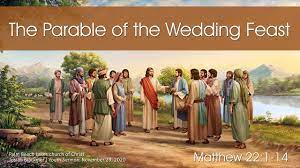
In the Gospel reading for this Sunday we hear about the king sending his servants out to call all those who were invited to come to his son’s wedding but none of the invited guests would come.So the king told his servants to go out and invite everyone on the road to come to the wedding feast.  Jesus tells the parable because his ways doing and saying things had been criticized by the “the chief priests and the elders of the people.”  They rejected him so now he turns to  everyone on the road and he welcomes the outcasts the poor, the sinners, and the outsiders. Matthew emphasizes, not only the importance of the meal, but the urgent need we have to respond to God the fathers  invitation to his feast.  In the parable those who did respond to the invitation,  did so with enthusiasm and joy. They knew a good thing when they heard it and grasped it immediately, filling the banquet hall just as the king had wanted for his son. Today all of us who say we are Christians are also invited to the wedding feast and this is a pointer towards our participation in the life of the Church where we are now as well as pointing to  eternal life in heaven. This weekend’s parable reminds us that God’s invitation is his gift to us, and it is freely given so that we can accept or ignore it.

We are invited to a feast of great joy and we need to make sure that others feel welcome to join us on our journey to the feast, especially those who don’t get invitations to feasts very often if at all. Those who gathered in from the highways and byways had no claim on the king who really is God our Father. We, too, have no claim on God, We do not merit God’s invitation on our own. It is a grace the father  lovingly offers to each and every one of us. Hopefully all of us will be able to accept the invitation to come to the feast and enjoy it when we get there instead of being like the invited guests who did not come to the wedding feast who were left behind.

27th Sunday in Ordinary Time

This week we began  the month of October and on Wednesday the Synod opened in Rome. There are many varied opinions on what this synod may do and what it might change but through all of this we need to pray and trust in God. This Sunday St. Paul tells us in the Second Reading that we should not worry and that we should pray to god for our needs and as a result of our prayer the peace of God will come to us and guard our hearts and our thoughts in Christ Jesus. This Sunday  we are back in the vineyard and the first reading and the Gospel are all about grapes and the wine that comes from them.  Our first reading, from the prophet Isaiah, speaks of God planting, caring for and protecting a vineyard. The vineyard is a symbol for the people of Israel and God’s loving care for them.

Through the parable of the vineyard Jesus reprimands the “chief priests and elders of the people” gathered around him.  He focused on the unfaithful people who, by their sin and failure to listen to the prophets, had brought God’s anger down on them. Jesus’ reference to the killing of the King’s only Son was not lost on the Pharisees. They had already decided to kill Jesus who claimed to be the Son of God. Jesus’ words enraged them, and their hearts were further hardened against Him and it all ended up at the Cross of Calvary on Good Friday. As we know Calvary was not the end as we are talking about the parable in 2023 and we are called to take note. We normally like to think of ourselves as the new tenants of the vineyard who have taken over from the old tenants  the scribes and Pharisees  who failed to produce good fruit. That is true. But in taking over that inheritance we have also taken over the responsibility that goes hand in hand with it.

Harvest time is the time for us to reflect  on how much fruit we really are producing.  We should ask ourselves What part have I in the Lord’s vineyard. What part do I play in building God’s kingdom in the world? So today as we listen again to this parable we are called to go out to play our part in the lords vineyard. To be workers rather than the owners to nourish the vines of other people’s faith by our words and deeds so that as a result of our efforts they may produce much good sweet grapes that produce sweet wine.

26th sunday of ordinary time

This weekend we begin the month long synod on synodality being held in Rome during October which is the first of 2 synodal meetings the next will be held in 2024. There have been many arguments on various things that people believe this synod will do or not and those people will find that they are wrong as our God is a God of surprises. Above all else we have to pray that all those who are at the synod will have wise heads and give proper consideration to all the points raised in the meetings that will take place. In our Gospel reading for this weekend we hear the story of the two sons. The first son, who said no to his father but who went and did what his father wanted. And then the second  son, who says yes to the father but does not deliver . The first son “thought the better of it.” He was open to change. The second son was set and closed. The ability to change one’s mind is essential to all healthy relationships.  

A mind that is closed, whether from pride, stubbornness or stupidity, tends to destroy all relationships, e.g., when we refuse to admit a mistake, when we are unwilling to apologise and change our ways, when we persist in prejudice against a person or group, when we think we know it all when we don’t.  Jesus surprises the people around him by responding favorably to the actions of the tax collectors and prostitutes who may have gotten it wrong at first but have since repented and come back.   Too many of us are down on ourselves for our past lives. Many of us can truthfully say, “I have made mistakes.” But we are here now. We are doing our best to follow the Lord. We try our best to receive the strength of Christ, the power of the Gospel, and integrate this into our daily lives. This Gospel passage points out something very important about faith and religion. Sometimes the terms faith and religion are taken to be the same. But they are not at all the same. The difference between them be seen more clearly if we speak of religious practices rather than religion. There is of a close relationship between religious practice and faith.

 Religious practices have to be based on and animated by faith It is easy to say that we are going to do something to please someone. If we really want to honour our God, we must find ways to do the will of God. Sometimes it won’t be easy, sometimes it will put us out.  The Lord calls us to a living faith whereby we enter into a living relationship with God. That involves something more than adherence to a system of ideas or obedience to a collection of rules or the practice of certain rites. It requires an authentic desire to follow Christ, whatever the costs to us material or otherwise. Through this parable of “the second chance,” grace is given to enable us “to change our minds.” We can start anew. This parable is Good News indeed, for those who think it is too late to change, or can’t change. Jesus  who tells this parable to us today assures us we have his help to redirect our lives – to say “Yes” to the God who calls and enables us to change our hearts and our minds in order to bring about his kingdom in our world where we are today.

26th Sunday of Ordinary Time

This weekend we begin the month long synod on synodality being held in Rome during October which is the first of 2 synodal meetings the next will be held in 2024. There have been many arguments on various things that people believe this synod will do or not do and those people will find that they are wrong as our God is a God of surprises. Above all else we have to pray that all those who are at the synod will have wise heads and give proper consideration to all the points raised in the meetings that will take place. In our Gospel reading for this weekend we hear the story of the two sons. The first son, who said no to his father but then went out and did what his father wanted. And then the second  son, who says yes to the father but does not deliver . The first son “thought the better of it.” He was open to change. The second son was set and closed. The ability to change one’s mind is essential to all healthy relationships.  

A mind that is closed, whether from pride, stubbornness or stupidity, tends to destroy all relationships, e.g., when we refuse to admit a mistake, when we are unwilling to apologise and change our ways, when we persist in prejudice against a person or group, when we think we know it all when we don’t.  Jesus surprises the people around him by responding favorably to the actions of the tax collectors and prostitutes who may have gotten it wrong at first but have since repented and come back.   Too many of us are down on ourselves for our past lives. Many of us can truthfully say, “I have made mistakes.” But we are here now. We are doing our best to follow the Lord. We try our best to receive the strength of Christ, the power of the Gospel, and integrate this into our daily lives. This Gospel passage points out something very important about faith and religion. Sometimes the terms faith and religion are taken to be the same. But they are not at all the same. The difference between them be seen more clearly if we speak of religious practices rather than religion. There is of a close relationship between religious practice and faith.

 Religious practices have to be based on and animated by faith It is easy to say that we are going to do something to please someone. If we really want to honour our God, we must find ways to do the will of God. Sometimes it won’t be easy, sometimes it will put us out.  The Lord calls us to a living faith whereby we enter into a living relationship with God. That involves something more than adherence to a system of ideas or obedience to a collection of rules or the practice of certain rites. It requires an authentic desire to follow Christ, whatever the costs to us material or otherwise. Through this parable of “the second chance,” grace is given to enable us “to change our minds.” We can start anew. This parable is Good News indeed, for those who think it is too late to change, or can’t change. Jesus  who tells this parable to us today assures us we have his help to redirect our lives – to say “Yes” to the God who calls and enables us to change our hearts and our minds in order to bring about his kingdom in our world where we are today.

25th Sunday in Ordinary Time

In this weekend’s gospel story  we hear about the Laborer’s in the vineyard. As unskilled workers, they lived day to day just above the poverty line. In areas where such workers got employment, they got   together in a common area known to employers called  the marketplace that acted as their gathering area. The employers sought the workers out, hired them only for the day, and paid them the same night . Day laborers in the vineyard objected to the amount of pay the owner gave them as the first was paid exactly the same as the last one denarius. This tense image rode against the popular view of the Kingdom as a peaceful feast of the faithful in paradise. Jesus told this story to emphasize how the Kingdom differed from people’s  ideas and expectations what people expected and the actual kingdom of God were two very different things.  

According to Jesus, the faithful, even those who practiced faith all life long, did not earn the Kingdom. The Father gave his children the Kingdom as a gift. The pay issue scandalized Jesus’ followers the most, however? Imagine the most dedicated and hard working were paid the same as the others. And they were paid last! Beyond the question of money lies the question of social treatment. The owner treated those who worked for only an hour as he would treat his own family. Those hired at dawn were treated as mere workers. The owner gave greater honor to those who worked the least by paying them well and paying them first. The owner belittled those who worked all day long by paying them so little and paying them last. And, when the workers grumbled, the owner rebuked them in public. No wonder they gave him the “evil eye.” If our  ways of thinking and judging are truly far from the Lord’s way, then we have some adjustments to make!

Perhaps we  need to work harder in the areas of forgiveness, mercy, and generosity, to name a few. Maybe the answer lies in the first reading for today: My ways are not your ways; my thoughts not your thoughts. In other words the ways of God are not always in sync with what we want to do. So often in the scriptures, God has a totally different way of approaching things to most of us. To think as God thinks requires openness and a broad vision, free of self-pity and selfish brooding. It takes a habit of gratitude. It means sitting down and reflecting, “What does God want me to do in this  or that situation?” It takes courage, humility and grace to act this way. The parable of the  workers in the vineyard is the Lord’s call to all of us  who have received Him in word and sacrament to share generously with all people  what we  have received and that means sharing our resources and our time.

All of us share equally in the task, whether called early in the morning or late in the evening, we are called  to be the workers in the vineyard who  build up the kingdom of God in this  unjust and often times hard world. When we focus upon the needs of others, even if they encroach upon our rights, we give  ourselves for the Kingdom. Our work  becomes more honest and our leadership will then lead others to Christ. Ultimately, service means sacrifice. What are we willing to give up for the Kingdom of God as we proclaim the good news in what we do and say for others where we are in 2023 ?

24th Sunday in ordinary time

As we come to another weekend we have many people and things to pray for. We remember the people of Morocco after the devastating earthquake as well as the flood hit areas of Libya. We pray for the people of these countries as well as all those involved in the rescue efforts. Our Gospel reading for this Sunday is all about forgiveness. The parable of the unforgiving official is told in order to underline our need for forgiveness. When the king calls his court officials to audit the accounts, one shows a deficiency of ten thousand talents, a colossal sum of money. The sum is deliberately extravagant, running into millions of pounds, to heighten the contrast with the few pounds owed to the official.  When the king orders the sale of the debtor and his family into slavery, the official pleads for time. The king feels sorry for him and decides to remit the whole of the vast debt.  

The official, however, learns nothing from his experience, for he refuses to give a colleague time to pay a trifling debt; instead, he has him thrown into prison. When this heartless behaviour is reported to the king, the grant of full forgiveness is withdrawn and the unforgiving official is thrown to the torturers. What do we learn from this parable about showing mercy? The saying goes that the mercy we show to others will also be the mercy that  will be shown to us . We often forget that God showed us mercy In the same way that the king showed mercy to  the official!  If we think we do not need the mercy of God we need to stop for all of  us need forgiveness  and mercy in one way or another. I am sure you have found yourself in a situation like I have where it was difficult to forgive someone who offended you all of us have been in that situation at some time in our lives. Forgiveness can be very hard sometimes, and for this reason it takes a long time before we bring ourselves to forgive those who sin against us  especially when it might be  someone we trusted a lot.

In this Gospel Jesus tells us that God’s forgiveness has necessary limits, but perhaps these are just the limits we set by what we do and say. The unforgiving slave brings judgment on himself by treating his own forgiveness as a license to bring judgment on others which it was not. He thus transforms a merciful king into a vengeful judge by his actions. The problem lies not with the king, or even by analogy with God, but with the world the slave insists on constructing for himself, under which terms his fate is now set.  The moral of the parable is that God is merciful and forgiving to those who practice mercy and forgiveness. The cost of human forgiveness is insignificant compared with the cost of Divine forgiveness. Let us ask the Lord for forgiveness for all our sins. Let us also forgive all those who have sinned against us in word or deed because that is what our father in heaven asks us to do in this gospel story. Let us pray that the lord will show us his loving mercy and grant us his saving help as we move forward in faith and hope.

Post Navigation