Fullerton T

RELIGION LITURGY AND LIFE

Archive for the category “LITURGY”

Easter Sunday

Holy Saturday is a day to pause and take stock, all is quiet as we wait watching by the tomb, after the great liturgies of the last few days and the fasting of the forty days of Lent we are Quiet in the  reflective mood that is part of Holy Saturday. Holy Saturday gives us  a chance to think about all that we are and what we should be as Christians while we wait and watch for the resurrection. While  we  wait we think about the  betrayal, suffering and death of Jesus as we look forward to his resurrection when we hear the cry he is risen.

The Easter Vigil is the most distinctive liturgy of the Christian year, as we celebrate our life in the risen Christ during the Vigil. In the expanded readings we recount the history of God’s saving actions in the lives of his people.We add new members to the Body of Christ in the sacrament of Baptism and we renew our own baptismal vows. Then in the Eucharist, we celebrate our membership of the Church, the Body of the Risen Christ. On Good Friday we celebrated Jesus life giving death on the Cross but today we stop and reflect on our own personal faith journeys. The Easter celebration is an invitation to come out of darkness of life and the way we live it into the light of the risen Christ. In that light we see him and recognise each other as brothers and sisters in the Lord. It is that light which summons us to leave the darkness of our lives behind and all of us have some of those. As a  result of Jesus conquering death on the cross nobody can be written off as a lost cause ever again. Year after year when we celebrate Easter we hold as holy the memory of God’s great act in raising Jesus from the dead. We believe that God’s graciousness will be extended to ourselves and that our own death will not be the final word.  Our faith and our hope is that we will participate in Jesus resurrection on the last day. But a question raises itself: is our faith in the resurrection limited to remembering Jesus’ resurrection and hoping for our own on the last day? What happens between times? What about today? The resurrection of Jesus is a proclamation that this outcast from Galilee is the beloved Son of God who cannot be held in the darkness of death because he was raised by God his father. The truth that God raised Jesus from the dead gives hope and help to all those who want that miracle repeated in the midst of life. All of us believe that God’s work continues not least because we believe Jesus’ words: “I am the resurrection and the life he who believes in me will never die.” Our celebration of the Easter Season begins with our celebration of the Resurrection of Jesus on Easter Sunday  and continues for 50 days until Pentecost  and then it resonates throughout the rest of the year: full of gratitude for Christ’s passion, with joy in his resurrection and, strengthened by the Spirit, we continue our Christian journey this Easter time.

HOLY THURSDAY

Lent has ended and now we begin the Holy Week Triduum. The word Triduum is the Latin for three days of Holy Thursday, Good Friday and the great Easter Vigil on Holy Saturday night. The Church celebrates one liturgy each day. We should not think of the liturgies of Holy Thursday, Good Friday and the Easter Vigil as three separate events, all three form part of one single extended liturgy. In fact at the end of the Mass on Holy Thursday there is no dismissal and blessing instead we accompany Jesus to the Altar of repose that represent the garden of Gethsemane . In the same way there is no formal beginning and end to the Good Friday liturgy.  This three-day liturgy concludes with the solemn blessing at the end of the Easter Vigil or at the morning Mass on Easter Sunday.

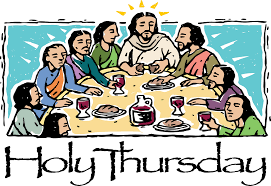
Holy Thursday is all about the priesthood and the institution of the Eucharist at the last supper. On the Morning of Holy Thursday, there is only one mass celebrated in a Diocese (Although the Chrism Mass may be celebrated earlier in the week). All the priests gather around the Bishop and the people of God to renew their commitment to priesthood. Also at this Mass the oils of Chrism, Catechumens and the Oil of the Sick are blessed by the bishop, these holy oils will be used in the Baptisms, Confirmations and anointing of the sick in the local parishes over the next 12 months. The theme running throughout this day is one of humble service that is service of God and his people.  The Evening Mass commemorates the Last Supper again the theme is service and sacrifice both of these are aspects of the same mystery.  The scene in the upper room is not your usual friendly night out. There is something about the host which makes this meal different.  We see Jesus on his knees as one who demonstrated the parable of his kingdom: that in his upside-down world, the king was servant, and the person  who ministered to the other was master and king.

And whatever belonged to the creed of power and greed  had no place in Jesus Gospel of love and service . He gave them the most costly gift he could give: the gift of himself. It was at this moment that Jesus identified himself for ever with bread and wine. He gave his followers more than food for thought; he gave them himself. In the same way in 2023 we receive Jesus in the form of Bread and wine from the hands of our priests. All these acts of self-giving service are the same act – that of the Son of Man who came ‘not to be served, but to serve, and to give his life as a ransom for many and he did that for  us all those years ago as well. May we take up the mantle of humble service giving a helping hand to others and not counting the cost to ourselves. Many people over the years have given much at great personal cost and have not failed in their example of humble service and that for me  is what  Holy Thursday is all about  Humble service for others and not being afraid of being the presence of Christ no matter what the cost is.  Jesus has shown us that it is worthwhile to pay the price for who we are and for what we stand for as his followers; it is worthwhile to pick up our bill for having fellowship with him.

The liturgy on Holy Thursday is a meditation on the essential connection between the Eucharist and Christian love expressed in serving one another. Christ is not only present in the Eucharist but also in the deeds of loving kindness offered to others through us. We are the ones who make ‘real’ the presence of Jesus in every smile, kind word and loving action. On Holy Thursday the Lord invites us again to copy what he has done for us and that is to serve others as he did when he washed the feet of his followers on that first Holy Thursday evening. 

Palm Sunday

On ash Wednesday we placed the ashes on our foreheads as a sign of our humility as we began our Journey for Lent and now six weeks later on Palm Sunday we remember Jesus entrance into Jerusalem on a donkey as the people raised their voices in joyful acclamation as they sang hosanna to the Son of David.  As we move from the Hosannas of Palm Sunday to the Upper room on Holy Thursday and then to the denials of peter and the Cross of Good Friday when all seemed to be lost. And then we come to the Resurrection when all that seemed to be lost on Good Friday was redeemed and renewed. So now we stop and reflect for a moment on how we began our journey on Ash Wednesday and where we are now as we approach the life changing and life giving events of Holy Week.  The entrance into Jerusalem is one of the very few events in Jesus’ life which is mentioned in all four gospels.  It is the only time that Jesus accepts and encourages public acclaim as Messiah. 

He even goes as far as organising his entrance by telling the disciples to go and fetch the donkey.  The key moment in God’s plan of salvation is about to begin and Jesus knows exactly how it will unfold as he knew and understood what the will of the father would mean for him. The first reading from Isaiah, speaks of a courageous and obedient messiah-figure, who says, “I have set my face like flint” against the beatings and scourging that lie ahead, “knowing that I shall not be put to shame.” The second reading from Philippians reminds us of Jesus’ total emptying of His divinity in order that He might identify Himself with the lowest criminal being led to His execution, “obedient to the point of death, even death on a cross.” And the reading continues but God raised him high and gave him the name above all other names. We move towards the heavenly Jerusalem because Christ himself made the journey to the Cross for us and now he offers to make it with us here and now in 2023. The full drama of the Gospel  begins with the crowd’s fickle acclamation of Jesus as King. It reminds us of our own fickle response and our lack of courage in responding to His love and truth.

 Palm Sunday and Holy Week are about Jesus suffering for our inadequacies and our own sins. This week is a time for us to understand what we are really like, and to find that the only remedy for our pain and our fears is love. Our journey during Holy Week is a journey about god’s love for all of us that is manifest in the cross of Good Friday.  May the passion story inspire all of us to try to imitate in some small way the all loving all forgiving Jesus who went through betrayal to death and finally to resurrection for us so that we will have life and have it to the full.  In just three years of his life, Jesus set in motion a change in the hearts of thousands, then millions, then billions of people. Just three years of walking around healing the broken, freeing person’s enslaved spirits, bringing hope, purpose, and meaning to the poor. Those “poor” included people with wealth, with power, with influence. But mostly it includes us ordinary folk who live with pain, suffering, anxiety, failed relationships, fears of inadequacy, lives lived on a hamster wheel in pursuit of wealth, power, influence, and accumulation. The Church leaves us in no doubt on Palm Sunday that we have now set out on the solemn journey of Holy Week. How will we mark this journey in the coming days? Will we let it pass by with little interruption to our normal routines? Or will we prayerfully walk with Jesus through Holy Thursday to the cross of Good Friday and then to the Feast of Easter.  It is up to each one of us to make up our minds how we will celebrate the great events of Holy Week that are at  the heart of all we believe in 2023.

5Th Sunday of Lent

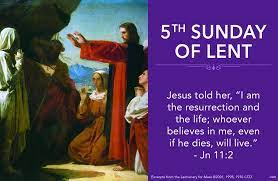
We are now at the 5th Sunday of lent as we look towards Palm Sunday and Holy Week. And, as the drama intensifies in the tension between Jesus and the Pharisees, so too, our personal struggle to overcome the weak spots in our spiritual armor should also “heat up.” There’s so little time remaining before our well-deserved Easter joy! As usual time has just flown in it seems to me that it has been no time since we celebrated the feast of Christmas  and  that was three months ago!!  Time waits for no one is certainly a saying that is so true. I hope that Lent hasn’t served to mire us in guilt and shortcomings. Instead  the Sundays of Lent give us the opportunity to look at where we have been, where we are and where we need to go  as we listen to the Word of God. The prophet Ezekiel tells us God intends to “open your graves and have you rise from them.” And again, as John puts it:  Jesus is “the resurrection and the life.” And we see this especially in the Gospel which is a pointer to the resurrection of Jesus on Easter Sunday. It seems a bit strange to have this gospel on the Fifth Sunday of Lent . It seems to be clearly about the resurrection and yet we are still plodding through Lent and have to get through Good Friday before we get to Easter and the joy that is there waiting for us.  Beneath the layers of theology in today’s Gospel reading, John tells us that Jesus had some very good friends.  Some people followed Jesus for what he could do for them.  But Martha, Mary and Lazarus seem to be  the type of people that would “sit around the table with a glass of good wine and share the daily life” kind of friends. The kind of friends whose faces “light up” with  arms open wide when you meet them. The kind of friends who will witness your execution and stay with you when others run away. They are the friends you are one in spirit and mind with.  This sort of friendship brings life and joy, to individuals and to communities.

It seems to be another good image of Church – Jesus surrounded by people who love him and each other, working together to bring life to others. Martha and Mary both say the same thing when they meet Jesus, “Lord, if you had been here my brother would not have died.” When Jesus tells Martha, “Your brother will rise,” she professes faith that he will rise, “in the resurrection on the last day,” Then she professes her faith in Christ as “the Son of God, the one who is coming into the world.” But neither Martha nor Mary express faith that Jesus will resuscitate their dead brother. In fact, when Jesus orders the stone removed Martha says, “Lord, by now there he will smell, he has been dead for four days.” Do you notice that Jesus doesn’t work some miracle to remove the stone from Lazarus’ tomb? He asks others to do it for him. When that barrier is removed, Jesus calls Lazarus forth to life. The gripping drama of the rising of Lazarus points towards Jesus as the Lord of Life and prepares us for the celebration of our sharing in His Life at Easter. this Gospel is also a call and a command for all of us  to stop and consider if we are in a tomb, the tomb of a faithless life and if so, it asks us to hear the voice of the Lord calling us to shore up our courage and to come out of the tomb. The Gospel calls us to walk to the Lord and then to walk with the Lord as he shows us the way. As we go forward on our Good Friday journey to Calvary, we should not fear the power of evil that so clearly fuels the plotting of the Pharisees. All evil in this world will have a short life. We need fear only our own weakness and vulnerability, our own false selves. From the deadness of our sinfulness and fears, we need to open our ears and our hearts to hear Jesus calling us to come into a new life. How loving and compassionate is our God in the person of Jesus! He wept over Lazarus, wept over Jerusalem, he weeps over those killed through terrorism and war, through famine and disease, and-weeps when we fail to forgive one another.

In these days of continued wars, terrorism, and ethnic hatreds, may we reflect on the truth that Jesus had to give his own life that we might have life and have it to the full. Lent may be winding down, but there is still time for us to receive the sacrament of penance.  There is still time left for our Lenten Spiritual Spring cleaning. There is still time for us to be at peace with ourselves and with our Lord.  May we appreciate more each day that we are privileged to share with Jesus in his continual work of bringing the world from darkness to light, from hatred to forgiveness, and from death to life. We ask God today for the courage to walk away from that which is killing us and to walk towards the Light. We ask the Lord for the courage to walk towards the voice that is saying, Lazarus, Come out which in turn is asking us to come away from all that entombs us to  the everlasting love of God. 

4th Sunday of Lent +


This Sunday has a particular place among the Sundays of Lent. In Advent we had Gaudete Sunday, so in Lent we have a Sunday commonly called Laetare Sunday. The word laetare comes from the Latin and it means rejoice; this Sunday is a day of joy. Even the vestments may be different as the celebrant has the option to wear rose vestments instead of the purple of lent. Our gospel for this weekend  is  about the blind man, in this story we have another example of God’s choice, one which confuses the religious leaders of the day. John’s beautifully crafted story tells how a blind man comes to see the light in Jesus, both physically and spiritually. When Jesus’ disciples first see the blind man they presume that his affliction is a result of sin. But Jesus sees in the blind man something else: this roadside beggar who has always inhabited a world of darkness will be the one to display the work of God and point to who Jesus really is. If we are to really see clearly, we need to let Jesus heal us of our blindness  and open our eyes as He did the man born blind in this weekend’s Gospel.  This is a challenging gospel story for all of us even today because so many people are spiritually blind.

It is possible that the places and things we think we are seeing clearly are not as clear as they should be.  Remember that the ones, who were 100% sure they knew what was going on, the Pharisees, were blind to God. They were religious experts, like many other experts they missed the truth staring them in the face. The one who is turning their world upside down was the Son of God who was trying to open their eyes. There are many things that raise questions and upset our routines these may be the very places God is trying to open our eyes and give us the vision to set things right for our lives. The story of the blind man getting his  sight gives us an opportunity to pause and ask ourselves:  How well do I see? Do I see what is really going on in my life? Has the road I have taken made me lose my way?  Are things happening to me that make me trip up and stumble like a person walking and groping around in the dark? We need to ask ourselves: what is blurring our spiritual vision these days? What’s dulling our appreciation of life and gods place within it? As we remember the Blind spots in our own lives we also remember that faith always remains a choice we make that helps us to see with great clarity of vision. When we choose to trust in God and believe in what he reveals to us, we exercise our freedom to believe.  Our minds and wills freely cooperate with God’s grace.

Faith is not and can never be an act coerced by God or others. Faith in God and each other is a journey which takes along many roads and the road we are called to follow during Lent is the road that leads us to Jesus the light of the world at Easter. The question we should ask ourselves is this: will we continue to be blind or will we let our faith in God heal the blindness of our lives and our world so that we may rejoice in the Lord at Easter and there after as we continue our lives of faith.

Third Sunday of Lent

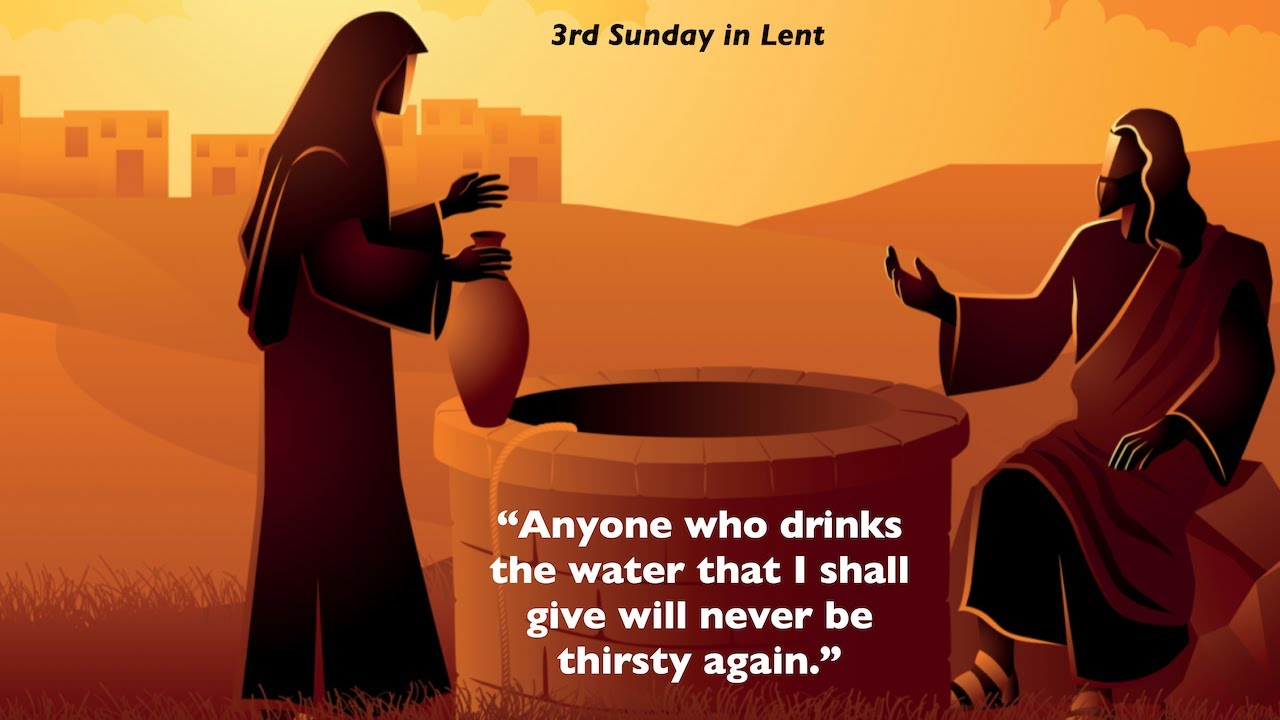
As we continue our journey of prayer for lent we come to the 3rd Sunday. Our gospel story tells us about the Samaritan woman at the well.  What a surprise it must have been for her when Jesus, tired, hungry and thirsty, asks her for a drink of water! He broke all the rules in speaking to her and as we know Jesus didn’t let the rules get in the way when he saw an opportunity to make a difference to someone and the life they are leading. Jesus suggests that He can give her living water that is far superior to anything she had ever tasted. We presume she was no stranger to intoxication, power, and money! Jesus offers this woman spiritual grace that is living water. Finding her heart curious and open to this miraculous water, He proceeds to raise her vision. He asks her to go back and bring her husband to the well with her. Of course, this is the turning point of the story. When He confronts her with the truth, she could have flounced off in righteous indignation and denial as many people do when confronted with the truth of their lives but she doesn’t run away as many of us would do.

In true humility, she accepts the reality of her life. Because of her humility, Jesus floods her soul with grace. Lent is a time for us to let Jesus satisfy our thirst for the truth. Like the Samaritan  woman, we too have tried the all kinds of water to quench our thirst for happiness, satisfaction, and peace of mind without really finding it. Lent   is the time for us to find real joy and satisfaction of letting the Lord fill us with grace in order to fully enjoy the season of Easter. We will find that our joy comes from the well of salvation the living water is greatest when we share the gift of salvation with others by really listening to them, praying from the heart in a quiet place, reflecting on the Word privately or at Mass, and letting the Eucharist change us into the Body of Christ his church.  The Samaritan woman at the well reminds all of us who doubt, or struggle with faith that we should take encouragement to stay in the conversation with Christ. The Woman at the well  came looking for physical water and found Jesus, the “living water,” who would quench her thirsty spirit. Physically, our bodies are dependent on water: without it we die. Spiritually, our life depends on the grace and pre­sence of Christ, so he is like spiritual ‘water’ which refreshes, quenches our ‘thirst’ or longing, and gives us health and vitality; without it we are bound to die spiritually.  One of the responses for the psalms of the Easter vigil sums up what this gospel is really about  it tells us with joy you will draw water from the wells of salvation May we find joy at the well of salvation which is Jesus Christ, the living water of salvation and life.

=

Second Sunday of Lent

This weekend we continue our journey through Lent  and hopefully the  various  aspects of penance alms giving and fasting that we are undertaking are not too hard. This Sundays gospel story is about the Transfiguration. This momentary vision of Christ, in his glory, was given in order to strengthen the three Apostles Peter James and John  to face the trials to their faith which the sufferings and crucifixion of their beloved master would bring to them. For the very same reason this Gospel is retold to us today, in the early part of Lent so that we will strengthen our resolve to keep our faith.  The voice of the Father told the apostles “This is my Son, the Beloved; with whom I am well pleased; listen to him!” What is so important about listening to Jesus? Wouldn’t we rather have the spectacular vision as a sign of God’s presence in our lives of course we would. We live such regular, ordinary lives most of the time and such a vision might help us get stirred up and enthusiastic again. Well it’s not really about the big splash, or the spectacular vision on the mountain, instead its all about listening to Jesus and hearing what he is saying to us in our own time and place.

To really listen to anyone with your heart is a  hard thing to do sometimes we have to listen to someone going on about something that is or at least seems to be complete rubbish to us but is really important for them. Listening to Jesus means not just hearing his words, but listening  to his words with your heart and learning from everything his life and his story tells us about how we should  live our lives as a children of God. There are many people out there who listen to the story but don’t take it to heart. Jesus, trusted His Father’s plan completely with faith that recognized his dependence on his Father. This is the same sort of faith that you and I are asked to embrace during lent and throughout our lives. Through prayer we remain in contact with the heart of God which allows God’s love to transform and transfigure us and to ‘burst forth’ in goodness. Being transfigured is about allowing the presence of God to completely transform us; it’s a revolution of mind and heart driven by God’s Spirit and enabled by our open heartedness to that spirit so that God is seen in, and experienced through us. It takes faith and perseverance to dare to allow ourselves to be tempted by the passion, hope and vision of God rather than what we want for ourselves. if we have faith in the living word of Jesus  the son of the Father then as a result of that faith by our words and actions we will be able to transfigure our own lives and the lives of those around us as we continue our Journey of faith during Lent. Let us remember the words of our Father in heaven from this Gospel Reading who said “This is my Son, the Beloved; with whom I am well pleased; listen to him!”

First Sunday of Lent

With the ashes of ash Wednesday and the call to repent and believe the gospel ringing in our ears  we are at the 1st Sunday of Lent.  Our Gospel Reading  for this Sunday is all about the temptation of Jesus in the wilderness by the devil. In the same way that Jesus went out into the dessert God asks us to go out into the dessert during the 40 days of Lent to undertake this time of renewal. Why do we have Lent every year? Why penance? Why fasting? Why almsgiving? Many people fail to see the connection. “I’m not a sinner when the truth is I AM A SINNER”  So why Lent? Lent is the time for correcting our faults and raising our minds and hearts to God. A time for personal and community conversion of heart and renewal! A time for coming face-to-face with God – our origin, our purpose and our destiny and being changed for the better and forever by that encounter!  The bottom line for all of us during Lent is that we should try to get to know God better by works of faith and charity so that those not too easy to detect lines separating good and evil will become more apparent.  

The Church teaches that prayer, fasting, and almsgiving are significant ways to become closer to God.  The decision for each of us is to determine what form of those three things to make our own this Lent. The temptations, to which our Lord submitted himself, are a source of encouragement and consolation for all of us. If our Lord and master underwent temptation, we cannot and must not expect to live a Christian life without experiencing temptations and trials. The three temptations Satan put to our Lord were suggestions to forget his messianic mission of redemption for one and all of us. He was urged to get all the bodily comforts of life, all the self-glory which men could give him, and all the possessions and power this world has to offer. In the same way all the comforts of life are put before us including the self indulgence and glory which is the exact opposite of our calling as followers of Christ. During Lent we are called not to give in to the temptations of this life instead we are called to renewal of heart mind and Spirit so that we can live in god and god can live in us through faith.   Jesus trusted the Spirit to take him into the desert to be tempted. Jesus knew the Father completely. He weathered the temptations that were presented to him by Satan in the desert. As we begin Lent for this year It is the way, the truth, and the life we seek and we pray to the lord hide not your face. We also  pray that god may give us his grace to make a good Lent as we begin our journey  on the road to Easter joy.

7Th Sunday in Ordinary Time

Next Wednesday with the Ashes of repentance we begin the holy season of Lent. On Ash Wednesday we are called to repent and believe in the Gospel as we place the ashes on our heads. For us the 6 weeks of Lent will be a time of soul searching and a time for renewal of heart mind and spirit as we look forward to Holy Week and the Easter Celebration. This Sunday in our Gospel we are told that we should offer the wicked man no resistance and that we should love our enemies and pray for those who persecute us these are strong words even now in our own time and place. Jesus asks his followers to take a different approach by resisting retaliation altogether. The response to a stronger person who slaps us on the cheek, takes us to court, or demands a service of us is not to resist. Similarly, for a weaker person, such as a beggar or borrower, we are to give him or her what he or she asks for. Those who are called to the Kingdom of Heaven are to go beyond the way the world usually works and serve God’s kingdom here on earth. We must, if we are truly Christian, forgive those who offend or injure us. We must love all people, whether they are friends or enemies.

G. K. Chesterton says : “We are commanded to love our neighbours and our enemies;  very often we find that they are the same people.” . It is very easy for us to love in a theoretical way all people as they never come in contact with us in a personal way and never tread on our feet.  Jesus argues that the love that we his disciples give is not related to the love they receive from others: it is not a social contract or a fair bargain it is unconditional. The disciple loves because that is what the nature of discipleship involves. That means loving your enemy as yourself and doing good to those who persecute you . A disciple is the child of the Father  and look at the Father’s gracious love for us as we are. He does not withhold the sun and the rain from those who oppose him; likewise, disciples must not withhold their love from those who oppose them. The love is offered not because Jesus thinks that it will change the enemy into something else, Love is offered because that is the example and the way of life disciples of the kingdom should follow. Jesus is telling us not to follow the way of the world, which often perpetuates old oppressions and makes new ones as well. Jesus is telling us that we should be agents of real change in the world by acting in unexpected ways. This means that we do not go along with the crowd but rather approach the various situations of life with new and imaginative thinking as befits a disciple of Christ. He wants us to see the world from the top down as God does. And then  by seeing the world the way it really is with all that is good and bad within it we will find that we are in a far better position to change it. True Christian virtue always goes beyond merely what is required. It is always willing to ‘go the extra mile’ in tolerance, love, forgiveness and mercy. It mirrors the excessive generosity of God. The perfection of true holiness is found in acting towards others, including our enemies, as God acts towards us all with love beyond all telling.

6th Sunday of Ordinary Time

This weekend we celebrate the feast of Our Lady of Lourdes on Saturday as well as the world day of Prayer for the sick. We remember  in a special way all those who are sick in the places where we live as well as all those caregivers who look after them.  Following two Sundays of discipleship training we come to the discipleship that is the  easiest to understand. It is about compliance, about rules and regulations. The First  reading from Sirach sets the theme very clearly. “If you choose to keep the commandments, they will save you: if you trust in God you shall live. Before man are life and death, good and evil, whichever he chooses shall be given him.” That is a clear statement about will-power, choice. There seems to be nothing about using our heads to think, to discover meaning, nothing about growing spiritually, nothing about forming our personal characters. Just show me the rules, give me the commandments, let me know what behaviour is expected and I’ll choose life.

Stick to the letter of the law and we’ll be saved from an eternity of damnation and that’s what the pharisees in the Gospel for this weekend were all about keeping the rules and regulations.  In the Gospel reading for this Sunday Jesus tells us that he has come to fulfil the law not to abolish or replace it.  When he introduced the New Law of the Kingdom of God Jesus said something that was absolutely shocking to those heard what he told them that the holiness of the people had to surpass that of the scribes and the Pharisees. How could anyone be holier than the Pharisees who were supposed to be holy men”!  They dressed well, they fasted said their prayers loudly for all to hear. Jesus explains, our external actions must be a reflection of what we are really like. If what we do is not a reflection of who we are, then we are hypocrites. Hypocrite, is the word that Jesus uses over and over to describe the Pharisees. They were considered the righteous and holy ones who in truth were neither righteous or holy in so many ways.  Jesus’ challenge was not only to his followers, but to the Pharisees and scribes as well.  

Their religious faith was to go deeper than exterior works – the right motives were supposed  to support the right behaviour. His demands are high indeed!  They seem impossible to achieve. The Pharisee spent a lot of time and energy fulfilling the Law like so many people today the law was more important than compassion. They were of the middle class and unlike the desperately poor, who were most of Jesus’s followers, the Pharisees had the education and leisure to pursue the purity of observance. What chance did the illiterate, overworked and burdened poor followers of Jesus have? For that matter, what chance do we have in fulfilling these teachings? Jesus’ demands are more radical; his vision sharper; his expectations greater in regard to  looking after his  poor illiterate, overworked and burdened followers. When we see our own record of doing good against the demands of Jesus in the Gospel, we all come away feeling helpless. Our own efforts look so shabby against the clear unambiguous demands of the larger vision that Jesus had.

May we be courageous in taking up the challenge that Jesus vision gives each one of us today that is the call to live our lives so that everyone will see that we are faith filled people who live our lives with the compassion of God for those around us in our hearts and that we are not afraid to show it.

Post Navigation