As we all know the corona virus pandemic is ongoing and throughout the world many Churches are taking precautions and we here in Northern Ireland where I live are no different. Many people out there are panic buying and believe it or not Toilet Rolls are the hard to get thing such is the panic !!!! But for all of this we need to look out for one another and follow the guidance of the Government and Church authorities wherever we are in the world. We are also asked to look out for those who are vulnerable in our communities especially the Old and those who are unable to get around who might have other health worries as well.
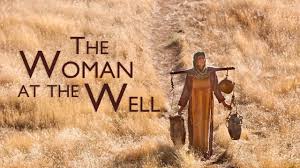
As we continue our journey of prayer for lent we come to the 3rd Sunday and our gospel story for this weekend tells us about the Samaritan woman at the well. One of the responses for the Easter Vigil is with joy you will draw water from the wells of salvation and this sums up what the reading from johns gospel is about. It is about the great joy that comes from being a Christian a believer in the good news of the Gospel. Jesus breaks the law to speak to a Samaritan woman who had come to Jacob’s well to draw water.
What a surprise it must have been to her, when Jesus, tired, hungry and thirsty, asks her for a drink of water! He broke all the rules in speaking to her. Now, He keeps on talking, ignoring her hostility, aware that, in this unexpected encounter, the Father has provided Him with an opportunity for piercing the heart of this sinful woman with His love and also leaving an example for all those who thirst. Jesus suggests that He can give her living water that is far superior to anything she had ever tasted. Certainly her five husbands haven’t brought her what she is really looking for. We know that she had tried cheap love, and we presume she was no stranger to intoxication, power, and money! This isn’t a gentle lady who comes to draw water from the well, but a toughened cynic. Cynical with the world around her in her time as so many are cynical in our modern world for many different reasons. Jesus forgets His own needs, and offers this woman living water that is spiritual grace. Finding her heart curious and open to this miraculous water, He proceeds to raise her vision. He asks her to go back and bring her husband to the well with her. Of course, this is the turning point of the story. When He confronts her with the truth, she could have flounced off in righteous indignation and denial as many people do when confronted with the truth but she doesn’t.
In true humility, she accepts the reality of her life. Because of her humility, Jesus floods her soul with grace. Dropping her bucket, she runs back to spread the good news. “I’ve found the Messiah!” And she had! Lent is a time for us to let Jesus satisfy our thirst for the truth. Like the Samaritan woman, we too have tried the wrong kinds of water to quench our thirst for happiness, satisfaction, and peace of mind without really finding it. Lent is the time for us to find real joy and satisfaction of letting the Lord fill us with the grace in order to fully enjoy the season of Easter so that we can say “I’ve found the Messiah!”. The Samaritan woman reminds those who doubt, or struggle with faith that all of us are like that we all have doubts about our faith but we are asked to stay in a conversation with Christ. The Samaritan woman at the well came looking for physical water and found Jesus, the “living water,” who would quench her thirsty spirit. May we find joy at the wells of salvation brought to us through Jesus Christ as we go forward during Lent to Easter.
Over the past few weeks we have been hearing about the spread of the COVID19 virus throughout the world especially in Europe. It would seem that if we follow the guidance of the various health agencies with regard to hand washing etc we will be ok. We remember in a special way all those who are affected and those who have died as a result of the virus and their families. We also remember the healthcare professionals who are one the front line during this time. Despite the Corona Virus we continue our Lenten journey and hopefully the various aspects of penance alms giving and fasting that we are undertaking are not too hard. This Sundays gospel story is about the Transfiguration. This momentary vision of Christ, in his glory, was given in order to strengthen the three Apostles Peter James and John to face the trials to their faith which the sufferings and crucifixion of their beloved master would bring to them. For the very same reason this Gospel is retold to us today, in the early part of Lent so that we will strengthen our resolve to keep our faith. The Father of Jesus told the apostles “This is my Son, the Beloved; with whom I am well pleased; listen to him!” What is so important about listening to Jesus?
Wouldn’t we rather have the spectacular vision as a sign of God’s presence in our lives of course we would. We live regular, ordinary lives most of the time and such a vision might help us get stirred up and enthusiastic again. Well it’s not really about the big splash, or the spectacular vision on the mountain, instead its all about listening to Jesus and hearing what he is saying to us in our own time and place. To really listen to anyone with your heart is a hard thing to do sometimes we have to listen to someone going on about something that is or at least seems to be complete rubbish to us but is really important for the person telling their story. Listening to Jesus means not just hearing his words, but listening to everything the story of his life tells us about how we should live our own lives as a children of God. There are many people out there who hear the story and pay it lips service but don’t take it to heart. Jesus, trusted completely in His Father’s plan for him with faith that recognized his dependence on his Father. This is the same sort of faith that you and I are asked to embrace during lent and throughout our lives. For us in 2020 this gospel asks us to listen to Jesus words and bring them into our lives so that by our words and actions we will be able to transform and transfigure our own lives and the lives of those around us.
In our Lenten journey this week, may we keep in mind that God and the community around us provide us with encouragement and strength to continue our lives rooted in faith. So let us keep on going this Lent so that we will be able to celebrate the Easter Feast renewed in Heart and soul.
With the Ashes of Ash Wednesday we have begun the season of Lent for 2020. We have heard the words repent and believe the Gospel but what does lent really mean for us in 2020. Lent should mean that we take time to renew our spiritual selves as we go forward to Holy Week and Easter. Why do we have Lent every year? Why penance? Why fasting? Why almsgiving? What does that have to do with us? Many people fail to see the connection. ” many say I’m not a sinner when the truth is I AM A SINNER” So why Lent? Of course We know the answer that the Church gives us. We have to prepare ourselves during Lent for the celebration of Holy week that leads us on to Easter the season of the resurrection. Lent is a time for correcting our faults and raising our minds and hearts to God. Lent is a time for personal and community conversion it is also a time for personal and community renewal! It is the time for a face-to-face encounter with God our origin, our purpose and our destiny and hopefully we will be changed for the better by that encounter! The bottom line for all of us during Lent is that we should try to get to know God better so that those not too easy to detect lines separating good and evil will become more apparent to ourselves and everyone else.
The Church teaches that prayer, fasting, and almsgiving are good significant ways to become closer to God How we do these is something that is personal to each person. The temptations, to which our Lord submitted himself to in this Sundays Gospel story are a source of encouragement and consolation for all of us. If our Lord and master underwent temptation, we cannot and must not expect to live a Christian life without experiencing similar trials. The three temptations Satan put to our Lord were suggestions to forget his purpose in life that is his messianic mission of redemption for one and all. He was urged to get all the bodily comforts of life, all the self-glory which men could give him, and all the possessions and power this world has to offer. In the same way all the comforts of life are put before us including the self-indulgence and glory which is the exact opposite of our calling as followers of Christ. We are called during Lent not to give in to the temptations of this life we are also called to renewal of heart mind and Spirit. As we begin Lent many things are placed before us to enhance our spiritual lives such as the early Mass which in our parish is at 7.15am or the Friday stations of the cross or some of the other spiritual programs. All of these help us to renew ourselves in preparation for the events of Holy week and the Easter feast.
May god give us his grace to make a good Lent as we take the road that leads us to Holy Week and the great feast of Easter.
Believe it or not next Wednesday is Ash Wednesday and my first thought when this came into my mind was here we go again. Another year gone full circle as we arrive back at Ash Wednesday and the 6 weeks of Lent. Lent is a time for giving up and taking up things that means giving up the things that we really enjoy such as Sweets and treats and taking up the opportunities such as the early Mass before work or the various Lenten programmes that are available in the places where we live. Lent is the time that we should use to renew ourselves and our spiritual lives. Lent also gives us the opportunity to give alms to others through the Church organisations .
This Sunday in our Gospel we are told that we should offer the wicked man no resistance and that we should love our enemies and pray for those who persecute you these are strong words. Jesus asks his followers to take a different approach by resisting retaliation altogether. The response to a stronger person who slaps us on the cheek, takes us to court, or demands a service of us is not to resist. Similarly, for a weaker person, such as a beggar or borrower, we are to give him or her what he or she asks for.
Those who are called to the Kingdom of Heaven are to go beyond the way the world works and serve God’s kingdom here on earth. We must, if we are truly Christian, forgive those who offend or injure us. We must love all men, whether they be friends or enemies. G. K. Chesterton says : “We are commanded to love our neighbours and our enemies; very often we find that they are the same people.” This is very true for all of us. It is very easy for us to love in a theoretical way all people as they never come in contact with us in a personal way and never tread on our feet. But it is those among whom I live and work, who are liable to injure me and might become my enemies. Jesus argues that the love that we his disciples give people is not related to the love they receive from others: it is not a social contract or a fair bargain it is unconditional. The disciple loves because that is what the nature of discipleship involves. That means loving your enemy as yourself and doing good to those who would persecute you . A disciple is the child of the Father and look at the Father’s gracious love for us as we are. He does not withhold the sun and the rain from those who oppose him; likewise, disciples must not withhold their love from those who oppose them.
The love is offered not because Jesus thinks that it will change the enemy into something else: certainly, love might confuse the enemy! Love is offered because that is the example and the way of life disciples of the kingdom should follow. Jesus is telling us not to follow the way of the world, which often perpetuates old oppressions and makes new ones as well. This only leaves people stuck and unable to move forward. Jesus is telling us that we should be agents of real change in the world by acting in unexpected ways. This means that we do not go along with the crowd but rather approach the various situations of life with new and imaginative thinking as befits a disciple of Christ. He wants us to see the world as God does. And then by seeing the world the way it really is with all that is good and bad within it we will find that we are in a far better position to get out there and change it.
This Sunday we celebrate the 6th Sunday in Ordinary Time and for us in Northern Ireland we are pondering what happened last Saturday in the Southern Irish Election and the result. A result that has placed Sein Fein in the political driving seat and side-lined the other 2 political parties what will happen going into the future is anyone’s guess but we hope and pray that changes will be made that will benefit everyone.
In the Gospel reading Jesus tells us that he has come to fulfil the law not to abolish or replace it. Any new movement or community which emerges from an older tradition has to face the problems of its own identity and direction. How different is it from the old community? How similar? One of the problems which the early Church had to face was its relationship with Judaism. Jesus was a Jew and his early followers were all Jews: they upheld the Law of Moses and they honoured the traditions of their own people. But there is also discontinuity with that tradition when it comes to healing on the sabbath, attitudes to Samaritans, and fasting. When he introduced the New Law of the Kingdom of God Jesus said something that was absolutely shocking to those heard what he told them that the holiness of the people had to surpass that of the scribes and the Pharisees. How could anyone be holier than the Pharisees who were supposed to be holy men”!
They dressed well, they fasted said their prayers loudly for all to hear. But Jesus said that his followers had to be holier than the Pharisees. How could that be possible as they were the people that everyone held up as being good. Jesus explains, our external actions must be a reflection of what we are really like. If what we do is not a reflection of who we are, then we are hypocrites. Hypocrite, is the word that Jesus uses over and over to describe the Pharisees. They were considered the righteous and holy ones who in truth were neither righteous or holy in so many ways. Jesus’ challenge was not only to his followers, but to the Pharisees and scribes as well. Their religious faith was to go deeper than exterior works – the right motives were supposed to support right behaviour. His demands are high indeed! They seem impossible to achieve. The Pharisee spent a lot of time and energy fulfilling the Law like so many people today the law was more important than compassion. They were of the middle class and unlike the desperately poor, who were most of Jesus’s followers, the Pharisees had the education and leisure to pursue purity of observance. What chance did the illiterate, overworked and burdened poor followers of Jesus have? For that matter, what chance do we have in fulfilling these teachings? And yet, Jesus calls for a holiness that surpasses those scribes and Pharisees the people who stuck by the letter of the law instead of the compassion of God! Jesus’ demands are more radical; his vision sharper; his expectations greater When we see our own record of doing good against the demands of Jesus in the Gospel, we can all come away feeling helpless.
Our own efforts look so shabby against the clear unambiguous demands of the larger vision. May we be courageous in taking up the challenge that Jesus gives each one of us today that is the call to holiness living our lives so that people will see that we are faith filled people who live our lives with the compassion of God for those around us in our hearts.
This weekend we pray for the sick as we celebrate the World Day of the Sick next Tuesday the feast day of Our Lady of Lourdes. We also pray in a special way for all those who care for the sick in our Hospitals and care facilities, Doctors, Nurses, Care assistants and Chaplains We also pray for the families who care for their Sick family members and friends at home may God bless all of them. We also hear about the Corona Virus and its continuing effects on China and the world at large and we pray for all those who are involved in that.
In our gospel reading this Sunday Jesus tells his disciples that they are the salt of the earth and the light of the world. He adds, “. . . your light must shine before others, that they may see your good deeds and glorify your heavenly father.” If we were to witness the events of this passage being acted on stage, I think we would find them humorous: Jesus telling a motley group of puzzled followers, many illiterate, that they are the light of the world and when we hear the gospel passage in church on Sunday, we assume that Jesus is talking to those first disciples, surely not to us. But Jesus is talking to us in the same way he spoke the Disciples long ago. .Jesus used salt as a metaphor to describe who his disciples are and how they are to be in the world. Just as salt draws out the flavour of food, so we as Jesus’ disciples we are asked to draw out goodness in the world.
As salt of the earth we may even have to upset the way things are and how life is ordinarily carried on – the usual “salty taste” of daily life in the world these days can be so topsy turvy as recent events have shown in many places . Jesus tells his disciples, “You are the light of the world.” They are to be seen, not hidden away they are called to be the light overcoming the darkness of our world and its peoples.
We in our own time are also called to be the “light of the world,” each one of us a tiny ray of light, dispelling darkness, living in charity toward all, including persecutors. This light is an inner light the light of faith . Its source is divine grace that becomes visible to others by our kind words, our gracious acts, our personal refusal to resort to “oppression, false accusation or malicious speech.” And thus, as Isaiah promised, the gloom of sin and death shall be overcome, or as the psalmist declares, justice and mercy of the upright will be a light shining through the darkness. Christ gives us a huge amount of latitude and invites us to carry out our role as his representatives with the maximum level of personal responsibility. We are invited to utilise our own special gifts and talents to inform our role of being a disciple who is the salt of the earth and the light for the world.
So let us turn to Jesus the light of life today, let us pray that we might share in his life, so that we might be the salt of the earth, and light in the darkness for all the people in our world still looking around for light in darkness of their lives.
In his Apostolic Letter of 30 September 2019, Pope Francis established that the Third Sunday in Ordinary Time to be the Sunday of the Word of God. It is a day to be devoted to the celebration, study, and spreading of the Word of God.
Each and every Sunday we listen to the word of God in the Scripture Readings at Mass and we hear the Gospel reading explained to us by the priest or deacon. Throughout the whole year we see the message of salvation placed before us in the readings from the sacred scripture texts as they tell us about the message of salvation from the Angel at the annunciation to the birth of Jesus in Bethlehem. From the temptation of Jesus in the dessert for 40 days during Lent to the Last Supper in the upper room and then to the Cross of good Friday and the resurrection from the tomb on Easter Sunday to Pentecost when the Church began with the Holy Spirit coming down on the Apostles.
All of these events are marked in and through the readings from scripture that we listen to week after week as they tell the story of salvation. We are called to listen as the reader, proclaims God’s Word. For in fact it is God who speaks to us when the Scriptures are read or studied. In our Gospel story this Sunday we hear about Jesus calling Andrew, Simon, Peter, James son of Zebedee and his brother John to follow him. As Jesus travelled around Galilee, he actively built a following. Biblical scholars speculate that the Galileans would network and form groups around social, economic, or religious issues. There was strength in numbers. This gospel is about the call of Jesus to the first apostles to be his followers. This gospel story is not just an echo from the past it is very much for us today as it was yesterday as all the stories in the Scriptures are call to us to action. The Word of God, that we listen to each and every Sunday which is living and active, challenges us and calls us individually and all of us together to a response that moves beyond the liturgy itself and moves out into our daily lives.
And the word of God should lead us to engage fully in the task of making Christ known to the world by all that we do and say. So on this day when we celebrate the word of God in a special way let us listen more attentively to the message of the Scripture Readings and put it into our daily lives.
This weekend we have the second Sunday in ordinary time. Christmas and new year are now a distant memory as we continue our spiritual journey. In the Gospel reading this Sunday we hear about the meeting between Jesus and John the Baptist at the Jordan River. We hear John telling us Look, there is the lamb of God that takes away the sin of the world. He is the one who I spoke about Yes, I have seen and I am the witness that he is the Chosen One of God.’
The first Christian communities saw a clear difference between John’s baptism that immersed people in the river Jordan and Jesus’ baptism that communicated his own Spirit, to cleanse, renew and transform the heart of his followers. Without that Spirit of Jesus, the Church would simply close up shop and die. Only the Spirit of Jesus can put more truth and life into today’s Christianity and lead us to recover our true identity, letting go of paths that lead us further and further away from the Gospel and what it teaches.
Only that Holy Spirit of Jesus can give us light and energy to fire up the renewal that we need today so that we can also become Christ’s authoritative witnesses in the world. A believer can only be an authoritative witness if he or she lives in harmony with two of the Baptist’s evangelical qualities. Firstly, knowledge of Christ that is cultivated through prayer, the sacramental and ecclesial life and good friendships. Secondly, the constant attribute of the person who goes in search of the Jesus is the virtue of humility because in everyone’s life, Christ must increase and we must decrease. We have all been baptized; through our Baptism we have been called to be witnesses to Jesus the chosen one of god. We are asked to point away from ourselves to the lord; as we lead others to know the person of Jesus. None of us comes to him alone we all know people who help us along on our own faith journeys. Most people are moved when others share with them what really matters in their lives. Perhaps we have lost the courage to say any more about what matters to us as people who take faith seriously perhaps we doubt if anyone will care and yet so many do. We should take courage to share what we believe.
With Saint John Henry Newman, we know that we believe because we love. In the power of that love, the Love of God made real in his Son let us share our belief with each other and everyone else as well. So that we can say with John the Baptist that Jesus is the lamb of God that takes away the sin of the world, he is the Chosen One of God.’ Let us follow him,
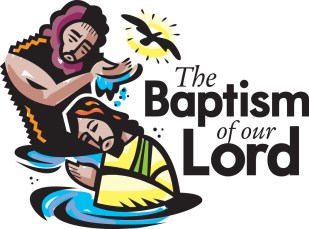
After the arrival of the Wise Men on the feast of the Epiphany on Monday we have come to the end of the Christmas season as we celebrate the Baptism of the Lord when Jesus was baptized in the river Jordan by John. This feast is also a reminder to us of our own baptism, most of us were baptised when we were babies and today we recommit ourselves to the promises that were made on our behalf when we renew our Baptismal Promises.
The figure of the Baptist is mysterious and captivating. He was the Precursor of Christ, not only two thousand years ago but in a sense also in our day. He is the voice, which makes us hear the Word which introduces us to the mystery of the redemption, who helps us to respond to the call to conversion, with humility and love. He helps us understand that the human person, every person in front of the Lord Jesus stands before the greatest mystery of our existence: the Mystery God made man! Our own Baptism calls us and empowers us to be Christ like that is what the word Christian means. Our humility can openly declare our trust in God the Father.
The great medieval theologian Thomas Aquinas whose feast day is at the end of January spoke of times of grace when God enlivens people in special ways for different tasks and this is what baptism is all about the grace of god enlivening us to live out our new beginning living life as people who are Christians that means Christ like.
The Holy Spirit is the power behind all our spiritual beginnings, when we are willing to begin, God is there as the grace behind our going out into the sea of faith. There are beginnings that we know are important like baptisms, marriages and ordinations. We like to mark these beginnings as important, so we surround them with ceremony to give a sense of occasion and there is an atmosphere of rejoicing. The new beginnings that we make in our own lives may not mark the fulfilment of anyone’s prophecy, but they probably mark the fulfilment of someone’s hope. Sometimes we are so hesitant about making a new start that we end up in no-man’s-land waiting for more weather reports wondering what to do instead of getting on with it. This weekend as we think about our baptism we stop and think about our journey of faith as we celebrate beginning of Jesus ministry, we look at our own beginnings.
And if some of them look a bit shabby now or half-hearted, we take consolation from the Gospel challenge to begin again. There probably won’t be any doves flying or voices from heaven, but as people of God we make our beginnings like Jesus with the help of the Holy Spirit. We are not alone. We make them in the power of the Spirit and in the love of the Father. So let us take courage to face our own rocky roads as the new year unfolds before all of us.
Some 20 years ago at the end of 1999 many people foretold that the turn of the new millennium would mean the end of the world. As we all know here we are at the end of 2019 looking forward to all the adventures that 2020 might bring to us and the end of the world has not happened though many things in our daily lives have changed with many people gone from our lives and the lives of those around us. We remember with thanks all that has been as we look forward to all that will be in the year that lies ahead
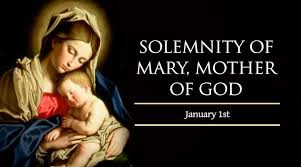
On the 1st of January we celebrate two things the feast of Mary the Mother of God as well as world day of prayer for peace in the world. While we exchange the new year greetings with each other we should try to lend a Christian understanding to this custom making of these greetings an expression faith in that regard there is no better teacher of faith than Mary the Mother of Jesus.
Mary teaches us that being a disciple of Jesus is a matter of the heart: contemplating Jesus and allowing his presence to transform the thoughts, words and actions of our lives. There is a mosaic in the Rosary Basilica in Lourdes which tells us through Mary to Jesus and that is what Mary is all about pointing all of us in the right direction towards Jesus her Son .On this feast we ask a special favour of Mary our mother and intercessor: that the love we have for Jesus her son will Grow in our hearts and lives!
Also we continue to pray for peace in our own lives in our countries and in the world. We live in a world where so many people are at war and we ask god to bless his people with peace of heart mind and soul during 2020. As We thank God for all that has been over the last year we pray through the intercession of Mary mother of the Church that God will be present with us in the good bad, happy and sad times we might encounter in the year that is ahead and give us the strength to continue our faith journeys wherever they may lead us.


 Fullerton T