Fullerton T

RELIGION LITURGY AND LIFE

Archive for the category “LITURGY”

32nd SUNDAY IN ORDINARY TIME

 

32_4c


In the course of his public ministry Jesus came across many people who had differing opinions about his message. This Sunday we hear about the Sadducees they accepted Roman rule and customs as a trade-off for retaining the power they had. The worldly influence of led them to be religiously conservative. Unlike the Pharisees, they accepted the written Law of Moses and rejected the authority of oral tradition. In our Gospel story they attempt to ridicule the resurrection of the dead by recalling the Mosaic Law on levirate marriage. The Sadducees develop an example to the point of absurdity in giving the example of seven brothers each of whom marries the same woman, but each of the brothers dies childless. None of the brothers has proved husband in terms of producing an heir: in that case, whose wife would the woman be in the resurrection?

In his reply Jesus makes it clear that there is no comparison between human life, shared by all, those who are children of God. Jesus makes the distinction between two ages and two peoples: the people of this age who live a life peculiar to this time, and those who are resurrected from the dead into a new age. The tightly wound arguments of the Sadducees and of Jesus present an interesting contrast. The Sadducees pointed to an ordinance in the Law to prove the absurdity of a popular belief. Jesus countered by refusing the key issue in their argument the afterlife was an extension of present life. Then, he proceeded to fuse the belief in the resurrection with the revelation of God to his people.Through his argument Jesus reveals something of his own image of God – a God who keeps his promise to his faithful ones even when they die. Jesus does more than argue that case he leads by example when the time comes he himself becomes the argument. He undergoes death on Good Friday and then he experiences the glory of resurrection on Easter Sunday when God the Father refused  to let death have the last word. The risen Jesus is the greatest argument against the Sadducees and their idea of religion and faith. Death has been overcome and sin need not dominate our lives. We may not have the plans for the arrangements of the next life, but what we do know is that we have the hope of God’s promise to us that He will rescue us from the darkness of the shadow of death and lead us into the light of Christ in our heavenly homeland.


31ST SUNDAY IN ORDINARY TIME

images-5

This weekend our gospel story tells us about Zachaeus the Tax Collector. The tax collectors in Jesus time were despised because they were seen as enforcing the tax system of a foreign country. It seems that Zacchaeus was a small man who was anxious to see the person that all the fuss was about; personally I think he was looking for something more in the spiritual sense as he climbed up into the branches of the sycamore tree to get a look at Jesus as he passed by.  Zacchaeus put his dignity and the prestige of his position on the line when he scrambled up the tree Jesus saw him and he saw his willingness to accept the message of salvation. The story of Zacchaeus encourages us to seek and find Jesus in our daily lives.  Sometimes we need to let go and climb up the sycamore tree of faith to a different level to see the Lord as he passes by .  

All of us have a role to play in the ongoing work of building up the kingdom of God in our own place.  Our task is to bring love and care to all the people we encounter whoever they may be.  If we ignore people and bring them down to our own sometimes self-centered level we end up being the thorns and weeds that are removed from the harvest and cast into the fire as rubbish. We come to worship in our churches each week to get a better glimpse of Jesus as our Faith is the “tree” we climb. Our hope is that Jesus will  give us a clearer view of where he is in the midst of the issues and struggles we face day and daily. We’ll stay in this “tree” where we meet the Lord each Sunday but just for a short while, then we will climb down to return to our daily lives. The final verse in today’s Gospel can help us interpret many other stories about Jesus. His key mission was “to seek out and save what was lost.” Jesus wants to come to the lost and confused parts of our lives. The parts we cover up and want to forget and there are so many dark places in people’s lives these days for so many reasons.

Jesus wants to make a home with us in the very places we have closed up and locked away. He knocks on the door of our hearts and invites us to let him in to change what we have given up on and so many people have given up on Faith and all it entails in recent times. He knocks on the door to bring out into the light the broken and discarded parts of our lives that need healing and Love. In the days ahead may we be like Zacchaeus not afraid to go out into the world climbing the tree to look for Jesus and not be afraid to bring his message to the people of our time.

28TH SUNDAY OF ORDINARY TIME

28c_4

This Sunday in our Gospel Reading we hear the story of the ten Lepers and their lack of gratitude. This is one of many such examples of ingratitude that occurred during Christ’s public ministry, most of those he cured forget to thank him. In today’s incident there was one who had the decency to return and thank his benefactor, and he was the one least expected to do so,. This pleased our Lord and led Him to remark on the ingratitude of the others. “Were not all ten made whole, where are the other nine?” This Gospel story is not only about the Lepers it’s also about our lack of gratitude for the many good  things that we have in our lives given to us by God. When we were youngsters growing up we were taught to say, “Thank you” by our parents when they gave us a sweet or whatever, when we didn’t we would be dutifully reminded, “What do you say?” and of course we said the magic words ‘Thank You.’

All the lepers showed great faith and confidence in Jesus’ power to heal but only one of them said thanks. They had not heard Him preach nor had they seen any of His miracles. They lived in isolation camps because of the leprosy, yet they believed the reports they had heard.  The nine lepers were appreciative of what Jesus had done; we don’t know, why they didn’t bother to show their gratitude to Jesus. We can only look to ourselves to ask why we are often reluctant to say thank you for all the things we have. There is seems to be great deal of awkwardness surrounding the attitude of gratitude and saying thank you. Personally I find that to be thanked means more to me than being given a gift for a task just done. Whatever the reason for our own ingratitude, we know that it diminishes us and those who help us. All of us have reasons to give thanks for so many things yet very few turn to the Lord with words and hearts expressing our thanks for all the wonders he has done for us in our lives.  We need to ask ourselves today, “Am I really grateful for God’s constant love? Or do I just take Him for granted?”

Do we have the attitude of gratitude which thanks god and those around and us for their goodness to us.  When we gather each Sunday we come to join God in the midst of the assembly with gratitude in our hearts. We give praise and thanks to God and we thank God for all those who have given us their help. May all of us have the attitude of gratitude for all the good things that we have in our lives which means that we are thankful for all that we are and all that we have.

27TH SUNDAY IN ORDINARY TIME

download-5

This Sunday here in Ireland we celebrate our annual Day for Life, it is the day when we give thanks to god for his gift of life. These days many people think that life is not worth a lot and many support abortion euthanasia and other forms of destruction of life. I on the other hand believe in life from the womb to the tomb with all the in between stages with all the ups and downs that life brings. So this weekend We pray in a special way for the gift of  life that god will give us the grace to cherish and defend it from conception to natural end.

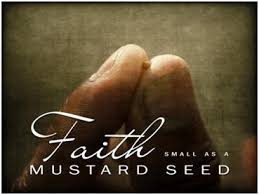
This Sundays gospel is all about having faith, Jesus tells the apostles Were your faith the size of a mustard seed you could say to this mulberry tree, ‘Be uprooted and planted in the sea’, and it would obey you”. So many people have little or no faith and many who have been brought up in the catholic faith have left for many reasons. Perhaps we think that having faith means believing certain things. If I want more faith is it so that I can hold more firmly to the “truths of the faith?” Thinking our faith lacks sufficient size can keep us from doing so many things that we are called to do by our faith in Jesus the Son of God and face of the Fathers Mercy. The disciples must have thought their faith was so small they couldn’t act on it. But Jesus wants his disciples and by association ourselves to trust and act on our god given faith. The alternative to acting out of faith would be saying things like: I can’t take on that responsibility, I don’t have enough faith. I can’t be kind to those people that will take more faith than I have. The disciples may have felt similar inhibitions after hearing what Jesus just taught about not leading others into sin and the necessity to forgive someone seven times a day (17 1-5). But Jesus teaches, “Act on the little faith you have. You’ll be surprised what you can do.” His example of the deep-rooted mulberry tree underlines his lesson about the power of the smallest seed of faith to work marvels. We may find ourselves doing something that surprises us and those who know us. Perhaps it’s a great act of charity; working away on another’s behalf; or, an act of forgiveness. Such deeds often win praise among those around us. But despite the remarkable things we might do, we must acknowledge the source of all our good deeds – the mustard seed that is faith planted in us by God. Realizing this we can say with those servants in the parable: “We are unprofitable servants, we have done what we were obliged to do.” We could also add: “We have only done what the mustard seed of  our faith has enabled us to do.

“God gives us the grace to do great things in his name. Today as we pray for our faith to be strengthened we thank god for all those people who helped us to have faith in the first place, our parents, families, teachers, friends and our clergy they all played their part in giving us the faith.  Although Christ was speaking to the Apostles, His words apply to all of us, in our own lives. Following the example of the Apostles, we must all pray for greater trust and faith in God and his merciful love for all of us.

26TH SUNDAY OF ORDINARY TIME

download-1

Our gospel story for this Sunday tells us about two people, a rich man and a poor man. The first detail we have concerns the rich man’s wardrobe: he dresses in purple and fine linen, an outfit which was similar to that worn by the high priest. He feasts magnificently – not once a week, but every day – a figure of massive self-indulgence. The rich man is wealthy in clothes and food; he is also rich in privilege and  freedom he is free from the worry that besets those who are poor even though he was poorer than the poorest man because of the way he lived his life. You can imagine Lazarus praying: “Give us this day our daily bread.” But he didn’t get  a crumb. You cannot imagine the rich man praying, “Give us this day our daily bread.” Because the privilege he has hides his responsibilities from him; it blinds him to the man who lies at his own gate.

The poor man is of course Lazarus who is covered in sores. Lying at the gate of the house, Lazarus can see the traffic that is heading for the rich man’s table. Both men eventually died as all of us will. Lazarus went straight to heaven to a state of endless happiness. His bodily sufferings have ended forever, he will never be in want again. On the other hand the rich man fares very differently. His enjoyments are over. He is now in torments of Hades and he is told that he can expect no relief. Abraham tells him why he is in his present state: he abused his time on earth he acted as though there would be no judgment day of course there was and he sees the truth of this. He knows that he has no one to blame but himself which adds to his torment. It is also a cause of additional grief to him that his bad example will lead his brothers that is his fellowmen to a similar fate.

All the parables of our Lord are based on everyday happenings. While we hope and pray that the case of the rich man described here is not an everyday occurrence, there is no doubt that such cases have happened and will happen again. This rich man is not in eternal torments because he was rich and even very rich. He is in eternal torment because he let his wealth become his master and forgot God and his neighbor and his own real welfare that is eternal life. There are people like the rich man in our world today, men and women young and old who completely ignore their real future. While they know that their stay on this earth is of very short duration and that they will have to leave it they still act and live as if they had a permanent home here. There is a lovely scripture verse that tells us that when the tent of our earthly dwelling is folded up we will come to our true home in heaven and this is so true.

For all of us today there is a simple question are we going to be like the rich man and ignore those around us who are the Lazarus’s of our own world. The rich man did nothing to Lazarus, but he was not innocent. There are times when our lack of action is our crime think of how we react to The homeless, the refugees or those who don’t have enough daily bread. All of them all worthy of our thoughts our prayers and our resources. Christ, shared his riches with everyone we should do the same and not be like the so called rich man in the gospel story!!!

25TH SUNDAY OF ORDINARY TIME

maxresdefault-1

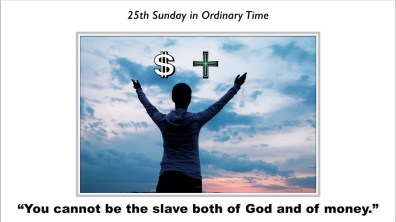
Our gospel story for this Sunday tells us about the rich Man and his dishonest steward. The steward who looked after his master’s estates is accused of wasting his employer’s goods; he is dismissed, but before he goes he must submit the final account of his stewardship.  In this time of crisis the steward takes firm and immediate action to ensure his own future. He is praised not for his dishonesty, but for his resourcefulness in coping with an emergency with such speed. If a dishonest man can use his employer’s money to ensure there will be people to welcome him when he’s out of a job, how much more should honest people use their money in such a way that they will be welcomed into the kingdom of God when they arrive there. This parable invites us to examine our use of material possessions. One of the central themes in Luke’s gospel is the suspicion Jesus conveys towards worldly wealth.

Material things can divert our attention and in some cases they can take the place of what truly matters in life. These particular words of Jesus are a warning to those who follow him on the road to heaven, the warning is that we shouldn’t be the slaves of earthly things and this is applicable to all of us. Most of us may feel that this warning is for millionaires and business magnates. Our Lord didn’t say who he was warning and his words at all times are meant for all of us. What Jesus warned against was not the just acquisition of this world’s goods but their unjust acquisition, and the dishonest use of them when they were justly acquired. There are wealthy people in Luke’s gospel who seem to follow the thrust of the parable and make wise use of their time, their talents and their wealth. They use their possessions to serve Jesus as sons and daughters of God.

Stirred by teachings like today’s gospel story  they decided to act quickly and decisively when occasions arise to help others and journey with them in their time of need. This gospel story gives us an example of someone who knew what he had to do in a crisis situation and Jesus asks all of us to remember no matter what situations we might find ourselves in that we shouldn’t become slaves to the processions or wealth that we might have and that we shouldn’t be afraid to use whatever our resources are for the good of everyone especially those in need.

24TH SUNDAY OF ORDINARY TIME

images (12)

This Sunday the 11th of September, is the day when we remember all those who lost their lives in the World Trade Centre atrocity which took place in 2001. Fifteen years on all of us who were around at that time remember exactly where we were on that fateful day as the events unfolded on the TV before our eyes.Disbelief at how this had happened and wondering about what would happen next were the order of that life changing day. The question we need to ask ourselves at this time has to be what have we as individuals learned from this event and are we safer in our day to day living as a result of the actions of our governments after 9/11. I’m not really sure that I know the answer but I do know that we need to continue to pray and work for peace in our world, our countries, our hearts and minds

In this Sunday’s reading from the Gospel of Luke we hear the story of the Prodigal Son. This story is all about the mercy of God for all of us. It is also about us looking for the mercy of the father while not being afraid to say that we were wrong or afraid to say sorry. At times the steps necessary for our walk back to the Fathers house may seem too arduous for us and we hesitate even to make the first move. Perhaps it is only when we see, like the Prodigal Son, that we are then willing to rouse ourselves to say sorry and to take the path that leads to the merciful embrace of our heavenly Father. When we make even the slightest effort with God’s grace, it is then we see the Father waiting at the door to embrace us and welcome us back home. Rejection of the love and presence of his father, in the communion of life and love as a family, was a terrible choice for the prodigal son. He desired things over people, his share of the inheritance in preference to a life in communion with the father who and loved him. Let us remember that God our father celebrates every time that we return to him.   The tax collectors and sinners did not come to hear the Pharisees and scribes, because they knew that they would find only judgment not mercy. They came to hear Jesus, because he was happy that they wanted to change their lives.  God does not give up.  He will not give up on us, calling us to him personally seeking us out individually. Nor does He give up on anyone, even those who have been far from the him. Even today Jesus calls us all to join in the joy of His Presence in the blessed sacrament and the joy of the banquet of the lord in the Eucharistic Sacrifice of the Mass. 

The return of those who have had been away is a time for celebration.  Maybe some sin or other thing in life convinced them to leave the warmth of the family of god. The cause of leaving no longer matters what matters is the fact is that many who have left are beginning to come back  and we need to welcome them with open arms as the father welcomed the prodigal who had come to his senses and realized the big mistake that he had made. In the Old Testament the mercy of God was something that you had to beg for but in the New Testament the mercy and love of god are freely given and available to all. The mercy of God is there for our benefit as long as we have the breath of life in us. The coming of the Son of God on earth, His teaching, His sufferings and death, His resurrection were all accomplished for us, so that we share the joy of heaven. In the meantime may we show the mercy of God to others as he has shown his mercy to us.


21st SUNDAY OF ORDINARY TIME

maxresdefault

As we gather this weekend we remember all those who have got A level exam results. We offer a prayer for all those who have done well and we also pray for those who have not done as well as they wanted as they continue their education. We also thank god for our teachers, families and friends, all those who have helped our young people and journeyed with them along the way whatever the results.

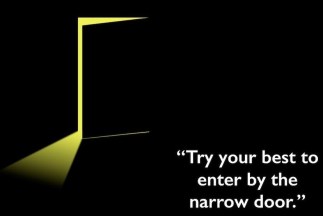
In this Sundays  Gospel Luke tells us about the door policy of the kingdom of God and how there is no such thing as automatic membership. While Jesus is making his way to Jerusalem, someone asks him about the number of those who will be saved. Rather than speculate about the arithmetic of salvation, Jesus gives practical advice about the present time: “Try your best to enter by the narrow door, because, I tell you, many will try to enter and will not succeed.” The image changes from tight space to time up.

Those who wait until the door is shut try knocking, but the householder regards them as strangers. The latecomers try to remind the householder of common ties: they ate and drank with him, they listened to him teaching in their streets.  In Jesus’ world (as in our own) there were “insiders” and “outsiders.” A person would be an insider by their birth into a family or group. Or, one might become part of the family/group by being invited to eat with the members. Thus, they are distressed because they are being excluded, the people in the story “prove” they are part of the group. “We ate and drank with you, and you taught in our streets.”

Jesus like the house owner is not impressed with this type of superficial acquaintance: people who eat and drink in the same restaurants and bars, read the same papers, watch the same programmes, don’t always  share the same commitment to God. In the gospel stories Jesus has a habit of telling religious people not to get smug; in fact, the so-called “devout and religious” were the ones who rejected Jesus the most. He was most critical of the judgemental religious leaders who were the very ones to condemn him in Jerusalem – where he is determined to go… and where he asks us to follow and remember that includes the cross that Jesus carried to Calvary. Jesus is our example of the good and faithful person who goes through a period of trials and even death trusting God no matter what happens.

Through Jesus we come to know the faithfulness of God. For Isaiah, a faithful band of witnesses will announce the news of God’s restoring love and invite all people to Jerusalem to see the manifestation of God’s power and fidelity. For us, Jesus is the “sign” of God’s fidelity. The God who raised him from the dead offers us that same new life through him. Pope Paul VI said in his famous encyclical, “Evangelii Nuntiandi” that people listen more to witnesses than to teachers. Pope Paul was also right  when he said that the most convincing messengers of our faith are those who speak from their personal experience of God – they are viable witnesses. Perhaps, they were sick and God healed them, or gave them strength and endurance for the trials of life. We are reminded today that everyone loves a humble person, because the humble person keeps a balanced outlook on people and events. And what is it that we are called to be as gods people we are called to be authentic witnesses to the Gospel message Passed down to us through the generations through the Scriptures and so many individual people. Our lives must be changed by our faith in the life, death and resurrection of Jesus. We are given the gift of faith; but a subsequent change of life is expected as our response to that gift.

During this Year of mercy we are called to show the love and the mercy of God to those around us may we not be afraid to be the agents of the mercy  and love of God.

17th SUNDAY IN ORDINARY TIME

images (7)

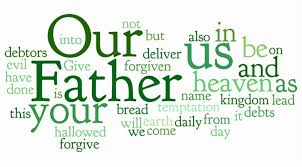
The Gospel story for this Sunday has the disciples asking Jesus to teach them to pray. In response to this request Jesus teaches them how to pray in the words of the our Father. He also encourages them to be unwearied in their prayer because the Father who loves them will pay attention to their pleas. Prayer for all kinds of things is good, because it is faith in action and trust in God. As we pray, we are changed. Many people have told me that they have prayed for this or that intention but didn’t get what they wanted when they wanted that particular thing. My experience is that we often get the thing that we pray for not when we think we need it but when god sees that we really need it and it always brings a change for the better in the person who made the prayer. There are so many different forms of prayer and praying such as the Rosary and the Stations of the Cross etc each of us will have a particular favorite.

The greatest example of prayer that has been passed down to us through the generations is the Mass. Each time we gather as a community of believers to take part in the Mass we reaffirm our belief in God made incarnate in Jesus his Son. We also bring all our intentions with us and we leave them for god to answer in his own time. Persistence in prayer is a worthwhile exercise because the God we believe in is not some sulky, withdrawn figure who is unmoved by what he hears and sees remember that our God is with us. Behind Jesus’ advice on prayer is his image of a God who really does want to help and journey with us as part of our lives. The message of Jesus in the our Father is that our God is one who cares for us as well as concerned about us and those who are close to us. So can we depend on God’s providence to feed us, to shelter us, to clothe us, to save us from violence? If we pray hard enough will God see to it that we have a new car, a better house, maybe win a lottery? God doesn’t work for us in that way and we shouldn’t expect him to either. The most important part of our human life is what we become day by day through faith in the will of the Father.

Of course we need to survive and flourish. When things don’t go the way they should, we benefit from our prayers. Think of Jesus in the Garden of Olives. He prayed what was coming his way would not happen. He also added he would abide by God’s will when he said Abba, Father let it be done as you not I would have it. If we stay in sync with the will of God we will grow day by day, despite what good or bad things come our way we will know that God is for us a refuge and our strength in all things.  These days when so many parts of the world are hurting for many reasons let us remember the power of prayer to help us to do the right thing in the situations we might find ourselves.

16TH SUNDAY OF ORDINARY TIME

images

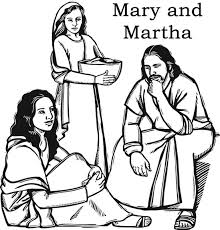
In our Gospel reading for this Sunday we hear all about Martha and Mary. On his way to Jerusalem, Jesus led his entourage into the village to call at  the home of Martha. As the good host, she served them but, her sister, Mary, sat listening to Jesus. Martha tried to shame Mary into helping with the work but Jesus would have none of it. Instead, he praised Mary’s choice when he said leave her alone for she has chosen the better part. Martha loved Jesus as much as Mary did, and it is clear that he treasured them both. Her mistake was in not trying to find out how Jesus wanted to be entertained, while visiting her house. Her sister correctly senses that when Jesus comes on a visit the last thing he wants is to have people fussing over how to feed him. So, while Martha makes the greater housekeeping effort, Mary understands better what is expected of her by him. Her contemplative intuition grasps instinctively the real reason for Jesus’ visit.  He is there not to receive but to give, not to be served but to serve. He has something he needs to say and the one thing necessary is to listen to his voice.

There a whole theology of contemplation in this gospel reading, on how to receive the Lord’s visit. It starts off from the basis that, no matter who our visitors may be, there is always something to be learned, something from them. The one who comes knocking on our door will have something to tell us, should be listened to and understood. When Jesus comes to us he wants to talk to us in the quiet of the evening or the freshness of the morning, to share with us the Word that brings us to salvation. He comes not because he needs us but because we need him. We too can be “distracted with all the serving;” we too can “worry and fret about so many things.” We may, like Martha, miss the better part, the one thing necessary, which is to submit to the Word of God. If we are to make people welcome in our community it will be by being attentive to who that person is are what they seek rather than giving them the impression that their presence is disrupting our well ordered lives. let us not be afraid of being like Mary and be attentive to what Jesus is telling each of us today.

Post Navigation