Fullerton T

RELIGION LITURGY AND LIFE

Archive for the category “LITURGY”

FIRST SUNDAY OF LENT
images (4)


Well here we are at the First Sunday of Lent having placed the ashes on our heads on Ash Wednesday we have embarked on our annual time of renewal. In every area of our lives there is an ongoing need for mending, renewing and refocusing. Lent is our annual spring clean of our spiritual lives renewing our faith as a preparation for celebrating the events of Holy Week.

In the Gospel reading for this Sunday we hear the reading from Luke that details the temptation of Jesus in the dessert. Before Jesus set out to do his Fathers work he went out into the dessert for forty days of fasting and prayer and during this time he was tempted by the devil. The devil tempted him to use his power  to take care of himself, prove his identity by performing astounding signs and make alliances with political and military powers to get himself and his message across. It is immediately after His time in the desert that Christ began His work, of proclaiming the kingdom of God.”

In proclaiming the message of the Kingdom Jesus gives us all  the good news of truth, hope, peace, and salvation and this enables us to live life to the full and conquer sin.  As well as this there is great encouragement for all of us to know that Jesus not only shared our human nature but, like us, he was subject to temptation. In the course of our daily lives we too face temptations to put comfort and material possessions over the sacrifices involved in being a disciple. We often get sidetracked and lose sight of what and who are important in our daily lives. This Gospel highlights that we are dependent upon God for all that we have and all that we are. God’s desire for us on this first Sunday of Lent in the Year of Mercy is that we Come back to him with all our heart. God does not want empty words but full hearts.  Hearts full of remorse when appropriate; hearts full of trust as we face the realities about ourselves; hearts full of love as we realize how much we are loved; hearts full of joy as we journey towards Easter, the moment when life, and everything else changed forever when Christ died and rose again for us in all our ways good and not so good.
4th SUNDAY IN ORDINARY TIME

images (8)


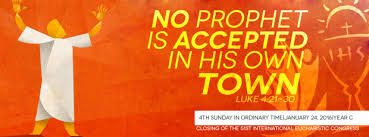
This weekend we celebrate the fourth Sunday of the year. In our first reading which is also the first reading for the feast of John the Baptist Jeremiah says, “The word of the Lord came to me….” I wonder if he understood the implications of what God was saying to him when he heard it.  In Jeremiah’s narration of his calling we have a summary of a typical prophet’s call. First, God does the choosing and then empowers the person with the Word of God. It is not explicitly mentioned in this passage, but when prophets are called they are also empowered with God’s Spirit. They will need both, the gift of the Word they must speak to the people and the presence with them of God’s life-giving and fortifying Spirit. Prophets do not have an easy job and need all the help they can get from God. The second Reading is Paul’s hymn to true love. It is an awe-inspiring challenge to those who claim to be followers of Christ and is a reading that is often heard during wedding ceremonies. The first part describes the folly of good works done without a relationship built on love. The second part describes love in terms that appear prosaic but, because they allow for infinite development, are transcendental. Then the third part is wisdom which comes from years of reflected experience.

In the Gospel Jesus’ preaching begins with affirmation from the hearers. “All who were present spoke favorably of him.” Almost immediately the mood changed. The use of the reading from Isaiah was welcomed. It is good news that the people have waited a long time to see fulfilled. But, somehow conveyed in the words was the suggestion that Jesus himself has a role to play in the inauguration of the new age, the eternal Jubilee and it is this that is not acceptable. The examples that follow indicate that Jesus was hinting that the word of God was spoken universally, not to one particular person or group of people. The stories of the prophets, Elijah and Elisha, show that God’s love and mercy are to be found wherever there is a need and the faith to receive it. The reaction from the group was swift and indignant. They rose up and wanted to throw him not only out of the synagogue but out of the town. The hearers have hardened their hearts to the word.

Why did the crowd rise up against Jesus? Because he stepped outside the box they had constructed for him. He was no longer the local boy who made good; he was a self-proclaimed prophet. And his signs were not for the edification of the mob, but for the glory of God. In these ways, he rejected the expectations of those in Nazareth, and, so, they rejected him. As a last sign to them, Jesus walked safely through them and, according to Scripture, he never returned to his home town. Expectations are always hard to fulfil as we hear from the readings of this weekend. But, faith is not based upon expectations, but on a relationship with God. We must recognize the difference between the two. And place our expectations before God. There is a great saying that was often quoted to me by a friend who passed on a few years ago she always pointed out the man proposes and God disposes meaning that god will see and do whatever is good for us whether it is what we want or not for sometimes what we think is for our good is in fact the opposite !!

3RD SUNDAY IN ORDINARY TIME

images

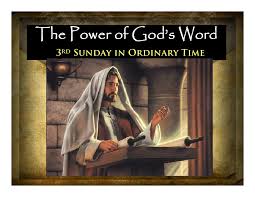
This Sunday we celebrate the 3rd Sunday of ordinary time which falls during the week in which we pray for the unity of Christians. The second reading from St. Paul tells us that though the Church has many parts we are one body, the body of Christ and this is true. As Christians there are different faiths and each of us has a different faith journey but the one thing that unites all of us as one body is Jesus Christ the son of God.

In the Gospel Reading for this Sunday Luke wants to make very clear to his readers what drives Jesus the Prophet from Galilee and what is the goal of his action. We as Christians need to know in what direction God’s Spirit pushes Jesus, since following him means that we are walking in the same direction as he did. The Spirit descended upon Jesus at his Baptism in the Jordan. With the Spirit poured upon him, Jesus would proclaim freedom for the trapped (captives), the diminished (blind), and those in need (oppressed). When Jesus proclaimed the Good News, he proclaimed the Spirit. Since Spirit meant breath, Jesus breathed God’s word in his words and deeds.  The power of his proclamation changed people, situations, and environments because he breathed out the power of God.

When Jesus spoke, hearts turned to God and health of mind body and spirit were restored. There is an immediate life-implication of today’s passage that is easy to overlook for us in our I want I get world. it is this: The Spirit of the Lord comes upon Jesus and comes upon the Church in order to bring good news. The presence of the Spirit means joy. In the 21st century we’re OK with entertainment and pleasure, but we are often suspicious of Spiritual joy because it might be a pie-in-the-sky illusion. How can we talk about or even allow ourselves to experience joy, when there is so much false hope, so much suffering, so much serious work to be done in the world around us? The paradox of Christian faith is the cross of Jesus. The cross symbolizes the pain and sorrow that Jesus and we know so well. At the same time, the cross of Jesus is the ultimate revelation of the love and mercy of God shown to us through his son. “For the sake of the joy that lay before him he endured the cross despising its shame, and has taken his seat at the right of the throne of God” (Hebrews 12: 2). The joy that lay before him was not only that God would wipe away his every tear, but that through his self-giving love, his joy might be in us and our joy might be complete. We pray that as individual Christians and as Church, through the power of the Spirit, we will have the courage to bring Mercy to the poor, liberty to captives, sight to the blind, and freedom to the oppressed especially during the Year dedicated to  Mercy in all its forms.

iec2016_banner1452722818

This weekend we also have the beginning of the week-long Eucharistic Congress in the Philippines. It seems like yesterday when we celebrated the 50th Eucharistic Congress in Dublin in 2012 and yet four years have passed and so many things have happened. We pray this weekend for a successful congress for all those who will be going there in the days  ahead.

3RD SUNDAY OF ORDINARY TIME

images (5)

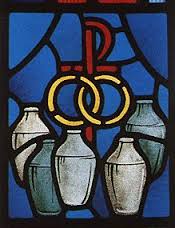
This weekend we have the gospel story of the wedding at Cana which was the first time that Jesus worked a miracle when he changed the water into wine. We hear Mary telling Jesus that ‘they have no wine’ Jesus said ‘Woman, why turn to me? My hour has not come yet.’ His mother said to the servants, ‘Do whatever he tells you.’  This Gospel is a story with many threads – the insight into the relationship between Mary and Jesus – the miracle of the wine itself – the fact that the miraculous wine is better than the original – the fact of Jesus honoring the young couple in this way – and so on. Images of marriage feasts and bridegrooms, wine and water, appear in the Old and New Testament with great regularity. The relationship between God and Israel was often seen as a marriage – Israel the bride, God the bridegroom. The coming of the Messiah was described in terms of a wedding feast and later, in Revelation, we hear of the marriage feast of the Lamb. Jesus spoke of himself as the vine and of longing to celebrate Passover, blessing wine into the cup of his blood. The abundant wine reminds us of the “new wine” spoken of by Jesus: the new order of things that he was inaugurating through his Paschal Mystery.

In contrast, the water jars of the Jews represent those who refuse to believe in Christ are empty and there must be a large number of empty jars in people’s lives these days for the same reason they don’t believe! The wedding celebration provides the context that enables us to see the greater reality. The bride and groom whose wedding is being celebrated are in the background as a matter of fact scripture says nothing about them or who they were. In the foreground we see Mary and Jesus. Mary, who asks for help when she tells Jesus “they have no wine”, Mary the faith filled disciple, has trust in divine providence. In the place of the divine spouse, stands Jesus. “The Word was in the world, yet the world did not know it.” The care, concern and affection of God are manifest in the Son.  Today there are so many different definitions of marriage and what exactly being married means and as we know so many freely choose not to get married and for some they live together which of course has its own particular problems.  In her response at the wedding at Cana Mary shows herself a model disciple who trusts in God. She shows that trust with the words that are meant for all of us even now we read them again “Do whatever he tells you.”  If we place ourselves at that wedding banquet, Mary is giving us direction. 

She is mother to us all and also the first disciple of her son. She knows the way to live because she learned it by listening to her son and thinking in her heart and in her mind about what he did and said. We should listen closely to what she says as Mary is the one who “keeps all these things in her heart, pondering them.” She learns to understand the message that is Jesus. Do whatever he tells you is Mary’s message for us. Today what does Jesus ask us to do as we think about the wedding at Cana are we like Mary prepared to trust in the Father who can give us all things or are we prepared just to trundle along accepting the things that come along. Or are we prepared to learn and understand the message that is given to us through Jesus whose mother asks us in the to ”do whatever he tells you.”

THE BAPTISM OF THE LORD

images (2)

This Sunday we celebrate the baptism of the Lord, when Jesus was baptised in the river Jordan by John. None of us remember when we were baptised when we were infants but that said we may know an Adult who was baptised at the Easter Vigil or at another time through the RICA process.

Sometimes beginnings are not remembered because they didn’t seem important at the time. However, some events in our lives become important because later on we see that it was then that something started, it was when we met that particular person or did a particular thing that changed our lives. Of course there are beginnings that are important like baptisms, marriages and ordinations. We like to mark these beginnings so we surround them with ceremony to give a sense of occasion. So the relatives are called in, photographers are hired, priests officiate, solemn words are spoken, cameras click, music is played, and there is an atmosphere of rejoicing. Clearly, something happened to Jesus while he was with John. He underwent a change that gave his life a new direction while he is with John, Jesus makes his big beginning. As Peter says in the second reading, “Jesus of Nazareth… began in Galilee, after John had been preaching baptism.” John was a very important turning point in the life of Jesus – so important that Jesus says of him later: “of all the children born of women, there is no one greater than John” (Luke 7:28).

It is a measure of John’s importance that Jesus makes a three-day journey south to the place in the Jordan valley where people immerse themselves in the river in response to John’s call. It is unlikely that Jesus’ relationship with John was confined to the moment of baptism; but it is the baptism that is the most important moment. Jesus is baptised in the company of many other people; for him, as for them, a new time begins. For us when we celebrate baptism there is a new beginning for the person who is baptised infant young person or adult. The baptism of Jesus by John in the Jordan marked the beginning of a journey which ultimately led Jesus to the Cross on Good Friday and our own baptism was also the beginning of our faith journey which won’t lead to the cross but will lead to eternal life.  Through our baptism we died with Christ and thus have been reborn into a whole new life (Romans 6). We, the baptized, are made a part of the body of Christ. We are called to imitate Jesus. We have the companionship of the Spirit of Jesus who is our wisdom, impulse and help to do good.

That same Spirit will enable us to do what is right in every situation we may find ourselves in. So today as we are reminded of our baptism by renewing our baptismal promises and being sprinkled with holy water. Take a moment and reflect on where your baptismal journey has brought you. What has been joyful for you on this journey? Then look around at everyone else and give thanks that together we can celebrate our life in Christ and look forward to further adventures in the life of faith  as we journey along the road.


Second Sunday after Christmas

download (1)

Yes you did read the heading correctly it is the second Sunday after Christmas and we are now almost  at the arrival of the Three Wise Men on Epiphany which takes place on Wednesday 6th January in Ireland. By long standing tradition Christians celebrate Christmas as a season, with the twelve days between Christmas and the Epiphany as one long “Christmas feast.” The season ends with the Baptism of the Lord which is also the first Sunday of ordinary time and that takes place next Sunday. The Christmas and New Year festivities are now a distant memory, and I am certain many people  out there are asking themselves the time honored question for this time of the year,  why did I make such a fuss!!!  So many make a fuss about the secular part of Christmas and as a result they have missed the essential message of the season.  The essential message is that Jesus Emmanuel was born in the stable in Bethlehem at Christmas and  that he is the reason for the season.

Our readings this weekend are all about Wisdom and the blessings of God and the Gospel tells us about the word who was in fact the Son of God. Jesus Christ, therefore, the Word made flesh, was sent as “a man to men.”  He “speaks the words of God” to us and completes the work of salvation which His Father gave Him to do. To see Jesus is to see His Father. To see Jesus is to see the face of the Fathers Mercy. Through the “least,” and the poor, Christ comes to us. That’s a lesson that we the members of the Church need to continually remember and proclaim in our lives and our dealings with other people. We will find Christ among the “least” and this is the message, the humble message that lies at the heart of our faith It is the message that Pope Francis is proclaiming in our own time and place. May we not be afraid in the year that has just begun to seek the wisdom that God wants for us, that is the wisdom and the light of faith so that we will be able to show the mercy of God to those around us during the year of mercy and throughout our lives.     

4th SUNDAY OF ADVENT

images (1)

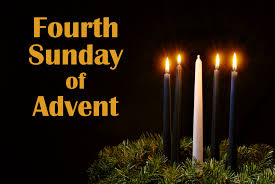
This weekend the Holy year of Mercy is underway throughout the world and we light the third purple candle on the Advent wreath.  Last Sunday we opened the doors of mercy in our diocesan centers of mercy and opening the door means much more than just simply opening a door. We usually open a door to let someone in of course we also close the door to keep people out as well. In the sense of this Holy Year opening the door means that we open ourselves up to let the grace and mercy of the Father into our hearts and minds. I think that one of the ways we might show mercy to others these days is in our treatment of the refugees from other countries as they come to live in our communities in the days ahead.

The final Sunday of Advent draws us closer to the celebration of the Christmas mysteries. Christmas is almost upon us: yet are we ready in the true sense of the word remembering that Jesus is the reason for the season? Christmas we are told is a time for so many things  yet for many of us it is a time of stress and pressure with all the extra work to sort out every­thing that needs to be done.  For many it is a time when we are fearful that the children won’t be disappointed or that there won’t be tension in relationships or there won’t be a breakdown in the ceasefire with the in-laws.  And on top of all this there is a feeling of guilt for feeling like this when we should be happier that we are. Now in the midst of the preparations we meet Mary and her cousin Elisabeth in our Gospel reading for this weekend. Mary, who herself had been prepared for the coming of the Messiah. She has received the angel’s greeting, and his strange news, and has accepted her role in God’s plan.

Now she hurries to her kinswoman, Elizabeth, who herself bears John the Baptist in her womb. John, alerts us to the presence of the Lord, as he leaps for joy in his mother’s womb. His joy is that God has kept his promise, and is with his people.  That two women were chosen to play such a role in the story of salvation is remarkable, as women were often marginalized in the society of their time. In all of these events we see the great mission that Mary undertook as a privileged instrument in the hands of God. Mary is not only the mother of the source of grace; she is the very model of what a Christian heart should look like. We look to Mary to see our fullest Christian dig­nity. In Lumen Gentium 68, Vatican II describes our contem­plation of Mary as an act of entering our own deepest mystery, catching a glimpse of what we shall he at the end of our faith journey.

Over the next few days the journey to Christmas will have many pressures for everyone especially those who are worried or afraid about so many things family and otherwise.  Mary in her calm gentle way encourages us to trust in God’s word and to believe in God’s promises as she did. If we believe and have trust in God as Mary did then all the problems that might arise will assume their proper perspective and we will get through them and come out the other side wondering why we got so worried in the first place.

FIRST SUNDAY OF ADVENT

11141157_1606343736288278_5910075055057336030_n

Here we are at the beginning of another Church year, today  we have a change of colour and a change mood we go from the green of Ordinary time to the Purple which symbolizes the penitential season of Advent last week, at the end of the Church’s year, we had the  highpoint of the Feast of Christ the King. This weekend we begin all over again as we light the first purple candle on the advent wreath. Advent is the season that brings us back to the ancient longing of the human race for the coming of one who would bring to this world liberation from sadness and the fulfillment of perfect peace.


The word Advent derives from the Latin word meaning coming. The Lord is coming may the heavens rejoice and earth be glad. We may reflect that every year at this time and celebrate his coming, so that in a sense we can lose the feeling of expectancy and joyful anticipation, because at the end of the season everything seems to return to pretty much the same routine. If that is the case, then our preparation may have been lacking and we have therefore been robbed of much of the true meaning of this season.

During Advent we recall the history of God’s people and reflect on how the prophecies and promises of the Old Testament were fulfilled.  At the beginning of each church year we are reminded that Jesus the Christ is present as a person to us.  When we think that his presence is something so exalted as to be beyond our own experience, we are reminded that he was born in the lowliest of places, a common stable.  The first visitors were rough shepherds.  The preparation of Advent is for us to prune, weed and convert our way of thinking. 

The prophet Jeremiah foretold the day when God would send his Messiah King  to “execute justice and righteousness in the land” (Jeremiah 33:15). Jesus is the fulfillment of this promise and every promise which God has made. In these short verses in the Gospel, Jesus described the beginning of God’s final initiative. He would give signs of warning across the sky, cause anxiety on earth with violent sea storms, and shake up the heavens. What we would explain scientifically today as eclipses, meteor showers, and the result of storm systems on earth, the ancients attributed to God’s intervention in the order of the cosmos. God would shake things up and so he does just look at Pope Francis for example and the way he challenges us as individuals and as members of the Church.

People of Jesus time would grow anxious because their faith systems and rituals failed.  But, Christians were to rejoice. Their Savior was at hand! Now, their world view and lifestyle would be vindicated. For, Christians saw the world and lived in the world differently. Finally, Luke presents a time of hope. Through great power and glory, the Son of Man would come and free his followers. Unlike the anxious people of the world, the Christians were to anticipate the end in hope. During Advent, we are invited to prepare our hearts for the coming of the Lord – to wait in joyful hope for his return in glory at the end of time  and to prepare for the annual celebration of his birth. So now let us go forth in peace and hope to prepare meet the Lord at Christmas.

33rd SUNDAY IN ORDINARY TIME

download (1)

We pray today for all those who perished in Paris on Friday night this atrocity serves no one. This Sunday in our Gospel story we hear about the End times and I am sure that the people who died didn’t  think that they were approaching their end times may all of them through the mercy of God rest in peace.

For the past two millennia, Christians have looked to the future and asked, “When, Lord, when is all this going to kick off?” Jesus saw the end of time event as the visit of the divine King. God would prepare the visit with cosmic signs and events as a means of announcement. The King would arrive in a way that reflected his power and reputation (on the clouds); his messengers (“angels”) would go throughout the known world to gather all the faithful. Remember that the Jewish people had been displaced throughout the known world because of economic opportunity or oppression. Jesus implied that the injustice of Jews living on foreign soil would be corrected during his lifetime  How did his disciples know Jesus spoke the truth? Jesus gave a farming analogy of the fig tree to support his belief in God’s immanent judgement.

Every spring we observe the twigs on a bare tree start to grow and go green then Leaves appear and we know that summer is on the horizon. As Spring is a prelude to Summer, and Autumn warns of Winter so we must not be complacent, imagining that life can be held in suspension because life keeps marching on.

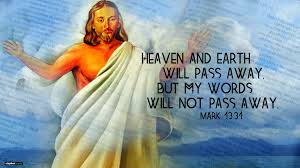
After the cosmic fireworks, Jesus imagines a peace beyond suffering. This vision of peace is important for Mark’s persecuted community: they need more than a firework display to see them through their own historical apocalypse. If their hope is not to be exhausted by force of circumstances, they need help to imagine a far side to pain and suffering. Mark gives their hope help in sharing Jesus’ vision. For that is the purpose of all apocalyptic writing: to fund the hope of those who suffer in the present. We live in an age of uncertainty: the future never looks wholly secure. But Jesus holds out a vision that takes us beyond our worst imaginings. There is a place beyond the mountains of arms and weapons, beyond environmental damage and terrorism. This vision doesn’t free us from the duty to strive for peace and right living, but it does free us from the blasphemy of believing that a nuclear holocaust will be the last word in the human story. In the meantime, we have to depend on the promise of Jesus: “Heaven and earth will pass away, but my words will not pass away.” No one, not even the Son, knows when all this will take place. The only sure thing we can hold on to is the word of Jesus and all we are asked to do is hold fast to what we know to be good and in these times when we look at all that is happening around us this is good advice.

32nd SUNDAY IN ORDINARY TIME

Widows-Mites-Display

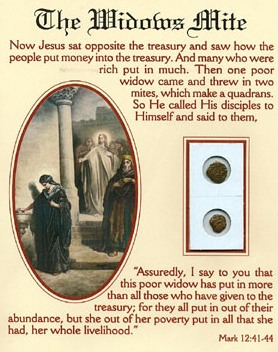
This Sunday in our Gospel story we hear about the widows mite. Mark sharpens the lesson Jesus gives, by linking this incident with what he has to say about ‘scribes’ who ‘swallow the property of widows while making a show of lengthy prayers’. The situation of widows was insecure. The ‘scribes’, so often mentioned in the gospels, were interpreters of the Law of old Israel they were the lawyers of the day But beneath their exterior religious garb, they were rapacious and in many respects just didn’t give a damn as long as they had what they wanted. The widow, on the other hand, reveals the true religious practice of those who have little, but express great trust in God to provide for them.

Jesus makes a series of charges against the scribes. He criticises their habit of wearing distinctive dress, which marks them as different from others and is calculated to win people’s deference. He criticises their habit of taking the places of honour at religious and civil functions. He criticises their habit of long-winded prayers, made not to God but to their immediate audience. Finally, he denounces their practice of exploiting helpless widows by living off their savings.

In contrast to the counterfeit piety of the scribes, Jesus honours true piety in the generosity of the poor widow. The pious frauds who abused their religious status could take a lesson from a woman who had no status in their religion or society, a poor widow. The two small coins make up the total of her resources. She could have kept one. She doesn’t. Her generosity cannot be bettered. For Jesus, true generosity is measured not by what people give but by what they have left after they give. The poor widow leaves herself with nothing. She cannot give more, for she has nothing more to give. In Jesus’ estimation she is a mighty widow.

We, need to listen to Jesus’s words. We are tempted to preserve our systems and benefit from what they give us: standing in the community, predictability, stability and a blessing of the status quo. The church’s history also reveals how we have blessed armies that invaded and enslaved indigenous peoples, preached slavery and oppression. Our religious apparatus has tended to side more with Caesar and with the economic and political world that belongs to Caesar. Jesus condemns those individuals and institutions that benefit from the burdens put on the poor. He said previously in Mark (11:17) that the Temple had become a den of thieves and not a house of prayer.

He predicted it would all come tumbling down.  Today’s passage illustrates why this destruction was inevitable, because those in the temple were corrupt. Every day demands are made on us. We are called on to be generous with our love, our forgiveness, our patience, our resources. The good news is that when we do that out of love, Jesus will be our constant support through the good and bad and happy and sad times which we often find ourselves in.

Post Navigation