Fullerton T

RELIGION LITURGY AND LIFE

Archive for the category “RELIGION”

28th Sunday of Ordinary Time
28TH SUNDAY IN ORDINARY TIME YEAR B (David Nkong Fomanka's blog)

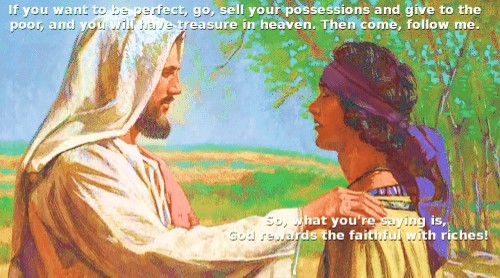
This Sunday we hear the Gospel story of the Rich man and Jesus invitation for him to give everything to the poor and  follow him.  Besides being a very interesting story, this Sunday’s Gospel gives rich spiritual advice for us. To put it simply, God is worth more than anything else in our lives. Jesus looks on the rich man with love; he wants this blameless enthusiast to become one of his disciples. So the challenge is made: “There is one thing you lack. Go and sell everything you own and give the money to the poor, and you will have treasure in heaven; then come, follow me.” The cost of Christian discipleship is heavy for this prospective disciple as there has been a heavy cost for many throughout the history of the Church. The man in the gospel must renounce the security and the prestige that wealth brings him; when he sells everything he owns, he must not give the money to his family or friends, but to the poor. If he does this he will have treasure in heaven. That treasure will be his new security. The sorrowful departure of the would-be disciple that Jesus loved is one of the most touching scenes in the Gospel. He is too attached to what he has to become what Jesus asks him to be.

 When he goes, and we hear no more of him, Jesus turns round to tell his disciples how hard it is for those who have riches to enter the kingdom of God.   For us today Jesus asks the same question do you want to follow me and many have done that but for others the call has been accepted but it was just too hard to follow the path of Jesus and they have left the faith behind. All of us have many riches that have been given to us by God Family, faith, friends are just a few example of gods goodness to all of us would we leave everything to follow Jesus that is another question. Instead I think that we are called to follow Jesus in our world were we are by trying to be faithful to what Jesus teaches us as we pass his message on to others by the things we do and say that is a hard thing to do in the world especially when people put their own slant on the message of Jesus using it for the own not always good ends.  This Gospel text is reassuring but challenging. Sacrifice for the sake of the Kingdom is an essential requirement of those who wish to truly follow Christ. The Christian follows a difficult path in life but it is the  journey of life with a destination. And the destination is nothing other than the Kingdom of Heaven so let us take up the challenge to follow Jesus as we go forward.

27th Sunday in Ordinary Time

MARRIAGE IN GOD'S ORIGINAL PLAN. HOMILY FOR THE 27TH SUNDAY IN ORDINARY TIME  (YEAR B) Rev. Fr. Boniface Nkem Anusiem Ph.D.. | Fr Bonnie's Reflections

Our readings for this weekend  set the ideal of God’s purpose and plan for creation and marriage.  In the Catholic Church, marriage is a sacrament. A sacrament is the presence of God, the most powerful presence of the Lord possible in this world. In the sacrament of Baptism, God is present giving the Life of the Trinity to the baptized. In Penance God is present through his Son giving his forgiveness to the penitent. In the Eucharist, the Son is present nourishing the communicant and uniting him in an intimate way to the Divine Presence as Jesus is offered to the Father for us. In the sacrament of marriage, Jesus is present uniting the love of the husband and wife. Marriage, according to Genesis, was always meant to be a joining of man and woman in one flesh, in one heart, and in one spirit. It all begins with caring about the other. It all begins with a sense of respect and dignity for the other. It all begins with each contributing to the Then follows a walking together, side-by-side, holding hands and confronting whatever would seek to divide. The effect of all of this  is a growth in love. In that growth of love there comes to each an understanding of the magnificence of God’s love for us.

 Marriage is a sacrament, a making present the Son of God who sends us God’s Spirit. That Spirit unites us, makes us whole. Contentions and disagreements become not a divider but a pathway to greater union. There are many people who are in various forms of civil partnership and I am not going to knock them for not following what marriage is all about in the sacramental sense. The people involved in Civil  partnerships  have made a commitment to their partners and we need to show respect for the commitment that is there while being true to why we think so much of the Catholic idea of marriage and what it stands for.  The “rit of divorce” in the Gospel Reading for this Sunday was there to protect the woman from being discarded arbitrarily without any possibility of survival in a society where she could not work or support herself.  How does our society and our Church actually treat and those who find themselves as unable to keep the “happily ever after” scenario?  Togetherness for life certainly remains the ideal both for Jesus and his followers.  But our Church community has to face the reality  that many marriages break down, and some of the victims of a broken marriage feel a deep longing for a new life partner and a new start.

 But this raises an acute question for the Church community: Can there be only point-blank black and white refusals there is much debate around all of this as there has always been as this is not the black and white issue many people would like it to be. I have been blessed in seeing so many people getting married and many others celebrating the 25th 50th and even the 60th anniversaries of their marriage commitments. But many people will tell you that their married lives were not always a bed of roses. Married life, like any human endeavour, requires effort, work, and discipline. The exchange of vows is  only the beginning of a life together it is not the high point. The term “partner” should be taken literally as true marriage means that the 2 people work together in partnership. Whenever marriage is celebrated and respected, there is peace, joy, and Love. So today we pray for a proper understanding of what marriage means in the catholic sense as we acknowledge the goodness that are there in other forms of partnerships that are more normal these days than in the past.

26th Sunday in Ordinary Time

Opening the Word - FORMED

Few of us go through life without joining some kind of group or club. Joining a particular group, religious, political or social, can enlarge our world and introduce us to new people and new possibilities. It can help us to move within a relatively secure network of relationships. That sense of belonging is important to our identity: membership is proof of how others accept and recognise how we see ourselves. Rejection is a clear signal of disapproval and this is what this Sundays Gospel reading is all about rejection. The man in the Gospel who was healing in Jesus name is put before us as the example of someone who was rejected because he was not one of the apostles. The disciples consider Jesus their own personal treasure and they want keep him for themselves.

The Apostles seemed to have been an ambitious group last Sunday we heard them arguing over who was the greatest among them.  This Sunday they complain that they saw someone who was not part of their group performing a healing in Jesus’ name. If there had been laws  concerning  copyright at the time I think the Apostles would have copyrighted Jesus name and the power that went along with it. I can just imagine them licensing the use of Jesus’s name and then asking “How many times do you want to use Jesus’s name that will cost so much. How many times do you want to cure someone in his name that will be so much more”. They felt they were privy to Jesus that is to say he was the apostles and no one else’s, it’s as if Jesus was a rock star and they are his agents, with exclusive rights over what he does and says. What they really wanted was a tidy little religious box, clearly in their control but they hadn’t factored in Jesus and what he had been sent into the world to do and the fact that they were not in control God the Father was.

They forgot how compassionate he was, remember Jesus compassion for others never ran out and wasn’t limited to a few people or those who had the proper disposition to receive it.  There was plenty for everyone in terms of Love and Compassion  then as there is now. Jesus is the visible face of the God that we can’t see and yet we believe; we believe in the God who wants to speak words of love and joy to everyone, not just a few; who wants to reach out and touch all those broken in mind body or spirit, not just those who carry the right credentials. After they see Jesus crushed on the cross and later, when he rises from the dead, the apostles finally get the message and understand what had happened to them as a result of their involvement with Jesus. Then they would do exactly what we are doing right now, retelling the stories about Jesus as they set out to continue to write the story without restrictions or limits of any kind. When they went out to continue the story they would have been speaking and acting in Jesus’ name, not just to a select few, but for everyone they met, or came to them in any need. In Jesus’ name they opened the eyes of the blind, cured the cripples, and gave the people a sense of something special, the great love that God has for them. At first they got it wrong, but when they learned what it meant to speak and act in Jesus’ name they knew that everything was possible for them and that meant they were able to share the message of Jesus with the people of the world.  In our world today we often forget that faith is not about the chosen few but faith is for everyone who accepts it as a gift from God freely given and accepted as such. We need to understand  that we don’t always get it right and remember that everything is possible to those who have faith in Jesus Christ the Son of God and the message he proclaims and that is the  message of the compassionate love of God the father for all people regardless of who they are or where they are in the world.

We are called to take up the challenge to be messengers of Jesus in our daily lives sharing the compassionate love of god with those we meet wherever we are.

25TH SUNDAY IN ORDINARY TIME

25th Sunday in Ordinary Time, Year B | For Catholic Grownups

In our Gospel for this Sunday we begin with the second prediction of the passion. Like many things in the biblical tradition, a threefold repetition gives emphasis and dignity to the pronouncement. The predictions are also a reminder to us that Jesus was not surprised by the later events in Jerusalem; he had seen them on the horizon for a great part of his journey. The predictions are each constructed in the same way with Jesus’ teaching followed by misunderstanding. Towards the end of this Gospel Jesus brings the child to centre stage and instructs his disciples: “Anyone who welcomes one of these little children in my name welcomes me; and anyone who welcomes me welcomes the one who sent me.” In this instance Jesus doesn’t ask his disciples to become like children; he asks his disciples to welcome them. The disciples have a problem about welcoming littleness because they think that they are at the top of the tree and are above this. This basic Christian teaching, common to all the Gospels, is one that has not always been honored. “To be first in the group is to occupy the last place and to be a servant to the group.”

That means to be the greatest you must make yourself the least in service of other people especially those around you. Jesus taught his followers the true meaning of leadership. Leadership does not mean power but service. Power often strangles life and brings a slow death. But, service brings life, even from death itself. An attitude of serving others should not be a triumphal attitude lording it over everyone else, yet much of our history has been about individuals seeing themselves as better than everyone else. In this passage we listen to the words of Jesus about the child he tells us “Whoever receives a child like this in my name receives me. Whoever receives me receives God”. In the first part, the disciples are told that a measure of their discipleship is their attitude to power. In the second part, discipleship can be judged on the disciple’s attitude to children who are powerless in many ways. Jesus compares himself to the little child, the one who cannot resort to power tactics when threatened or maltreated. Jesus’ protection is his Father; his trust is placed in the God who will ensure his protection. When suffering comes, Jesus refuses to abandon trust in the Father.  

That trust makes him vulnerable, like a little child, but unless the disciples can come to welcome that vulnerability they will never understand the way of Jesus. When we welcome the stranger we might understand what Jesus means in this Gospel reading that wee bit better. Jesus offers us a permanent challenge to welcome the powerless, to take to heart the weakest members of the community. He places himself in their company. Their vulnerability is something that Jesus not only shares but values. May we understand that to be be first in the group is to occupy the last place and to be a servant to the group.”  May we take up the challenge that Jesus places before us in this gospel reading and that challenge is to become humble servants of those who need us whoever they are.

24th Sunday of Ordinary Time

Lockdown Liturgy on the 24th Sunday in Ordinary Time of Year B - YouTube

Today the 11th of September  is the 20th anniversary of the attacks on the World Trade Centre in New York. As we know nearly 3000 people lost their lives on that day and all of us remember where we were at the time of the attacks in New York and Washington. I am sure there are many people out there still wondering why this happened and still hurting because of their loss even now. We pray for all those who lost family members friends and colleagues in the events of 9/11 and we pray for peace. Peace for our world and peace for ourselves and all those who are dear to us wherever they are.

In our gospel reading this Sunday we hear Jesus asking Peter and the disciples the famous question “Who do you say I am the apostles guesses all lead us  to someone else, Elijah or John the Baptist or one of the prophets, the people  who were celebrated for pointing to the Messiah. In contrast to what others think, Peter speaks on behalf of the disciples who have shared Jesus’ life intimately: he identifies Jesus as the Christ. Jesus then tells his disciples that his way to glory is only via suffering and the cross.  The first reading is one of the great poems of Isaiah on the theme of suffering.  The servant of God is described in clear unambiguous terms. God gifts the disciple with a well-trained tongue.  This is not an orator’s tongue, capable of delivering prize-winning speeches, but a tongue with the ability to rouse the weary from despair, the ability to bring comfort and compassion to the suffering. We know this response to the pain of the other does not require words but is an attitude of the heart and spirit. In the Gospel Jesus speaks to us about himself using the figure of the Son of Man, the suffering servant who will be rejected and put to death. Not only must he suffer, but experience comfortless suffering in being rejected. That rejection robs the suffering one of his dignity. He has to face the forsakenness and the loneliness of the cross. He will not die of natural causes, but be put to death by the authorities of the time. And this experience of dereliction and emptiness will be answered by God who will raise him up on the third day.  Although the message given to the Disciples was only vaguely and dubiously grasped, Christ had forewarned his Apostles, in order to prepare them for the scandal and folly of the cross.

While it did not really prepare them because they were still too worldly-minded, it did help to strengthen their faith once the facts of the empty tomb convinced them of the resurrection. When they realized that their beloved Master was more than Messiah, that he was in fact the Son of God, who freely accepted his humiliations and shameful death for their sakes and ours.  The apostles gladly gave their lives to bringing the Good news of God’s great love for all people  to the four corners of the world. From being a scandal the cross became the emblem and the proud standard of God’s love for all of us. If Jesus was to stand beside us today and ask who do you say I am? What answer would we give would we answer the same way as Peter when he said you are Christ the son of God or would we answer something else given all that is going on around us these days?

23rd Sunday of ordinary time

This Sunday the schools are open again after the summer holidays which are distant memory. Many people are asking themselves where did the summer go?  Even with the COVID19 pandemic it seems like a blink of an eye since the end of June and many things have happened all over the world since then. We have seen the end of the American involvement in Afghanistan as well as the continuing COVID19 risk to the world as we head towards the 20th anniversary of 9/11, there is much food for thought this weekend for so many reasons personal and otherwise and we pray for all those who might need our support through prayer at this time.

In this Sunday’s Gospel Jesus comes face to face with a deaf man who has a speech impediment. The man is doubly afflicted: he is a Gentile, regarded by the Jews as unclean, and is also physically disabled. Jesus takes him aside, away from the crowd, and cures his deafness and his stutter. Mark emphasises the response of the crowd, who publish their judgement that Jesus has done all things well.  

Thus the messianic prophecy of Isaiah heard in the first reading is seen to be fulfilled: “the ears of the deaf [are] unsealed… and the eyes of the blind are opened”. Jesus’s love is available to everyone, without any conditions attached. He is not disconcerted by the disabled; neither is he prejudiced against those weren’t members of his own race or religion as we see with this man. The uniqueness of Jesus was not employed to lord it over others, but to be of service to them. In his presence there is no need to hide one’s disability, no one has to remain isolated, and no one has to be rejected. Jesus’ acceptance and love open up new possibilities; for him, nothing is settled. Prejudice, on the other hand, tries to settle everything and in reality settles nothing and causes so much hurt and anxiety. We are people of faith, but our spiritual focus is often based on what we want. Many times we struggle between our “real needs” where god works through us and what we think we need. These shortcomings can lead us to discouragement many say that the “church does not fulfill my needs anymore”. On the other hand those same shortcomings can be turned around into a challenge for us to grow.

 Through growth in faith, we begin to listen and understand. Then, we can speak clearly.  Our ears are no longer blocked. Our tongue is no longer held bound. Despite our shortcomings and weaknesses, Jesus will touch our lives and call out to us.  Are we prepared to open our ears to the call of Jesus and open our eyes to see the needs of all those around us as we are asked to do, so that people around us may say that united to Jesus in faith we have done all things well.

22ND SUNDAY OF ORDINARY TIME

22nd Sunday in Ordinary Time, Year B | CJM MUSIC

There is much to think about these days regarding the situation in Afghanistan and other places in the world. We pray in a special way for all those who lost their lives on Thursday in Afghanistan as a result of the 2 bombings  as we pray for all those who are in trouble wherever they are. We also pray for those who are going back to school or college and their teachers, hopefully school life will bring a bit of normality to the lives of our young people despite COVID19 still being around.

In this Sundays Gospel Jesus is accused of flouting sacred tradition. Religious officials from Jerusalem and local Pharisees want to know why Jesus permits his disciples to disregard the unwritten tradition of the elders. The problem is that the disciples do not wash their hands before they eat. I always remember my mother telling us children to wash our hands before we had I our dinner but it wasn’t about religion it was just about dirty hands!! The complaint is not that the disciples ignore good hygiene, but that they ignore the tradition of ceremonial washing. In doing this they are numbered among the unclean.

Let us be  clear, Jesus does not dismiss the Law but he condemns its misuse. And the Pharisees were certainly guilty of misusing the Law by placing heavy burdens on the shoulders of the people.  The ritual hand washing before eating has its origins in the common sense practice of washing one’s hands before eating a meal, something any sensible person would do. But by the time of Jesus this custom had become incorporated into the Law, it had become much more elaborate and was accompanied by prayers as a way of consecrating the whole day and all one’s actions to God. This is fine and good, but it should not become a burden or become a reason for accepting some people and rejecting others, depending on whether they observed these prescriptions or not. Jesus cuts through all of this and turns it around and accuses the Pharisees of honouring God with lip-service while their hearts are far from him. Jesus sees the true purpose of the Pharisees, he knows that they are there to build a case against him and that their fine words about these Jewish customs are just a pretext and he gives them pretty short shrift. Jesus points out that nothing that goes into a man can make him unclean, it is what comes out of him that makes him unclean.

  Jesus goes to the very core of the matter and tells us that it is not whether we fail to perform this or that pious act that makes us evil but the desires of our heart. It is our heart that we have to look at; we have to examine the seat of our wishes and desires to see whether we conform to God’s laws or not. The law of God  forbids all those things that set people against each other: theft, murder, greed, etc. The positive command of God’s law is “to serve God in each other,” to walk blamelessly, do justice, to walk humbly with our God. The big question for us this weekend is whether we are prepared to do this hopefully we will be prepared to serve God through each other as we walk humbly with our God.

21st Sunday in Ordinary time

As we gather this weekend we have seen the situation in Afghanistan getting worse as the USA and their allies leave the country after 20 years. There is much fear and trepidation around as we try to make sense of this move as the Taliban take over the government of the country. As people of faith we are called to pray for peace we are also asked show our solidarity with all those who may come to our shores as refugees in what we say and do for them when they arrive. This Sundays Gospel reading has a resonance with the modern world In today’s Gospel, Jesus puts the choice to His apostles of following Him, or of leaving Him that is also the choice he gives to all of us as well. Many of the Lord’s followers had left Him because of His teaching After hearing Jesus’ teaching on the bread of life, many of the people find Jesus’ language intolerable and they asked how could anyone accept it..

As a result of this intolerable language some  of them choose to leave him.  In a similar way today so many people find the words of Jesus to be intolerable language as many people have got up and left their faith behind them and some may never return again. No one who accepts that Christ is the Son of God has any difficulty in believing that he left us himself in the Eucharist. He promised to give his body and blood in the Eucharist as an everlasting memorial to be our spiritual nourishment and our means of offering an acceptable  sacrifice to God every time his body and blood are made present by the words of the priest. He fulfilled that promise at the Last Supper. He gave to his Apostles and their successors the power to repeat this act of divine love when he said: “Do this in memory of me.” When Simon Peter answered Christ’s challenge will you too go away?”  he spoke not only for his fellow Apostles he also spoke for us when he said “Lord to whom shall we go? You have the words of eternal life. and we believe; and we know that you are the Holy One of God.”

We are the people who really believe that Christ was the incarnate Son of God. Peter made his act of faith before he was fully convinced of the divinity of Christ, but he already knew that Christ was close to God and spoke nothing but the truth. We have the proof of Christ’s divinity which Peter and the Apostles later got, he gave them the bread of life and he went to the cross and rose again it certainly was intolerable language for some people. We also have the witness of the early Christians whose belief in Jesus  the bread of life was at the very centre of their Christian lives as it should be the centre of ours.   We can trust that what Jesus taught is true, even if we do not fully understand how it could possibly be. Many people who became saints died for their belief in Jesus; hopefully we can live our faith fully, even in times of doubting some doctrine or even the wisdom or actions of some of those in the Church.  So with all the doubting and faith filled people wherever they are we say “Lord to whom shall we go? You have the words of eternal life.” and we believe; and  we know that you are the Holy One of God.”

The Feast of the Assumption

Here we are at the 15th of August  as we celebrate the Assumption of Our Lady into heaven. Our Gospel Reading for this Sunday  shows us that Mary’s faith found expression in prayer as she went to visit Elisabeth Our faith also finds its expression in prayer as we listen to the great evening hymn of praise and thanksgiving the Magnificat.  The Magnificat has occupied an important place in the Liturgy of the Church since the fourth century, the canticle is taken from the Gospel of Luke (1:46-55) where the events of the Visitation of Mary to her kinswoman Elizabeth are recorded. Elizabeth, who was pregnant with John the Baptist at the time, greeted Mary with the phrase “Blessed art thou amongst women,, and blessed is the fruit of thy womb.” Mary responded with this canticle. Every time  we pray the Magnificat we encounter a wonderful model of Christian spirituality in Mary our mother, who according to the Second Vatican Council is “a model of the Church in faith, charity, and perfect union with Christ” (Gaudium et Spes, 63).

Mary’s faith expressed in the Magnificat reached out to others in love and it reached out to God in prayer. If our faith finds expression in love, it will also find expression in prayer. In her prayer, Mary comes before the Lord as his lowly servant, ready to receive from God all the great things that God wants to give. Mary teaches us that when we pray we always come before God with open hearts ready to receive all God has to offer us and there is so much on offer. Mary’s prayer also shows another side of her faith. It shows us that her faith is one  that hungers for God’s justice to become a reality on earth. She speaks to us about a God who pulls down the mighty from their thrones and lifts up the lowly, she tells us about a God who works to fill the hungry with good things and sends the rich away empty.  The Assumption celebrates Mary as one who not only shows us the glorious destiny that awaits us at the end of our life’s journey but also how we are to travel on that journey as disciples of the Lord. Mary Our Mother was  born to be the first and perfect disciple, unstained by Original Sin.

We who want to be disciples of the Lord, look to her as our guide in this life, learning from her example especially that of faith in God and what he wanted her to do be the mother of his Son as well as the mother to all who share the catholic faith. The Assumption is God’s crowning of His work as Mary ends her earthly life and enters eternity.  The feast days of the Church are not just the commemoration of historical events; they do not look only to the past. They look to the present and to the future and give us an insight into our own relationship with God. The Assumption looks to eternity and gives us hope that we, too, will follow Our Lady to heaven when our life is ended.  So let us renew ourselves with Mary as we celebrate the  Assumption  as we pray the words of the Magnificat giving glory to God for all he has done for us.

18th Sunday of ordinary time

18th Sunday in Ordinary Time – Diocesan

Here we are at the beginning of August and it will be no time until the schools go back at the start of September. Over the past months all of us have come through a lot journeying along with the COVID 19 pandemic. Sadly many people have lost much loved family members and as we get back to normality such as it is we remember all those who have been affected.

Our Gospel reading this weekend has as its focus Food that is food for the body that is bread and food for the soul that is Jesus  the Bread of life. Jesus tells the people that they are only following him because they have enjoyed the food that physically satisfies them; they should work, he says, for the food that endures that will bring them to eternal life. The one thing which earns this food is believing that Jesus is the one God has sent.

The Galileans promptly ask Jesus for a sign to aid their belief in him – a sign like the manna their fathers ate in the desert.  Jesus points out that it was God, not Moses, who supplied the manna, he compares himself to the God who now gives bread from heaven. Jesus declares that he himself is the bread of life, the bread come down from heaven. Whoever believes in him will never be hungry.  The promise that Jesus held out to the Galileans is one that is held out to us today. It is a promise fulfilled in the Eucharist. If there is one thing we all share it is the same hunger. We hunger for a love that does not disappoint; we hunger for a word that does not fade away; we hunger for bread that does not fail to satisfy. Yet there are so many people in our world who suffer from physical hunger as many do not even have a wee bit of bread to eat or water to drink.

Also there is a great spiritual hunger, there are many people out there who have lost their faith and there are also many people searching for faith who have yet to find it. I think that need to be the bread of life for all those who are out there who have lost the faith or those who are searching.  It means being the light of Christ showing that God the Father has sent Jesus from heaven to be our food, our strength, our hope, and our joy in living. Nothing else in life can surpass this Bread of Life given freely and freely accepted by those who choose to accept this great gift of God. 

Post Navigation