Fullerton T

RELIGION LITURGY AND LIFE

Archive for the category “RELIGION”

6TH SUNDAY OF EASTER
download (4)


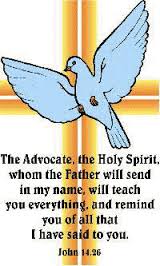
This weekend we celebrate the 6th Sunday of Easter. It seems no time since we began Holy Week on Palm Sunday and now we are heading into Ascension and then Pentecost Sunday which is often called the birthday of the Church. In this Sunday Gospel Jesus promises to send the Holy Spirit to the apostles as the advocate. Although Jesus had spoken to the Apostles and told them many different things, he knew them well and realized that they wouldn’t remember everything he said Jesus also knew that they would have to endure many struggles, that they would have to face ambiguity and confusion, difference and disagreement. They would not see eye to eye on everything; they would have different memories of Jesus; they would emphasise different things. In the conflicts that would arise they would have to put their faith to work. That is why he told them and he tells us that the Advocate, the Holy Spirit, whom the Father will send in his name, will teach you everything and remind you of all I have said to you. These words are a direct pointer towards Pentecost and the gifts that the Holy Spirit would bring to them as well as us.

We don’t have the physical presence of Jesus with us the way his first disciples did when he talked with them around the table at the Last Supper, washed their feet, and gave them his reassuring promises. His farewell to them was a real farewell he was going, he would no longer be with them as he had been. But he assured them and us that he is present in a different way, in his gift of the Holy Spirit. In the Gospel Reading Jesus also promised the Apostles Peace  ‘A peace that the world cannot give.’ Sometimes we mistake this peace for our idea of quietness or tranquillity, but the peace the Jesus gives is a peace that can be found even in the midst of turmoil. This peace is not something we can manufacture ourselves by our own power. It’s a gift that comes from Jesus, who doesn’t want to lose touch with us. Jesus chose his followers to carry out God’s plan of salvation. He chooses us today to do the same. By allowing us to participate in his work of redemption, he gives us a personal stake in the Kingdom of God. If we keep on trusting in the presence of the Spirit to us, we will have peace in the midst of any personal, family, or community turmoil that comes our way as well as someone who will keep us going along the right Road!

DIVINE MERCY SUNDAY

images

I was sitting here a few days ago  just thinking that the season of Lent, Holy Week and  Easter  Sunday have come and gone. Many people think that Easter begins and ends on Easter Sunday but it doesn’t end there, the celebration of the season of Easter goes on to Pentecost Sunday. I wonder what the Apostles would think if they were to come down to us these days and find that we are celebrating the Death and Resurrection of Jesus that took place all those years ago, they would be amazed especially as they thought everything was over with the Crucifixion on Good Friday. In this Sundays Gospel reading the Apostles were still huddled together behind locked doors, pondering the shocking experience of the week before when all seemed to be lost. Then we are told that Jesus came to them and to assure them that He was alive. His message must have troubled them as well when he told them: “As the Father has sent me, so I am sending you.” 

In the same way as the apostles were sent out we are sent out to bring his message of mercy to other people wherever we are. Then of course there is doubting Thomas who heard the witness of the those who saw Jesus but, like so many of us today he wanted more proof. Jesus says to Thomas, “Have you come to believe because you have seen me?  Blessed are those who have not seen and have believed.” That is a favourite quote for many of us, who have not “seen” the risen Christ as the disciples did. We have come to believe though we have not seen him in the flesh but he is with us in the midst of our communities through so many different people. When Jesus says to the Apostles Peace be with you the Peace he is talking about is much more than the lack of conflict. True peace, gives us happiness, since it is built on trust.  The gospel tells us how Jesus gave his followers peace because they trusted him. In spite of the scepticism of Thomas and so many others, Jesus  offers us the same peace of heart mind and soul. As we celebrate Divine Mercy Sunday we remember the joy, the hope, the grief and the anxieties of the people in our time those we know and those unknown to us and we bring them to the Lord. As Pope Francis says, we must courageously reach out to those who are doubtful among us, and assure them of the great mercy of Jesus the face of the father’s mercy. Our world is hurting so much because of the things that are happening within it with so many people at each other’s throats for so many reasons. May all of us be witnesses to the joy and mercy of the Gospel as we bring the caring face of God’s mercy to the people in our own communities wherever we are called to be.


EASTER SUNDAY

Copy of images (48)

Having  completed our Lenten observance and after the liturgies of Holy Thursday and  Good Friday we  are now at the stage of celebrating the Easter Vigil on the day of resurrection that is Easter Sunday. Holy Saturday is about emptiness, the cross is empty and Jesus lies in the tomb everything around us is still.  The heavens and the earth cry out with longing for the sinless one who is not to be found, if we stop to think for a moment we remember that Jesus died and rose again on the third day. We wait, as mourners beside a grave, unsettled, ill at ease, not knowing what to do with ourselves. The Church has only one thing to do today: to pray through the emptiness of Holy Saturday.

Holy Saturday is the day when we experience watching and waiting at the tomb as we await the celebration of the Resurrection which we celebrate in the Easter Vigil and the season of Easter. The Psalm for Easter Sunday says, “This is the day the Lord has made; let us rejoice and be glad in it.”Above all days, Easter is a day of joy. At Easter, we celebrate the kind each of us longs for, when every tear is wiped away, and there is no sorrow any more no more suffering from weather or hunger or hurtful human beings. As we sing in the much-loved hymn by Fr. John Foley, S. J., at Easter, “the cross and passion past, dark night is done, bright morning come at last!”  When we ourselves rise to meet our risen Lord, in that bright morning we will hear him say, “Come away, beloved. The winter is past; the rain is gone, and the flowers return to the earth” (Song of Songs 2:10-12). In the loving union of that encounter, all the heart brokenness of our lives will be redeemed. That will be perfect  joy.So in that same vein of perfect joy we say “this is the ‘day which the Lord has made.’ Alleluia!  let us take fresh hope,  with Christ our Passover everything is possible! Christ goes forward with us in our future!” Let us go forward together as Easter people rejoicing in the Resurrection.


SPY WEDNESDAY

images (5)

As we continue our Holy Week journey we have come to the Wednesday of Holy Week and it is called Spy Wednesday, it was the day when Judas made his bargain with the high priest to betray Jesus for 30 silver pieces (Matt 26:14-16; Mark 14:10-11; Luke 22:1-6). In Germany, this day was often called ‘Crooked Wednesday’, while some other countries called it ‘Black Wednesday’. Early Christians also used to fast on Wednesdays throughout the year in remembrance of the betrayal of Jesus. The name ‘Spy Wednesday’ is said to be of Irish origin, although the Bible never refers to Judas as a spy. His surname, Iscariot, is believed by some to be a corruption of the Latin ‘sicarius’, meaning “murderer” or “assassin”.  Matthew narrates everything, not to criticize or to condemn, or discourage the readers, but in order to underline that acceptance and the love of Jesus exceed the defeat and the failure of the people of God! Because of the frequent persecutions, many were discouraged and had abandoned the community and asked themselves: “Will it be possible to return? Will God accept and forgive us?” Matthew responds by suggesting that we can break the relationship with Jesus, but Jesus never breaks it with us. His love is greater than our infidelity. As we look towards the three great days of the Easter Triduum we know that it is possible to return and that  God will accept and forgive us remember the prodigal son and the woman caught in adultery whose stories we heard recently in our Gospel readings at our Sunday Masses.

PALM SUNDAY 2016

images (4)

For the last five weeks of Lent we have journeyed along the path of reconciliation forgiveness and mercy with Jesus. As those who know his mercy we now begin Holy Week with our annual celebration of our Lord’s entrance into Jerusalem, his own city on the day more commonly known as Palm Sunday. As we end the season of Lent it isn’t really the end as we all know that first Holy Week was the beginning and here we are in 2016 celebrating the life changing events that took place all those years ago. There was an American TV programme called That Was the Week that was which I’m told went out in the 1960’s and in many ways for us as Christians Holy Week was the week that was in the past, as it is for us now in our own time and will be the week that was in the future for other generations. So now in the context of faith we stop and ponder where our Lenten journey of mercy has brought us and what Holy Week is about. It is simply not just about the death of Jesus on Calvary it is about a great deal more and the cross is one of the central parts of this week.  We begin on Palm Sunday with a few days to go until Good Friday, days that are packed with symbolism and meaning. We hear in the Gospel the crowd goes from rejoicing and singing Hosanna to the Son of David to calling out crucify him, crucify him. The entrance into Jerusalem is one of the very few events in Jesus’ life which is mentioned in all four gospels.  It is the only time that Jesus accepts and encourages public acclaim as Messiah even at that it wasn’t really about him it was about doing his father’s will.  He even goes as far as organising his entrance by telling the disciples to go and fetch the donkey.  The key moment in God’s great plan of salvation is about to begin and Jesus knows exactly how it will unfold and where he will end up. As we reflect upon the story of Jesus going up to Jerusalem we recommit ourselves to Jesus and his message of mercy and salvation.The events of Palm Sunday were foretold thousands of years ago.

The first reading from Isaiah, was written at the time of the Babylonian captivity and it speaks of a courageous and obedient messiah-figure, who says, “I have set my face like flint” set my face against the beatings and scourging that lie ahead, “knowing that I shall not be put to shame.”  On Palm Sunday we feel an certain amount of embarrassment when we cry out “Crucify Him” with the palm branches still in our hands. It reminds us of our own fickle response and our lack of courage in responding to His Mercy, love and truth. Yet as we know it was the sins of us all which brought Jesus to Calvary. Palm Sunday and Holy Week are all about Jesus suffering for our inadequacies and our own very real sins. Holy Week is a time for us to realize what we are like, and to find that the only remedy for our fears is mercy and love. That is the Mercy and Love of God. Are we ready to join our own fears to the Master’s? Are we ready to add as much love and mercy as we can possibly muster to His boundless love and endless  mercy?


FOURTH SUNDAY OF LENT

images (12)

This weekend we celebrate the fourth Sunday of Lent which is also called Laetare Sunday and is a Sunday of joy.  Our Lenten journey of mercy  is half over and Easter is near. This Sunday we hear the story of the Prodigal Son, the contrast between the two brothers is quite sharp. After wasting his share of his father’s fortune the younger brother recognizes his misery and the mistakes he has made and returns home looking for the mercy of his father when he says: “Father, I have sinned against heaven and against you. I no longer deserve to be called your son” (Lk 15: 18-19, 21). The older brother takes a different sort of attitude one of arrogance not only towards his brother but also towards his father! His scolding is in great contrast with the tenderness of the father who comes out of the house and goes to meet him to “entreat” him to go into the house (Lk 15: 20, 28) after  he told him that his brother that was lost has been found. The big question that we should ask ourselves when we hear this story is what does God do when we turn away from him like the younger son in the Gospel? He does exactly the same as the Father in the gospel story did he waits and when we return he goes out to meet the returning Son or Daughter with endless mercy and compassion. The gospel story of the Prodigal Son is an image of God the Father who invites us to experience his mercy and return to him especially during the year of mercy season of Lent. We all get second chances in life and this gospel is really  about God our Father giving us the chance to start over again and again, perhaps taking the chance to right a wrong or the chance to make a difference to someone or do something these are just a couple of examples. Of course being given a second chance is not always fair or just and we see this from the reaction of the other son who complains in a big way about his Father not even giving him something to celebrate with his friends. The story of the Prodigal Son is also a story of transition as much as it is about second chances. We remember that second chances are invitations to move forward leaving our old selves behind. Leaving our old selves behind and getting another chance is why we have the Sacrament of Reconciliation or confession. This sacrament is a chance to the wipe the spiritual slate clean, a time to start anew as a child of the Father. Pope Francis has asked each Diocese to dedicate a period of “24 hours for the Lord” on the 4th and 5th March. This weekend in many places all over the world we will be able to adore the Blessed Sacrament and celebrate the Mercy of God in Confession. May we like the Prodigal Son not be afraid to come back for we will be received with open arms like the Father in the Gospel story god will come out to meet us for his mercy and compassion are without measure.


SECOND SUNDAY OF LENT

images (8)


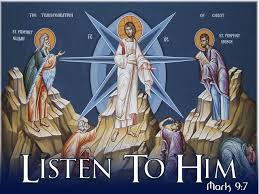
This weekend we continue our Lenten journey of mercy as we hear the gospel story of the Apostles going up the mountain were the voice of God reveals Jesus’ true identity: «This is my Son, the Chosen One Listen to him». For many, mountains are a place of encounter with God with Moses encountering God on a mountaintop, so did Elijah, and it was a favorite place of prayer for Jesus too. This particular gospel scene is traditionally considered as Jesus’ transfiguration and is reported in the Synoptic Gospels—Matthew, Mark, and Luke. It’s not possible to reconstruct with certainty the experience that led to this surprising story: we only know that the Gospel writers give it great importance, since it is told as an experience that gives a glimpse of Jesus’ true identity as the Son of God. The splendid vision in our Gospel for this Sunday comes after Jesus had said that “The Son of man must suffer many things, and be rejected by the elders and chief priests and scribes, and be killed, and on the third day be raised” (Lk 9:22).

This was not the good news that the disciples wanted to hear as they expected Jesus, as the Messiah, to drive out the Roman army of occupation and restore the kingdom to Israel (Acts 1:6). Many of them would have begun to have second thoughts: Is Jesus really the expected Messiah? The transformation or transfiguration of Jesus that the disciples experienced was not simply something they were to see and experience as happening to him alone. It was also an invitation for them to undergo a transformation and transfiguration of their own. How is that transformation or transfiguration to take place in each of our own lives? We will be transfigured by listening to Jesus, listening to all that he invites us to be and do, however much it may seem to go against the conventions that we were brought up on and the conventions of today. It means especially listening to those words which caused such difficulty for Peter and his companions and integrating them into our own vision of life. In short It means having a total trust in walking his Way, a total trust that only his Way brings us  into full union with God, the source of all truth, love, happiness and peace.

We know that Christ “had to suffer and thus enter into his glory.” We also understand the purpose of Christ’s passion was that we, in spite of our own mortality and weakness, might enter into eternal glory through his suffering. So the question for all of us this Sunday is are we prepared to be transfigured this Lent from what we are into Gods new creation remembering that Jesus underwent his Passion so that we might have life and have it to the full.

FIRST SUNDAY OF LENT

images (4)


Well here we are at the First Sunday of Lent having placed the ashes on our heads on Ash Wednesday we have embarked on our annual time of renewal. In every area of our lives there is an ongoing need for mending, renewing and refocusing. Lent is our annual spring clean of our spiritual lives renewing our faith as a preparation for celebrating the events of Holy Week.

In the Gospel reading for this Sunday we hear the reading from Luke that details the temptation of Jesus in the dessert. Before Jesus set out to do his Fathers work he went out into the dessert for forty days of fasting and prayer and during this time he was tempted by the devil. The devil tempted him to use his power  to take care of himself, prove his identity by performing astounding signs and make alliances with political and military powers to get himself and his message across. It is immediately after His time in the desert that Christ began His work, of proclaiming the kingdom of God.”

In proclaiming the message of the Kingdom Jesus gives us all  the good news of truth, hope, peace, and salvation and this enables us to live life to the full and conquer sin.  As well as this there is great encouragement for all of us to know that Jesus not only shared our human nature but, like us, he was subject to temptation. In the course of our daily lives we too face temptations to put comfort and material possessions over the sacrifices involved in being a disciple. We often get sidetracked and lose sight of what and who are important in our daily lives. This Gospel highlights that we are dependent upon God for all that we have and all that we are. God’s desire for us on this first Sunday of Lent in the Year of Mercy is that we Come back to him with all our heart. God does not want empty words but full hearts.  Hearts full of remorse when appropriate; hearts full of trust as we face the realities about ourselves; hearts full of love as we realize how much we are loved; hearts full of joy as we journey towards Easter, the moment when life, and everything else changed forever when Christ died and rose again for us in all our ways good and not so good.

4th SUNDAY IN ORDINARY TIME

images (8)


This weekend we celebrate the fourth Sunday of the year. In our first reading which is also the first reading for the feast of John the Baptist Jeremiah says, “The word of the Lord came to me….” I wonder if he understood the implications of what God was saying to him when he heard it.  In Jeremiah’s narration of his calling we have a summary of a typical prophet’s call. First, God does the choosing and then empowers the person with the Word of God. It is not explicitly mentioned in this passage, but when prophets are called they are also empowered with God’s Spirit. They will need both, the gift of the Word they must speak to the people and the presence with them of God’s life-giving and fortifying Spirit. Prophets do not have an easy job and need all the help they can get from God. The second Reading is Paul’s hymn to true love. It is an awe-inspiring challenge to those who claim to be followers of Christ and is a reading that is often heard during wedding ceremonies. The first part describes the folly of good works done without a relationship built on love. The second part describes love in terms that appear prosaic but, because they allow for infinite development, are transcendental. Then the third part is wisdom which comes from years of reflected experience.

In the Gospel Jesus’ preaching begins with affirmation from the hearers. “All who were present spoke favorably of him.” Almost immediately the mood changed. The use of the reading from Isaiah was welcomed. It is good news that the people have waited a long time to see fulfilled. But, somehow conveyed in the words was the suggestion that Jesus himself has a role to play in the inauguration of the new age, the eternal Jubilee and it is this that is not acceptable. The examples that follow indicate that Jesus was hinting that the word of God was spoken universally, not to one particular person or group of people. The stories of the prophets, Elijah and Elisha, show that God’s love and mercy are to be found wherever there is a need and the faith to receive it. The reaction from the group was swift and indignant. They rose up and wanted to throw him not only out of the synagogue but out of the town. The hearers have hardened their hearts to the word.

Why did the crowd rise up against Jesus? Because he stepped outside the box they had constructed for him. He was no longer the local boy who made good; he was a self-proclaimed prophet. And his signs were not for the edification of the mob, but for the glory of God. In these ways, he rejected the expectations of those in Nazareth, and, so, they rejected him. As a last sign to them, Jesus walked safely through them and, according to Scripture, he never returned to his home town. Expectations are always hard to fulfil as we hear from the readings of this weekend. But, faith is not based upon expectations, but on a relationship with God. We must recognize the difference between the two. And place our expectations before God. There is a great saying that was often quoted to me by a friend who passed on a few years ago she always pointed out the man proposes and God disposes meaning that god will see and do whatever is good for us whether it is what we want or not for sometimes what we think is for our good is in fact the opposite !!

3RD SUNDAY IN ORDINARY TIME

images

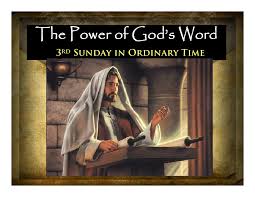
This Sunday we celebrate the 3rd Sunday of ordinary time which falls during the week in which we pray for the unity of Christians. The second reading from St. Paul tells us that though the Church has many parts we are one body, the body of Christ and this is true. As Christians there are different faiths and each of us has a different faith journey but the one thing that unites all of us as one body is Jesus Christ the son of God.

In the Gospel Reading for this Sunday Luke wants to make very clear to his readers what drives Jesus the Prophet from Galilee and what is the goal of his action. We as Christians need to know in what direction God’s Spirit pushes Jesus, since following him means that we are walking in the same direction as he did. The Spirit descended upon Jesus at his Baptism in the Jordan. With the Spirit poured upon him, Jesus would proclaim freedom for the trapped (captives), the diminished (blind), and those in need (oppressed). When Jesus proclaimed the Good News, he proclaimed the Spirit. Since Spirit meant breath, Jesus breathed God’s word in his words and deeds.  The power of his proclamation changed people, situations, and environments because he breathed out the power of God.

When Jesus spoke, hearts turned to God and health of mind body and spirit were restored. There is an immediate life-implication of today’s passage that is easy to overlook for us in our I want I get world. it is this: The Spirit of the Lord comes upon Jesus and comes upon the Church in order to bring good news. The presence of the Spirit means joy. In the 21st century we’re OK with entertainment and pleasure, but we are often suspicious of Spiritual joy because it might be a pie-in-the-sky illusion. How can we talk about or even allow ourselves to experience joy, when there is so much false hope, so much suffering, so much serious work to be done in the world around us? The paradox of Christian faith is the cross of Jesus. The cross symbolizes the pain and sorrow that Jesus and we know so well. At the same time, the cross of Jesus is the ultimate revelation of the love and mercy of God shown to us through his son. “For the sake of the joy that lay before him he endured the cross despising its shame, and has taken his seat at the right of the throne of God” (Hebrews 12: 2). The joy that lay before him was not only that God would wipe away his every tear, but that through his self-giving love, his joy might be in us and our joy might be complete. We pray that as individual Christians and as Church, through the power of the Spirit, we will have the courage to bring Mercy to the poor, liberty to captives, sight to the blind, and freedom to the oppressed especially during the Year dedicated to  Mercy in all its forms.

iec2016_banner1452722818

This weekend we also have the beginning of the week-long Eucharistic Congress in the Philippines. It seems like yesterday when we celebrated the 50th Eucharistic Congress in Dublin in 2012 and yet four years have passed and so many things have happened. We pray this weekend for a successful congress for all those who will be going there in the days  ahead.

Post Navigation