Fullerton T

RELIGION LITURGY AND LIFE

Archive for the category “RELIGION”

The Baptism Of The Lord
BAPTISM

This Sunday we celebrate the baptism of the Lord, when Jesus was baptised in the river Jordan by John. None of us remember when we were baptised when we were infants having said that I have had the privilege of knowing two adults who were baptised in our parish in the last year and I wish them well for their future faith journeys.

 It may seem strange, but this is a Christmas Feast. Not if we think of Christmas only in terms of the Baby in Bethlehem, but if we have followed the ideas of the Feasts of Holy Family and especially Epiphany, and have seen the Season in terms of the growing manifestation or appearing of the Son of God: first to the shepherds and then to the wise men from the East. Now in the River Jordan, Jesus, Son of Mary, is revealed to all and everyone as the fullness of all God’s promises: “This is my Son, the Beloved“. On this day we stand before the revelation of God’s love for us, such that he would send his only Son into the world. Christmas without the Baptism of the Lord, and the words that are spoken from heaven, would be incomplete, since it is only in them that we fully see the wonder of what happened in Bethlehem, that we fully understand the reason for the joy with which we celebrated Christmas Day.

As we come to the end of Christmas time we do so having been shown who it is we listen to: the only Son of God, the Beloved in who the father is well pleased. As 2013 unfolds, will it be truly a Year of Faith for us and a new opportunity for truth and love to overcome the evil that surrounds us? Light always has power over darkness, especially when it comes through Jesus Christ  who is the way the truth and the life and His followers that means you and me. let us not be afraid to show the light of Christ to others in the months ahead.
THE EPIPHANY OF THE LORD


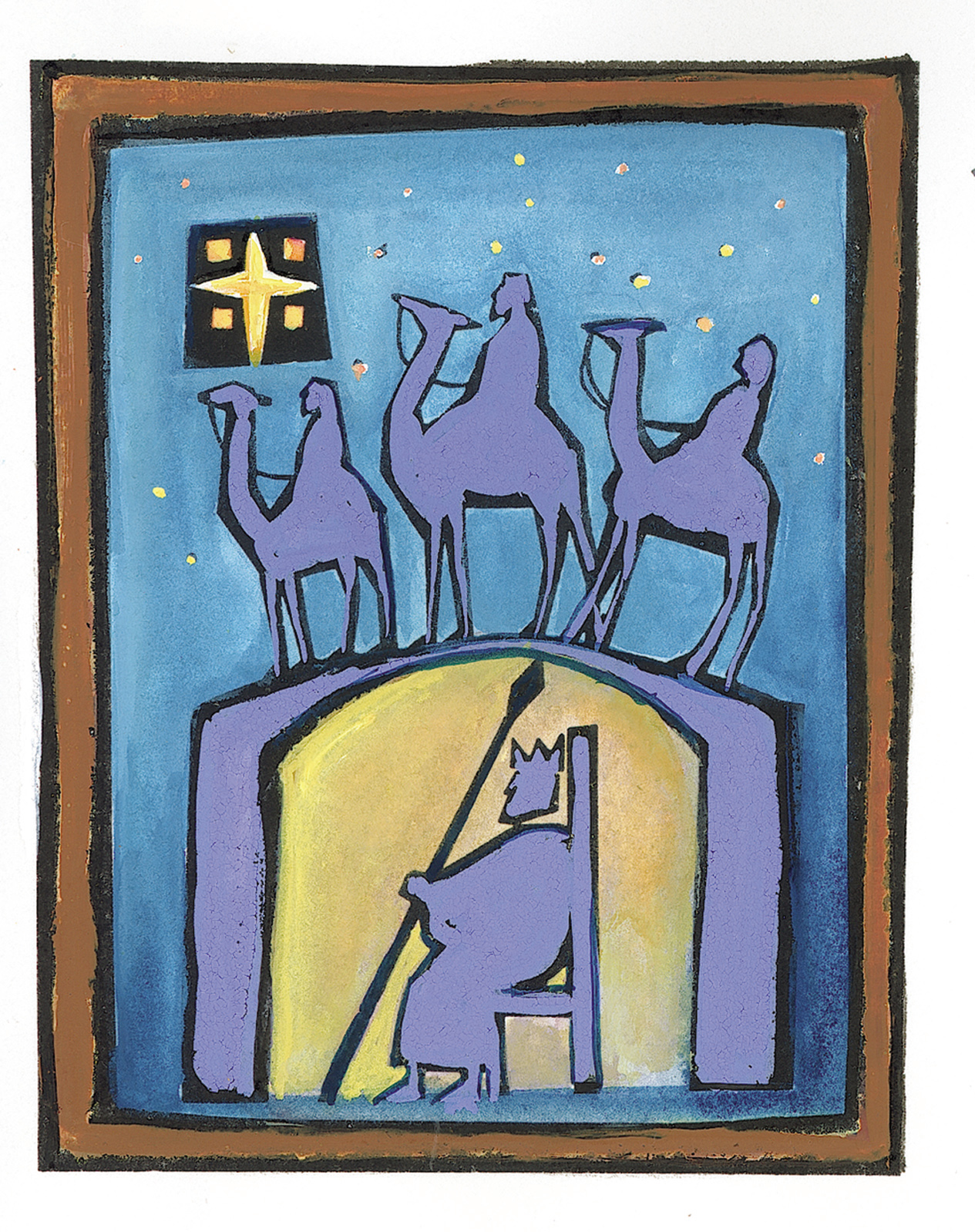
THE THREE WISE MENJOURNEYING TO JERUSALEM

THE THREE WISE MEN
JOURNEYING TO JERUSALEM


By long standing sacred tradition Christians celebrate Christmas as a season, with the twelve days between Christmas and the Epiphany as one long “Christmas day.” The season ends with the Baptism of the Lord which is also the first Sunday of ordinary time and that takes place next Sunday. Christmas celebrations with friends and family, decorations, and all of the other means of rejoicing, should continue throughout the season. We can never rejoice in the Lord’s birth too much. As Christians, we will very often find ourselves living in contradiction to the styles and preferences of the present age. We should get very much used to the fact that we will face conflict among friends, and even at times within families, as we seek, more generously and more regularly, to live out and celebrate the mysteries of our redemption in Christ Jesus.

“Arise, shine; for your light has come, and the glory of the Lord has risen upon you.”(Is 60:1) Isaiah the prophet describes the glory of Jesus Christ, who is “full of grace and truth; we have beheld his glory, glory as of the only Son from the Father”(Jn 1:14), our Messiah. The prophet also foretells the reality of those first three wise men, who represent the kings and the peoples of the whole earth, all of whom are called to realize their full dignity as sons and daughters of God in worship and praise of him for his glory and goodness. “Above you (US) the Lord now rises and above you his glory appears. The nations come to your light and kings to your dawning brightness.” (Is 60:2-3)

The story of the magi  or the three wise men carries with it an extraordinary richness. In it the evangelist teaches us about the mission of the Son of God. Jesus is ‘made manifest’ (epiphany = manifestation) as Messiah not only for his own people, but for those who come ‘from the east’, for all the peoples of the earth. At the same time this is the Messiah heralded by the prophets. The Scriptures are fulfilled.

This Messiah is born into danger, as the cruel tyrant, known to history as ‘Herod the Great’, is the first to threaten his life. The gift of myrrh alludes to the death he is to suffer. The presentation of gifts from the peoples of the world completes the Christmas scene. The magi represent the nations, but also the age-old quest among the peoples of the earth for true wisdom. This wisdom is found in Christ. May we not be afraid in the year that has just begun to seek the wisdom that God wants for us, that is the wisdom and the light of faith

The Feast of the Holy Family


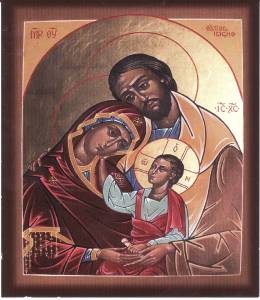
THE HOLY FAMILY


THE HOLY FAMILY

Every year, the Church celebrates the Feast of the Holy Family of Jesus, Mary, and Joseph on the Sunday within the Octave of Christmas. And that means a celebration of family life — births, weddings, funerals, anniversaries. In the first reading, we hear about a joyful birth — that of Samuel. After years of prayer, Hannah and Elkanah are granted a son. As soon as Samuel is weaned, his mother fulfils her promise and gives him up to the Lord’s service at the shrine at Shiloh. We in our parish have a particular reason to celebrate as we are the Parish of the Holy Family. As an example for us to follow, the Holy Family can seem a little too perfect: when we consider the more “dramatic” events of the Christmas and Easter stories, it can seem so far removed from us. And yet, as today’s Gospel reminds us there were also the so-called “hidden years” – the many years of family life in Nazareth, spent in doing ordinary family things. During that time, we hear how Jesus grew and matured, and in the glimpse of that family life we see our example. Our celebration of this feast announces that there is a lasting value in the ideals of family life especially when so many are denigrating what it means to be a family as well as the relationship between husband, wife, parents and children. Whatever the changing details of each age, honour, understanding and love always remain the recipe for the perfect, and holy, human family.

Today we remember the care that Mary and Joseph gave to Jesus. We recognize the sacrifice they made for Jesus, in the same way as we recognise the sacrifices our own parents made for us  and many more  are making for their children today in our I want I get world.   

Our families would find the disagreements, stressful relationships, and resentments that spoil the joy of family harmony so much easier to solve by imitating the faith and loving trust of the Holy Family. “Lord Jesus, you came to restore us to unity with the Father in heaven. Where there is division, bring healing and pardon. May all peoples and families find peace, wholeness, and unity in you, the Prince of Peace and Saviour of the world.”


CHRISTMAS DAY 2012

Art Christmas Day

Well  we are nearly at the great day itself CHRISTMAS DAY so happy Christmas wherever you are. For the last four weeks of advent we have been looking forward to the coming of Christ into our world with all its ups and downs and lumps and bumps along the road of life. We have completed our advent observance with all its preparation and now we celebrate with gifts and happiness all around So now  then let us rejoice in the Lord, not in the world; that is, rejoice in faithfulness and not in iniquity; rejoice in the hope of eternity and not the brief flower of vanity that is part of our  daily lives.  During these days of Christmas celebration we will often have occasion to sing as the angels did long ago, “Glory to God in the highest!” At this time when we celebrate the birth of “a saviour who has been born for” us, the One who is “Wonder- Counsellor and  Prince of Peace,” the One who is “a great light” in the darkness of war and strife around us, we welcome an opportunity to put aside our cares and worries, bask in the joy and generosity of the season, and sing out our “Glory to God in the highest as we celebrate the birth of Jesus Christ.  None of us will travel to Bethlehem to behold the  newborn infant lying in the manger in the way the shepherds and the wise men did in their time. But all of us travel the road of daily life, and we are called to see Jesus the newborn Infant in the youngster who needs companionship, the teenager who needs a listening ear, the parent who needs a helping hand, the older person who needs someone to care to name but a few there are so many others. We remember in a special way all those who have died since last Christmas and we keep their families in our thoughts and prayers. Some of our Christmas customs seem to turn away from Christ. Or do they? The giving of gifts expresses love of the other person. Festive decorations set this season apart from all others. Santa Claus was originally St. Nicholas, a bishop remembered for his generosity. Every letter sent and received bears the stamp of this special season, tidings of good will, and a reminder that those who are far away are close to us in mind and heart. The customs of this season are veiled announcements of one message: Christ is born for us. To remove the veil, to hear the good news, we gather together in our churches =. There the message of Christmas speaks loud and clear. The Letter to the Hebrews says, “In times past, God spoke in  various ways to our ancestors through the prophets; in these last days, he has spoken to us through his Son.”

The customs of Christmas speak the message in partial ways, but God speaks the message clearly through his Son, who is born in our midst this day. on this day the whole community of heaven joins with all believers of good will on earth in a jubilant song of praise for the good news proclaimed by the angels: Behold, I bring you good news of a great joy which will come to all the people, for to you is born this day in the city of David a Saviour, who is Christ the Lord (Luke 2:10-11). So with Mary and Joseph with the shepherds and Angels and the Arch Angels and the whole company of heaven    Come let us adore him Christ the Lord.

DDEA6629

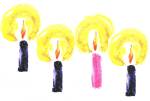
This weekend we come to the last Sunday of the Advent season. In our churches we light the last purple candle as well as the other three leaving the last candle the white one for the first Mass of Christmas Day. It’s only in this last week before Christmas that we begin to hear about the “Christmas story” itself. For the past weeks we have been preparing ourselves to greet the Lord, when he comes. Now we prepare to remember how he first came, by listening to the prophecies of his coming, and by hearing of the events before his birth. We meet Mary, who herself had been prepared for the coming of the Messiah. She has received the angel’s greeting, and his strange news, and has accepted her role in God’s plan. Now she hurries to her kinswoman, Elizabeth, who herself bears John the Baptist in her womb. John,  alerts us to the presence of the Lord, as he leaps for joy in his mother’s womb. His joy is that God has kept his promise, and is with his people.

On the days before the feast of Christmas, and on this final Sunday, the gospel read at Mass is taken from the first chapter of Matthew’s gospel or the first chapter of Luke’s. Today’s gospel passage is unique because it presents a meeting between the mothers of the two men. The story, known as the ‘Visitation’, follows the account of the Annunciation to Mary of the coming birth of the Saviour, which ended with Mary’s ‘Yes’ to God and her words, ‘let what you have said be done to me’. (Luke 1:38) As Mary welcomed the coming of the Lord into her body, now John, as yet unborn, welcomes his arrival too. If we continue to read the gospel beyond today’s passage we hear the words of Mary’s hymn of thanksgiving, the Magnificat, prayed daily by the Church at Evening Prayer.This last Sunday of Advent gives us a brief time to reflect upon and kindle within ourselves the light of the incarnate Lord. The foundation is laid for what we will find at the manger.

Now as  having made our final preparation to join the shepherds and the angels in their Joy, great joy in what God has done for us we go forth in peace to greet the Lord remembering that Jesus Christ the Son of God the light in the darkness is the reason for the season.

THE THIRD SUNDAY OF ADVENT

C841CD23


This Sunday is called “Gaudete” Sunday — it is the Sunday during advent in which we rejoice of course we are supposed to rejoice on every Sunday as we celebrate the resurrection of Jesus in our liturgies. The rejoicing we are talking about today comes from the today’s readings, and it underlines an important point. In the Gospel, we hear John the Baptist telling different groups what to do – they must repent, and change their lives. We might think of this as a rather joyless thing – something which is hard and unrewarding. In many of our Churches this weekend we will light the pink candle and the president/presider may be wearing rose or red colored vestments. The message of this Sunday is one of repentance that is repentance in order to change our lives so we are really able to welcome Jesus and this is something richly joyful as we make our Christmas Preparations. When we are planning to welcome anyone to our homes, we set about cleaning and preparing for their visit with enthusiasm – nothing is too much trouble for someone we care for greatly. Even scrubbing the bath or polishing the furniture can be a happy and joyful thing yes you did read scrubbing the bath! The message of this Sunday is that preparing to welcome the Lord – even though it may involve hard work – is something joyful, because of our love for Him, and His love for us for great in our midst is the holy one of Israel.

A sensible way to prepare for Christ’s arrival is to learn from the example of other people who have prepared well while they awaited his arrival. There are many such examples in the Bible and John the Baptist is one of the most striking. John’s preparation for the Messiah’s arrival was characterised by his preaching. He preached a message of hope and repentance to dejected people   whose land was occupied by foreigners, who were often exploited by their religious leaders and who had become spiritually enslaved to sin. John also fasted and did penance in preparation for the coming of the long-awaited Messiah and he urged other people to do the same.

John learnt that the only way to become disentangled from sin is through repentance and conversion. Thus his preaching focused on the urgency of repentance and he reassured the people about God’s providential care and complete fidelity towards them even when, at times, they were unfaithful and sinful. They could be certain that God’s promise to send the Saviour would soon be realised. We are asked to emulate John’s example by being people who are repentant for our sins. We are invited to encourage other people to become repentant too. We cannot truly meet Christ as he comes into our lives each day unless we are without sin because it imprisons us and prevents us from recognising him. Nowadays, people have lost their sense of sin and the damage it can do to the individual and our communities.

Many people mistakenly think that sin does not exist and as we all know SIN certainly exists in our modern world. Many people presume that they can do whatever they wish and as we know all our actions have consequences. In effect, God gave us free will so that we can choose good instead of evil. In addition, the Church’s teaching guides us in our beliefs and practices so that we can prepare adequately for eternity with God.  There is so much in our lives in these days of instant communications to make us anxious worried and afraid. Anxious and worried about the present times and afraid of the future but we have to remember in him that is in God in whom we live, and move and have our being nothing is impossible. I know that there is a great spirit of rejoicing for many people for many reasons all over the place whilst there is also a spirit of fear and trepidation for many more in these uncertain times. Let us remember as we continue our daily lives not to be anxious about anything the Lord is very near to us as we journey along our pilgrim path. So then let us rejoice in the Lord, not in the world; that is, rejoice in faithfulness and not in iniquity; rejoice in the hope of eternity and not the brief flower of vanity that is part of our  daily lives. Rejoice wherever we are for the Lord is very near: do not be anxious about anything our hope and our salvation are at hand. Let us go forth in peace and joy to meet the Lord when he comes.


THE SECOND SUNDAY OF ADVENT


Art Advent 2C


Advent, the Church’s world-wide retreat in preparation for Christmas, now begins its second week. Whilst advent continues for the next number of weeks we have to remember that we are also in the year of Faith and in faith and because of faith we continue our advent journey. Advent is a quiet time, it is the great contrast with our culture’s consumer-bonanza. Consumerism-as a-way-of-life is a blessing in many ways for so many people, but it also shields our eyes against what needs to be prayed for rather than what we might want. This week we hear about the coming “Day of Christ”, and meet the character of John the Baptist. Just as once before he “prepared the way” for the coming of Christ, so today he does the same for us in our time and place. Our hearts should be open to his voice, as he calls us to repentance, and asks us to make the way straight for the coming of our Lord. The imagery of this Sunday is particularly rich: the dominant image is of a vast population moving together – the return from exile in the first reading, the going and coming of the sowers in the psalm, the community of the Church preparing together in Paul’s letter. We prepare for the coming of the Lord as His people – a community who cooperate to make the “processional way” of the Holy One – flattening the hills of opposition and ridicule, filling in the valleys of doubt and despair, so that “all mankind shall see the salvation of God.”

Advent then  is a time of joyful anticipation for all of us young and old  and all the in-betweens . The prophet Baruch tells us, “It is time, to take off your robe of mourning and misery,” for God is leading his people “with his mercy and justice for company.” God’s people “that is you and i are wrapped in the cloak of justice from God. As Christians, our lifestyle is meant to be different from those around us who are not Christian. If John the Baptist worked alongside us, would he, for example, hear us swearing or see us being uncharitable? And if he did, would he turn a deaf ear or a blind eye I don’t for a moment think his eye would be blind or his ears deaf to our shortcomings.  Many of us are reluctant to speak about our faith and share it with others. The challenge of the Good News is to become humble disciples, always permitting the name and power of Jesus Christ to take precedence over our own name and fame.  We are looking forward to Christmas: the Christ we seek to welcome calls us to look forward in the way we live and move  and have our being and he calls us to look forward to his own coming in glory. Let us look forward in faith and hope to Christmas so when Christmas comes we will be able to get the greatest possible spiritual benefits of this particular season of the year.

First Sunday of Advent Year C


week1

Well here we are at the start of the Advent season and the new liturgical year.  In our Churches on this Sunday we   light the first candle on the Advent Wreath and put the first leaves on the Jesse Tree. Advent like Lent is a time of preparation of body mind and spirit though it is a good bit easier than the six weeks of Lent for so many reasons. The word ADVENT comes from the Latin and it means coming and that is what advent is about the coming of Jesus into the world. Yet with all the flurry and hurry of December it can be so easy for us to lose the short time that we might have during each day to pray and listen to what god is saying to each of us.

The Scriptures of Advent open this year with an appeal for justice and security. Our society longs for a better life the same way ancient Israel and Judah did. We long for safety within our borders. We long for leaders of blameless conduct. We long for these blessings to last.

During Advent we want to see the fulfilment of God’s promises. God promised peace. God promised safety. God promised good leaders.God promised food, drink, and strength. During Advent we anticipate the fulfilment of God’s main promise: salvation. We await the annual celebration of the birth of Jesus, whose name means Saviour and whose mission brought redemption. God gives us a different grace in every liturgical season and God has a grace to give you and me this Advent. If Advent is only a time of consumerism and buying gifts for people that they don’t really want or need, it is flying in the face of what Jesus is all about. There is only one gift at Christmas, that gift is Jesus. Jesus is the grace that the Father wants to give to us this Advent. Let us spend time with God to receive this grace. As we examine our consciences this Advent and see our shortcomings we are privileged to receive the mercy of God in the Sacrament of Reconciliation. When Jesus was entering Jerusalem for the last time he cried because the people of Jerusalem did not recognize the time of their visitation (Luke 19:41-42). Let us not miss out on the grace God is offering us this Advent and remember when we get to our Christmas Celebrations that Jesus is the reason for the Season.

THE FEAST OF CHRIST THE KING


CHRIST THE KING

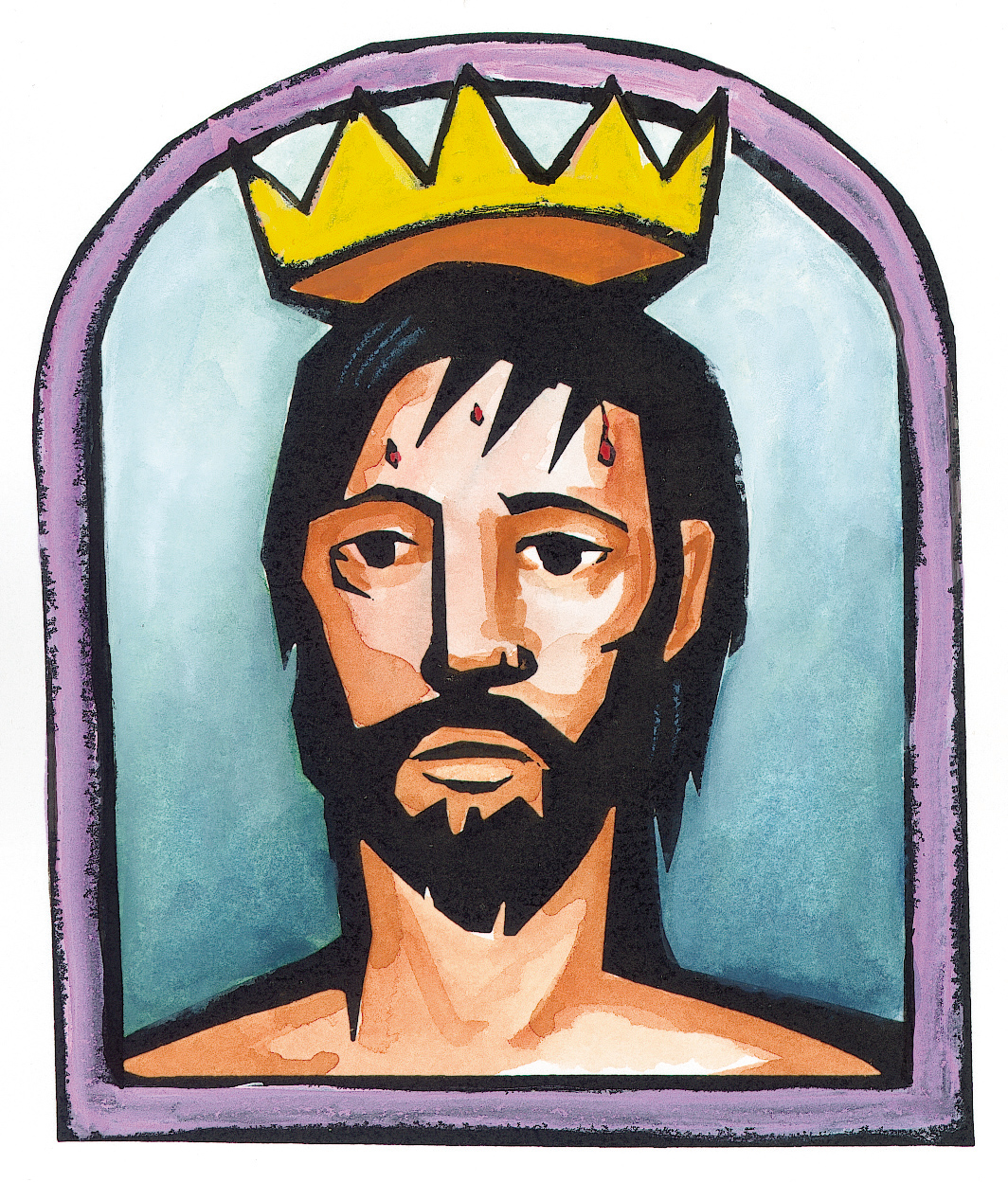
Every time we complete the cycle of the liturgical year, there is a seamless blending from the old year into the new year: so, just as this week we hear of the King who is to come, next week, we begin a New Year and the Season of Advent by more medita­tion on the end of time, and the One who is to come again, as he once came among us. This feast affirms that Christ is King, that he is Judge, that he is Ruler of the kings of the earth. By his own words we know that this is true, as he stands before Pilate and says, “Yes, I am a king.” But his kingship is different: it is not of the same kind as earthly kings, whose empires fade and pass away. His kingship is eternal, and holy lasting until the end of time. Through his love for us, we share in this sovereignty – this holiness – as priests and kings who “serve his God and Father”. We end our year in simple, awe filled praise of the One who is, who was, and who is to come ‑ the Almighty.

The theme of the kingship of Christ should not be misunderstood. Jesus is not king in an earthly sense. The acclamations of the crowds on Palm Sunday and the enthusiastic endorsement of the disciples that Jesus is the Messiah might mislead us. Jesus is king; Jesus is Messiah, because he is the anointed one of God, who comes to do the will of God.

 For the evangelist John, Christ’s kingship is revealed above all on the cross. In the dialogue with Pilate in the Fourth Gospel Jesus points Pilate in the right direction: his kingdom is not an earthly one. He came ‘to bear witness to the truth’. Those who seek the truth are members of his kingdom, which our liturgy today describes in the Preface as ‘a kingdom of truth and life, a kingdom of holiness. We remember that The Kingdom of God exists in every home where parents and children love each other. It exists in every region and country that cares for its weak and vulnerable. It exists in every parish that reaches out to the needy. The Kingdom of God   happens whenever someone feeds a hungry person, or shelters a homeless person, or shows care to a neglected person. It happens whenever we overturn an unjust law, or correct an injustice, or avert a war.

It happens whenever people join in the struggle to overcome poverty, to erase ignorance, to pass on the faith. The Kingdom of God is in the past (in the life and work of Jesus of Nazareth); it is in the present (in the work of the Church and in the efforts of many others to create a world of goodness and justice); it is in the future (reaching its completion in the age to come). May we build the kingdom of God where we are called to be in the here and now of our lives and living. We don’t know how many people witnessed the death of Jesus in Jerusalem. We know that some of those who did were delighted to have him out of the way at last. Others were heartbroken at the death of a truly good man and the shattering into pieces of a dream for something better, a new world order in which love and service would triumph over oppression and hatred. The majority probably just went about their business and reflected that really it is wiser just to keep your head down and say nothing. We can be sure that nobody there on Good Friday  thought they were witnessing the death of Christ the Universal King. His kind of kingship has to be learned and not in palaces nor in schools of diplomacy but among the poor and needy and those whom the world has forgotten. For our king is the servant of the poor and we only belong to his court when we do likewise become servants of the poor.

33Rd Sunday Of Ordinary Time

This Sunday we celebrate the 33rd Sunday of the year as we head towards the end of the Churches liturgical year at the feast of Christ the King and  then we go into  the Advent and  Christmas seasons (Dare I mention CHRISTMAS?) As always at this time of year, we begin to contemplate the end of the world ‑ a theme that carries us over into next Sunday’s feast Christ the King and then  into Advent. Such a contemplation is not gloomy or morbid: throughout the ages (and especially in the early days) Christians have been utterly posi­tive about the coming end of all things, because we know what will happen  the phrase that gives this away is in the Gospel: “Then… he will send his angels to gather his chosen from the four winds.” This gathering of God’s children to­gether will be a truly wonderful event, when we will all be completely enfolded in that love of God that we hear so much about.

Jesus’ teaching today reminds us that there is nothing really permanent in all the structures of this world. Jesus cuts straight to our desire for immortality with these disquieting words “All will be thrown down.”   These are the words that echo the great prophetic tradition of the Jewish people. No doubt this raised the anxiety of the disciples who press him for answers of “when will this be?” They press him for signs of the end.

In Jesus’ day, and down throughout the ages to our own time, there are plenty of people out there who look for signs, as if knowing when the end will come will somehow change its coming. Our faith tells us there will be a time when all things will come to an end; does knowing exactly when it will happen really give us any mastery over it? I don’t think that it does.

In the larger context of Mark’s gospel, these words from Jesus come just before he enters Jerusalem to be crucified. These words about the destruction of the temple and upheavals to come are a prefiguring of his own death – the very destruction of his own body. “All will be thrown down” is a promise that all things of this world will fall apart, disintegrate and die. However  Jesus reminds us that our job in this present time isn’t to know exactly what will happen, how it will happen, or when it will happen; rather our job is to be faithful, patient and keep awake, because God is working out the plan of salvation and has not abandoned us. Everything will be all right because God is in charge. This isn’t to say things will be easy and that hardships and suffering won’t befall us because they will. It isn’t an empty optimism promising things will get better for our lives; they may or may not be better and more often they may well be worse. It is a promise that God is in charge regardless of anything that happens to us.

Christ promises us that things will be all right because God has the last word. When death on the cross appeared to be the end, it certainly was not God had the last word at an empty tomb on the third day,  the day of resurrection.

Throughout our lives, we will experience death and resurrection many times over as the neatly arranged structures of our lives are thrown down. In faith and because of faith we will not be disappointed god is with us and there will be many times in the future as there have been in the past and are in the here and now of today when we see that everything will be all right because God is in charge and God is  working out the plan of salvation for all of us and has not abandoned us. So let us trust in the Lord who made heaven and earth and remains with us in happy and sad as well as the good and the bad times .

Post Navigation