Fullerton T

RELIGION LITURGY AND LIFE

Archive for the category “Uncategorized”

5th Sunday of Lent

It seems no time since we began Lent with the ashes of Ash Wednesday and now, we have come to the 5th Sunday of lent. We look forward to Palm Sunday and Holy Week and all the opportunities that they give us to prepare for the Easter Feast. in the 1st Reading Ezekiel tells us that our God is the God of Life, able to bring life even to dry, scattered bones. He can do the same with our broken lives and shattered communities—this is the powerful promise He made to the people of Israel.in our 2nd Reading from St. Paul’s letter to the Romans we are told that 8:8-11 Living according to the flesh brings death, but life in the Spirit brings eternal life through Jesus’ resurrection, the firstborn of the dead. This is our calling, nurturing both body and soul.

In this weekend’s gospel reading we listen to the story of Lazarus, and we hear about the compassion that Jesus had towards him and his sisters Martha and Mary. This story is also the faith that Martha and Mary had in Jesus when they sent the message to him that Lazarus was sick; indeed, he had died and was in the tomb for four days when Jesus arrived and called him to come out from the tomb. When Lazarus was called from the tomb, it was the last sign worked by the Lord before his triumphant entrance into Jerusalem, everything seems to flow to that ‘new reality’ inaugurated by Jesus who is Emmanuel, God with us. Sharing our lives and our existence, Jesus loves us with a supreme passion right up to sacrificing Himself for us on the cross of Good Friday. He was moved by those who were linked to him by ties of the most profound friendship who understood that jesus could not be anything but God’s presence amongst them.  John’s message for us today is that Jesus raises us to new life even with all the wars that are going on in the world at the present time. This raising to new life does not mean that we no longer suffer. As a matter of fact, this new life leads through pain and suffering before it reaches fullness of resurrection. Jesus demonstrates this to us as it leads to his painful death on the Cross on Good Friday.

But the new life we live leads us to a new way of living. The proof of this is Christ who rose from the dead on Easter Sunday. After his resurrection he appears to those at the beginning of their new life in Christ. We ask the Lord for the courage to listen to the voice that is calling us. The story of Lazarus invites us to look at our own lives and ask what might need to be brought back to life. Lent for 2026 may be winding down as next Sunday is Palm Sunday, but there is still time for us to do a bit spiritual spring cleaning. As we prepare for Holy Week, let us embrace these remaining days of lent trusting that, with God’s grace, even the most hidden parts of our hearts can be made new. So that when we come to the Easter celebration, we will be able to accept the invitation of Jesus to be his people and walk in his light.
4Th Sunday of Lent

On the Fourth Sunday of Lent the Church celebrates Laetare Sunday, a moment of joy in the middle of the penitential season. With the Iran war continuing and the Middle East and other countries in turmoil there does not seem to be a lot to happy about this weekend however as people of faith we continue to pray for the Peace of the world. Peace should be at the heart of anything we do but sadly for some peace is not an option, and war is the easy way out of doing the right thing. As we continue our Lenten journey this week, we are at the midpoint of Lent as we celebrate laetare Sunday at the midpoint of Advent in the same way we celebrate Gaudete Sunday these are the 2 days in the annual penitential seasons when we rejoice because the Lord is near. Hopefully, the things that we have given up or taken up have not been as stressful as we thought. Lent is a time for giving things up that might not be as good as we think it is also a time for taking up other more meaningful spiritual things. Things that lead us out of the darkness into the light of Christ that we celebrate at Easter.

In the first reading we hear about Young David’s selection as Israel’s king, and it shows God’s plan unfolding and we are reminded that he values the heart over outward appearances. In the second reading, St. Paul reminds us that baptism makes us “light in the Lord,” calling us to live as “children of light” in a world shadowed by false values and mis-placed priorities we are called to be a light to the nations. Our gospel is the story of the blind man, in this story we have another example of God’s choice, one which confuses the religious leaders of the day. John’s beautifully crafted story tells how a blind man comes to see the light in Jesus, both physically and spiritually. When Jesus’ disciples first see the blind man, they presume that his affliction is a result of sin. But Jesus sees in the blind man something else: this roadside beggar who has always inhabited a world of darkness will be the one to display the work of God and point to who Jesus really is. If we are to really see clearly, we need to let Jesus heal us of our blindness and open our eyes as He did the man born blind in this weekend’s Gospel.  This is a challenging gospel story for all of us even today because so many people are spiritually blind. It is possible that the places and things we think we are seeing clearly are not as clear as they should be. Remember that the ones, who were 100% sure they knew what was going on, the Pharisees, were blind to God. They were religious experts, like other experts they missed the truth staring them in the face. The one who is turning their world upside down was the Son of God who was trying to open their eyes and send them along the right road. There may be things that raise questions and upset our routines these may be the very places God is trying to open our eyes and give us the vision to set things in the right light for our lives.

The story of the blind man getting his sight gives us the opportunity to pause and ask ourselves:  How well do I see? Do I see what is really going on in my life? Has the road I have taken made me lose my way? What is dulling our appreciation of life and gods place within it? As we remember the Blind spots in our own lives, we also remember that faith always remains a choice that we make that helps us to see with great clarity of vision. When we choose to trust in God and believe in what he reveals to us, we exercise our freedom to believe. Our hearts and minds freely cooperate with God’s grace. Faith in God and each other is a journey that we take during our Lent. The 6 weeks of Lent lead us to Jesus the light of the world at Easter. The question we should ask ourselves this weekend is this: will we continue to be blind, or will we let our faith in God heal the blindness of our lives and our world so that we will be a light to the nations.

Second Sunday of Lent

This weekend we continue our Lenten journey and hopefully the various aspects of penance, alms giving and fasting that we are undertaking are not too hard. The readings for the 2nd Sunday of Lent show us how God calls people to trust Him. In each reading, we see someone stepping forward with faith. Abram leaves his home. The disciples follow Jesus up the mountain. Paul tells Timothy to keep going even when life is hard. These readings help us see that Lent is a time to listen and follow God. We are not meant to stay in one place. Just like Abram and the disciples, we are called to move forward with hope.

 In the First Reading the Lord commands Abram to leave his homeland and go to a new land that God will show him. God promises to bless Abram and make him the father of a great nation, and Abram obeys, leaving his home as directed.  In the Second Reading Paul encourages Timothy to join in suffering for the gospel, reminding him that God has saved and called them to a holy life, not because of their own deeds, but because of God’s grace. In the Gospel, we get further advice for the journey when we hear the voice of the father saying, “This is My beloved Son, with whom I am well pleased; listen to Him!”. On the mountain, Peter, James, and John catch a glimpse of the glory of God. As they approach the summit, the three suddenly notice a change in the garments Jesus is wearing. They become dazzlingly white. The disciples then recognize Moses the Lawgiver, and Elijah the Prophet. They are both discussing something with Jesus. Then their joy is turned to fear when suddenly a cloud comes between them and the sun, and the Voice of the father thunders out, “This is My beloved Son, with whom I am well pleased; listen to Him!”

As the disciples fall to the ground, Jesus calms them and tells them not to be afraid. The glory fades and then they proceed down the mountain as they continue their spiritual journey. What does all this mean for us on our own spiritual journeys? If we’re really serious about Lent, we’ll take the Transfiguration experience as Jesus intended. As He taught a lesson in patience and hope to Peter, James, and John, so he teaches us to listen and wait, to listen intently to Jesus and His message and wait and see where God will lead us.  We have the advantage of knowing and believing in the Resurrection.  The Transfiguration reminds us that there is more to the story of Jesus on the mountain. Just as Jesus rose from the dead, we are called to a new life with Him as we continue the story of faith as Jesus leads us through the suffering of Holy Week to the resurrection of easter Sunday. Lent is a time to prepare our hearts for Easter, remembering that no matter what we face, God’s plan leads to new life as he tells us, “This is My beloved Son, with whom I am well pleased; listen to Him!”.

First Sunday of Lent 2026

With the ashes of Ash Wednesday and the call to repent and believe the gospel ringing in our ears we now come to the 1st Sunday of Lent.  In the same way that Jesus went out into the dessert God asks us to go out into the dessert during the 40 days of Lent to undertake a time of renewal. So why Lent? Lent is the time for seeing and correcting our faults and raising our minds and hearts to God. Lent is a time for personal and community conversion of heart and renewal! A time for coming face-to-face with God – our origin, our purpose and our destiny it is also the time to be changed for the better by that encounter!  The main thing for all of us to do during Lent is that we should try to get to know God better by works of faith and charity so that those lines separating good and evil will become more apparent to all of us.

In the First Reading we hear that God formed man and placed him in the Garden of Eden. The serpent deceived the woman into eating the forbidden fruit. She and her husband ate it and realized they were naked.  in the Second Reading: St Paul in this extract from his letter to the Romans tells us that one man’s sin brought death to all, but God’s grace through Jesus brings life and righteousness to many. Christ’s obedience will make many righteous the gospel for this weekend was first addressed to the Church as it coped with divisions, weakening of faith and scandals. The image of the wilderness evoked many memories for them. In the time of Moses God had led his people out if Egypt to begin a long and trying wilderness experience. Our own experience of Church today is, in ways, very similar. God is leading us. We continue to be humbled and tested. What is crucial is the hope that we have from dealing with events through eyes of faith. The Church teaches that prayer, fasting, and almsgiving are significant ways to become closer to God.  The decision for each of us is to determine what form of those three things to make our own Lent. The temptations, to which our Lord submitted himself, are a source of encouragement and consolation for all of us. If our Lord and master underwent temptation, we cannot and must not expect to live a Christian life without experiencing temptations and trials.

Christ the King

This weekend we celebrate the last Sunday of ordinary time which is also called the feast of Christ the King. The Feast of Christ the King was established by Pope Pius XI in 1925 as an antidote to secularism, that is a way of life which leaves God out of man’s thinking and living life as if God did not exist. In the First Reading The tribes of Israel came to David in Hebron, recognizing his leadership. They made an agreement before the Lord, and David was anointed king of Israel. In the Second Reading we hear Let us thank the Father for rescuing us and bringing us into the kingdom of his Son, Jesus, who is the image of God and the head of the church.

In Our Gospel reading for this Sunday Rulers and soldiers mocked Jesus on the cross, challenging him to save himself. One criminal joined in, but the other defended Jesus and asked to be remembered in his kingdom. Jesus promised him a place in Paradise. The Gospel reading reminds us that Jesus rules with love, even from the cross. The Good Thief didn’t have fancy words, just honest prayer. Jesus answered with a promise of heaven. it’s never too late to choose faith, and Jesus is always ready to listen. How do we work to make Jesus and the kingdom of God known is the question to ask ourselves today. The way to serve Christ our King is to work for the coming of his kingdom. We do this through working for the relief of the deprived, the oppressed and the outcast. By doing that we are serving Christ in person, because he fully identifies himself with all those in need. The disciple of Christ the King cannot afford the luxury of saying “I keep myself to myself” or “I do nobody any harm.” To be deaf to the cries of the oppressed is to be deaf to Christ. To be blind to the agony of those around us is to be blind to Christ. To take Christ as our King involves becoming a shepherd to others making Christ present to others and reaching out showing the faith to them and leading them into the paths of faith.

The kingdom of Christ, a reign of charity and peace, is for all. The Lord sends us out as his disciples so that all mankind may be brought under his reign in the world. We remember that The Kingdom of God exists in every home where parents and children love each other. It exists in every region and country that cares for its weak and vulnerable. It exists in every parish that reaches out to the needy. The Kingdom of God happens whenever someone feeds a hungry person, or shelters a homeless person, or shows care to a neglected person. It happens whenever we overturn an unjust law, or correct an injustice, or avert a war.

We the baptized are the agents through whom the kingship of Christ will be realized. Our baptism is our commission and our grace for the apostolate. As we conclude the liturgical year, are you with Christ and what he teaches us? Is your life an open sacrifice in a demonstration of love?  As we begin Advent next week lets not forget the beautiful truths that we have learned, but let’s continue to learn more about them, celebrate them, live them, and pass them on. The Solemnity of Christ the King reminds us that Jesus is the true King. His rule is not about power or wealth. It is about love, mercy, and peace. He leads us by giving His life for us. This feast helps us see what kingship means in God’s eyes.  As we remember that Jesus is the servant King who came to serve and gave his life on the Cross as a ransom for many. Everything belongs to Him. Yet He chooses to care for us as a shepherd cares for his sheep. 

This Sunday we are invited to deeper discipleship, marked by generous service and unwavering hope. As we move into Advent with its spiritual preparation for Christmas let us respond with open hearts and generous spirits with a renewed commitment to serve others, as we walk with Christ our King, making His kingdom present wherever we are.

2nd Sunday of Ordinary Time

THE WEDDING FEAST AT CANA

In the First Reading we hear Issiah telling us for the sake of Zion and Jerusalem, I will speak until their righteousness shines. Nations will see their glory. The Lord will rejoice over them as a bridegroom rejoices over his bride. In the Psalm we Sing to the Lord, proclaim his salvation, and declare his wonders. We give him glory, worship him, and say to the nations: The Lord is king who rules with justice. In the Second Reading we hear that it is the same Spirit that gives different gifts to each person for the benefit of all, such as wisdom, knowledge, faith, healing, miracles, prophecy, discernment, tongues, and their interpretation.

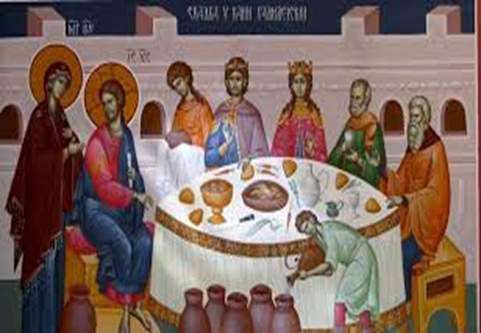
The  gospel story of the wedding at Cana was the first time that Jesus worked a miracle when he changed the water into wine. We hear Mary telling Jesus that ‘they have no wine’ Jesus said ‘Woman, why turn to me? My hour has not come yet.’ His mother said to the servants, ‘Do whatever he tells you.’   This story is not just about Mary asking her Son to help with the wine it is also about us here today. Mary told the servants to do whatever he tells you and she says the same thing to us here and now. In Lourdes in the Rosary Basilica right above the altar there is a huge icon of our lady with the inscription to Jesus through Mary. Though Mary was the mother of Jesus she did not claim any of the limelight for herself instead she pointed the people around her to her son as she told them to do whatever he tells you. Mary, who asks for help when she tells Jesus “they have no wine”, Mary the faith filled disciple, has trust in divine providence.  

In her response at the wedding at Cana Mary shows herself a model disciple who trusts in God. She shows that trust with the words that are meant for all of us even now as we read them again “Do whatever he tells you.”   At the end of this Gospel passage, John tells us that Jesus’ action in turning the water into wine was the first of the signs he gave.  In John’s Gospel there will be six more. All of them to do with healing, saving, restoring, feeding and giving life to human beings. None are empty displays of Jesus’ power. The ‘glory’ of Jesus lies in revealing the God of love, especially in moments of real human need. The signs show that the power of love which comes from God are always at the service of human beings. We, too, are called to allow the glory of God to shine out through us in loving, healing, transforming and hopeful words and actions.

Today what does Jesus ask us to do as we think about the wedding at Cana are we like Mary prepared to trust in God the Father who can give us all things or are we prepared just to go along accepting the things that happen to us. I think that we should be prepared to learn and understand the message that is given to us through Jesus whose mother asks us in the gospel to ”do whatever he tells you.”

12th Sunday in Ordinary Time

The readings for the 12th Sunday show us God’s power and our need to trust Him. In the first reading, God reminds Job of His control over the sea. He set boundaries for the waters and commands the waves. This shows God’s authority over creation. Even the mighty sea, which can be so powerful and frightening, obeys God’s commands.  Our gospel reading for this week is all about being Calm amid the storms of life that sometimes come our way. The context of this passage is the calming of the storm when Jesus rebuked the wind and said to the sea, ‘Quiet now! Be calm!’ And he says the same to us now in all our trials ‘Quiet now! Be calm!  Jesus understood that all would be well even if he and the disciples perished or if the storm subsided. Mark’s original audience was a community undergoing persecution. Their leaders had been martyred and, they questioned what was happening to them. The church was undergoing internal strife as they struggled to bring Jews and Gentiles into their new Christian community.  Mark’s church was hardly sailing on calm waters not unlike our church today.

Jesus’ previous parables of sowing, growth and harvest showed God’s control over the land. This passage also shows that God is in charge and has control over the chaos we often see and hear about exemplified for us today by the calming of the storm.  Jesus asks the disciples in the midst of the storm, why are you so frightened and why do you have so little faith. He could be saying the same thing to us today as many lack faith in God and mankind.  Amongst all the hurt and devastation in our lives Jesus changes the darkness that is in our daily lives into the sunshine of everlasting life, and replaces our distress with comfort and peace. When we don’t know the best way forward or the best way out Jesus gives us peace of mind and heart to make the right decision. At such a crossroads of life, we can ask him, ‘Lord, what road should I take what way should I Go?’ The best way will become so much clearer, and bring us calmness and peace as well as the knowledge of a decision well made.  We have so many things to occupy our minds these days with all the things that are going on in  our world.  If we stop and look around us we see the signs of Jesus in people trying their best to look after others, to provide meals and shelter, to keep themselves and their loved ones safe, to work for peace in the midst of conflict to bring comfort and to pray.  The disciples’ fear during the storm teaches us about our own fears and who we should trust. We often feel overwhelmed by life’s challenges and there are many. But Jesus shows us that He is greater than any storm. We remember that Jesus is with us in the good times and bad as a gentle calming presence as we go through the storms of life that affect all of us from time to time and we should trust him to be our helper and guide as we go forward.

Ascension of the Lord

This Sunday  we celebrate the feast of Ascension.  In our lives we have seen the departure of so many people, Perhaps it is a son or daughter leaving for university or maybe it was someone leaving to go to another country or the hardest departure of all someone close to us dying. Our lives are made up of so many different times and places of departure or leave-taking and that is what Ascension is really about as Jesus returns to the Father. Jesus leaves us but remains with us through the gift of the Spirit that came at Pentecost.  The readings for the  Ascension of the Lord encourage us to be open to the Holy Spirit and be willing to spread the Good News.  In the first reading from the Acts of the ApostlesJesus, after His resurrection, instructed the apostles to await the Holy Spirit in Jerusalem, promising them power to witness globally. He then ascended into heaven, affirming His eventual return. In the Second Reading Saint  Paul prays for believers to receive wisdom and revelation to know God fully, understanding their hope, inheritance, and the immense power granted to them, the same power that raised Christ.

The words of the Gospel for Ascension day strike me in a particular way Jesus tells us ‘go therefore make disciples of all the nations and know that I am with you to the end of time.  Jesus has called the ragged, group of disciples, scattered after his crucifixion, back to himself to form them, fragile and doubtful as they are, into a community for mission in the name of God. The task of the historical Jesus is complete; the task of the church as the living Body of Christ has just begun. It is comforting to recognise that Jesus doesn’t insist on perfection before he calls us and entrusts us with his mission. Jesus is definite about what he has to say when he speaks and calls his disciples to be the first missionaries. This is in sharp contrast to the fact that, their feelings were varied. Some of them worshipped him, while some of them still doubted.  Jesus didn’t seem to have any great problem with that, because he knew that, when the Spirit came, all of those doubts would be ended. It would seem, indeed, that he was in a hurry to take his leave of them, so that the next  part of his salvation plan could get underway.  The mission of the apostles was simple to understand; difficult to carry out. It was to teach others all that Jesus had taught them.

Just as he asked his disciples to follow him, they were to ask that others would follow him and was so hard for them then and it is hard for us to do in the world of today.  So many things have changed in the Church and society. However the two things that have not changed are Jesus himself and his message as they are always new for each generation.  Again and again we need to ask ourselves what we are doing to make disciples of the people around us . The feasts of the Ascension and Pentecost help us to realize that we are part of a long tradition of faithful people who have taken up the challenge to pass on the faith . We have our faults and failings, but our call is to witness to and teach the way of Jesus by the kind of people we are, the values and attitudes we hold, in thought, word and deeds our calling is to be the living presence of God in the world where we are today.

2nd Sunday of Easter Divine Mercy Sunday

This weekend we celebrate the second Sunday of Easter also known as Divine Mercy Sunday when we celebrate the mercy of God in a special way. Our first reading from the acts of the apostles tells us that the early believers were united, sharing possessions and resources. The apostles’ powerful testimony about Jesus’ resurrection earned them high regard. They distributed funds meet everyone’s needs, ensuring no one was in need. These days we ask ourselves are we helping to provide for those who have needs in our own places. In the second Reading we see that  Belief in Jesus as the Christ the son of God  shows we are born of God. Loving God and His children means obeying His commandments, which are not burdensome. Our faith in Jesus as God’s Son overcomes the world, affirmed by the Spirit of truth. In the Gospel story Jesus appears to his disciples, offering peace and showing his wounds, which brought them joy. He empowered them with the Holy Spirit and the authority to forgive sins.

The Apostles were huddled together in fear. They weren’t so sure that the women’s report that Jesus had risen was believable. They weren’t singing for joy! Now, a whole week has gone by. They still felt “rocky” about their future and what it would hold for them. Thomas wasn’t the only one who had doubts about Jesus, I think so many were doubtful then as so many are doubtful right here and now. The Apostles were pondering the shocking experience of the week before when all seemed to be lost as Jesus hung on the Cross. But here we are over 2000 years later thinking about how they felt after the events of that first Holy Week.  Jesus had broken through those doors and came to assure them that he was alive and then his message must have troubled them: “As the Father has sent me, so I send you.”  The disciples  were to go out to  teach, to preach, to heal by announcing the gospel. They were going  to open the eyes of the blind, to give hearing to the deaf, and soften the hardened hearts of man. They were sent to bring the message of Jesus to others and in the same way we are sent out to bring his message to other people wherever we are by what we say and do.

We are asked to bring the mercy and love of God to all those out there who need his healing merciful touch.  We remember the joys the hope, the grief and the anxieties of the people in our time these are the joys and hopes, the grief and anxieties of the followers of Christ. The Apostles felt rocky about their future as many of us do today but god is with us as we go out into the world as his messengers. May all of us be witnesses to the Gospel bringing the mercy of God to the people of our time and place as we go forward into a the future as Easter people with Christ as our light  to help and guide us along the road we travel.

GOOD FRIDAY

Post Navigation