Fullerton T

RELIGION LITURGY AND LIFE

Archive for the category “Uncategorized”

20th Sunday in Ordinary Time

In the gospel for this Sunday Jesus says, “I have come to set the world on fire and how I wish it were already blazing.” Jesus is ready and willing to face the hardships that lie ahead his words must have unsettled the people around him. It doesn’t sound like Jesus meant that the practice of our faith should make us comfortable, guarantee harmony or tranquility. Indeed, as he predicted, belief in him would cause the most severe conflict, even in the close-knit-family world of his Mediterranean followers and this interreligious conflict continues today in many places throughout the world especially in the Holy Land.

Jesus is zealous about his mission; He has a task to complete and will follow it through, despite the threats to his personal safety. Jesus refers to his fate as “a baptism with which I must be baptized.” He sees his passion as a baptism which he will accept and which will set a fire upon the earth. Remember when John the Baptist spoke of Jesus he linked baptism and fire, “He will baptize you with the Holy Spirit and fire”. When our lives get difficult, for any reason we are tempted to think that the Holy One is asleep behind a closed door. We feel very much on the outside. At these times it’s important to remember that Jesus the Son of God is with us throughout the turmoil we may have as a result of the hurts and hardship that life throws out to all of us on many occasions. Making decisions on the journey of life is a natural process for us; we make many of them each day. Our senses take in all kinds of information some of which we accept, some we discard and much, we are not aware of.

Our minds move us to a yes or no that is what the will does. So our imaginations can present data to our minds for a choice as well.  So a faith based decision to walk the ways of Jesus needs some information which Jesus gives his disciples, t and the same information  is given to us through the scriptures the word of God that we hear every Sunday when we come to Church. The faith that Jesus calls us  to is the  faith that leads us to live lives which reflect the life of a believer in Jesus and what he teaches. It is much easier to follow from a safe distance and not let our lives be challenged and changed by faith in the Son of God. It is very easy to let the bitterness of others take us over but at the end of it all Jesus went to the Cross to overcome all the hatred and bitterness that we see around  us. Remember that the words of Jesus are there to afflict the comfortable and comfort the afflicted. Faith was not easy at the beginning of the Church and isn’t easy now the martyrs throughout history right up to our present time bear witness to this.

 If we stop and look around us even now there are people who are prepared to give everything they have including their lives for the faith. Following  Jesus is not easy and we have to work at it for anything that is worth doing or being part off will never be easy.  Today we are called to follow were God leads us in faith and he will do the rest for nothing is impossible to the Father who journeys along with us in the good and bad times of our lives.  

14th Sunday of Ordinary Time

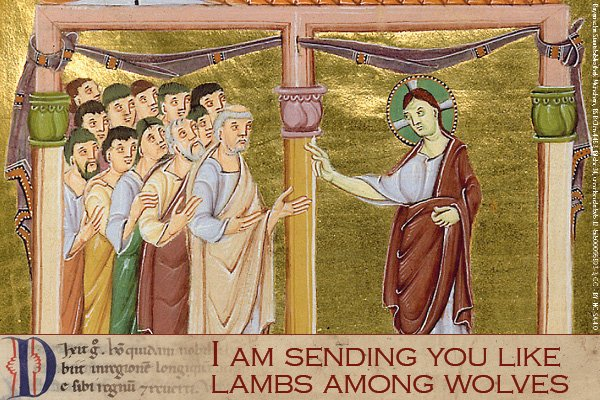
gather this  weekend  the schools have closed for the summer break and the holidays have begun. We remember those who are going through tough times as the cost of living continues to rise and we pray for the peace of the world especially for peace in Ukraine. This Sunday’s Gospel reading tells us about Jesus appointing the 72 others and then sending them out in pairs to the towns he was going to visit. As he gives his missionary instruction Jesus seems under no illusion about the territory compared to the wolves roaming around, his own crowds are like lambs. He tells the 72 to lead the radical lifestyle of the wandering preacher who must face homelessness and renunciation of family and property. When they enter a house they should bless it with peace. The Gospel also tells us about the practical things to direct the people  as they proclaim the Good News of the Kingdom and in rebuilding community life. Jesus told them to carry no purse, no haversack, and no sandals. Proclaiming the Good News of the Kingdom and community life are two sides of the same coin. One does not exist and cannot make sense without the other.

 There is a clear urgency about the task in hand Jesus says, “Start off now” with urgency in his voice. On their return the disciples were delighted that their mission has actually worked! Their joy demonstrates that people do welcome the word of God and that the word of God is their real resource for mission. Jesus counsels them to rejoice not because their mission has worked but because their names are written in heaven. There is a line in this gospel reading that struck me when  Jesus tells us that the Harvest is rich and the labourers are few. This is so very true today when we have a shortage of men  coming forward to enter the vocation of service that is the priesthood and religious life. But that said we need to keep on Praying for vocations and encouraging people young and not so young to become priests and religious.  There will be a time of crisis and for some we are living in a time of crisis with so many things that are wrong in our world. There will be times, as we know, when the scorpions will bite us, and when the wolves will have their day.  Jesus speaks to us today in order to reassure us and he tells us to hold on to all that is good. May our hearts our minds be open to his words! May our hearts direct our minds! And may our minds direct our hands in the work of the Lord.  

It is our responsibility as people of faith to exercise our mission as the people of God the Body of Christ. The fullness of life is the message and the mission of Jesus  who empowers us in our time and place  to do his work, and to work in his name.  Jesus assures us that we have a passport, visa, and “green card” for heaven. Our names are already registered there and our mission is to proclaim the good news of salvation to others by our words and our deeds so that the world will believe.

HOLY THURSDAY

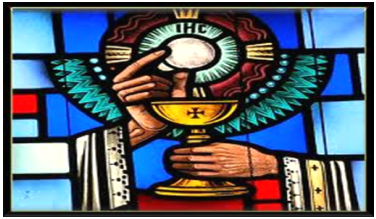
 On this day we celebrate the Sacraments of Priesthood and Eucharist. In every  diocese the priests who have given their lives in generous service of the people of God gather with the Bishop for the Chrism Mass and they renew their commitment to priestly service. Also at this Mass the oils of Chrism, Catechumens and the Oil of the Sick are blessed by the bishop, these holy oils will be used in the Baptisms, Confirmations and anointing of the sick in the local parishes. The theme running throughout this day is one of service, service to God and one another. On Holy Thursday Evening we commemorate the first Eucharist when Jesus gave us the gift of himself to be with us for all time.  The Evening Mass commerates the Last Supper and its theme is one of service and sacrifice.  We see Jesus as one who serves. Just as he  freely gives himself in washing the feet of his disciples, so too he gives himself  in the bread and wine he takes, blesses and hands to the apostles gathered in the upper room as he does through the priests down through the generations to us, in the same way he will give himself on the cross on Good Frida.  All these acts of self-giving are the same act – that of the Son of Man who came ‘not to be served, but to serve, and to give his life as a ransom for many.’

The action of the Church that is our action  as the body of Christ on this night also witnesses to the Church’s respect for Christ’s Body present in the consecrated Host in the Adoration of the Blessed Sacrament, carried in solemn procession to the  Altar of Repose. No Mass will be celebrated again in the Church throughout the world until the Easter Vigil on Holy Saturday evening when we proclaim the Resurrection. As people who are followers of Christ We should embrace all those who are in need of any kind as Christ did. We should be leading lives of generous service to all those who need our help wherever they are and there are many people around who may need our help and care. Each of us is called to show that we are a caring people showing the love of God to all those who have nobody to care for them we have to show them that ours is an all loving and caring God.  When we serve our brothers and sisters in whatever way we are called showing them that our God is an all-loving and caring father in heaven then the Eucharist whenever we partake of this great sacrament will bring us joy and peace. In the words of the liturgy let us go forth to meet the Lord in peace and thanksgiving as we celebrate the three days of the Easter Triduum

Saint Patrick’s Day

Today with all the Irish all over the world we celebrate the feast of Saint Patrick who is credited with bringing the faith to Ireland. We also pray for all those who are suffering as a result of the War in Ukraine especially the refugees who have been forced to flee to other countries. I often wonder what St. Patrick who drove the snakes out of Ireland would do about the modern snakes that we have in Ireland today. I imagine he would look at what was going on around him and get on with the job of proclaiming the Gospel and its values which are timeless.  The spirit of St Patrick affirms the worth of each human being. His Confession invites us all to personal conversion especially during Lent. His message is to draw people to follow Christ in the sharing spirit of the Gospel. This mission is still an urgent one especially in today’s Ireland were there are so many people who are experiencing a crisis of faith.   proclaimed the message of salvation and he insisted on it and many years later we are the inheritors of the rich tradition  of faith born of him. In our Gospel Reading for today the phrase Fishers of men” is used to describe the mandate given by Jesus to his first disciples. Two brother’s the  fishermen, Simon called Peter and Andrew, were casting a net into the Sea of Galilee and got a huge catch. As he commenced his Sea of Galilee reaching ministry, Jesus called them to follow him and told them that in doing so they were to become “fishers of men”. Saint Patrick in his turn was a fisher of men as he took up the challenge to follow Jesus and through his acceptance of that challenge he brought the faith to Ireland and many people of his time followed the faith he professed as we follow that faith today. As we all know there are many snakes out there looking to destroy what we hold as being good and honourable as Catholics, it  is up to us to us to choose the right course; to be brave under trials; so that we in our turn will be fishers of men.

7th sunday ordinary time

This weekend we are continuing to come out from the darkness of the COVID19 restrictions in our parishes. As we do this, we take the time to remember all those who are not with us as well as all those who have kept us safe wherever we are over the past 2 years. We pray a prayer of gratitude for all those who have done so much in so many different ways.

This weekend we think about the things the Lord asks us to do in following Him, nothing is more difficult that the teaching  in this weekend’s  Gospel. “Love your enemies, do good to those who hate you, bless those who curse you, pray for those who mistreat you. To the person who strikes you on one cheek, offer the other one as well, and from the person who takes your cloak, do not withhold even your tunic. Give to everyone who asks of you, and from the one who takes what is yours do not demand it back.

Do to others as you would have them do to you It is much easier to sacrifice our wants for the needs of others, then it is to avoid lashing out at someone but that is what Jesus is calling us to do.   And what does God do besides showing us extraordinary compassion, mercy and patience? What he does is love us the way we are. And his love for us is so immense that he makes the greatest of all sacrifices for us by giving for our salvation the life of his own dear Son.  What we are talking about then in today’s Gospel is not some ethical system for the good of society or for our own self-interest but something way beyond this. What Jesus gives us is the very principle behind the creation of the universe: God’s infinite love for us all. This is the extraordinary challenge that he lays before us: To love the people around us just as he loves us, just as he loves them.  It is not easy and we won’t achieve it often but we know that this is what God wants from us and it is something that deep in our hearts we are glad to do. The way God treats us is to be the guideline for our life as Christians. God is infinitely compassionate and merciful, he is extraordinarily patient with our many shortcomings and he puts up with all sorts of foolishness on our part.  It is our task as a true disciple to imitate our master, to imitate the behaviour of God himself.  In the words of Micah this is what God asks of us: only this, to act justly, to love tenderly and to walk humbly with our God.

The Feast of Christ the King

cross-clipart-christ-is-king - Abiding Word Lutheran Church

Every time we complete the cycle of the liturgical year, there is a seamless blending from the old year into the new year: so this week we hear of the King who is to come, next week, we begin a New Church Year with  the Season of Advent. This feast affirms that Christ is King, that he is Judge, that he is Ruler of the kings of the earth. By his own words we know that this is true, as he stands before Pilate and says, “Yes, I am a king.” But his kingship is different: it is not of the same kind as earthly kings, whose empires fade and pass away. His kingship is eternal, and holy lasting until the end of time. Through his love for us, we share in this sovereignty – this holiness – as priests and kings who “serve his God and Father”. We end our year in simple, awe filled praise of the One who is, who was, and who is to come ‑ the Almighty.  The theme of the kingship of Christ should not be misunderstood. Jesus is not king in an earthly sense. The acclamations of the crowds on Palm Sunday and the enthusiastic endorsement of the disciples that Jesus is the Messiah might mislead us. Jesus is king; Jesus is Messiah, because he is the anointed one of God, who comes to do the will of God and he invites us to do the same.

 For the evangelist John, Christ’s kingship is revealed above all on the cross. In the dialogue with Pilate in the Fourth Gospel Jesus points Pilate in the right direction: his kingdom is not an earthly one. He came ‘to bear witness to the truth’. Those who seek the truth are members of his kingdom, which our liturgy today describes in the Preface as ‘a kingdom of truth and life, a kingdom of holiness. We remember that The Kingdom of God exists in every home where parents and children love each other. It exists in every region and country that cares for its weak and vulnerable. It exists in every parish that reaches out to the needy. The Kingdom of God   happens whenever someone feeds a hungry person, or shelters a homeless person, or shows care to a neglected person. It happens whenever we overturn an unjust law, or correct an injustice, or avert a war. It happens whenever people join in the struggle to overcome poverty, to erase ignorance, to pass on the faith. The Kingdom of God is in the past in the life and work of Jesus of Nazareth passed on to us through the generations; it is in the present in the work of the Church and in the efforts of many others to create a world of goodness and justice here and now; it is in the future reaching its completion in the time  to come when all things will be made new..

May we build the kingdom of God where we are called to be in the here and now of our lives and living. We don’t know how many people witnessed the death of Jesus in Jerusalem. We know that some of those who did were delighted to have him out of the way at last. Others were heartbroken at the death of a truly good man and the shattering into pieces of a dream for something better, a new world order in which love and service would triumph over oppression and hatred. The majority probably just went about their business and reflected that really it is wiser just to keep your head down and say nothing. We can be sure that nobody there on Good Friday  thought they were witnessing the death of Christ the Universal King and I am sure they did not think that we would be celebrating Christ as our King over 2000 years later. Jesus and his kind of kingship have to be learned and not in palaces nor in schools of diplomacy but among the poor and needy and those whom the world has forgotten and there are many forgotten people out there. We remember that our king is the servant of the poor and we only belong to his court when we become servants of the poor and those who need us.

May all of us take up the challenge that the feast of Christ the King gives us. That challenge is to reach out to others showing them that the ways of Jesus are what we as Christians are really all about as we go about our daily lives.

31St Sunday of Ordinary Times

THIRTY FIRST SUNDAY IN ORDINARY TIME, YEAR B. | Sunday Homily

This weekend we celebrate the 31st Sunday of ordinary time.  In the gospel reading a scribe asks Jesus, “Which is the first of all the commandments?” Jesus gives his reply and the scribe gives his approval At that moment there is a great meeting and agreement between the best of the Jewish and Christian traditions: that love of God has precedence over all other religious requirements, observances and loyalties. In his reply to the scribe Jesus also makes it clear that you cannot compose summaries of the Law while forgetting love of god and neighbour.  The scribe is pleased with Jesus’ reply and adds his own point, that the love of God and neighbour is far more important than any ritual worship. The transformation caused by the love god has for us is so profound that it is expressed in the love of god and our  neighbour. Jesus calls us to love God with our entire being because his life and death are a manifestation of God’s love for each of us.

 The scribe states that the law of love of God and neighbour is greater than any of the religious observances and laws concerning sacrifices. Revered Temple worship and sacrifice must take second place to the observance and sacrifice that comes with loving God and neighbour. Jesus says that the scribe has answered wisely about the superiority of love over any sacrifice and then says to him, “You are not far from the kingdom of God. Our God is the God of the past , the present and the future. Our God is the creator of all that is that was or will be. We are God’s dream. Our living with God  in faith is not only for our places of worship our living in and with God is really about our  communities of love and faith right where we are as we bring the love of god to the world. God is with us in the market place, on the factory floor, in the politics of life. God is with us on the streets, in homeless shelters, in the hospitals.  As a matter of fact God is with us wherever we are and in whatever good  we are doing in his name. Our lives are not divisible into secular and religious though some might want it that way. Jesus’ summary of the Law is a personal challenge to love God wholeheartedly and have regard for our neighbour actively promoting his good. That is not only Jesus’ digest of the Law, it is also the Gospel portrait of Jesus.

The Kingdom of God is not in some far off place, but it is there in the moments when God’s life breaks into the every day story of our own lives. Those moments bring love, wisdom, grace, compassion, generosity, forgiveness and peace to us where we are. We are called to love the Lord our God and  our neighbour as ourself and to bring that love that god has for us out into the world where we are asked to share it with all those around us so that they can see the love, wisdom, grace, compassion, generosity, forgiveness and peace that god brings to us as we bring it to others wherever we are in our world.

29th Sunday of Ordinary Time

In today’s Gospel two brothers James and John the sons of Zebedee are asking Jesus for a big favour to ensure their privileged seating arrangements when they come to meet Jesus in glory. They want to sit, one at Jesus’ right hand and the other at his left. While they don’t specify which of them should sit at Jesus’ right  no doubt that problem would have emerged later  they imagine themselves in a cosy triumvirate of their own making. Of course Jesus blows this notion out of the water when he tells the two brothers that they don’t know what they are asking. Their request is to share Jesus’ power when he comes into glory, so timing their appointment to begin when the suffering is over but this was not the way of things.  The two disciples mention nothing about the suffering of Good Friday but Jesus brings the conversation back to what happens before the glory which is suffering the glory comes as a result of the suffering. Jesus’ kingdom is not about who wears the crown, but who wears the crown of thorns and bears the cross .  So he asks the brothers as he asks us today: “Can you drink the cup that I must drink, or be baptised with the baptism with which I must be baptised?” They boast that they can.

The message from Jesus is clear: there is no shortcut to God’s favour. Jesus does what he asks all of us to do: that is to serve, not to be served; to give love freely, not to exact everyone’s worship; to reach out to those in need. Christian discipleship and endeavour  are a vocation of service and there is much work out there for everyone to do. To be servants in the way that Jesus was servant means to live in complete trust that God will look after us. Jesus was not  a servant out of fear of a tyrant Father, but as beloved Son, who in turn loved as he was loved by the Father. Ours  is a free service of love, not of fear So,  like Jesus, Christians serve others by proclaiming the truth of God, by praying, giving a good example, acting to defend human rights, and by being respectful, fair, kind, compassionate, caring and forgiving towards others. His teaching and example have left us with a brilliant example of an authentic life, for becoming the best people we can be.

19th Sunday of Ordinary Time

Jesus is the Bread of Life – John 6:35 – ScriptureWay – Whitney V. Myers -  ScriptureWay

This Sunday we hear Jesus telling the Apostles that he is the bread of life. The Gospel reading deals with a doubting audience, and at times we  are also members of that doubting audience. The people who heard Jesus were shocked and critical of his claim to have come down from heaven as the Bread of Life. Despite the miracles they had witnessed, and the words of wisdom they heard preached with such convincing authority, they could not take the extra step to accept His claim. Many people these days are also unable to make that extra step on their faith journey. We, on the other hand  are able to take that extra step because our Christian faith has come to us from Jesus, passed down through the generations of those who went before us.

We know where he came from, we know where we are going and we know how to reach that destination. The personal faith that we have means that “God out of the abundance of his love, speaks to us as a friend and lives among us as  the living bread which came down from heaven.  The Gospel lesson for this weekend tells us that we can’t live our lives by ourselves as we search for answers when we have doubts.  We find Jesus who is the answer to the doubts we have through the teachings of the church and through our communion with him through the eucharist the bread of life.  When we gather at the Eucharist we bring ourselves and our needs in prayer to God. We bring ourselves to God because God is with us and continues to be with us in good and bad times through the sacramental life of the Church and through the Eucharist in particular.

When we see the Eucharistic Bread, we believe that it is Jesus who is there before us:  such is the faith we have in the Eucharist the bread of life.   In our day-to-day lives we are empowered to be imitators of God’s love and we are asked to pass that love on to those around us.  So, at the end of each day, when we give thanks for all of our blessings, most of all, we give thanks to God for the presence of Jesus in our lives and the lives of those who are around us as we remember that Jesus is the bread of life.

6th Sunday of Easter

6th Sunday of Easter (Year B)

We continue our journey out of the COVID restrictions and as we do that we remember all who are affected especially those in India and other affected countries.  Our Gospel for this Sunday is  a reading from the gospel of John in which Jesus tells us ‘As the Father has loved me, so I have loved you. Remain in my love. This is my commandment: love one another, as I have loved you. The love of God is easy for those who see God as a loving and faithful Father. St. Therese of Lisieux,  who was a master of the spiritual life tells us about the love which is its essence. She taught the “little way” of childlike simplicity and obedience to God as the way to grow in love.  “It seems to me St. Therese said that there will be no judgment for victims of love, or rather, the good God will hasten to reward, with eternal delights, His own love which He will see burning in their hearts.” Love of God is tied to the commandments, because the commandments are the love of God in action.

Those who love God long to be holy as he is holy and so live by the commandments.  But they do it out of love not because they have to. “In the heart of the Church I will be love,” St. Therese exclaimed upon discovering her true vocation. Though bound by the walls of her cloister, she knew unlimited freedom to reach the heights of holiness through courageous devotion to charity.  We too are students of the love of God. The commandments that Jesus gives are valuable  lessons by which we master the love of God our Father in thought, word and deed. Jesus chose his followers to carry out God’s plan of salvation. By allowing us to participate in his work of redemption, he gives us a personal stake in the Kingdom of God. “Love is the best way to become his “co-worker,” since it reveals the reason he came into  the world and affirms our friendship with the creator. Love changes everything it touches. It tells us to stop bragging about this or that. It enhances our reputation. It denies the power of position and wealth which we sometimes feel is ours by right, it raises us up as true leaders.

It might take away the advantage of our personal ideas on any topic. However, It connects us in unimaginable ways to God and to one another. Divine love transcends mere emotion. It becomes our lifeline to God. And it forms the basis of real community where everyone is valued and no one is left out. It is inexplicable in theory, yet easily seen in action. Wherever God loves, he acts. Wherever he acts, he is there with us. He is with us because he loves us and the love of God knows no bounds.  we remember the love that God has for each and every one of us each time we look at the Cross. We also remember that Jesus the son of God who gave up his life on the Cross out of love for us is our saviour who will show us the way to bring the love of God the Father into our lives so that we will pass it on to other people.

Post Navigation