Fullerton T

RELIGION LITURGY AND LIFE

21st Sunday in Ordinary time
As we gather this weekend we have seen the situation in Afghanistan getting worse as the USA and their allies leave the country after 20 years. There is much fear and trepidation around as we try to make sense of this move as the Taliban take over the government of the country. As people of faith we are called to pray for peace we are also asked show our solidarity with all those who may come to our shores as refugees in what we say and do for them when they arrive. This Sundays Gospel reading has a resonance with the modern world In today’s Gospel, Jesus puts the choice to His apostles of following Him, or of leaving Him that is also the choice he gives to all of us as well. Many of the Lord’s followers had left Him because of His teaching After hearing Jesus’ teaching on the bread of life, many of the people find Jesus’ language intolerable and they asked how could anyone accept it..

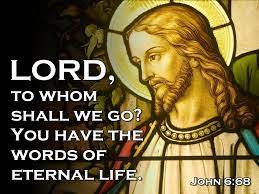
As a result of this intolerable language some  of them choose to leave him.  In a similar way today so many people find the words of Jesus to be intolerable language as many people have got up and left their faith behind them and some may never return again. No one who accepts that Christ is the Son of God has any difficulty in believing that he left us himself in the Eucharist. He promised to give his body and blood in the Eucharist as an everlasting memorial to be our spiritual nourishment and our means of offering an acceptable  sacrifice to God every time his body and blood are made present by the words of the priest. He fulfilled that promise at the Last Supper. He gave to his Apostles and their successors the power to repeat this act of divine love when he said: “Do this in memory of me.” When Simon Peter answered Christ’s challenge will you too go away?”  he spoke not only for his fellow Apostles he also spoke for us when he said “Lord to whom shall we go? You have the words of eternal life. and we believe; and we know that you are the Holy One of God.”

We are the people who really believe that Christ was the incarnate Son of God. Peter made his act of faith before he was fully convinced of the divinity of Christ, but he already knew that Christ was close to God and spoke nothing but the truth. We have the proof of Christ’s divinity which Peter and the Apostles later got, he gave them the bread of life and he went to the cross and rose again it certainly was intolerable language for some people. We also have the witness of the early Christians whose belief in Jesus  the bread of life was at the very centre of their Christian lives as it should be the centre of ours.   We can trust that what Jesus taught is true, even if we do not fully understand how it could possibly be. Many people who became saints died for their belief in Jesus; hopefully we can live our faith fully, even in times of doubting some doctrine or even the wisdom or actions of some of those in the Church.  So with all the doubting and faith filled people wherever they are we say “Lord to whom shall we go? You have the words of eternal life.” and we believe; and  we know that you are the Holy One of God.”
The Feast of the Assumption

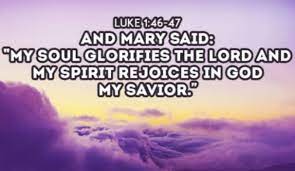
Here we are at the 15th of August  as we celebrate the Assumption of Our Lady into heaven. Our Gospel Reading for this Sunday  shows us that Mary’s faith found expression in prayer as she went to visit Elisabeth Our faith also finds its expression in prayer as we listen to the great evening hymn of praise and thanksgiving the Magnificat.  The Magnificat has occupied an important place in the Liturgy of the Church since the fourth century, the canticle is taken from the Gospel of Luke (1:46-55) where the events of the Visitation of Mary to her kinswoman Elizabeth are recorded. Elizabeth, who was pregnant with John the Baptist at the time, greeted Mary with the phrase “Blessed art thou amongst women,, and blessed is the fruit of thy womb.” Mary responded with this canticle. Every time  we pray the Magnificat we encounter a wonderful model of Christian spirituality in Mary our mother, who according to the Second Vatican Council is “a model of the Church in faith, charity, and perfect union with Christ” (Gaudium et Spes, 63).

Mary’s faith expressed in the Magnificat reached out to others in love and it reached out to God in prayer. If our faith finds expression in love, it will also find expression in prayer. In her prayer, Mary comes before the Lord as his lowly servant, ready to receive from God all the great things that God wants to give. Mary teaches us that when we pray we always come before God with open hearts ready to receive all God has to offer us and there is so much on offer. Mary’s prayer also shows another side of her faith. It shows us that her faith is one  that hungers for God’s justice to become a reality on earth. She speaks to us about a God who pulls down the mighty from their thrones and lifts up the lowly, she tells us about a God who works to fill the hungry with good things and sends the rich away empty.  The Assumption celebrates Mary as one who not only shows us the glorious destiny that awaits us at the end of our life’s journey but also how we are to travel on that journey as disciples of the Lord. Mary Our Mother was  born to be the first and perfect disciple, unstained by Original Sin.

We who want to be disciples of the Lord, look to her as our guide in this life, learning from her example especially that of faith in God and what he wanted her to do be the mother of his Son as well as the mother to all who share the catholic faith. The Assumption is God’s crowning of His work as Mary ends her earthly life and enters eternity.  The feast days of the Church are not just the commemoration of historical events; they do not look only to the past. They look to the present and to the future and give us an insight into our own relationship with God. The Assumption looks to eternity and gives us hope that we, too, will follow Our Lady to heaven when our life is ended.  So let us renew ourselves with Mary as we celebrate the  Assumption  as we pray the words of the Magnificat giving glory to God for all he has done for us.

19th Sunday of Ordinary Time

Jesus is the Bread of Life – John 6:35 – ScriptureWay – Whitney V. Myers -  ScriptureWay

This Sunday we hear Jesus telling the Apostles that he is the bread of life. The Gospel reading deals with a doubting audience, and at times we  are also members of that doubting audience. The people who heard Jesus were shocked and critical of his claim to have come down from heaven as the Bread of Life. Despite the miracles they had witnessed, and the words of wisdom they heard preached with such convincing authority, they could not take the extra step to accept His claim. Many people these days are also unable to make that extra step on their faith journey. We, on the other hand  are able to take that extra step because our Christian faith has come to us from Jesus, passed down through the generations of those who went before us.

We know where he came from, we know where we are going and we know how to reach that destination. The personal faith that we have means that “God out of the abundance of his love, speaks to us as a friend and lives among us as  the living bread which came down from heaven.  The Gospel lesson for this weekend tells us that we can’t live our lives by ourselves as we search for answers when we have doubts.  We find Jesus who is the answer to the doubts we have through the teachings of the church and through our communion with him through the eucharist the bread of life.  When we gather at the Eucharist we bring ourselves and our needs in prayer to God. We bring ourselves to God because God is with us and continues to be with us in good and bad times through the sacramental life of the Church and through the Eucharist in particular.

When we see the Eucharistic Bread, we believe that it is Jesus who is there before us:  such is the faith we have in the Eucharist the bread of life.   In our day-to-day lives we are empowered to be imitators of God’s love and we are asked to pass that love on to those around us.  So, at the end of each day, when we give thanks for all of our blessings, most of all, we give thanks to God for the presence of Jesus in our lives and the lives of those who are around us as we remember that Jesus is the bread of life.

18th Sunday of ordinary time

18th Sunday in Ordinary Time – Diocesan

Here we are at the beginning of August and it will be no time until the schools go back at the start of September. Over the past months all of us have come through a lot journeying along with the COVID 19 pandemic. Sadly many people have lost much loved family members and as we get back to normality such as it is we remember all those who have been affected.

Our Gospel reading this weekend has as its focus Food that is food for the body that is bread and food for the soul that is Jesus  the Bread of life. Jesus tells the people that they are only following him because they have enjoyed the food that physically satisfies them; they should work, he says, for the food that endures that will bring them to eternal life. The one thing which earns this food is believing that Jesus is the one God has sent.

The Galileans promptly ask Jesus for a sign to aid their belief in him – a sign like the manna their fathers ate in the desert.  Jesus points out that it was God, not Moses, who supplied the manna, he compares himself to the God who now gives bread from heaven. Jesus declares that he himself is the bread of life, the bread come down from heaven. Whoever believes in him will never be hungry.  The promise that Jesus held out to the Galileans is one that is held out to us today. It is a promise fulfilled in the Eucharist. If there is one thing we all share it is the same hunger. We hunger for a love that does not disappoint; we hunger for a word that does not fade away; we hunger for bread that does not fail to satisfy. Yet there are so many people in our world who suffer from physical hunger as many do not even have a wee bit of bread to eat or water to drink.

Also there is a great spiritual hunger, there are many people out there who have lost their faith and there are also many people searching for faith who have yet to find it. I think that need to be the bread of life for all those who are out there who have lost the faith or those who are searching.  It means being the light of Christ showing that God the Father has sent Jesus from heaven to be our food, our strength, our hope, and our joy in living. Nothing else in life can surpass this Bread of Life given freely and freely accepted by those who choose to accept this great gift of God. 

17th Sunday in Ordinary Time

World Day for Grandparents and the Elderly – Catholic Grandparents  Association

This Sunday we celebrate the world day of prayer for Grandparents and elderly people. Our Grandparents and our older people are important. Without them the body of the Church lacks something. That is why it is necessary for them to have their rightful place within our Families and communities. It is crucial that we share in the lives of older people in the same way that the Lord, in giving us his Body and Blood, has made us sharers in his own. Today we pray in a special way for  those who are  grandparents or older people, may they accompany their  families with wisdom as they pass on the treasure of faith to the grandchildren and the younger generation

In the Gospel reading for this Sunday we hear the story of the feeding of the five thousand. The crowd is huge can you imagine five thousand people and all of them are hungry: for physical food in a deserted place and hungry for still more. They are hungry to be acknowledged, to feel counted and recognized. Like those of us gathered for Eucharist each Sunday, they are also hungry for what Jesus had to say about God .

They hunger to know that God is on their side, when the rest of the world considers them insignificant.  How can their need to feel important, and their hunger to know God be filled? In their Roman- occupied world they are slaves. In their religious world, a long way from the seat of their faith in Jerusalem and the religious elite, these Galileans were considered next to pagans; ignorant and a long way from God when in truth they were nearer to God than many of the so called righteous people of the day much the same as it is today. There is some food there, but almost nothing in the light of the numbers who are hungry. In this story the food of the poor barley bread counts and it is not an insignificant gift. It’s given by a boy, it’s all he has, and he makes it available. We tend to measure the size of any problem that may arise and then back away, shrugging our shoulders, “What can I do about such a big problem?” Well we in simple terms have to face the problems head on like the boy in this Gospel it is better to do something about the situation we are in than nothing at all.

The life implication of this gospel is simple: Jesus wants to work the miracle of feeding a huge number of people who are hungry; but the miracle will not happen without someone to provide five barley loaves and two fish and the young man did exactly that. The end of this passage is important: “and all ate and were satisfied. And they took up what was left over, twelve baskets of broken pieces”. Jesus asked the disciples to ensure that nothing was wasted: nothing thrown out!   The people in this story realize that Jesus had something to offer them in the deserted and lonely places in their lives. Jesus wasn’t just filling their stomachs he was also nourishing their souls. They weren’t rich, famous, educated or powerful; they were the afflicted and marginalized people that Jesus went out of his way to seek out.  Life may have passed them by, but god through Jesus didn’t.  He took note of them, and they in turn saw in him a place to be nourished, a place where deep  spiritual and physical hungers and longings would be fulfilled. The Gospel account of the loaves proclaims who Jesus is and gives us  food for our journey that is life with all its ups and downs with all its happy and sad times..

This Gospel also proclaims who we are as people who are hungry for what Jesus the bread of life has to say to us about God.  Are we prepared to open our ears and listen to the message of Jesus in the Gospel so that we can pass that message on in what we say and do in our lives ?

16th Sunday in ordinary time

This Sunday in our Gospel story we listen to Jesus as he tells the apostles ‘You must come away all by yourselves and rest for a while’. He first planned to give his Apostles a well-earned rest. They had worked hard while out on their mission and a few days rest would restore their lost energy. He himself, too, must have been hard pressed, preaching and dealing with the crowds. In the absence of the Apostles he had no one to help him he too needed a rest. He, therefore, planned that he and they should go to a quiet corner of the Sea of Galilee where there was no village and where they would not be disturbed. As we all know sometimes the best laid plans go astray as the people got to the quiet spot first. He could have sent them away, but again his compassion for those around him took  over. Seeing these simple people of Galilee so anxious to hear about God he let them stay and began to preach the good news of forgiveness and hope to them.

Jesus cares for us and all those needing rest and spiritual nourishment as he did his apostles and crowd in our Gospel story for this Sunday! We have only to listen to Jesus speaking within our hearts to hear where we will find him. In addition to that blessing, we all know someone in our midst who mirrors the Lord’s unselfish care for others. Often we are the recipient of that care and attention. We might take those people for granted whether they be in our family, community, work place or parish. The widespread problems of so many are symptoms of deep unsatisfied longings to be loved and to love. Can we be a little more caring towards the lost and lonely people we know? And will we hear Jesus as he says to us: ‘I was a stranger and you made me welcome, lacking clothes and you clothed me, sick and you visited me, in prison and you came to see me? Jesus clearly identified himself with people in physical, emotional and spiritual need. To meet them is to meet him especially these days where so many have been affected by the COVID19 pandemic.

Jesus has the answers to our questions; and they all come down to living a humble life in harmony with God. And he not only tells us but shows us the way. He talks the talk as he speaks to us but he also walks the walk with us. And this walk takes him to Jerusalem and up the hill to Golgotha where he gave his life for us. Jesus invites us to walk with him as we listen to his teaching and then at the end of the walk to rise to new life with him. No wonder they wanted to hear more.  So the call to us this weekend is that we should come apart and rest for a while and as we rest we should recharge our spiritual batteries as we  listen to Jesus and try to follow what he teaches us today.

15th Sunday of Ordinary Time

This Sunday our Gospel reading about Mission. Jesus summons the twelve apostles and sends them in twos on a missionary journey.  The chosen followers of Jesus have to carry the word of God as a challenge to others wherever the find people to listen. They are not to rely on their own resources but on the authority that has been given to them by Jesus and the hospitality that will be offered to them. With no bread and no money, they have to depend on the kindness of others: that vulnerability makes their message their real resource. If they have bread to eat, it means that people are not only hospitable to them but to the word they preach. If they are not accepted, they have no option but to move on. And when a town rejects their message, the apostles are to shake the dust from their feet a symbolic act performed by strict Jews returning to Palestine after journeying abroad. Jesus and the Twelve Apostles preached that God would adopt humanity, making its members which include you and me “sons” and “daughters” of the Father This was Good News then just as it is now!  We need to be like the twelve who were sent out with the message of Jesus but with one difference we need to seek out those who do not want to hear the message instead of shaking the dust off our feet we really need to let our feet get dirty.  

We have to have carry the word of God as a challenge to others and as we carry gods word  to others it should also be a challenge to us in our time and place right where we are. We, like the first disciples, are inadequate for the task; yet Christ’s mission for God’s kingdom is given to us in order to make it a reality in our lives and the lives of those who live around us. If we labor under the illusion that we can bring about God’s reign on our own, we will not be advancing God’s kingdom on earth.  Paul refers to his experience of preaching the gospel as foolishness. He relishes saying “we are fools for Christ’s sake. Because he understands that it is because of his weakness that the power of Christ can dwell in him. If we understand our own weaknesses we too can be witnesses with the power of Jesus dwelling within us. The crucial point in the Gospel is that by doing things Jesus’ way the Apostles get close to the people, they understand their concerns and they share their life. There is no better way of communicating the love of God to the people around us than sharing the concerns of others and getting close to the people of God where they are in their faith and life Journeys. Let us be fools for Christ like St. Paul as we remember that it is through our weakness that the power of Christ can dwell in us and work through us for other people.

Are we willing to advance his gospel project by our words and deeds in the world? Will we “travel light,” trusting in the Lord’s presence to guide us Or will we wipe the dirt of our feet as we leave?

14th Sunday of Ordinary Time

11th Sunday in Ordinary Time (Year B) - Ordinary Time — Liturgical Year B -  FORMED

This Sundays  Gospel sees Jesus going back to his roots in Nazareth. This is not a social visit: like other towns in Galilee, Nazareth and its people have to hear the Good News of the kingdom. When Jesus teaches in the local synagogue, many of the townspeople are astonished at the performance. They wonder at the origin of Jesus’ teaching and the nature of his wisdom, as well as the miracles that are done through him. From the unanswered questions about Jesus’ wisdom, the neighbours move to more familiar territory and focus on what they do know about Jesus. Whatever their wonder, they are not going to allow the wisdom of Jesus  to interfere with their memories of him. Prior to this section in Mark’s gospel, Jesus has been doing some extraordinary things. His baptism by John in the river Jordan was accompanied by an affirming voice of the Father from the heavens, “You are my beloved Son. On you my favor rests.”

After his desert testing Jesus called his first disciples, cured the man in the synagogue with the unclean spirit and the paralytic in Capernaum; expelled the legion of devils from the Gerasene man, you may remember last week in our Gospel Reading Jesus raised the daughter of Jairus, and cured the woman with hemorrhage, Jesus is doing wonderful things as he proclaims, in word and deed, the coming of the reign of God. Though he did all the wonderful things the people still had little faith which also seems to be the case these days. The people wanted the powerful signs of God’s final coming with a strong right arm to rescue them. But when Jesus spoke about the signs of the kingdom’s presence, he spoke of scattered seeds and, to emphasize the kingdoms small beginnings, he compared it to a mustard seed, “the smallest of all of the seeds of the earth” Where was God’s show of power and mighty arm in a tiny mustard seed? Mark sums up their reaction, “And they took offense at him.” And so it is today as many take offense at the values of Christianity in our world. A world which in many respects is so faithless with many  people taking offense at Jesus and his teaching.

You only have to look at the current debate about the Eucharist in the USA to or the state of the church in Germany to see this. Jesus revealed God’s presence to the people of Nazareth as a different kind of power: the power used only to help others, not ourselves; a gentle power that does not force or coerce people to do our will; the power of compassion and gentleness, when others are expecting force. All of us know from our own experience that when we admit our failures and limitations, that exercise in honesty can mark the beginning of a new understanding. If our Lord and God can take failure in his stride, we might even end up boasting about God’s fantastic message! What is the message of the wisdom of Jesus? Jesus message is really about using whatever power that we might have in a positive good way to help others and the greater our weakness the more powerful we will be that is powerful with the power of compassion and gentleness that is the power of God that our world needs more today than ever before.

13th Sunday in Ordinary Time

13th Sunday Of Ordinary Time (B). THE FAITH OF JAIRUS AND THE WOMAN WITH  HEMORRHAGE. - Catholics Striving For Holiness

This weekend we celebrate the 13th Sunday of Ordinary Time. In the Gospel reading for this Sunday we hear about the woman who had the hemorrhage and we also hear about the official’s daughter. Whilst the stories are about the faith of the people involved they are also about the mercy of Jesus towards them both. Jairus, the synagogue official and loving father of a ‘desperately sick’ twelve-year old daughter, is convinced that if only Jesus would place his hands on her ‘to make her better and save her life’ she will surely recover. The unnamed woman, suffering for twelve years from a condition for which she has spent her life-savings on one doctor after another, has one last hope. She is convinced that ‘if she can touch even his clothes’, surely she will ‘be well again’ and then she was able to get near to Jesus and touched his garments. The poor woman and Jesus know that healing power has gone forth. Jesus turns around, inquiring who is the one who had touched him. Fearfully, the woman admits that she is the one. Jesus immediately calms her fear, telling her to go home in peace, for she is healed.

Then, He proceeds to the house of Jairus, where He learns that the little girl has died. Quieting all the commotion, He goes in with the child’s parents and Peter, James, and John. Taking the hand of the girl, He brings her from death to life, ordering that some food be brought to her.

It is worth dwelling on the detail of the stories because they give us an insight into the mystery of Jesus. They tell us about a man who has a fierce kinship with those who suffer, who does not disappoint those who look to him for help. Like Jairus, there are many people who suffer on behalf of their loved ones and who feel powerless when they are confronted by the pain of those they love The Gospel story of Jairus’ daughter is given to all of us as Good News. It is offered to us today to nourish our faith in Jesus, to enliven our hope in his power over death itself. We know there are those who mock that belief, professional mourners who believe that death must have the last word in every human story but the scripture clearly says that death will not be the end. Over the past 14 months or so our faith has been sorely tested in so many ways as we have dealt with the COVID19 pandemic. Many people have suffered greatly with the sickness and death it has brought and as we hear the stories of the healing  of Jairus Daughter and the Woman with the Haemorrhage we pray for all who are suffering in our world today especially those affected by the Pandemic and their families. We pray that the healing hand of Jesus may touch them and bring them healing and peace. We also pray that we may be the healing hand of Jesus for all those around us who need his healing touch in their lives so that they will see that we live by faith

12th Sunday in Ordinary Time

Jesus Calms the Storm at the Sea - Matthew 8:24-34 - Bible Verse of the Day

The gospel reading for this Sunday is all about being Calm amid the storm. The context of this passage is the calming of the storm when Jesus rebuked the wind and said to the sea, ‘Quiet now! Be calm!’ And he says the same to us now in all our trials ‘Quiet now! Be calm!  Jesus understood that all would be well even if he and the disciples perished or if the storm subsided. Mark’s original audience was a community undergoing persecution. Their leaders had been martyred and, they questioned what was happening to them. The church was undergoing internal strife as well as they struggled to combine Jews and Gentiles into their new Christian community. Mark’s church was hardly sailing through calm waters not unlike our church today. We hear  Jesus asking the disciples in the midst of the storm, Why are you so frightened and why do you have so little faith. He could be saying the same thing to us today as many lack faith in God and humankind.  For many of us these days we are frightened with the various events that are ongoing throughout the world. Especially the COVID19 pandemic. When that storm comes Jesus reminds us of the glory of the life to come after the storms of life have ended.

He changes the darkness that is often in our daily lives into the sunshine of everlasting life, and replaces our distress with comfort and peace. When we don’t know the best way forward or the best way out a particular problem Jesus gives us peace to make the decisions needed at that time. At such a crossroads of life, we can ask him in prayer, ‘Lord, what road should I take what way should I Go?’ The best way will become so much clearer, and bring us calmness and peace of mind as well as the knowledge of a decision well made. We have so many things to occupy our minds these days with pandemic and so many other things that are going on in our lives and the lives of those around us. Despite everything that is going on we believe that Jesus accompanies us on our journey to God, that he is “on board” with us. Sometimes, when we see such disorder and chaos around our world, we might wonder if Jesus has chosen to sleep through disaster – even though we know that his presence is no insurance against our own fear and anxiety.  To journey with Jesus is all about going through the storms, not around them. The peace of our lives will be disturbed. But we know that the disciples of Jesus went on to face hardship and rejection. Ultimately, many of them came face to face with a violent death and martyrdom.

What kept them going is what keeps us going: and that is our faith that  tells us  God the Father is in charge and  he is the person who brings calm of all chaos the storms of life bring, it is the faith which tells us that there is no storm that will not be stilled by the peaceful presence of god. So let us be at peace amid the storms of our lives for God is in Charge and he knows we will get through whatever happens because we have faith.

Post Navigation