Well here we are at the beginning of August It will be no time until the new uniforms etc will have to be bought and the schools will reopen hopefully at the beginning of September after the covid19 lockdown.
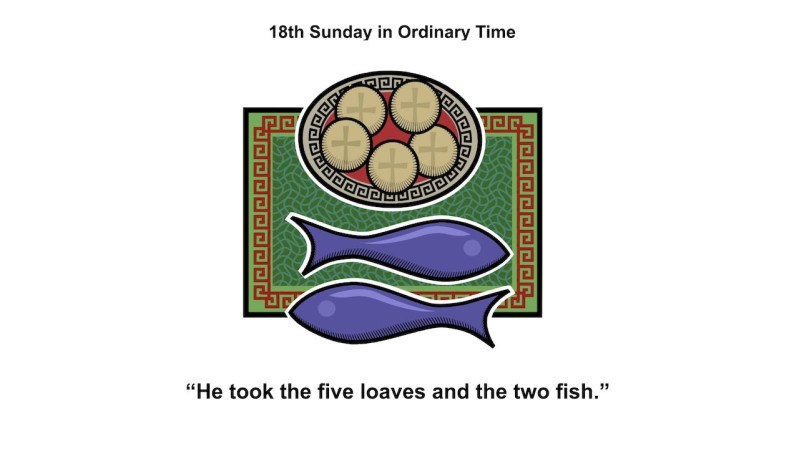
In our Gospel story for this Sunday we hear about the feeding of the five thousand. The gestures and words of Jesus in the Gospel bring to mind the Last Supper The Gospel writer is making clear references in this miracle story to the Eucharist. The people in this story are a crowd that realize Jesus had something to offer them in their “deserted places.” Jesus wasn’t just filling their stomachs. They were not the rich, the famous, the educated or the powerful; they were the afflicted and the marginalized people that Jesus went out of his way to seek out. Life may have passed them by, but Jesus didn’t. He took note of them, and they in turn saw in him a place to be nourished, a place where deep hungers and longings would be fulfilled. The physical bread of the miracle story was of temporary value. It could not satisfy deeper spiritual hungers, but it was a sign that Jesus can and that his heart is moved with pity for us.
In this version of the story, there is no boy to provide the loaves and fishes for this miracle. The people are weary looking for hope, for consolation after the death of John, looking for a leader to inspire them, and they discovered Jesus. The disciples have the food. Was it their own food for the trip? Is Jesus asking them to share out of their supplies? Is he asking them to risk it all, to take a chance at extravagant generosity? And they do—maybe this too is the miracle; the change in the disciples who now have learned that whatever they have, it will be more than enough in collaboration with Christ. They are learning to cast their lots with him, to risk what they have in his service. As we heard last week, the person who discovers the treasure in the field goes out and sells everything to buy the field and have the treasure.
The sign for us today is that we too are the beloved of God and we will not be left hungry or alone for God is with us in the good, bad, happy and sad things that are part and parcel of our daily life.
In this unusual time in our lives, it is difficult to hold on to, the familiar line from the Letter to the Romans that states “We know that all things work for good for those who love God.” We Christians believe this, way down deep. Who among us though would honestly ask God for the “understanding heart” as did Solomon as our one request, during this pandemic? But as we get back to the normality of our lives and daily living we need to have understanding heart’s and minds as so many things will change and are changing in our lives and the lives of our families friends and those around us. We have to understand that in the words from the liturgy life as we know it has changed but it has not ended.
In this Sundays Gospel we hear the story of the treasure hidden in the field. The kingdom of heaven is like a treasure buried in a field or a pearl of great price. When its great value is recognized, one gladly does all that is necessary to obtain it. Jesus teaches us that the most important and the most urgent thing in life is to find out just what God wants of us, and to do it. This is what he means when he urges us to be as single-minded, as focused, and as dedicated, as someone who digs up a treasure in a field, re-buries it, and hurries off to buy that field, so that he can have that treasure all to himself. Jesus makes the same point about priorities when he urges us to be as single-minded, as focused, and as dedicated, as a collector of jewelry, who comes across the finest pearl in the world, and sells all personal possessions in order to acquire it.
To possess the Kingdom means that we should share our knowledge of the kingdom with others. To truly believe in Christ means leading other people to the same belief; for secret faith is no faith at all. We need to be like the householder, mentioned at the end of our Gospel reading for this Sunday, who brings out of his house things both new and old. We should be happy to bring out of the house that is our faith all kinds of treasures to share with our family friends and neighbors. But these treasures are not physical things like clocks and pearls but attitudes spiritual and otherwise that are virtues like love and justice and truth and hope and so on. What we bring out from our treasure store are the values of the Kingdom, the attitudes of Jesus and the knowledge of the one true God. God loves us just the way we are, but He refuses to leave us that way. He wants us to become just like Him. He wants us to pass on our treasure to other people so that they can discover the faith which is the pearl of great price the treasure hidden in the fields of our hearts.
This weekend we continue opening our local churches for worship as we emerge from the COVID19 pandemic and continue to move forward into the new normal with all the changes it will bring .
This Sunday we hear the reading from Chapter 23 of St. Matthews gospel, the story is the parable of the seed and the weeds and the darnel in the field. In the parable of the wheat and weeds, Jesus recognized good’s co-existence with evil. He also held out the hope that the Kingdom would right all wrongs. I think that there is the potential in each of us to be either wheat or darnel that is good and bad. We often say ‘wouldn’t life be easier if everything were black and white’ as if there are ‘totally good people’ and ‘totally evil people’. Of course life is never that simple. If we are really honest nothing is ever that straightforward to be black and white. We need to ask ourselves Who are we called to be in a world where weeds and seeds grow side by side and we often find it hard to distinguish the difference between them.
As people of faith we have to constantly ask ourselves : Should we hide from the messiness and make religion a privatized personal relationship with God? Should we insulate ourselves – sharing with those we think are worthy of our love, deciding who is worthy? Where is God in all this concern, worry and judgment? If we pray about these three questions and our problems and those of others we will see god is there in the middle of everything and his hand will guide us and as a result we will be the seeds that flourish and not the weeds that die. Jesus used parables to challenge his audience to think and he uses the parables in our world of today to challenge all of us to make us think as well. In truth and charity we must speak to others and teach them about the great responsibility they have to choose either Life or Death to be weeds or seeds .All of us have the power to freely choose Him or to reject Him. May we see the seeds of the Kingdom of Heaven grow and flourish in our midst .
God will guide all of us along the roads that lead to Salvation and he will help us to be the seeds that flourish in the rich soil of faith and be the examples to the people around us .
This weekend we arrive at the fifteenth Sunday of ordinary time. Lent and Easter are but a distant memory and we are now gearing up for the opening of our Churches for Sunday services and hopefully some holidays after the COVID19 lockdown.
This Sunday we hear the Gospel story of the sower who went out to sow the seed. For me the story is really about the seed of faith with Jesus the sower and you and me as the soil on which the seed that is the word of God lands. The context of today’s parable provides some insight into its interpretation and application The parable is located between stories of confrontation and rejection. As the early church faced opposition and a seeming lack of success, the parable must have given encouragement to the first preachers and members of the early church a promise of fruit not yet visible to them. Jesus is speaking to a large crowd.
They may be listening to what he says, but some will follow him and others will leave and go their own way. He is realistic as he seems to randomly cast his words out upon the crowd. What he says to them will not seem to bear fruit – not straight away. Often that wee seed of faith may take root many years after it has been planted and today we see many people returning to the faith or coming to the faith for the first time after someone or some event in their lives planted that first seed with others helping nourishing the seed and helping it to grow. What is striking about the parable is the amount of waste I’m sure those who are reading this who are recyclers will be horrified. The bulk of the details are about wasted effort and lost seed. Why wasn’t the sower more careful, after all farmers were poor and the seed was precious? Sometimes, we wonder if all our efforts and words are worth it when things are falling down around us. But if we stop for a moment and think about it anything done for God in faith is never lost.
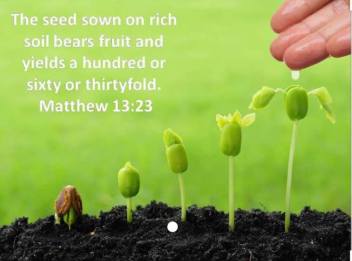
Very often things that are happening our lives don’t seem to be the way we might want them to be but when we look at the problems with eyes of faith we see that things around us are the way they are meant to be for the good of all. We also get the strength to deal with the problems that go on through. Nobody really knows what’s beneath the surface of the soil we cast the seed of the word of god upon. Who knows the potential of the good soil? Do good and poor soil both exist in the same person I think that it most probably does much in the same way that a person can do good or be bad. Is there something we might say that will land on the interior good soil in a person and bear the “hundredfold, or sixty or thirtyfold” Jesus promises? who knows only God knows. While the gospel parable begins with and spends time on hardships and failure it ends in surprise and abundance. What was the source of this abundance? We look to what Isaiah told us today in the reading about the fertile, life-giving nature of God’s Word.
Our God is a God of surprises and our faith is also filled with so many surprises as well. Despite any discouragement we might feel because our efforts in many things seem futile and draining, we put our trust in the one who speaks to us a living word who sows the seed. The message of Jesus may not always be welcome especially in our modern world were faith and religion are constantly under assault by those who oppose the Christian faith based outlook on life. That said we still have to sow the seed of faith by what we do and say and then we leave the rest up to God our efforts are never futile and we don’t always see the fruit of the seed that’s sown. Let us remember that tall oaks from little acorns grow and Our God is a God of surprises and our faith is also has many surprises as well especially during these days.
Well here we are trying to get into the holiday mood as the corona virus lockdown is easing. While many people will be taking the time to get away as things ease we spare a thought for all those who may not get away for a break this year .
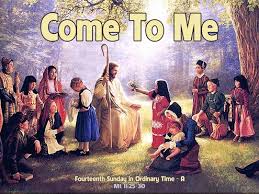
One of the most wonderful things about the person of Jesus has been and continues to be, his special love for ordinary people like us with all our faults and failings. This love is seen in a particular way within the two statements that he makes in this Sundays Gospel reading. The first is in his prayer to God: ‘I bless you, Father, Lord of heaven and earth, for hiding these things from the learned and the clever and revealing them to mere children.’ The second is in his Invitation to all of us: ‘Come to me, all you who labour and are overburdened and I will give you rest.’ Why did he say this? The answer comes across very clearly so many times in the gospels, and may be summed up in just one word – COMPASSION. For example: – The plight and tears of the widow of Nain touches his heart to the core: ‘Don’t cry,’ he says to her, before bringing her son back to life.
He is moved with compassion at the plight of a leper begging for help (Mk 4:41), for two blind men sitting at the side of a road and pleading for mercy (Mt 20:29-34), and for a crowd of people with nothing to eat (Mk 8:2). In each case he responds to their sufferings with the power, love, compassion and care of God. To be a Christian and to have the light of faith to guide our steps in the neo-pagan darkness of today’s world, is a gift, and a blessing from God, for which we can never thank Him enough. So, in the here and now of our daily lives the big question for each of us has to be whose side are we on? Are we on the side of Jesus, that is the side of compassion, kindness, help, healing, and mercy? Or on the side of the scribes and Pharisees who are amongst us even today and they are – fierce, fault-finding, heartless, and critical, people without much compassion. Will we take our cue from their cruel, harsh, and insensitive judgments and actions? Or will we take our inspiration from what we see in Jesus, and from his touching compassionate outreach to the poor and the broken when he said ‘Come to me, all you who labour and are overburdened and I will give you rest’. This, then, is a clear invitation for us to slow down.
Let us resist the temptation to join the mad rush in this world’s rat race especially these days when we are coming out from the darkness of the COVID19 lockdown and getting back to a new sort of normal. There is more to life than speed. As the saying goes, “The early bird might get the worm, but the second mouse gets the cheese”. This time of return to normal is also an invitation for us to move to a life of simplicity. Happiness does not consist in having more, but in being contented with what we have. Jesus invites us, “Come to me!” And He waits for us so let us take up our rest .Over these past four months of lockdown I have found many people taking up the opportunity to take the rest that Jesus talks about and many have found their true selves within the quietness despite the pandemic madness that is around. Let us remember the words of Jesus as we go back out into the world with all its problems and opportunities ‘Come to me, all you who labour and are overburdened and I will give you rest.’
Here we are at the end of June after 13 weeks of COVID 19 lockdown. if times were normal the schools would be closing for the summer holidays as it is the schools have been closed for the past few months with everyone wondering what things will be like when the schools reopen. This weekend we remember the family of Noah Donohue as we hear the sad news that a body has been recovered we pray that God may give his family and friends strength at this sad time.
In our Gospel story for this Sunday we are reminded that The priority of faith demanded radical consequences for early Christians. At that time extended closely-knit families formed the basis of society, a choice for a follower of Christ could mean a rejection of the family’s faith and values. Jesus reminded his followers that the Christian life involved many risks and one could not compromise or hide these risks away a believer could not placate his or her family if the cost threatened faith. The people of the day thought that No, faith could involve such an extreme choice.
Either the relationship with family took priority or the relationship with Jesus took the number one slot it seemed that both could not go together. Even though they had only a very vague idea then of what he meant, when the time came, they remembered Jesus words and gladly suffered imprisonment, hardships, and finally martyrdom for Christ. This shows how the resurrection of Christ, and the descent of the Holy Spirit on them, changed them from worldly weaklings into fearless heroes. They had become convinced that Christ was the Son of God their saviour who had come on earth to bring all men to heaven. Through time they came to realize how unimportant, the few years of the earthly life that we have were compared to the eternal life of bliss to follow. Today, too, there are still those who are suffering a lingering martyrdom, worse than quick death on the scaffold, because they obey God rather than man. We can help them to persevere, by our prayers. We ourselves, who are free from any overt persecution, must show our gratitude to God for being allowed to practice our religion openly and without fear. As well as carrying out our own personal duties, we must remember the spiritual needs of our fellowmen. They, too, need to get to heaven and anything less will be eternal disaster for them.
We may not be able to preach, or teach them the truth of the Christian faith in the way our priests deacons and religious do but we can show them the way when we are seen to live according to our Catholic faith.Over the next few weeks and months we will come out of the lockdown as we try to move into a more normal way of life. Many things will be changed and our ways of going around and doing things will be different but for all of this we thank God that all of us have come through it safely. As we thank God for bringing us safely to where we are we also remember all those who have died during the pandemic that their families will be consoled by their faith and the love of those around them. May we have the courage to be people of faith as we go into the new future which the Covid19 pandemic has brought us.
This weekend our gospel story tells us not to be afraid but for many they are scared and afraid as we come out of lockdown after the last 12 weeks. It is certainly true that life will be changed not ended for all of us as we come out from the lockdown in the coming weeks. The Gospel message is quite simple Jesus tells us not to be afraid He does not disguise the truth that his disciples and all of us will be confronted by those who threaten, bully and intimidate others into submissive agreement. In the first reading Jeremiah refuses to be intimidated by terror from every side. That doesn’t mean that the terror doesn’t get to him it means that he has no intention of allowing the terror to write his script and dictate who he is. Jeremiah has been abandoned by all his friends who now try to discredit him. He is thrown into prison for his preaching, and the army council threatens him with death if he doesn’t change his tune.
But Jeremiah refuses to be bullied into agreement because he believes that “the Lord is at his side, a mighty hero”. What keeps Jeremiah sane amidst all this persecution is the profound belief that God cares for him. And, less spiritually, the frank hope that God will clobber all his enemies in good time! Not only does Jesus want his disciples to refuse to submit to the merchants of death, he tells them not to be afraid of them: “Do not be afraid of those who kill the body but cannot kill the soul.” What our Lord said to His Apostles applies to all Christians including you and me in the practice of our faith. By the very fact of living our faith day and daily openly and fully we are apostles especially during these weeks of the pandemic when we cannot be together as the Church. So today we think of all of those who have given us an example by living their lives in faith in difficult circumstances. These may be parents family members or people we have known we all have people who have shown us the way of faith.
So as faith filled people Jesus teaches us that our only source of freedom and strength is the goodness of our heavenly Father a goodness that is mediated through Jesus himself as well as through good people and beautiful flowers. Furthermore, the discovery of this goodness carries with it the solemn obligation to pass on one’s blessings through concern for others. We must look for the goodness in life and learn to count our blessings as we pass them on to other people. As we emerge from our lockdown there are many things that are changed or will be changing but we stop and thank God for all that we have and all the blessings that have come to us over the last 3 months of lockdown. We also remember all the families out there who have lost family members during the lockdown that God may console them at this time. May be people of courage in the days and months ahead as we remember the words of Jesus when he told us do be not be afraid.
This Sunday we celebrate the feast of Corpus Christi in some places this celebration took place last Thursday. It seems so strange that we have been unable to receive the greatest gift from God the Blessed Sacrament of the Eucharist during the corona virus instead we have been making a spiritual communion but that is not the same. let us remember the importance of receiving the Body and Blood of Christ! The Body and Blood of Christ is an eternal testament to the unconditional love of God for us. Throughout history, this love has been shown to the people of God by God, over and over again, as partially described in the first reading from Deuteronomy. The second reading from 1 Corinthians reminds us that receiving the Body and Blood of Christ is the participation in the life of Christ and that we are one body. In the Gospel passage according to John, Jesus tells the Jewish crowds and us that he is the living bread,
that the living Father sent him, and that we have life within us because of these things. We are spiritually alive and eternally connected. When we see the Eucharistic Bread, we believe that it is Jesus who is there with us: such is our faith in the Eucharist the bread of life. We are thus in the presence of the Resurrected One, He who has conquered death and who is now in Heaven, in the Glory of the Father! Only God can have a Heart so full of Love that he invites us in this way to contemplate him with the eyes of faith, for our eternal happiness, for his own Glory, forever and ever! Not only as individuals does Christ call us to store up eternal heavenly treasures, as opposed to earthly treasures which decay, but we are also called as a people to live virtuous lives. Sadly, we see the moral decay in our own time. By following in our Lord’s footsteps, Christians over the centuries have sacrificed greatly, in a labor of love, for their faith and their Christian way of life. Then as now, it begins with each individual humbly asking God to show the way and to provide the strength needed to follow in His footsteps. Gathered at the Eucharist even through the webcams we bring our prayers to God especially during this COVID19 Pandemic.
We each have our own needs. Friends are sick. Kids need work. The person who has been in our lives for so long has died. There are so many other needs as well and we bring our prayers to church because they remind us of our need and they raise our hope in God. We have this hope because God has rescued us and continues to rescue us time after time. Our relationship with God has produced fruitfulness, satisfied our longings, and brought us peace. Because of God’s faithfulness, we give thanks, offer sacrifice, and once again present our needs on this feast of Corpus Christi knowing that we will be heard by the Father in heaven who loves us with an everlasting love and does not give up on us or let us down.
From Ash Wednesday to Easter Sunday we have travelled the 40 days of Lent and from Easter Sunday until Pentecost we have travelled the 50 days of Easter we have now come to part of the Churches Year that is called Ordinary Time. This year for want of other words Ordinary Time is a Lot Less Ordinary as we emerge from the COVID 19 pandemic with changes made to so many things. This weekend we celebrate Trinity Sunday which is all about the triune god Father, son and Holy Spirit. The Father is equal to the Son and the Son is equal to the Spirit three in one and one in three we hear this in the breastplate of St. Patrick. The 4th century St Patrick, with a brilliance that we Irish are justly celebrate found in the three leaf shamrock rising from the one stem an image of the Trinity. The feast of the Trinity goes back to 12th century England and St Thomas a Becket, Archbishop of Canterbury. Historians say the great Thomas celebrated a Liturgy in honor of the Trinity in his cathedral. So was born the observance. In the 14th century, the feast came to be observed by the universal Church. We open each Liturgy especially the Mass invoking the Trinity . We close Mass and so many other liturgies by calling upon the same Persons Father Son and Spirit in blessing us as we go out into the world. Throughout the Christian world infants will be received into our faith communities through Baptism in the name of the Trinity
Trinity Sunday is the day when we stand back from the extraordinary sequence of events that we’ve been celebrating for the previous five months—Advent, Christmas, Lent, Holy Week, Easter, Ascension and Pentecost it is the day when we are asked to rub the sleep from our eyes and discover what the word ‘god’ might actually mean. How do we understand the Trinity? The Christian belief that God is a trinity helps underscore how rich the mystery of God is and how our experience of God is always richer than our concepts and language about God. The doctrine of the Trinity affirms God as loving and knowing, giving and receiving. We profess that God could not be God without the “other” (the Son) and the eternal bond of their relationship (the Spirit). While some may think that the doctrine of the Trinity is negotiable, it is actually central to our faith. If we lose it, we lose all we are. Moses’ personal God, “merciful and gracious, slow to anger, rich in kindness and fidelity,” emerges in St. Paul as the interpersonal Trinity that models true human relationship. Thus Paul prays: “The grace of the Lord Jesus Christ, the love of God and the fellowship of the Spirit be with you all.” When the Church celebrates the Feast of the Most Holy Trinity, it is an attempt to summarize the whole mystery of our God into one day. This is not just a “theological feast” ` but a feast which should speak to us of this simple fact of faith: the Father loves us, has revealed that love in his Son, and has called into a relationship sustained by the Spirit. It is our joy that, as baptized members of the Church, we can somehow share in that divine life and love which is the Trinity – becoming children of God. God has chosen us, and we are his own people, just as he chose the people of Israel long ago. Each Trinity Sunday, we only scratch the surface of this great mystery of our faith. In gratitude and faith, let us begin and end every prayer with greater faith and reverence “In the name of the Father, and of the Son, and of the Holy Spirit. Amen.”
This Sunday we celebrate Pentecost Sunday and it seems to be a new beginning for everyone as we emerge from the lockdown of the past 10 weeks or so. But our new beginning will result in many changes in our lives and our faith lives going into the future. As we go on through the process of getting back to a new normal we remember all those on the front-line who have done so much to keep us going throughout these weeks. We also spare a thought and a prayer for all the families who have lost loved ones during the pandemic whose lives are particularly hard during these weeks.
With the feast of Pentecost the seven weeks of Easter have come to an end, Christ’s Passover is fulfilled with the outpouring of the Holy Spirit, manifested, given, and communicated as a divine person: Christ, the Lord, pours out the Spirit in abundance. By the time John wrote his gospel, Jewish Christians had been excommunicated for their belief in Jesus. Ostracised and socially persecuted, some Christians reacted in fear, while others boldly proclaimed the gospel. The First Christians needed a sense of stability, a sense of serenity and peace the same as we do these days. The words of Jesus, “Peace” was John’s prayer for his readers at the beginning as it is for us as we listen to this gospel reading in our current situation. With the sight of Jesus, fear turned into great joy. Anxiety turned into relief. Desperation turned into vindication. Most important, a lack of spiritual direction turned into a sense of deep spiritual grounding.
The divine presence stood close to them and with the divine presence came peace. We too have the divine presence in the Blessed Sacrament and it brings Joy and spiritual grounding to all those who come and Jesus says to each and every one you are welcome. We can’t ignore the problems that are there for ourselves and those around us especially during these days. Very often we need to stop and pray through the problems as well as thinking them through. Gathered together in prayer week in week out we bring ourselves to God especially when we celebrate the Mass. We each have our own needs Family and friends may be sick, Kids need work. The person who has been in our lives for so long has died. We bring these and all our concerns in prayer because they remind us of our need and they raise our hopes in the power of God made real to every generation through the Holy Spirit.
As we go forward into a new unknown future as we come out from the lockdown we are like the first disciples who did not know what was going to happen or when but Through the Holy Spirit everything made great sense to them. With the Holy Spirit as our guide the relationship we have with God produces fruitfulness, satisfies our longings, and brings us serenity and peace. Because of God’s faithfulness, we give thanks, offer sacrifice, and once again present our needs as we remember the presence of God with us in all our lives especially at this time.


 Fullerton T