Many of us join groups or societies or whatever there is security in being part of a group of like minded people with the same goals in life. Rejection is a clear signal of disapproval and this is what the Gospel reading is all about this Sunday; Rejection of those who are not of our religious belief or whatever. The exorcist in the Gospel is put before us this weekend as the example of someone who was rejected and the gospel then goes on to tell us about the acceptance that Jesus has for those people such who were rejected. Don’t forget that Jesus suffered the ultimate rejection on the Cross of Good Friday. The disciples consider Jesus their own personal treasure and they want him for themselves. They seemed to have been an ambitious group last Sunday we heard them arguing over who was the greatest among them. This Sunday they complain that they saw someone who was not part of their group performing a healing in Jesus’ name. If there had been laws concerning copyright way back then I think the Apostles would have copyrighted Jesus name and the power that went along with it. I can just imagine them using Calamus to license the use of Jesus’s name and then asking “How many times do you want to use Jesus’s name that will cost so much.How many times do you want to cure someone in his name that will be so much more It’s as if Jesus is a rock star and the Apostles are his agents, with exclusive rights over what he does and says.
What they really wanted was a tidy little religious box, clearly in their control but they hadn’t factored in Jesus and what he had been sent into the world to do. They forgot the size of his heart, remember it had no limits. They forgot how big his compassion was, remember it never ran out and wasn’t limited to the few who under the law had the proper credentials or disposition to receive it. There was and continues to be plenty for everyone in terms of faith then as there is now. Jesus is the visible face of the God that we can’t see and yet we believe; we believe in the God who wants to speak words of love and joy to all, not just a few; who wants to reach out and touch all those broken of limb, and broken of spirit, not just those who belong to our club or carry the right credentials. After they see Jesus crushed on the cross and later, when he rises from the dead, the apostles finally get the message and understand what had happened to them as a result of their involvement with Jesus. Then they would do exactly what we’re doing right now, retell the stories about Jesus as they set out to continue the story without restrictions or limits of any kind; When they did all of this they would have been speaking and acting in Jesus’ name, not just for a select few, but for everyone they met, or came to them in any need.
In Jesus’ name they opened the eyes of the blind, cured the cripples, and even raised the dead. At first they got it wrong, but then they learned what it meant to speak and act in Jesus’ name everything was possible for them. We need to remember as we go forward that we don’t always get it right we are sinners and remember that everything is possible to those who have faith in the name and person of Jesus Christ the Son of God.
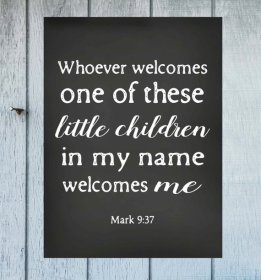
This weekend our Gospel story is all about being small as the little child in the Gospel story. This is a great gospel reading for the times we live. Towards the end of this Gospel Jesus brings the child to centre stage and instructs his disciples: “Anyone who welcomes one of these little children in my name welcomes me; and anyone who welcomes me welcomes the one who sent me.” In this instance Jesus doesn’t ask his disciples to become like children; he asks his disciples to welcome them. The disciples have a problem about welcoming littleness because they think that they are at the top of the tree and are above this. This basic Christian teaching, common to all the Gospels, is one that has not always been honoured. “To be first in the group is to occupy the last place and to be a servant to the group.” That means to be the greatest you must make yourself the least in service of other people especially those around you. Look around you see the likes of Saint Vincent de Paul and other charitable services helping those who are in need.
Jesus taught his followers the true meaning of leadership. Leadership does not mean power but service. Power often strangles life and brings a slow death. But, service brings life, even from death itself. An attitude of serving others should not be a triumphal attitude lording it over everyone else, yet much of our history has been about individuals seeing themselves as better than everyone else. In this passage we listen to the words of Jesus about the child he tells us “Whoever receives a child like this in my name receives me. Whoever receives me receives God”. In the first part, the disciples are told that a measure of their discipleship is their attitude to power. In the second part, discipleship can be judged on the disciple’s attitude to children who are powerless in many ways. Jesus offers us a permanent challenge to welcome the powerless, to take to heart the weakest members of the community. He places himself in their company. Their vulnerability is something that Jesus not only shares but values. May we understand that to be be first in the group is to occupy the last place and to be a servant to the group.”
May we take up the challenge that Jesus places before us in this gospel reading and that challenge is to become humble servants of those who need us whoever they are wherever they may be in our troubled world.
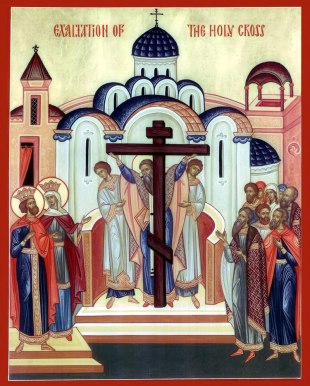
As we continue our faith journey we celebrated the Exaltation of the Holy Cross on Friday of this week. Jesus invites us to take up our crosses as he took up his own on Good Friday. Our faith is tested in the real world where we live, and reality comes to us often in the shape of a cross you know what your cross is as you read this and there are many crosses. In taking the cross up, in accepting its burden, we live up to our true name as Christians.
In our gospel reading this weekend we hear Jesus asking Peter and the disciples the famous question “Who do you say I am the guesses all lead us to someone else, Elijah or John the Baptist or one of the prophets, figures who were celebrated for pointing forward to the Messiah. In contrast to what others think, Peter speaks on behalf of the disciples who have shared Jesus’ life intimately: he identifies Jesus as the Christ. Jesus then tells his disciples that his way to glory is only via suffering and the cross. The first reading is one of the great poems of Isaiah on the theme of suffering. The servant of God is described in clear unambiguous terms. God gifts the disciple with a well-trained tongue.
This is not an orator’s tongue, capable of delivering prize-winning speeches, but a tongue with the ability to rouse the weary from despair, the ability to bring comfort and compassion to the suffering. We know this response to the pain of the other does not require words but is an attitude of the heart and spirit. In the Gospel Jesus speaks to us about himself using the figure of the Son of Man, the suffering servant who will be rejected and put to death. Not only must he suffer, but experience comfortless suffering in being rejected. hat rejection robs the suffering one of his dignity. He has to face the forsakenness and the loneliness of the cross. He will not die of natural causes, but be put to death. And this experience of dereliction will be answered by God who will raise him up on the third day. Although the message given to the Disciples was only vaguely and dubiously grasped, Christ had forewarned his Apostles, in order to prepare them for the scandal and folly of the cross. While it did not really prepare them because they were still too worldly-minded, it did help to strengthen their faith once the facts of the empty tomb convinced them of the resurrection. When they realized that their beloved Master was more than Messiah, that he was in fact the Son of God, who freely accepted his humiliations and shameful death for their sakes and ours.
The apostles gladly gave their lives to bringing the Good news of God’s great love for men to all the nations. From being a scandal the cross became the emblem and the proud standard of God’s love for mankind. If Jesus was to stand beside us today and ask who do you say I am? What answer would we give would we answer the same way as Peter when he said you are Christ the son of God or would we answer something else given all that is going on around us these days?
As we celebrate the feast of the exaltation of the Holy Cross on Friday I thought that it might be an opportune moment to reflect on the recent events that have happened in the Catholic Church. Over the past few days I have been thinking about the McCarrick affair, the Pennsylvania Grand Jury Report as well as the fallout from the Vigano testament. Many things have come into my mind. I feel very sad at the thought of all that has happened over the years. I felt exactly the same way about the abuses that took place in Ireland when they were uncovered a number of years ago back in the 1990’s. Then as now there seems to be a sense of helplessness and hopelessness. My prayer is that out of all this will come some good for everyone especially the victims. There are so many who have been hurt by the misdeeds of the few,
Again all of us have been reminded very forcefully of the hurt caused by those who were priests in the Church and also by some bishops in charge of the Church over the decades. In Ireland the catalyst for the Church to get its act together was the Murphy report. The Murphy report was the result of a judge led inquiry conducted by the Irish government into the sexual abuse scandal in the Catholic archdiocese of Dublin and it seems to me that the same could be said of the Philadelphia Grand Jury Report. It will be a catalyst for good. As a result of the Murphy report there was an Apostolic Visitation to the Church in Ireland which was a good starting point to get to where we are today but a lot more work will have to be done in the Irish Church as we move forward and we are moving forward. Then we had the explosive testimony from the retired Nuncio Archbishop Vigano and a lot has been said by many people Conservative, Liberal and all the in-between Catholics on his statement.
There is much in the testament that requires clarification and there is much that will cause division between the so called Conservative and Liberal parts of the Church in the USA and other places which I regret. In relation to the Archbishop’s demand for the Holy Father’s resignation let me point out what the Canon Law says about a papal resignation: Canon 332 §2 says, “Should it happen that the Roman Pontiff resigns from his office, it is required for validity that the resignation be freely made and properly manifested, but it is not necessary that it be accepted by anyone.” Putting canonically invalid pressure on the pope to resign through the media achieves a schism. It achieves a sede vacante. Consequently the resignation is not valid. Consequently any one elected by a conclave is an antipope. Is this what the Church really wants I don’t think so.
If what the archbishop says is the truth why is he afraid of the consequences of telling the truth to be seen and heard telling the truth for the truth sets you free. Jesus Christ told the truth to the people of his time and paid the price by dying on the Cross. The cross reminds us that God is in charge and has a plan for our ultimate well-being. We trust God who has made a promise to be faithful to us, and through the cross, he guarantees to see that promise come to completion. We sign ourselves with the cross as we enter and leave church and as we begin and end our prayers. Each time we do that we remember the God of the Promise, the God who was, who is and will be the one who will always be part of our journey. Signing ourselves with the cross also reminds us of God’s promise to be faithful to us when often times people are not as the scandal of abuse within the Church has shown.
Over the years so many people asked me in view of what has happened relating to the abuse and other church related scandals why did I stay. Well I remained because it was the right thing for me to do and continues to be the right thing because the Church means so much to me and so many others and that’s why we are hurt by all of this. I thank God that many of the ways of the past are gone. As we now know in many cases the people involved in the past were proven to be shamefully wrong with what they did. What has happened over the years certainly was not what we expect of the members of the church clergy or otherwise. Now is not the time for us to stick our heads in the sand ignoring what has gone on and what is now going on around us. Instead it is time for us start afresh looking for new ways to proclaim the old truths, the truths that were there at the beginning of the Church.
We cannot forget the Last supper in the upper room, the Cross of Good Friday and the Resurrection on Easter Sunday. They are part of what we as Church and faithful individuals are. We cannot forget all those who by their lives and witness over the centuries have brought many people to faith in God. We should not forget that Jesus Christ was the beginning and will be there at the end the alpha and the omega. At times it would have been so very easy for me and so many others to throw in the towel and that would be the easy solution and if the truth be told it would be no solution at all. Running away is easy but staying the course no matter how desperate the situation may seem to be at the time is what is required of all of us in order to make things the best they can be for the future. The Church in the USA at this time is bruised and hurting, much the same way we were in Ireland and as such we need to begin moving away from being confined to ourselves looking inwards staying in our own circles with their points of view. We need to get up and dust ourselves down and get going again. That is what the Cross calls us to do. We need to move away from the security of being on one side of the arguments or the other to looking outwards in order to bring the Gospel of Jesus to all those we meet. The question to be asked is what should be done to deal with the awful events that have been perpetrated over the years. It is not an easy question to answer in much the same way as many of the questions of recent times are not easy. But this is a question that we need to answer and I feel that the answer lies in honest open accountability. Accountability for all those who work in Church settings at all levels including the clergy. Civil law and the Canon law should be the same in that anyone found guilty of the crime of abuse or covering up abuse within the Church should be out no matter who they are or the job they hold.
Those who hold any office in the Church should be accountable at all times and in every place for what they have done and also for what they failed to do.We need to renew the faith community by creating new understandings, and new enthusiasms relating to faith and our great tradition of faith and all of these will lead to renewed life of faith. We need to acknowledge where we were in the past where we are now and we need to work out exactly where we need to be going into the future together. We need to reaffirm what we ourselves believe in as individuals and as communities so that we will inspire others to begin or continue their own faith journeys. I have heard so many people saying the Church is done for and I am sure the Apostles felt the same after Good Friday and here we are over 2000 years later wondering as they did what is going on and what are we going to do.
I am sure there has been and will be much discussion on how we as the Church in the world at large deal with the issue of abuse and the issues in the Church and all of that will be a matter of debate. But I hope that it will be a proper debate as we need to speak frankly and openly with each other. Seeking God’s will in our strengths and weaknesses. We should not be afraid of the opposite opinions to our own because seeing the other side will mean that we understand the decisions that we will make from both sides of the argument and as a result we will come to the right decisions with proper consideration of all the points of view. Over these days I have read many reports on the media about all of this and I hope that something will be done to begin to address the issues of Clerical Abuse in the USA and the other church related issues properly.
The beginning of the process here in Ireland was the Apostolic Visitation to the Irish Church in 2010 much good came from that visitation and that work continues today. But my fear is that any attempt to make things better in terms of how the Church deals with the issue of Abuse or anything else will be hijacked by those in the Conservative or Liberal wings of the Church and if that happens nothing will be achieved except division when there should be unity about getting this sorted. Unity of mind and purpose in defence of the good in the Church while remembering all who have been affected by the bad that was perpetrated over the years. I have been blessed by the priests and religious that have been part of my life as well as the many good faithful people of God who are trying to keep the faith despite the odds.
On August the 18th I attended Mass that was in honour of Our Lady of Good Counsel and the gospel reading was the Wedding at Cana. As we know in this gospel reading our Blessed Mother tells the servants to do whatever he (Jesus) tells you. That is what we need to be praying for that we will be able to do what god tells us to do in this present situation and bring it to fruition . Recently at a meeting I used the Adsumus prayer below and prayer is what is needed in our decision making processes as we go forward with God in his Church at this time. As we celebrate the Exaltation of the Cross we remember in the words of the Antiphon at the beginning of the mass for the feast that we should glory in the Cross of our Lord Jesus Christ, in whom is our salvation, life and resurrection, through whom we are saved.
The “Adsumus” prayer has been historically used at Councils, Synods and other Church gatherings for hundreds of years.
We have come, O God the Holy Spirit, we have come before Thee, hampered indeed by our many and grievous sins, but for a special purpose gathered together in Thy name. Come to us and be with us and enter our hearts.
Teach us what we are to do and where we ought to tend; show us what we must accomplish, in order that, with Thy help, we may be able to please Thee in all things. Be Thou alone the author and the finisher of our judgments, Thou who alone with God the Father and his Son dost posses a glorious name.
Do not allow us to disturb the order of justice, Thou who lovest equity above all things. Let not ignorance draw us into devious paths. Let not partiality sway our minds, nor respect of riches nor persons pervert our judgment. But unite us to Thee effectually by the gift of Thy grace alone, that we may be one in Thee and never forsake the truth; inasmuch as we are gathered together in Thy name,
so may we in all things hold fast to justice tempered by mercy, so that in this life our judgment may in no wise be at variance with Thee and in the life to come we may attain everlasting rewards for deeds well done. Amen.
This Sunday everyone is back in the swing of things with the schools, colleges and various clubs and societies back in full swing with the summer holidays a now distant memory. Many people are asking themselves where did the summer go it seems like a blink of an eye since the end of June and many things have happened all over the world since then. For us here in Ireland the highlight was the visit of the pope to the world meeting of families in Dublin and it was a grace filled time for everybody whether you went to Dublin or not.
In this Sunday’s Gospel Jesus comes face to face with a deaf man who has a speech impediment. The man is doubly afflicted: he is a Gentile, regarded by the Jews as unclean, and is also physically disabled. Jesus takes him aside, away from the crowd, and cures his deafness and his stutter. Mark emphasises the response of the crowd, who publish their judgement that Jesus has done all things well. Thus the messianic prophecy of Isaiah heard in the first reading is seen to be fulfilled: “the ears of the deaf [are] unsealed… and the eyes of the blind are opened”.
Jesus’s love is available to everyone, without any conditions attached. He is not disconcerted by the disabled; neither is he prejudiced against those weren’t members of his own race or religion as we see with this man. The uniqueness of Jesus was not employed to lord it over others, but to be of service to them. In his presence there is no need to hide one’s disability, no one has to remain isolated in a godless world, and no one has to be rejected. Jesus’ acceptance and love open up new possibilities; for him, nothing is settled. Prejudice, on the other hand, tries to settle everything and in reality settles nothing and causes so much hurt and anxiety. We are people of faith, but our spiritual focus is often based on what we want. Many times we struggle between our “real needs” where god works through us and what we think we need. These shortcomings can lead us to discouragement many say that the “church does not fulfill my needs anymore”. On the other hand those same shortcomings can be turned around into a challenge for us to grow. Through growth in faith, we begin to listen and understand. Then, we can speak clearly. Our ears are no longer blocked. Our tongue is no longer held bound. Despite our shortcomings and weaknesses and all of us have many shortcomings, Jesus will touch our lives and call out to us.
Are we prepared to open our ears to the call of Jesus and open our eyes to see the needs of all those around us as we are asked to do, so that people around us may say that united to Jesus in faith we have done all things well.
Pope Francis has Landed. I am in shock as I write this I didn’t think that nearly 40 years after the visit of Pope John Paul to Ireland I would be writing about another pope visiting Ireland with the visit of Pope Francis to Ireland for the world meeting of families. I remember as a 12 year old the anticipation of the visit and even now the excitement is there as the pope comes to Ireland. So much has changed in terms of faith and people and it would be easy to be critical and many are with good reason but we need to stop for a while and bask in spiritual sunshine that the world meeting of families and the pope’s visit bring to us and the world. There is much that has changed in my lifetime in relation to the faith that we profess and family life and I am sure that much will change if the future. But the words of Oscar Romero who will be made a saint in October sum up what we are about we are workers, not master builders, ministers, not messiahs. We are prophets of a future that is not our own. So as we go forward we thank God that we are at this point and we acknowledge that we are not perfect as the Church is not perfect as we look to the future that is gods not ours to own.
In this Sundays Gospel, Jesus puts the choice to His apostles of following Him, or of leaving Him. Many of the Lord’s followers had left Him because of His teaching that He Himself is the Bread of Life. After hearing Jesus’ teaching on the bread of life, many of the people find Jesus’ language intolerable. As a result of this intolerable language some of them choose to leave him. Today in a similar way so many people find the words of Jesus to be intolerable language as many Christians have got up and left their faith behind them and some may never return again. When Simon Peter answered Christ’s challenge—”will you too go away?”—he spoke not only for his fellow-Apostles that day with: “Lord to whom shall we go? You have the words of eternal life.” but for all of us in our own time and place as well, people who really believe that Christ was the incarnate Son of God.
Peter made his act of faith before he was fully convinced of the divinity of Christ, but he was already convinced that Christ was close to God and spoke nothing but the truth. We have the proofs of Christ’s divinity which Peter and the Apostles later got. We have also the faith of two thousand years of Christian people whose belief in the bread of life as a sacrifice and sacrament was at the very center of their Christian lives. This belief was passed down to us through each generation. We have also the noble example of many martyrs who gladly gave their lives in defense of this truth. “Lord to whom shall we go? You have the words of eternal life.” Lord we will go to you for you have the message of eternal life now as in the past and will lead us into the future by your grace and hope.
It is now just a week to the visit of Pope Francis to the World Meeting of families here in Ireland. It is against the backdrop of the recent abuse allegations against the retired archbishop of Washington and the grand jury report into the dioceses of Pennsylvania that the Holy Father will visit us. The sense of betrayal that I feel is awful each time I hear about these events is nothing compared to how the victims must feel. We pray in a special way for all the victims of those priests and bishops who have let the people of god down in doing such horrible deeds.
Our Gospel Reading for this Sunday suggests when we take Communion we really are taking real Food and real Drink. The receiving of this gift becomes the acceptance and acknowledgment of the Lord’s care for us and thus, ultimately, the nourishment we need to continue the journey. Sometimes it is not easy to put one foot in front of the other, let alone continue on the journey of faith.
In His book To Live Is to Love, Ernesto Cardenal says, “If in everything you fulfil God’s will rather than your own, every encounter in the street, every telephone call, every letter you receive, will be full of meaning, and you will find that everything has its good reason and obeys a providential design. To “live in love” requires us to be connected to the Love of God. There is one concrete way that the Lord helps us to make this connection that is by providing the Eucharist the bread of Life. In the bread and wine offered at the Eucharist, the risen Lord makes himself present. While the priest invokes the words of blessing (thus acting as the instrument of Christ or “in persona Christi”), the conversion of the bread and wine into the blood into the Body and Blood of Christ remains the initiative of God (specifically, the Holy Spirit). The offer to partake in the “living bread” is God’s offer of unity with Christ and his followers (his “body,” the Church). The attraction of the Eucharist or Blessed Sacrament is dynamic. Jesus is dynamic.
When we receive communion or when we come to pray before the Blessed Sacrament, we don’t receive an inanimate object. We don’t kneel before a static entity. This is not a crucifix or a statue that reminds us of something. This is Jesus. The One Who Is who was and will be in the future. When we receive communion or come to adoration, we take within ourselves or we come before the dynamic, powerful Presence who speaks to us through the life He has given us. How great is our God. He has found a way for each of us to have continual, intimate encounters with Him. Let us pray, for those whose access to the Gift of the Eucharist or Blessed Sacrament is not so easy whether they have left the faith or perhaps they might be struggling with it or for many they may not yet found it as we remember that Jesus has said ‘I am the Bread of life he who comes to me will never be hungry.’
We are now in the final countdown for the world meeting of Families and the visit of Pope Francis to Ireland. There are many voices out there saying many things with the southern politicians giving it the full measure of political cheap shots instead of trying to work with one of the world’s great leaders. However we have to get on with preparing ourselves for the great event and its hard to believe that it is nearly here.
The Gospel reading for this Sunday deals with a doubting audience, they were shocked and critical of Jesus’ claim to have come down from heaven as the Bread of Life. Despite the miracles they had witnessed, and the words of wisdom they have heard preached with such convincing authority, they could not take the extra step to accept His claim. We are able to take that extra step because our Christian faith has come to us from Jesus passed down through the apostles and many others who accepted the message for what it was and is God’s message.
we know where he came from, we know where we are going and we know how to reach that destination. Of all the knowledge a human being can acquire on this earth, the above facts are the most essential and important that through Jesus we hear god’s message of salvation. Our Christian faith and its message gives us certainty about eternity and our journey toward it. The personal faith that we have has passed down to us through each generation and this means that God out of the abundance of his love, speaks to us as friends and lives among us as the living bread which came down from heaven. The Gospel lesson for today tells us that we can’t do it by ourselves. We need Jesus. And we find Jesus through the teachings and Word of God. It is through our communion with him, in him, and through him in the eating of the bread of life that his flesh becomes the life of the world. It is in our relationships of love with each other and our listening to God and learning from God that we experience Jesus among us. In living simple lives of being kind to one another, compassionate, and forgiving one another, we are empowered to be imitators of God.
So, at the end of each day, when we give thanks for all of our blessings, most of all, we should give thanks to God for the presence of Jesus in our lives.
Here we are at the beginning of August in a few short weeks we will be welcoming people from all parts of the world to the world meeting of families that will take place in Dublin. We will also have the joy of welcoming Pope Francis for the closing events as we celebrate the Joy of the Gospel as the family of the Church in Ireland and the world.
Our Gospel reading this weekend has as its focus food, food for the body that is bread and food for the soul that is Jesus the Bread of life. Jesus tells the people that they are only following him because they have enjoyed the food that physically satisfies them; they should work, he says, for the food that leads on to eternal life. The one thing which earns this food is believing in the one God has sent. The Galileans promptly ask Jesus for a sign to aid their belief in him – a sign like the manna their fathers ate in the desert.
Jesus points out that it was God, not Moses, who supplied the manna in the dessert, he compares himself to the God who now gives them bread from heaven. Jesus declares that he himself is the bread of life, the bread come down from heaven. Whoever believes in him will never be hungry. Yet there are so many people in our world who suffer from hunger, physical hunger for so many do not even have a wee bit of bread to eat or water to drink. Also there is a great spiritual hunger, there are many people out there who have lost their faith and there are also many people searching for faith who have yet to find it. I think that in our day and age with all its possibilities for so many things both good and bad we need to be the bread of life for all those who are out there who have lost the faith or those who are searching and many people are . What does it mean for you and me to be the Bread of Life to others? It means two things:
(1) Feeding the hungry through our donations to organisations that bring physical relief to the people who need it in the world whoever they are wherever they might be.
(2) It also means that we are a light to others showing that God the Father has sent Jesus from heaven to be our food, our strength, our hope, and our joy as we live our lives as Christian people who believe in God.
There are so many people in the world that are hungry for the bread of life that Jesus tells us about how will you and I feed their hunger in the days ahead will they make the choice to accept this great gift of God ?
Well here we are nearly at the end of July and for us here in Ireland the summer break is almost at the half way mark. We are looking forward to the World Meeting of Families in at the end of August to be held in Dublin and we also look forward to the visit of Pope Francis as part of this event.
In the Gospel reading for this Sunday we hear the story of the feeding of the five thousand. The crowd is huge can you imagine five thousand people and all of them are hungry: for physical food in a deserted place and hungry for still more. They are hungry to be acknowledged, to feel counted and recognized. Like those of us gathered for Eucharist each Sunday, they are also hungry for what Jesus had to say about God. They hunger to know that God is on their side, when the rest of the world considers them insignificant. How can their physical hungers be fed, there is no food around? How can their spiritual and human hungers be noticed, their need to feel important, and their hunger to know God be filled? In their Roman- occupied world they are slaves. In their religious world, a long way from the seat of their faith in Jerusalem and the religious elite, these Galileans were considered next to pagans;
ignorant and a long way from God when in truth they were nearer to God than many of the righteous people of the day. There is some food there, but almost nothing in the light of the numbers who are hungry. In this story the food of the poor barley bread counts and it is not an insignificant gift. It’s given by a boy, it’s all he has, and he makes it available.We tend to measure the size of any problem that may arise and then back away, shrugging our shoulders, “What can I do about such a big problem?” Well we in simple terms have to face the problems head on and the boy in this Gospel is a good example for us: better to do something about the situation we are in than nothing at all. The life implication of this gospel is simple: Jesus wants to work the miracle of feeding a huge number of people who are hungry; but the miracle will not happen without someone to provide five barley loaves and two fish. The end of this passage is important: “and all ate and were satisfied. And they took up what was left over, twelve baskets of broken pieces”. Jesus asked the disciples to ensure that nothing was wasted: nothing thrown out!
The people in this story realize that Jesus had something to offer them in the deserted and lonely places in their lives. Jesus wasn’t just filling their stomachs he was also nourishing their souls. They weren’t rich, famous, educated or powerful; they were the afflicted and marginalized people that Jesus went out of his way to seek out. Life may have passed them by, but Jesus didn’t. He took note of them, and they in turn saw in him a place to be nourished, a place where deep hungers and longings of life would be fulfilled. The Gospel account of the multiplication of the loaves proclaims who Jesus is and provides food for thought and prayer. This Gospel also proclaims who we are as people who are hungry for what Jesus the bread of life has to say to us about God. Are we prepared to open our ears and listen to the message of Jesus in the Gospel so that we can pass that message on in what we say and do in our lives ?


 Fullerton T