Fullerton T

RELIGION LITURGY AND LIFE

8th SUNDAY IN ORDINARY TIME
8th-Sunday-in-Ordinary-Time-Year-A.png


In our Gospel reading for this Sunday we hear Jesus telling us that  ‘No one can be the slave of two masters: he will either hate the first and love the second, or treat the first with respect and the second with scorn. You cannot be the slave both of God and of money. He then goes on to say that we should  set our hearts on his kingdom first, and on his righteousness, and all these other things will be given you as well.  These day our world has so many worries for everyone with various countries in a state of flux with their governments not doing what everyone expects and this is creating uncertainty. Even where I am in Northern Ireland there is a sense of not knowing what will happen next as we go to the polls next week in what really is an unwanted election but we live in hope of better things and this is what keeps all of us going. I think that the key to this weekend’s readings lies in the psalm which tell us:  In God alone is my soul at rest; my help comes from him. He alone is my rock, my stronghold, my fortress: I stand firm. So for us god is our rock and our strong fortress and if we rest in him no matter what happens we will come through it and come out the other side realising that we got through that problem with the help of God.

This Gospel passage concludes  with Matthew  reminding us to address each day’s problems as they come, confident that we are in God’s loving care he will show us the solutions to our problems as they arise. God is a loving father who holds  each one of us and the whole world in his hands  If we develop that attitude of faith, then whenever the events of our lives become heavy, when calamity strikes individuals or relationships in a family, we can call on the presence of the Lord to care for us, to share our burdens.

Lent always seems to come around so quickly!  Next Wednesday March 1st  is Ash Wednesday, and we begin our 40-day annual Lenten journey once again. As we place the ashes on our foreheads we remember what Lent is about coming back to the Lord. Over the six weeks of Lent there will be a packed programme of activities providing many opportunities for undertaking spiritual renewal coupled with alms giving and all of these are good and I encourage you wherever you are reading this to try and take up some of the opportunities provided  for Lent where you are.
7TH SUNDAY IN ORDINARY TIME

images-17

This Sunday in our Gospel we are told that we should offer the wicked man no resistance and that we should love our enemies and pray for those who persecute us these are strong words. Jesus asks his followers to take a different approach by resisting retaliation altogether. The response to a stronger person who slaps us on the cheek, takes us to court, or demands a service of us is not to resist. Similarly, for a weaker person, such as a beggar or borrower, we are to give him or her what he or she asks for. Those who are called to the Kingdom of Heaven are to go beyond the way the world usually works and serve God’s kingdom here on earth. We must, if we are truly Christian, forgive those who offend or injure us. We must love all men, whether they be friends or enemies. G. K. Chesterton says : “We are commanded to love our neighbours and our enemies;  very often we find that they are the same people.” This is very true for all of us. It is very easy for us to love in a theoretical way all people as they never come in contact with us in a personal way and never tread on our feet. But it is those among whom I live and work, who are liable to injure me and might  become my enemies.

Jesus argues that the love that we his disciples give people is not related to the love they receive from others: it is not a social contract or a fair bargain it is unconditional. The disciple loves because that is what the nature of discipleship involves. That means loving your enemy as yourself and doing good to those who would persecute you . A disciple is the child of the Father  and look at the Father’s gracious love for us as we are. He does not withhold the sun and the rain from those who oppose him; likewise, disciples must not withhold their love from those who oppose them. The love is offered not because Jesus thinks that it will change the enemy into something else: certainly, love might confuse the enemy! Love is offered because that is the example and the way of life disciples of the kingdom should follow.

Jesus is telling us not to follow the way of the world, which often perpetuates old oppressions and makes new ones as well. This only leaves people stuck and unable to move forward.  Jesus is telling us that we should be agents of real change in the world by acting in unexpected ways. This means that we do not go along with the crowd but rather approach the various situations of life with new and imaginative thinking as befits a disciple of Christ.

He wants us to see the world from the top down as God does. And then  by seeing the world the way it really is with all that is good and bad within it we will find that we are in a far better position to change it. 


6th SUNDAY IN ORDINARY TIME

1240649_10151794295986112_1848925939_n

This weekend we celebrate the 6th Sunday of ordinary time along with that we also celebrate World Day of Prayer for the sick which takes place each year on the feast of Our Lady of Lourdes February 11th. Here in our parish we will have the anointing of the sick and the blessing of the carers on Sunday afternoon.  We pray for all those who are sick at this time and we pray for all those who care for them family members, friends, doctors, nurses, care assistants and the priests of our parishes along with the priests religious and lay people who are our hospital chaplains.

In the Gospel reading Jesus tells us that he has come to fulfil the law not to abolish or replace it. When he introduced the New Law of the Kingdom of God Jesus said something that was absolutely shocking to those heard what he told them that the holiness of the people had to surpass that of the scribes and the Pharisees. How could anyone be holier than the Pharisees who were supposed to be holy men”! They dressed well, they fasted said their prayers loudly for all to hear. But Jesus said that his followers had to be holier than the Pharisees. How could that be possible as they were the people that everyone held up as being good. Jesus explains, our external actions must be a reflection of what we are really like. If what we do is not a reflection of who we are, then we are hypocrites. Hypocrite, is the word that Jesus uses over and over to describe the Pharisees.

They were considered the righteous and holy ones who in truth were neither righteous or holy in so many ways.  Jesus’ challenge was not only to his followers, but to the Pharisees and scribes as well. Their religious faith was to go deeper than exterior works – the right motives were supposed  to support right behaviour. His demands are high indeed! They seem impossible to achieve. The Pharisee spent a lot of time and energy fulfilling the Law like so many people today the law was more important than compassion. They were of the middle class and unlike the desperately poor, who were most of Jesus’s followers, the Pharisees had the education and leisure to pursue purity of observance. What chance did the illiterate, overworked and burdened poor followers of Jesus have? For that matter, what chance do we have in fulfilling these teachings? And yet, Jesus calls for a holiness that surpasses those scribes and Pharisees the people who stuck by the letter of the law instead of the compassion of God! Jesus’ demands are more radical; his vision sharper; his expectations greater When we see our own record of doing good against the demands of Jesus in the Gospel, we can all come away feeling helpless. Our own efforts look so shabby against the clear unambiguous demands of the larger vision. May we be courageous in taking up the challenge that Jesus gives each one of us today that is the call to holiness living our lives so that people will see that we are faith filled people who live our lives with the compassion of God for those around us in our hearts.

5TH SUNDAY OF ORDINARY TIME

matthew-5-13-16

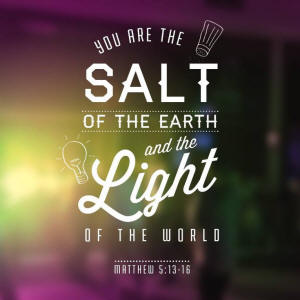
In our gospel reading this Sunday Jesus tells his disciples that they are the salt of the earth and the light of the world. He adds, “. . . your light must shine before others, that they may see your good deeds and glorify your heavenly father.”

If we were to witness the events of this passage being acted on stage, I think we would find them humorous: Jesus telling a motley group of puzzled followers, many illiterate, that they are the light of the world and when we hear the gospel passage in church on Sunday, we assume that Jesus is talking to those first disciples, surely not to us. But Jesus is talking to us in the same way  he spoke the Disciples  long ago. .Jesus used salt as a metaphor to describe who his disciples are and how they are to be in the world. Just as salt draws out the flavour of food, so  we as Jesus’ disciples we are asked to draw out goodness in the world. As salt of the earth we may even have to upset the way things are and how life is ordinarily carried on – the usual “salty taste” of daily life in the world these days can be so topsy turvy as recent events have shown in America and other places as well. Jesus tells his disciples, “You are the light of the world.” They are to be seen, not hidden away they are called to be the light overcoming the  darkness of our world and its peoples.

We in our own time are called to be the “light of the world,” each one of us a tiny ray of light, dispelling darkness, living in charity toward all, including persecutors. This light is an inner light the light of faith . Its source is divine grace that becomes visible to others by our kind words, our gracious acts, our personal refusal to resort to “oppression, false accusation or malicious speech.” And thus, as Isaiah promised, the gloom of sin and death shall be overcome, or as the psalmist declares, justice and mercy of the upright will be a light shining through the darkness. Christ gives us a huge amount of latitude and invites us to carry out our role as his representatives with the maximum level of personal responsibility. We are invited to utilise our own special gifts and talents to inform our role of being a disciple who is the salt of the earth and the light for the world. So let us turn to Jesus the light of life today, let us pray that we might share in his life, so that we might be the salt of the earth, and light in the darkness for all  the people in our world still groping around for light  in darkness of their lives.

4TH SUNDAY IN ORDINARY TIME

beatitudes

This weekend we continue our journey of faith as we hear the beatitudes. The first Beatitude strikes the keynote also for the seven Beatitudes that follow. The decisive word in this first Beatitude is the word, poor The first recipients of the Beatitudes are, in fact, the ‘poor in spirit’, an expression that indicates those who have their hearts and consciences directed intimately to Our Lord. They are the expression of the just who are tried by moments of suffering and difficulties. However, they are called ‘blessed’ and ‘happy’ because God’s merciful and compassionate gaze rests on them. These are the poor that the Bible text really refers to. The poor in the Bible are the humble people  who bear a burden on their shoulders. They are given God’s favour and because of this the Word identifies them as just, meek and humble. All kinds of attitudes are included in the eight beatitudes. This way the true significance of the ones who don’t confide mainly in themselves but in God. The poor are those who detach themselves concretely and interiorly from the possession of people and things and above all of themselves.

The poor don’t find security in the gods of this world like success, power or pride but the true Lord God in Heaven. Those who are called “blessed” or “happy” in these beatitudes can hardly be described as fortunate or lucky people in the eyes of the world: the lowly, the mourners, those deprived of justice, those who are persecuted and abused. In structuring the beatitudes in the way he does, Matthew is not offering an unusual programme to happiness; rather, he is describing what happens to Christian discipleship when the kingdom breaks into this broken world. The beatitudes speak of a variety of experiences that disciples undergo as a result of their involvement in living the Gospel. The result of this involvement might appear to the world as senseless suffering, but Jesus heaps blessings on those who struggle to love the truth of the Gospel.

Discipleship is centred on Jesus. Because of who he is, others will change. Jesus alone is the source of discipleship. Without the person of Jesus, discipleship is meaningless. All of us have some experience of the cost of discipleship. Some will know what it is like to be counted as a nobody because of our fidelity to Jesus. As Christians we are pledged to share the wisdom of one who was counted a nobody himself. In doing that we will continue “to shame the wise” by declaring the foolishness of God, remember that gods foolishness is wiser than human wisdom. The beatitudes of this Sundays Gospel are all about the mercy of God which Pope Francis in our own time is all about, Do we have the attitude of mercy that is the attitude of the Beatitudes or are we happy to be as we are instead of being merciful in our dealings with other people?


THIRD SUNDAY OF ORDINARY TIME

d1

These days we seem to live in weird and wonderful times at the start of this week we heard the British Prime Minister outlining the Brexit or at least putting a wee bit of meat on the bony skeleton of the UK leaving the EU. Then on Friday we had the inauguration of President Trump as the 45th US president how the world is continually changing hopefully for the better but who knows things really are in the hands of God. The Sundays of Ordinary Time lead us through the three years of Christ’s public ministry. We began last week with his identification as the Lamb of God by John the Baptist and this week we hear how he called the Apostles to follow him. In our Gospel story this Sunday we hear about Jesus calling Andrew, Simon, Peter, James son of Zebedee and his brother John to follow him. As Jesus travelled around Galilee, he actively built a following. Biblical scholars speculate that the Galileans would network and form groups around social, economic, or religious issues. Even though the Romans put down revolts with brutal efficiency, large Jewish protests did sway official decisions, especially at the local level. There was strength in numbers. Part-time fishermen like Peter and Andrew, like James and John would easily leave their daily tasks, if the group they joined promised to protect and enhance their way of life.

Proclaiming the Kingdom was a message with political undertones for Jews and Jesus quickly amassed an audience. This gospel story is about the call of Jesus to the first apostles to be his followers. This gospel story is not just an echo from the past it is very much for us today as it was yesterday. Are we listening to Jesus saying to us today, “Come follow me and I will make you fishers of men?”   This Gospel also asks us to remember that our own personal vocation is  an absolutely free choice to make.  This means that we are totally free to accept or deny the  invitation for us to take up the vocation that is there for us. Some are called to the Priesthood, or Consecrated Life, others to marriage, others are called to a single life there are many other vocations in life all of the m are  different and yet they are all calls to holiness that we are given. 


May we experience the beauty of accepting the call with faith in God and acting on it.  In this way we will become like the first apostles who quickly responded, continued to learn during their three years walking with Jesus and the years afterwards during which, with the power of the Holy Spirit, they did what they probably never imagined they would do when first called; travelled to the ends of the earth. 


SECOND SUNDAY IN ORDINARY TIME

images-2

This weekend we have the second Sunday in ordinary time. Christmas and new year are a distant memory as we continue our spiritual journey. In the Gospel reading this Sunday we hear about the meeting between Jesus and John the Baptist at the Jordan River. The first Christian communities saw a clear difference between John’s baptism (that immersed people in the river Jordan) and Jesus’ baptism (that communicated his own Spirit, to cleanse, renew and transform the heart of his followers). Without that Spirit of Jesus, the Church would simply close up shop and die. Only the Spirit of Jesus can put more truth and life into today’s Christianity and lead us to recover our true identity, letting go of paths that lead us further and further away from the Gospel. Only that Holy Spirit can give us light and energy to fire up the renewal that the Church needs today so that we can also become Christ’s authoritative witnesses in the world of today.

A believer can only be an authoritative witness if he or she lives in harmony with two of the Baptist’s evangelical qualities. Firstly, knowledge of Christ that is cultivated through prayer, the sacramental and ecclesial life and good friendships.

Secondly, the constant attributes of the ‘bridegroom’s friend’ who goes in search of the Groom through the virtue of humility because always, in everyone’s life, Christ must increase and we must decrease! Pope Francis is quite clear that the greatest obstacle to a new surge of evangelization is spiritual mediocrity. He says so all the time. He wants to spark a process that is «more burning, joyful, generous, bold, full of love to the end, and full of contagious life», but knows it will be insufficient «if the fire of the Spirit doesn’t burn in their hearts». And the charge that is given to each of us is to be Christ’s authoritative witnesses to the people around us and the world. We have all been baptized; we have all been called to be witnesses  to Jesus the chosen one of god. We are asked to point away from ourselves to the lord; as we lead others to the person of Jesus. None of us comes to him alone we all know people who help us along on our own faith journeys.

Most people are moved when others share with them what really matters in their lives. Perhaps we have lost the courage to say any more about what matters to us as people who take faith seriously perhaps we doubt if anyone will care and yet so many do. We should take courage to share what we believe. With Blessed John Henry Newman, we know that we believe because we love. In the power of that love, Love of God let us share our belief with each other and everyone else as well.


THE BAPTISM OF THE LORD

images (2)

After the arrival of the Wise Men on the feast of the Epiphany on Friday we have come to the end of the Christmas season as we celebrate the Baptism of the Lord when Jesus was baptized in the river Jordan by John. This feast is also a reminder to us of our own baptism, most of us were baptised when we were babies and today we recommit ourselves to the promises that were made on our behalf when we renew our Baptismal Promises..

The figure of the Baptist is mysterious and captivating. He was the Precursor of Christ, not only two thousand years ago but in a sense also in our day. He is the voice, which makes us hear the Word which introduces us to the mystery of the redemption, who helps us to respond to the call to conversion, with humility and love. He helps us understand that the human person, every person in front of the Lord Jesus stands before the greatest mystery of our existence: the Mystery God made man! Our own Baptism calls us and empowers us to be Christ like that is what the word Christian means. Our humility can openly declare our trust in God the Father. The great medieval theologian Thomas Aquinas whose feast day is at the end of January spoke of times of grace when God enlivens people in special ways for different tasks and this is what baptism is all about the grace of god enlivening us to live out our new beginning  living life as people who are Christians.

The Holy Spirit is the power behind all our spiritual beginnings, when we are willing to begin, God is there as the grace  behind our going out into the sea of faith. There are beginnings that we know are important like baptisms, marriages and ordinations. We like to mark these beginnings as important, so we surround them with ceremony to give a sense of occasion and there is an atmosphere of rejoicing. The new beginnings that we make in our own lives may not mark the fulfilment of anyone’s prophecy, but they probably mark the fulfilment of someone’s hope. Sometimes we are so hesitant about making a new start that we end up in no-man’s-land waiting for more weather reports wondering what to do instead of getting on with it. This weekend as we think about our baptism we stop and think about our journey of faith as we celebrate beginning of Jesus ministry, we look at our own beginnings.

And if some of them look a bit shabby now or half-hearted, we take consolation from the Gospel challenge to begin again. There probably won’t be any doves flying or voices from heaven, but as people of God we make our beginnings like Jesus with the help of the Holy Spirit. We are not alone. We make them in the power of the Spirit and in the love of the Father. So let us take courage to face our own rocky roads as the new year unfolds before all of us.


MARY MOTHER OF GOD

images (1)

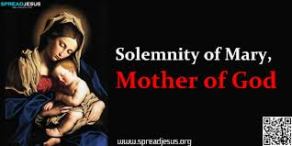
This Sunday January 1st we celebrate the Solemnity of Mary, Mother of God, as well as this we also celebrate world day of prayer for peace. In the modern Roman Calendar only Christmas and Easter have an octave. This Sunday it is the turn of Our Lady as we celebrate her as the mother of God. At the Council of Ephesus (451), Mary, the mother of Jesus was proclaimed as  Mother of God or Theotokos. Under this noble title she is still honored by most Christians around the world, and today’s feast invites us to lay our hopes and plans for the new year in her motherly care. We entrust all our concerns and those of our world, with all its conflicts and injustices, to her motherly protection. on the feast of the Holy Mother of God we see Mary marveling at what has happened, treasuring the events of Christmas in her memory, and pondering them in her heart. The image is that of the contemplative woman who ponders the marvels the Almighty has done for her. Mary treasured the words of the shepherds in her heart, for they were Good News. She was the vessel of God’s providence; she conceived by the power of the Spirit. Her Son was Messiah and King. She was the first follower and a symbol for all of us, the Church. On this feast we ask a special favour of Mary our mother and intercessor:  that the love we have for Jesus her son will Grow in our hearts and lives!  As We thank God for all that has been over the last year and look forward to all that will be we pray  through the intercession of our Lady that God  will be present with us in the good bad, happy and sad times we might encounter in the year that is ahead .


CHRISTMAS 2016

latest-religious-christmas-cards-hd-images-pictures

As we come to our celebration of Christmas this year the world is such a different place. In the UK referendum the people unexpectedly voted for the Brexit. Then a few short months later the USA voted unexpectedly for President Trump how the world has changed and of course the world is constantly changing. We are all panicking about what might or might not happen in the places where we live and how the world events will impact on us and our families we will have to wait to see how everything turns out. Preparing for Christmas is often a very tense time with extra hours at work, standing for hours on the queues at the shops as the craziness goes on around us. For a great number of  people Christmas is not all it seems as they deal with the stresses of not being able to provide a good time for the members of their families. Or for many they may find themselves refugees in foreign countries.

As we think of our own families we also spare a thought for  the poor, the neglected, the lonely, the victims of disaster and war.  Now after all the preparations and fuss of recent days we have time to think about Christmas and what it is all about, time to ponder on the fact that the birth of the Baby Jesus is the supreme manifestation of God’s love for humanity. Our salvation came in the messiness, poverty, and the weakness of ordinary human life that is to say our ordinary often times messy lives. Jesus was born in a stable not a great palace or mansion he was welcomed by the shepherds this hardly seems like a very auspicious beginning for the dawn of salvation! Yet, we have hope because Jesus was born into the Family of humanity with all its messiness. Christ came and brought new hope and transforming joy for all. In the middle of our own dark nights of pain and anguish, God comes and transforms them into “holy” nights of his peace.

Amid the noise and clamor that that are part of our lives, the voice of God speaks to us in the “silence” of our hearts. The first news of God’s coming to us does not go to the wealthy or those in high political or religious positions but to the  lowly shepherds, who had no wealth, power, or privilege by any standards they were a scruffy bunch. God to whom all riches belong wants to be sure that the poor and lowly are the first to hear about the arrival of the messiah. The shepherds used to being left alone during their long, dark nights in the fields where they watched over their flocks were terrified at the appearance of the angelic mes­senger surrounded by the glory of God.  Who told them Do not be afraid; for behold, I proclaim to you good news of great joy that will be for all the people. For today in the city of David a savior has been born for you, who is Christ the Lord” (Luke 2:10-11).The angel’s message to the shepherds is also for us in the here and now of today It simply states the good news of the birth of the Son of God into our lives. During these days of  celebration we will have occasion to sing as the angels did long ago, “Glory to God in the highest!” At this time when we celebrate the birth of “a saviour who has been born for us”, the One who is “Wonder- Counsellor and Prince of Peace,” the One who is “a great light”  we welcome the opportunity to put aside our cares and worries for a short while in order to bask in the joy of the season, and give Glory to God as we celebrate the birth of Jesus Emanuel who is God with us. Now with Mary and Joseph with the shepherds and Angels Let us take this story and the news of great joy into our hearts and let the joy and peace flourish within us as we pass this joy on. Let us be thankful for the light that is Christ the light of the world.  Let us hold this simple story of Jesus birth in the Manger in our hearts throughout the year whatever ups and downs it may bring.

Post Navigation