Fullerton T

RELIGION LITURGY AND LIFE

14TH SUNDAY IN ORDINARY TIME

images (2)


This Sunday’s Gospel tells us about Jesus appointing the 72 others and then sending them out in pairs to the towns he was going to visit. As he gives his missionary instruction Jesus seems under no illusion about the territory compared to the wolves roaming around, his own crowds are like lambs. He tells the 72 to lead the radical lifestyle of the wandering preacher who must face homelessness and renunciation of family and property. When they enter a house they should bless it with peace. The Gospel also tells us about the practical things to direct the seventy-two as they proclaim the Good News of the Kingdom and in rebuilding community life. Jesus told them to carry no purse, no haversack, and no sandals. Proclaiming the Good News of the Kingdom and rebuilding community life are two sides of the same coin. One does not exist and cannot make sense without the other.  When Jesus sends out the seventy-two you might wonder how ready they are for the demanding task ahead of them. Because he doesn’t have all the time in the world Jesus depends on the various talents of his followers; he must depend on their understanding and their resolve to get it right.

Perhaps if we were in charge of that first Missionary outing the seventy-two would still be waiting to get going! There is a clear urgency about the task in hand Jesus says, “Start off now” with urgency in his voice. On their return the disciples were delighted that their mission has actually worked! Their joy demonstrates that people do welcome the word of God and that the word of God is their real resource for mission. Jesus counsels them to rejoice not because their mission has worked but because their names are written in heaven. These words at the end of today’s gospel are addressed to each one of us. Jesus empowers us in our day to do his work, and to work in his name. Jesus assures us that we have a passport, visa, and “green card” for heaven. Our names are already registered there and our mission is to proclaim the good news of salvation to others.
12TH SUNDAY IN ORDINARY TIME

images

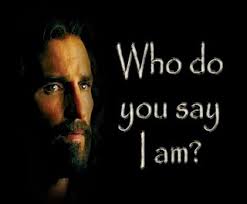
There is great uncertainty in the life of our nation these days. Polls show not only a general distrust of leadership and institutions as they battle it out to stay in the EU or make a BREXIT. The polls also show a breakdown in a general belief of progress. The mood in the country is bleak because we see so much loss of life first of all in Orlando and then the murder of Joe Cox MP as she went about her work during this week there just seems to be a lot of suffering at this time in so many places in the world. In our Gospel reading for this weekend we hear Jesus asking ‘Who do the crowds say I am?’ And the apostles answered, ‘John the Baptist; others Elijah; and others say one of the ancient prophets come back to life.’  He then asked his disciples the same question as he wanted to know who they thought he was and so he asked them who do you say that I am? It was Peter who spoke up and said ‘The Christ of God’. But, given the popular overtones of this title within a tradition which spoke of triumph rather than suffering, Jesus insists that he has to suffer for his identity. It’s not that Jesus plans it; rather, he knows that suffering is inevitable if he is to face the future honestly. And he states further that those who become his followers will have to suffer for their identity like their master.

The fact that the disciples still followed Jesus is a measure of the continuing impact that Jesus has on them. The disciples are not following someone who is programmed for failure: they are not idiots. They follow someone they sense is not kidding them; someone who faces real situations that are part and parcel of life with enormous courage and commitment. Every commitment to love means a willingness to suffer for a while. And it’s that kind of commitment that Jesus still expects of all who follow him. Over so many years we have seen so many people perhaps family members friends or other people leaving or at least not practising the faith. The questions for us who are following Jesus today are who do we say Jesus is and how do we make the Jesus of the Gospels alive in the lives of those around us. Many  people who have left the faith blame this priest or that scandal within the Church for leaving but when hardy comes to hardy the Church must face up to its own shortcomings and that includes you and me as members of the church.

In the face of the dark anxiety of these and other days, more people pray and attend weekly worship. While polls show faith in the secular world might be down, they also record and remind us that faith in God rising. The polls show that people need to place their faith in something. When the world lets them down, they return to God. I think it is the same for all of us there have been many occasions that I have felt down but I have been lifted up by the Faith that I have. All of us are asked to take up our crosses and follow Jesus as best we can and remember that none of us will be able to avoid the many crosses that will come our way. Yes, it might be tough to pick up the cross and follow Jesus day by day. But, in doing so, we who follow grow closer to him because we begin to understand his walk to suffering and death. We realize that he understands our troubles. We begin to realize we have a friend and fellow traveler in the Lord who does not let us down whether we are near the Church or even far away.

11TH SUNDAY IN ORDINARY TIME

download (3)

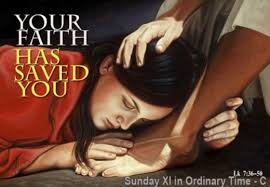
This weekend we celebrate the 11th Sunday of ordinary time and our Gospel Story tells us about the woman with a bad reputation. Having said that we also hear about the attitude of the Pharisees in this gospel or should I say the wrong attitude of the Pharisees. In this Sundays Gospel story Jesus is at the house of a Pharisee, one of those who emphasized love of law rather than the law of love. It was certainly no place for a public sinner to show his or her face. The woman who did show her face was outside the pale, of a group despised by devout Jews. Jesus frequently said that he had come to call sinners, and to befriend them. Not only did Jesus befriend the woman, but he even let her serve him. There was something about him that stirred a profound reverence within her, and she showed that reverence and respect by the anointing with oil, which was the highest expression of reverence one could show to another. Jesus had a ready-made, real, living object lesson right there, and he took full advantage of it. He was aware of the shock and horror among the onlookers, and he used the occasion to drive home a central point of his teaching.

Why did a woman with a bad reputation approach Jesus and anoint him with her tears and costly perfume at the risk of ridicule and abuse by others? The woman’s action was motivated by one thing, and one thing only, namely, her love for Jesus – she loved greatly out of gratitude for the kindness and forgiveness she had received from Jesus. She did something a Jewish woman would never do in public. She loosened her hair and anointed Jesus with her tears. It was customary for a woman on her wedding day to bind her hair. For a married woman to loosen her hair in public was a sign of grave immodesty. This woman was oblivious to all around her, except for Jesus and her gratitude for the mercy he showed towards her. There are two other lessons in this Gospel reading for us. The first lesson is that the pardoned sinner should show gratitude to God. One of the greatest proofs of gratitude is the firm resolution to avoid offending our God. The second lesson is for those amongst us who succeed, thanks to God’s grace, in avoiding serious sins is that we must avoid the sin of the Pharisees. They were, on the whole, devout men and did many a good deed. However, they took all the credit themselves instead of giving God the credit. They grew proud of their good works and despised all others who did not do as they did. The question for us this weekend is who are we like in this particular story are we like the woman who loved Jesus with a heart open to god’s mercy. Or are we like the Pharisees taking all the credit and giving God little or even none at all with our hearts closed to the love and mercy of God.  I would hope that we would be like the woman in the Gospel who wasn’t afraid to show her love for Jesus despite all that was going on around her at the time.


Corpus Christi

TN_eu01

In our Gospel story this weekend we hear the story of the feeding of the five thousand. The readings and the feast itself are full of richness. Jesus fills us with nourishing food, We are sent out to proclaim the good news of God’s kingdom to all around us, in doing this we provide food for others. Like the circulation system of a body, the Word and the Eucharist continue to live in our communities and in the world. The Eucharist  or the Bread of life is the sacrament of thanksgiving and spiritual journeying. When we see the Eucharistic Bread, we believe that it is Jesus who is there before us such is our faith in the Blessed Sacrament.  

The Church tells us that the Eucharist is “the source and summit of the Christian life.” (CCC 1324)  At the Eucharist God sees our hunger and feeds us through Word and Sacrament. We offer our prayer of thanksgiving. Remember, the crowd was first taught, healed and then fed. Their hungers were both spiritual and physical. Now it is our turn, well-nourished disciples, to find ways to address the physical and spiritual needs of the hungry we have noticed along the way. These needs can seem overwhelming. But, as with the bread and fish in the gospel story we take what the Lord has given us and give it freely to others. He will do the rest and all will be satisfied. The meal is also a promise: one day we will sit at the banquet feast where there will be no more hunger, no more illness and our satisfaction in God will be complete. Corpus Christi is the solemn commemoration of the institution of the Eucharist on the first Holy Thursday in the upper room. It is the Church’s act of homage and thanksgiving to Christ, who by instituting the Holy Eucharist gave us the members of the Church our greatest treasure.


TRINITY SUNDAY

images

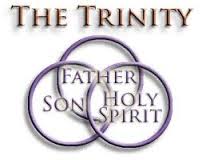
This weekend we celebrate Trinity Sunday which is all about the triune god Father, son and Holy Spirit. When my Father was alive he  often had a small tin of oil which was called three in one oil and it reminds me what the trinity was about  that is three divine persons in one. The Father is equal to the Son and the Son is equal to the Spirit three in one and one in three we hear this in the breastplate of St. Patrick. Saint Patrick, with a brilliance that we Irish are justly celebrate found in the three leaf shamrock rising from the one stem an image of the Trinity, father, son and Spirit one The feast of the Trinity goes back to 12th century England and St Thomas a Becket, Archbishop of Canterbury. Historians say the great Thomas celebrated a Liturgy in honor of the Trinity in his cathedral. So the observance was born. In the 14th century, the feast came to be observed by the universal Church.  We open each Liturgy especially the Mass invoking the Trinity . We close Mass and so many other liturgies by calling upon the Father Son and Spirit in blessing us as we go out into the world.

Throughout the Christian world infants will be received into our faith communities  through Baptism in the name of the Trinity. The Christian belief that God is a trinity helps underscore how rich the mystery of God is and how our experience of God is always richer than our concepts and language about God.  The doctrine of the Trinity affirms God as loving and knowing, giving and receiving.  When the Church celebrates the Feast of the Most Holy Trinity, it is an attempt to summarize the whole mystery of our God into one day.  This is not just a “theological feast” ` but a feast which should speak to us of this simple fact of faith: the Father loves us, has revealed that love in his Son, and has called into a relationship sustained by the Spirit. Each Trinity Sunday, we only scratch the surface of this great mystery of our faith. In gratitude and faith, let us begin and end every prayer with greater faith and reverence “In the name of the Father, and of the Son, and of the Holy Spirit. Amen.”


PENTECOST SUNDAY

ComeHolySpirit

This Sunday we celebrate the decent of the Holy Spirit upon the Apostles which heralded the beginning of the apostolic mission to bring the Church to the world at Pentecost. It is the birthday of the church so maybe we should sing happy birthday instead of Veni Creator Spiritus and blow out the candles on a birthday cake instead of blowing out the paschal candle because it’s the end of the Easter season!! With the feast of Pentecost the seven weeks that is the 50 days of the Easter season have come to an end with the outpouring of the Holy Spirit, manifested, given, and communicated as a divine person. “Peace” was John’s prayer for his readers as it is for us as we listen to this gospel reading on Sunday. With the sight of Jesus their fear turned into great joy, and their Anxiety turned into relief.

The lack of spiritual direction turned into a sense of deep spiritual grounding. The divine presence stood close to them and with the divine presence came a great sense of peace of spirit mind and soul. We too have the divine presence of Jesus in the Blessed Sacrament and it brings Joy and spiritual grounding to all those who come to meet him in the Eucharist. We can’t ignore our own or the problems  other people have.Most of the time the problems in our lives just don’t go away by themselves very often we need to stop and think and pray things through.  If we pray through the problems as well as thinking them through we will find that they are much easier to get through.  Simply put Prayer Moves Mountains but we must keep on climbing. Gathered at Mass week in week out we bring our prayers of intercession to God all of us have our own needs, Family and friends, someone we know may be sick, people need work.

Perhaps the person who has been in our lives for so long has died. We bring these and all our concerns in prayer to church because they remind us of our need and they raise our hope in the power of God made real to every generation through the Holy Spirit.  Through the Holy Spirit our relationship with God has satisfied our longings, and brings us the peace of God which is beyond all understanding. Because of God’s faithfulness, we give thanks, offer sacrifice, and once again present our needs this Pentecost Sunday as we remember the presence of God with us in all our lives through the good bad happy and sad times and we thank God for his enduring presence among us.


ASCENSION

unnamed (2)

This Sunday we celebrate the Feast of the Ascension. The Ascension marks the final part of Jesus ministry here on earth. During our lives whether we are young or old we will see the departure of many people. Perhaps it is a son or daughter leaving for university or maybe it was someone leaving to go to another country or the hardest departure of all someone close to us such as a family member father mother or whoever passing on to eternal life. Our lives are made up of so many different times and places of departure or leave-taking and this really is what Ascension is about the departure of Jesus to return to the Father.  The Apostles must have felt awful they knew that the time was fast approaching when they would have to say their final goodbyes as Jesus returned to the Father.

It marked the beginning of a new time when the apostles have to live in the absence of the Jesus they knew. They had to come to terms with the fact that Jesus will never again walk with them healing the sick and the wounded, preaching about the kingdom of God. He would soon be gone. But Jesus promised to be with them and by association with us through the working of the Holy Spirit the Advocate. Remember when Jesus began his public ministry he was first invested with the power of the Holy Spirit. In his baptism Jesus received power and authority from the Father through the experience of the Spirit. It was in that power, “Filled with the Holy Spirit” (Luke 4:1), that he began his public ministry. The Spirit marked the time of Jesus’ new beginning, his time of ministry, his time for reaching out to others and ministering to them. Luke closes his Gospel with the instruction of Jesus to his disciples that they are to wait in Jerusalem for the Spirit.

After this last instruction he blesses them and is carried up to heaven. The Spirit makes a new beginning for us as it made a new beginning for the Apostles at the very start of the church. The approaching feast of Pentecost is important because it is a memory of the beginning of the Church as well as a celebration of the Church of today.


6TH SUNDAY OF EASTER

download (4)


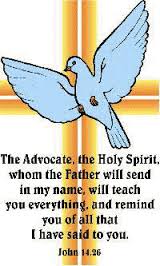
This weekend we celebrate the 6th Sunday of Easter. It seems no time since we began Holy Week on Palm Sunday and now we are heading into Ascension and then Pentecost Sunday which is often called the birthday of the Church. In this Sunday Gospel Jesus promises to send the Holy Spirit to the apostles as the advocate. Although Jesus had spoken to the Apostles and told them many different things, he knew them well and realized that they wouldn’t remember everything he said Jesus also knew that they would have to endure many struggles, that they would have to face ambiguity and confusion, difference and disagreement. They would not see eye to eye on everything; they would have different memories of Jesus; they would emphasise different things. In the conflicts that would arise they would have to put their faith to work. That is why he told them and he tells us that the Advocate, the Holy Spirit, whom the Father will send in his name, will teach you everything and remind you of all I have said to you. These words are a direct pointer towards Pentecost and the gifts that the Holy Spirit would bring to them as well as us.

We don’t have the physical presence of Jesus with us the way his first disciples did when he talked with them around the table at the Last Supper, washed their feet, and gave them his reassuring promises. His farewell to them was a real farewell he was going, he would no longer be with them as he had been. But he assured them and us that he is present in a different way, in his gift of the Holy Spirit. In the Gospel Reading Jesus also promised the Apostles Peace  ‘A peace that the world cannot give.’ Sometimes we mistake this peace for our idea of quietness or tranquillity, but the peace the Jesus gives is a peace that can be found even in the midst of turmoil. This peace is not something we can manufacture ourselves by our own power. It’s a gift that comes from Jesus, who doesn’t want to lose touch with us. Jesus chose his followers to carry out God’s plan of salvation. He chooses us today to do the same. By allowing us to participate in his work of redemption, he gives us a personal stake in the Kingdom of God. If we keep on trusting in the presence of the Spirit to us, we will have peace in the midst of any personal, family, or community turmoil that comes our way as well as someone who will keep us going along the right Road!

5th Sunday of Easter

download (1)

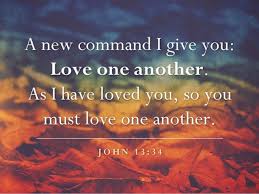
In this Sundays Gospel Jesus calls us to a new way of living when he tells us to love one another as I have loved you.  At one level this is a simple call to love, at another it is a big challenge for us to be Christ like  to others in this sometimes horrible world. This means that we should love as Jesus loves, in order to be the face and heart of Christ the face of the fathers mercy to a wounded and hurting world. It seems to me that our faith should constantly challenge us to live lives of love, love of God and love of one another and this ideal is so very hard to achieve. The love Jesus speaks of seems to be narrow and restrictive. He is addressing his disciples when he says, “love one another.” This love may seem insular and applicable just to an inner circle of his followers. Is he telling us that the sacrificial love he calls us to applies only to those around us in the Church? No, of course he is not saying that because we know from other parts of John’s gospel that Jesus’ mission of love includes an outreach to the world (John 10:16 I have other sheep, that are not of this fold; I must bring them also, and they will heed my voice. So there shall be one flock, one shepherd.)  That outreach in our modern times must include all those who have left the Church for many reasons we should not leave them behind as many people might want to do.

Jesus wants us to be united with him and one another in love. A loving and caring community has a great effect on others bringing those who might be doubtful with it. What more articulate proclamation of the gospel can there be than a group of diverse people drawn together, not by similarities in education, economic status, neighborhood, citizenship, race, etc, but by the love that God has for them and their bringing that love for one another to other people? A community such as this couldn’t help but draw others into it and to one who is the source of their universal love. We are called to be that community of love showing the love of God to those around us especially during this year of Mercy and at all other times as well.


4th SUNDAY OF EASTER Good Shepherd Sunday

SHEP


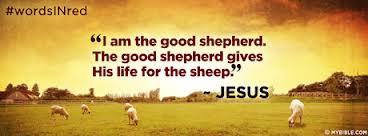
This weekend we celebrate the 4th Sunday of Easter which is also known as Good Shepherd Sunday. The idea of Jesus as the Good Shepherd is a lovely thought because it is a well known fact that the shepherd never leaves his sheep outside the sheepfold. If any are outside the sheepfold the shepherd will seek the lost sheep at all costs until they are found.  The wandering figure of the shepherd, anxiously tending his sheep to the point where he is willing to surrender his life for them, is the image Jesus uses about himself in this Gospel Reading. That mixture of tenderness and toughness, care and self-sacrifice, is one that summarises his own practice of leadership. It is not a leadership of detachment and defensiveness; rather, it is a leadership of physical involvement and self-sacrificial love. In the good shepherd’s foolish extravagant love, his own life matters less than that of his sheep as we know Jesus gave up his life for us on the cross Good Friday. 

The good shepherd is not an image of religious authority that is involved with its own importance, blind to the useless pain it causes in those it leads. The authority of the shepherd costs the shepherd, not the sheep. The image of the shepherd cannot be separated from how the shepherd actually cares for his own sheep. When we see how Jesus actually behaves as a leader, we see his tenderness and courage.   The parable of the Good Shepherd has many consoling truths and promises for people of every century, including ourselves in the twenty first. The good shepherd challenges our own way of leaving people for lost: remember that Jesus also said “I have come to seek out and save the lost.” All of us know people who have wandered away from the Church, who have lost their sense of belonging, who feel they have no community to belong to. How will they know they are welcome back if no one tells them? How will they be helped back if no one offers to make the journey with them?

This as we know is the Year of Mercy a year of return a year of journeying with those who want to return to God as well as those who believe. Turning our gaze to God the merciful Father, and to our brothers and sisters in need of mercy, means focusing our attention on the essential contents of the Gospel: As we celebrate the Jubilee Year of Mercy we are asked to place Jesus Christ, the face of the all merciful Father, at the centre of our personal life and that of our communities. As people of mercy we are asked to journey with those who are trying to return to the sheepfold as well as journeying along with our friends who are still there.


Post Navigation