Fullerton T

RELIGION LITURGY AND LIFE

5th SUNDAY OF ORDINARY TIME

SALT LIGHT


In today’s Gospel  passage Jesus speaks again in the present tense, “You are the salt of the earth….You are the light of the world.” It is very common these days, upon entering a church or religious institution, to see the community’s “Mission Statement” prominently posted. Usually, such a statement is the result of a prayerful dialogue by the community to arrive at a description of its identity and mission in the light of the Gospel.

At one parish some members of the staff told me their Priest  composed and published the statement without consulting members of the staff, parish council or parishioners. A woman said, “Since we didn’t have any input, how can we identify with and fulfill that mission statement? It’s not ours, it’s his She was right. But Jesus has that authority. Jesus’ mission statement to us, his followers, fits the requirement of a brief, focused and easily remembered summary of our task. Even those who don’t read much scripture can quote today’s teaching, “You are salt of the earth….You are light of the world.”

We are to be witnesses to the world. Jesus begins to describe the task for his disciples by using two images. We are to affect the world the way salt and light affect their environments. Salt seasons food, and in Jesus’ world, it was used as a preservative. It kept food from spoiling. Light removes or pushes the darkness back. Even one lighted match can be seen at a distance on a dark night. It doesn’t take much to have a surprising good effect when light is lacking.

With the salt image comes a warning. “But if salt loses its taste…it is no longer good for anything but to be thrown out and trampled underfoot.” Christians cannot merely co-exist and comfortably fit in we too could loose our saltiness and be trampled underfoot. We must change what needs changing. Remember the saying, “If it were a crime to be a Christian, would they have any evidence to convict you?” would the charges be against you and me be upheld and what exactly would we be convicted by? Hence, Jesus’ warning that salt can lose its capacity to season the food it is in and should be thrown out. We are sent on mission into the world to change it – not merely to live in it. Jesus tells his disciples that, though they are only few in number, they are salt.

The danger for the church is that, being in the world, we disciples can take on worldly ways and lose our “saltiness” to flavor those around us. We are called as Disciples to draw out goodness in the world by supporting what protects, nourishes and enhances life, while rejecting what limits or destroys it. For these and other positions of the status quo or the same old thing  “salty disciples” are to be agents of change. If we cannot bring about more humane conditions for all, then Jesus is right, we are salt without flavor and useless for his purposes of passing on the good news. In the Gospel reading today, Jesus, says to those who had just heard His teaching on the Beatitudes, “You are the salt of the earth … you are the light of the world.” In this passage, Jesus urges them not to “light a lamp and then put it under a bushel basket.” No, “your light must shine before others, that they may see your good deeds and glorify your heavenly Father.” We need always to look outward to those who are looking for light, as well as to those who have given up hope of ever finding it! As we hear the challenging mission Jesus gives us we can feel what those first disciples must have felt – we are not large or influential enough to affect the world and resist the powers that “run the world’s business.” On our own, that’s true.

But remember we are not on our own. Jesus began his words  with a reminder of God’s blessings here and now. At this Eucharist, through Word and Sacrament, we are again formed and reformed by God. We are called to be salt of the earth people and followers of Jesus whom God blesses and Jesus sends on mission. We strive, with God’s grace, to live out the gospel mission statement Jesus has enfleshed by his life, death and resurrection.
The Presentation of Our Lord in the Temple


MAY THE LIGHT OF CHRIST LIGHT UP THE PATHS OF OUR LIVES

In terms of the Liturgy there’s a lot going on this first Sunday in February and that’s right you did read February TIME IS PASSING US BY.  Like so many festivals in the church living in the northern hemisphere, a lot of liturgical celebrations centre on seasons and weather. This year especially, we are very inclined to pay attention to changes in the weather as it has been so very bad but at least we haven’t had temperatures of minus 55 like those who live in parts of Canada.

This Sunday we celebrate a major feast of Our Lord, The Presentation. This feast is also known as Candlemas Day, since traditionally candles used in the Liturgy were blessed on this day, with a solemn procession in which all carried lighted candles before the Mass. Forty days following the birth of a child, a Jewish mother, having been “purified”, came into the Temple with an offering to the Lord. Since every child belonged to God, the parents would “buy back” their child. Poor people, like Joseph and Mary, were obliged to bring only two inexpensive birds, like turtledoves or pigeons. This feast was first observed in the Eastern Church as “The Encounter.” In the sixth century, it began to be observed in the West: in Rome with a more penitential character and in Gaul (France) with solemn blessings and processions of candles, popularly known as “Candlemas.” The Presentation of the Lord concludes the celebration of the Nativity and with the offerings of the Virgin Mother and the prophecy of Simeon, the events now point toward Easter.

“In obedience to the Old Law, the Lord Jesus, the first-born, was presented in the Temple by his Blessed Mother and his foster father. The Christ Child is revealed as the Messiah through the canticle and words of Simeon and the testimony of Anna the prophetess. Christ is the light of the nations, hence the blessing and procession of candles on this day. We Christians stress our communal worship, especially our Sunday Eucharist. But we are also encouraged to take our faith home with us. In numerous ways we learn in our homes what we express each Sunday when we come together for Mass that we are the body of Christ. We are a family, Gods family who are nourished by our God through Word, Sacrament and one another. Our Faith is a treasure beyond price, by the strength of which we stand boldly against the winds of fad and fashion. May we be the light of Christ to all those we meet as we move forward in faith that is faith in God and in one another with our pathways lit up by the light of Christ.

3rd Sunday year A

I WILL MAKE YOU FISHERS OF MEN

FOLLOW ME AND I WILL MAKE YOU FISHERS OF MEN

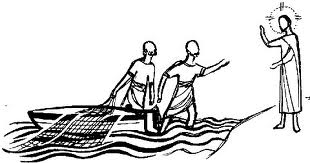
The whole thrust of this week’s readings are about the call of Jesus to Peter, Andrew, James and his brother John to follow him as disciples. The great words that Jesus spoke way back then “Follow me and you will be fishers of men” have resonated throughout the ages as many people have taken up the call of Jesus .

When Jesus heard that John the Baptist had been arrested, he left Nazareth and went to Capernaum. Herod Antipas was ruler of this territory, Galilee of the Gentiles, regarded as a region of God-forsaken pagan ways. It is here that Jesus goes to take up what is now the dangerous mission of John, to proclaim the coming of God’s kingdom.Jesus then proceeds to call Peter, Andrew, James and his brother John to follow him as disciples. Through Jesus, what has been spoken through the prophet Isaiah is at last fulfilled: “. . . the people who sit in darkness have seen a great light, and on those dwelling in a land overshadowed by death light has risen.”

The light becomes an efficacious means to express God’s involvement in human history. God manifests Himself as ‘The Light’ that disperses the darkness. The light illuminates, encircles, defines things, emphasizes the colours and gives depth to space. The light heartens and comforts: to be in an enlightened place helps us to accept reality for what it is and makes one feel happier, more certain and protected. A joy and happiness that became real in Jesus’ presence. He is the promised light that has come into our midst, His physical presence that expresses the definitive arrival of the Light. The light that shines brightly marks God’s initiative performing His first merciful and free step towards a wounded humanity.This dynamic is expressed through Jesus call of the first Apostles. He chooses them with an unequivocal call, ‘Follow Me’. Faced with God’s sudden interruption in their lives He invited them to abandon the nets and trust themselves totally to the Lord for a new ‘catch’, a new definitive horizon. At the Last Supper, the end of His earthly life, Jesus reminds His disciples ‘you did not choose me, no, I chose you’ (Jn 15:16).

 This Sunday’s our  Gospel invites us to remember that our personal vocation is founded on God’s original and absolutely free choice.  This means that we are totally free to accept or deny his invitation to us to take up the vocation that is for us.  Let us ask the Lord, for us and the whole Church, for the gift of a true conversion of our hearts enabling us to receive Christ as the only Light to follow. Christ is the only one that really dispels the darkness within and around us.

2Nd Sunday Ordinary Time

Well here we are at the second Sunday of Ordinary time. As our lives grow more pressured, more tired, and more restless, perhaps more than anything else we long for “ordinary time,” quiet, routine, solitude, and space away from the hectic pace of life. The lights of Christmas and Epiphany have all faded. We’ve come from last Sunday’s feast of the Baptism of the Lord into seven weeks in “Ordinary” time. Watch out!  Ordinary time in the liturgy never means going back to “business as usual.” Last Sunday we celebrated the gift of baptism, and now this Sunday we hear the words of  John the Baptist. In The Gospel reading for this weekend we hear  the words of the man who went before the Lord as he says “Behold, the Lamb of God, who takes away the sin of the world!”  We know these words, so well for we hear them in Church when we are just about to receive the Body and Blood of Christ during the Eucharistic celebration. 

There’s a lot of talk these days in our church about the “new evangelism.” Evangelism is not a notion we Catholics have always claimed as part of our Christian identity and activity. We, like John and Andrew, are supposed to bring others to Christ. Each of us in the church has this responsibility – not just the Priests deacons or religious. In one way or another, like John, we must also announce, “Behold, the Lamb of God.”

We squirm uncomfortably when we attempt – if we ever do attempt – to tell our faith story to others. But our baptism links us to Jesus and to the long line of his followers, who believe Jesus is the Lamb of God and that his death and resurrection is the source of new life for all peoples. We then, are to be like God’s servant in today’s Isaiah reading, “a light to the nations.” Or, to use the seldom spoken, we are to be “evangelists” That is people who get out there and tell the message to those around them about Jesus the lamb of God. 

John promises Jesus will baptise with the Holy Spirit. And so he did, for we received his Spirit when we were baptised and confirmed. Perhaps that Spirit will help us overcome our shyness and hesitancy to speak to others about who Jesus is for us. Most likely, we won’t have to do that from a soapbox in the town square. Probably the Spirit will guide us to share in more personal ways how we have come to freedom, peace, joy and hope through our faith in Christ. We remember that Ordinary time in the spiritual sense never means going back to “business as usual” it means that we are always ready to change and not be afraid to be people of faith. As we continue our faith journey during the next few weeks of Ordinary Time that take us up to Ash Wednesday let us remember that Jesus the Lamb of God is with us. 

The Baptism Of The Lord

images (17)

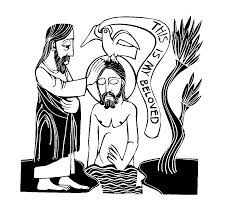
This Sunday we celebrate the baptism of the Lord, when Jesus was baptised in the river Jordan by John. None of us remember when we were baptised when we were infants but that said we may have known and Adult who was baptised.  It may seem strange, but this is a Christmas Feast. Not if we think of Christmas only in terms of the Baby in Bethlehem, but if we have followed the ideas of the Feasts of Holy Family and especially Epiphany, and have seen the Season in terms of the growing manifestation or appearing of the Son of God: first to the shepherds and then to the wise men from the East. Now in the River Jordan, Jesus, Son of Mary, is revealed to all and everyone as the fullness of all God’s promises: “This is my Son, the Beloved“. 

Just as Jesus entered the Jordan to be baptized, so he enters our scene of darkness and confinement in our lives today. He is the one promised us in the prophet Isaiah, the one who will “bring out prisoners from their prisons.” He comes to those hidden places that keep us locked up. He goes to the imprisoned areas of our lives and our restricted ways of behaving which we sometimes excuse by saying, “That’s just the way I am.” Rather than be a cheerleader on the sidelines, Jesus comes down into the dark places where we are. He helps us face the shadows and hidden places and leads us out – just as God promised God would do for us through the prophet Isaiah. Jesus’ baptism reminds us today that, through our own baptism, we are united to him. Most of us rarely, if ever, think about our baptism. Through our baptism we died with Christ and thus have been reborn into a whole new life ( Romans 6). We, the baptized, are incorporated into the body of Christ. We are called and enabled to imitate Jesus, whom Paul says, “went about doing good.” We don’t need a detailed rule book in order to know how we should act in each situation of our lives, for in baptism, we have the companionship of the Spirit of Jesus who is our wisdom, impulse and help to do good.

 Some treat Baptism as a private family event only. They even insist on a baptismal ritual separate from the ones celebrated at Sunday Mass or on Sunday afternoon. They don’t appreciate that Baptism is not a private, but a public affair. Jesus didn’t insist that John baptize him further up the Jordan River with only his mother and a few family members and friends present. Jesus’ baptism was public – and so should each Christian’s be – a public ritual for people who are called to live their Christian vocation in public ways. There is little that is private about our vocation to follow Christ Our role as baptised Christians has some of the characteristics of St. John the Baptist in that we also are to prepare the way for Christ, not only in our own lives, but in that of others. We do this by the example of how we live our own lives and by teaching informally when the occasion arises. If we are doing this, we can ask ourselves, “Does this role bring us joy as it did St. John the BaptistIn a world that celebrates life achievements mostly for celebrities, the church rejoices at the baptism of a person into the church as well as into their own unique relationship with Jesus, as they are sealed and marked as Christ’s own forever. Take a moment now and reflect on where your baptismal journey has brought you. What have you done as a result of your life in Christ? How has Jesus led you to use your talents and gifts for righteous actions? What has been joyful for you on this journey? Then look around at your sisters and brothers, and give thanks that together we  can celebrate our life in Christ and look forward to further adventures in the life of faith.


The Second Sunday after Christmas in some countries Epiphany

download (1)

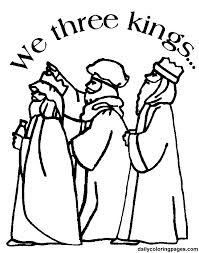
Yes you did read the heading correctly it is the second Sunday after the feast of Christmas and we are now almost  at the arrival of the Three wise men on Epiphany which takes place on Monday 6th January or in some countries on Sunday the 5th.  By long standing sacred tradition Christians celebrate Christmas as a season, with the twelve days between Christmas and the Epiphany as one long “Christmas feast.” The season ends with the Baptism of the Lord which is also the first Sunday of ordinary time and that takes place next Sunday.

Epiphany means manifestation. What the Church celebrates today is the manifestation of our Lord to the whole world; after being made known to the shepherds of Bethlehem He is revealed to the 3 kings  who have come from the East to adore Him. As Christians, we will very often find ourselves living in contradiction to the styles and preferences of the present age. The present age which presents I want I get as the normal thing. Regrettably we have to get used to the fact that we will face conflict among friends, and even at times within families, as we seek to live out and the Christian life more generously in word and deed.

 May we not be afraid in the year that has just begun to seek the wisdom that God wants for us, that is the wisdom and the light of faith so that we will have the wisdom of the three wise men to follow the star which is Jesus the light. 

FEAST OF THE HOLY FAMILY

THE HOLY FAMILY

This weekend  we celebrate the feast of the Holy Family which is the name of the parish in where I live. Just four days ago we celebrated the birth of a tiny Baby, surrounded by the ethereal angel choir, greeted with awe and adoration. Today, we commemorate a family in deep stress because their Son  is seen as a threat to a jealous king: Joseph and Mary are running for their lives from Herod the Great. Tradition says that after three years in exile, another angel informs Joseph that Herod the Great is dead. The Holy Family returns to their homeland, not to Bethlehem, since the new King Archelaus who reigns in his father’s place is also a cruel and barbaric ruler. Joseph brings Mary and Jesus to his native town of Nazareth in Galilee. There, they lived a simple ordinary life, Joseph as a carpenter, and Mary as a housewife and mother. Jesus grew in holiness and in knowledge of God’s will in the same ordinary ways that families do in our day. How their lives resemble the modern scene in Egypt, Jordan, and Turkey as well as in other countries as thousands of Syrian refugee families struggle to stay unified! The scene is repeated in many other countries as well. Families on the run with a few possessions loaded onto a tractor and cart, or on foot, move out of their native land to seek refuge wherever they will be tolerated. Most homes are abandoned and will probably be looted and vandalized. It may never be possible for these people to return to their homelands. Add to this the thousands of broken families, broken by divorce, , or abandonment by one or the other parent, and we may well wonder what is “normal” for the word “family.” Pope Francis is deeply concerned with these threats to family life. He has started the process for an extraordinary synod of Bishops to meet in 2015 to determine how the Church may help remedy the current situation.

St. Paul, in Colossians, gives families, both our own individual families, and the wider family of the Church, a surefire formula for success. We are to act with “heartfelt compassion, kindness, humility, gentleness and patience, bearing with one another and forgiving one another.” Who would ever want to escape — whether Dad, Mom, or teenager — from such a happy home?

As we think about the Holy Family we remember the care that Mary and Joseph gave to Jesus. We recognize the sacrifice they made for Jesus, in the same way as we recognize the many sacrifices our own parents made for us  and many more  are making for their children today in our I want what I want and  I get what I want world.   Our families would find the disagreements, stressful relationships, and resentments that spoil the joy of family harmony so much easier to solve by imitating the faith and loving trust of the Holy Family.

 “Lord Jesus, you came to restore us to unity with the Father in heaven. Where there is division, bring healing and pardon. May all peoples and families find peace, wholeness, and unity in you, the Prince of Peace and Saviour of the world.”


CHRISTMAS 2013


Well, here we are approaching the big event that all the preparation has been leading up to, but  the even bigger question is this, “Has all our preparation been about tinsel and glitter without anything else, especially the spiritual preparation that the Advent Season calls for?” That is the same type of spiritual preparation that we are called to undertake during Lent when we prepare for Holy Week and Easter. Many people forget the real reason for Christmas as the secular preparations overtake and often undermine the Spiritual reasons which are much more important than the externals of tinsel and glitter.

 Preparing for Christmas is often a very tense time with extra hours at work, standing for hours at the end of queues at the shops as the craziness goes on around us. And spending more time with families and friends can be an endurance test in many ways to say the least!! Having said this, we need to remember that for some people Christmas is not all it seems as they deal with the stresses of not being able to provide a good time for the members of their families.

 We need to remember that in many houses throughout the country things are not as good as they might be or they might have been in the past. Children are not unwrapping the presents as they have none. Many families are not preparing to sit down to a big Christmas dinner because they are going hungry again.  People have lost their faith, faith in God and man. Many others sit in dark despair, wondering where exactly the light will come from and who will bring it to them. And it simply put it is the baby in the manger who is  the reason for the season that brings the light of God into the world.

During these days of celebration we will often have occasion to sing as the angels did long ago, “Glory to God in the highest!” At this time when we celebrate the birth of “a saviour who has been born for us”, the One who is “Wonder- Counsellor and Prince of Peace,” the One who is “a great light” in the darkness of war and strife around us, we welcome an opportunity to put aside our cares and worries, bask in the joy and generosity of the season, and sing out our “Glory to God in the highest as we celebrate the birth of Jesus Christ. And as we do this we cannot forget those who are less well off than we are those who have little or nothing at all. We are mindful of all the organizations such as the Salvation Army and the St. Vincent De Paul who do so much good for so many at this time of year and throughout the whole year.

None of us will travel to Bethlehem to behold the newborn infant in the way the shepherds and the wise men did in their time. But all of us travel the road of daily life, and we are called to see Jesus the newborn Infant in the youngster who needs companionship, the teenager who needs a listening ear, the parent who needs a helping hand, the older person who needs someone to care, to name but a few. There are so many others. We remember in a special way all those who have died since last Christmas and we keep their families in our thoughts and prayers. Some of our Christmas customs seem to turn away from Christ. Or do they? The giving of gifts expresses love of the other person. Festive decorations set this season apart from all others.

Santa Claus was originally St. Nicholas, who was bishop of Myra in Lycia which is now in Turkey he was remembered for his generosity. Every letter sent and received bears the stamp of this special season, tidings of good will, and a reminder that those who are far away are close to us in mind and heart. The customs of this season are veiled announcements of one message: Christ is born for us. To remove the veil, to hear the good news, we gather together in our churches. There the message of Christmas speaks loud and clear. The Letter to the Hebrews says, “In times past, God spoke in various ways to our ancestors through the prophets; in these last days, he has spoken to us through his Son.”

 The customs of Christmas speak the message in partial ways, but God speaks the message clearly through his Son, who is born in our midst this Christmas day. On this day the whole community of heaven joins with all believers of good will on earth in a jubilant song of praise and thanksgiving for the good news proclaimed by the angels: Behold, I bring you good news of a great joy which will come to all the people, for to you is born this day in the city of David a Saviour, who is Christ the Lord (Luke 2:10-11). So, with Mary and Joseph with the shepherds and Angels and the Archangels and the whole company of heaven, let us take this story and the good news of great joy into our hearts and let the joy and peace flourish within us and around us this Christmas.

Let us be thankful for this great light that is Christ the light of the world. Let us keep the light burning brightly in our hearts and in our lives.  Let us hold this simple story of Jesus birth in the Manger in our hearts throughout the year as we continue to travel the often bumpy roads of daily life and living.  As we proclaim Come let us adore him Christ the Lord, the child in the Manger, the true reason for Christmas.


FOURTH SUNDAY OF ADVENT YEAR A


This weekend we come to the last Sunday of the Advent season. In our churches we light the last purple candle as well as the other three leaving the last candle the white one for the first Mass of Christmas Day. It’s only in this last week before Christmas that we begin to hear about the “Christmas story” itself. For the past weeks we have been preparing ourselves to greet the Lord, when he comes. Now we prepare to remember how he first came, by listening to the prophecies of his coming, and by hearing of the events before his birth. We meet Mary, who herself had been prepared for the coming of the Messiah. She has received the angel’s greeting, and his strange news, and has accepted her role in God’s plan. Now she hurries to her kinswoman, Elizabeth, who herself bears John the Baptist in her womb. John,  alerts us to the presence of the Lord, as he leaps for joy in his mother’s womb. His joy is that God has kept his promise, and is with his people.

Matthew is well planted in his Jewish tradition. He shows that from the very beginning of his gospel. By quoting the prophet Isaiah, Matthew tells us that God is with us; not in general, but now on the throne of David – as God had promised. The promise found in Scripture has been fulfilled. By referring his readers to the scriptures, Isaiah reminds his readers that believers do well to put confidence in the Scripture – especially to sustain hope and strengthen faith in discouraging times.

God enters into our world: it’s a world where plans don’t always work out and where people have to adjust to the reality presented to them. Joseph was betrothed to Mary; he had his plans. Mary’s pregnancy turns his world and plans upside down. Instead of exposing her, he “decided to divorce her quietly.” He was a “righteous man” and he will protect Mary from being publicly dishonored. He is not vengeful and, though wronged, displays mercy. After his dream Joseph, “took his wife into his home.” The world God chose to enter was not only one of poverty, hard labor and political and military oppression but, from the beginning, messy – even while the child was still in his mother’s womb. God took a big chance being born among us. Surely there must have been neater options for God, to make the savior’s path and work a bit smoother. But who has a “smooth path” through life anyway? It’s good to know that Emmanuel, “God with us,” chose to be with us – people of the real and messy world. God is with us in the mess of our daily lives!

3rd Sunday of Advent


This week we witnessed  the passing of one of the world’s great leaders Nelson Mandela. I remember sitting watching him coming out of prison in 1990 and wondering where we would be going from there as he came off Robin Island and now 23 years later we have said our final farewells to this great man. His greatness came from the fact that he forgave his tormentors in order to make his country a better place; as a result of this so many countries have held the South African experience  as a blueprint for reconciliation and forgiveness. I also think that there are many individuals out there who should take the example of his life and the way he lived to see how to forgive others for the wrongs that they had done to them. We pray that the soul of Nelson Mandela will rest in peace and that his legacy will continue to inspire countless others to go along the path of forgiveness and reconciliation.

This Sunday is known as Gaudete Sunday. The term Gaudete refers to the first word of the Entrance Antiphon, “Rejoice”. Rose vestments are worn in many churches to emphasize our joy that Christmas is near, and we also light the rose candle on the Advent wreath.As Christmas draws near, the Church emphasizes the joy which should be in our hearts over all that the birth of our Savior means for us or all that it should mean for us especially in our world where so many have little or nothing at all. The readings for this week, particularly the Gospel, express this theme of rejoicing at the imminent coming of the Lord. John’s disciples ask Jesus if he is the one who is to come. ‘Look around you’, they are told. ‘The blind see, the lame walk, lepers are cleansed, the deaf hear, the Good News is proclaimed to the poor and happy are those who believe.’ We praise and rejoice in God on this Gaudete Sunday. We thank him for all he has done for us. We rejoice that through the coming of his Son Jesus we have been saved. We do what we can to imitate his life, to follow his Gospel of love and that is all that faith asked of us to do our best in following Jesus. We join together to celebrate the Eucharist, sharing the bread that is his body and the wine that is his blood. We take seriously his plea to the Father: ‘May they be one, Father, even as you and I are one.’ We do all these things, yet mostly we wait. But this is not like waiting for a bus or for the postman to deliver a letter.

We wait with hope in our hearts for the culmination of all things in Christ and the prayer that is on our lips is ‘thy kingdom come!’ As we continue our Advent journeys let us prepare the way for the Lord in our own lives remembering that in  the words of the psalm the lord keeps faith forever and he won’t let us down.


Post Navigation