Fullerton T

RELIGION LITURGY AND LIFE

12th Sunday in Ordinary Time
The readings for the 12th Sunday show us God’s power and our need to trust Him. In the first reading, God reminds Job of His control over the sea. He set boundaries for the waters and commands the waves. This shows God’s authority over creation. Even the mighty sea, which can be so powerful and frightening, obeys God’s commands.  Our gospel reading for this week is all about being Calm amid the storms of life that sometimes come our way. The context of this passage is the calming of the storm when Jesus rebuked the wind and said to the sea, ‘Quiet now! Be calm!’ And he says the same to us now in all our trials ‘Quiet now! Be calm!  Jesus understood that all would be well even if he and the disciples perished or if the storm subsided. Mark’s original audience was a community undergoing persecution. Their leaders had been martyred and, they questioned what was happening to them. The church was undergoing internal strife as they struggled to bring Jews and Gentiles into their new Christian community.  Mark’s church was hardly sailing on calm waters not unlike our church today.

Jesus’ previous parables of sowing, growth and harvest showed God’s control over the land. This passage also shows that God is in charge and has control over the chaos we often see and hear about exemplified for us today by the calming of the storm.  Jesus asks the disciples in the midst of the storm, why are you so frightened and why do you have so little faith. He could be saying the same thing to us today as many lack faith in God and mankind.  Amongst all the hurt and devastation in our lives Jesus changes the darkness that is in our daily lives into the sunshine of everlasting life, and replaces our distress with comfort and peace. When we don’t know the best way forward or the best way out Jesus gives us peace of mind and heart to make the right decision. At such a crossroads of life, we can ask him, ‘Lord, what road should I take what way should I Go?’ The best way will become so much clearer, and bring us calmness and peace as well as the knowledge of a decision well made.  We have so many things to occupy our minds these days with all the things that are going on in  our world.  If we stop and look around us we see the signs of Jesus in people trying their best to look after others, to provide meals and shelter, to keep themselves and their loved ones safe, to work for peace in the midst of conflict to bring comfort and to pray.  The disciples’ fear during the storm teaches us about our own fears and who we should trust. We often feel overwhelmed by life’s challenges and there are many. But Jesus shows us that He is greater than any storm. We remember that Jesus is with us in the good times and bad as a gentle calming presence as we go through the storms of life that affect all of us from time to time and we should trust him to be our helper and guide as we go forward.
11Th Sunday in Ordinary Time

This weekend we celebrate the 11th Sunday of ordinary time The readings for the 11th Sunday in Ordinary Time Year B are filled with images of growth. In the First Reading –  from Ezekiel the Lord promises to take a shoot from a cedar, plant it on a high mountain, and make it a great tree where birds will find shelter.. In the Second Reading – from 2 Corinthians 5:6-10: We are told that we walk by faith, not sight, aiming to please the Lord. We will be judged by Christ for our deeds. In the Gospel  we hear once again the story of the mustard seed. Jesus seemed especially fond of using parables. Parables are meant to leave the hearers wondering. They are not straight-forward answers to questions. They are food for thought. By using parables Jesus is trying to engage his listeners at a deeper level. He wants his teaching to seize their hearts. He wants them to discover the truth of what he is saying for themselves. It is part of the business of conversion – coming to see with new eyes

The faith that we have handed down to us through the generations is represented in this Sundays Gospel by the mustard seed and our faith is something that all of us need to nourish When the seed that is the Word of God takes root within us the Kingdom grows.  We are called upon hearing the Word to meditate upon it in prayer so that it may take root in us and bear fruit in joy and hope.  We are usually helped by books, and Christians do not want for them: the Sacred Scriptures, particularly the Gospels, liturgical texts of the day or season, writings of the spiritual fathers, works of spirituality, the great book of creation, and that of history the page on which the ‘today’ of God is written. (CCC 2705) The Kingdom of God is like a tiny seed within each of us. It’s a strong seed, like those that push their way through the hard ground  in order to grow toward the light. Sometimes we nurture it and have expectations. Sometimes our expectations are fulfilled, sometimes not. Other times, we don’t know how, but we find ourselves bearing the fruits of joy, compassion, peace, generosity, faith-fullness, gentleness with thanksgiving for the wonder of it all.  

Then we know our growth is a partnership with god the father and, while we can care for the seed, we can’t make it grow or flower or reproduce on our own. The parable of the seed growing of itself which we hear this Sunday shows us that there is an almighty power working with and for us.  Our part is to do a good job preparing the soil of our hearts and minds as we  sow the seed. When we think of the small beginnings of Jesus’ ministry in Galilee to the spread of his message throughout the world, we appreciate the vast growth from the small mustard seed that has taken place over the years. We have reason to rejoice that the kingdom still attracts and welcomes so many different people as they respond to the mustard seed of faith that someone has planted for them. So let us rejoice and be glad for the lord has done great things for us in our time and place  and helped us to nurture and grow our own faith.

10th Sunday of Ordinary Time

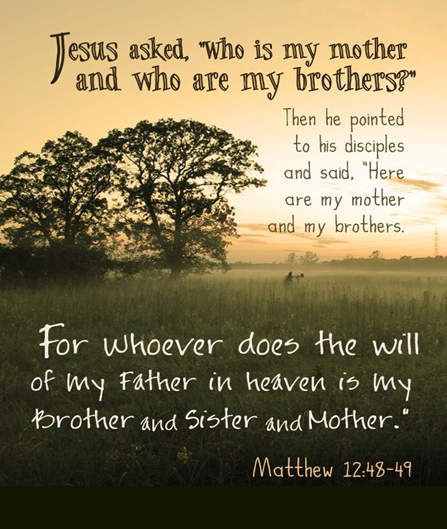
After the great feasts of Pentecost, Holy Trinity ,Corpus Christi and the Sacred Heart we now go back to Ordinary Time. The themes for the 10th Sunday include sin and redemption, God’s mercy and justice, hope and faith, the power of God’s Word, the challenges of discipleship, and the concept of the spiritual family. In the   First Reading from Genesis God confronts Adam and Eve after they eat from the forbidden tree. They blame each other and the serpent, who is then cursed by God.  Then in the Second Reading  from Corinthians  Saint Paul; tells us We speak from faith, confident that as God raised Jesus, He will also raise us. Despite physical decline, our spirits are renewed, with a focus on eternal, unseen glory.Our Gospel story for this Sunday is all about the Family of Jesus and their attempt to take control of him.  When  Jesus asks the question who is my Mother and my brothers he puts everything in its place. In one move, Jesus replaced his personal family and friends  with the family of God the Church and that is the people who did the will of God, his Father. Jesus is not disowning his family; he is acknowledging the relationship between himself and the Father and that bond is greater than the physical bond of family and homeplace.

Jesus establishes a new family, no doubt hoping that his own relatives, like everyone else, will come to accept him for who he is the son of God our saviour. Clearly his relatives like so many others have trouble accepting the change that Jesus has undergone from becoming a village carpenter to a mighty prophet who proclaims the kingdom of God his Father. Jesus has to face that misunderstanding and rejection. It is part of the cross he has to bear. Allegiance to the Father and by implication to his Son transcended ties of the country you come from and the family you belonged to. The Kingdom of God was above any social structure. Hence, social expectations over behaviour, even behaviour that challenged the status quo of the leaders, was also superseded. Family ties, social roles, and religious pecking orders were meaningless. Their  problem, and ours  lies in the  expectations we have. What do we expect others to do? What do we expect God to do? How do we react when God or others don’t meet our expectations? More important, how do we react when God or others CHALLENGE our expectations?  These days there are many different challenges to us as members of god’s family I believe that faith will prevail but the faith of the future will be different but in many ways will remain the same. The gospels are always challenging and calling us to a better way of life as members of the body of Christ his family.

We will become his brothers and sisters if we do the will of God. Doing the will of God may alienate us from our family and all the people we know and the things we cherish, but Jesus always points us towards a more important relationship the relationship we have through faith with the Father.  As we go forward there will be many challenges to us in our personal lives and our lives of faith. If we are true to the faith we profess each time we say the creed then we can say that we are the brothers and sisters of Jesus doing the will of the father as we face the challenges of being people of faith wherever we live in the world.

CORPUS CHRISTI

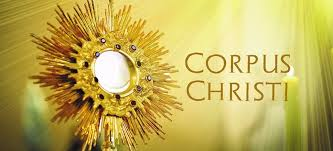
This Sunday we celebrate the feast of the Body and Blood of Christ also known as Corpus Christi. The readings for the Solemnity of Corpus Christi Year B give background for the notion of sacrifice and explain why we call Jesus the Lamb of God. The first reading describes how the Israelites sacrificed animals to seal their covenant with God. Moses relayed God’s laws to Israel, recorded them, and confirmed the covenant by sprinkling blood on the people, symbolizing their commitment to God’s commands. The second reading explains Christ is our high priest, but he also demonstrates sacrificial love. Christ, the perfect high priest, entered heaven with his own blood, not that of animals, offering us eternal redemption and mediating a new covenant. in the gospel Jesus instructs his disciples to prepare the Passover in a designated room, where he institutes the Eucharist and predicts he will not drink any more wine until he drinks the new wine in the kingdom of god.

 When we see the Eucharistic Bread, we believe that it is Jesus who is there before us what is known as the real presence such is our faith in the Eucharist.  We are thus in the presence of Jesus who has risen and conquered death and is now in Heaven, in the Glory of the Father!  The Church teaches that the Eucharist is “the source and summit of the Christian life.” (CCC 1324) This means that, because Christ is really, truly and substantially present in the Eucharist, we recognize that all the graces we enjoy come from this great Sacrament, and all we aspire to, the fullness of the life of God. Corpus Christi is a Eucharistic solemnity that is, the solemn commemoration of the institution of the eucharist. It is, moreover, the Church’s official act of homage and gratitude to Christ, who by instituting the Holy Eucharist gave to the Church and to us as members of the Church our greatest treasure the bread of life.  Each time we celebrate the mass we embody the covenant of Christ, wherein God sees in us anew the flesh of Jesus. It was not by the “blood of goats and calves that we hear about in the first reading but by the blood of Jesus that our sins were forgiven and our redemption was achieved.

Jesus Christ, “body, blood, soul, and divinity,” becomes substantially one with us as our food and sustenance. Thus God beholds each of us and sees in us the beloved Son he sent to save us. But it is not only God’s vision of us that is affected. Our own vision of ourselves and of each other is transformed. If we fully enter into the eucharistic mystery of Jesus we will  see each other as God sees us. By following in our Lord’s footsteps. Christians over the centuries have sacrificed greatly, in a labor of love, for their faith, their Christian way of life and their families. Then as now, it begins with each individual humbly asking God to show the way and to provide the eucharistic food needed to follow in His footsteps. This strength comes from the Eucharist the Bread of Life which is the body of Christ.

Trinity Sunday

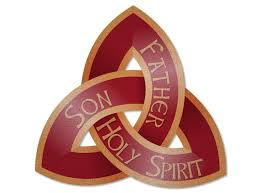
This weekend we celebrate Trinity Sunday which is all about the triune god Father, son and Holy Spirit. When my Father was alive he  often had a small tin of oil in the tool  box he used which was called three in one oil  when I was thinking about a definition of the Holy Trinity  it  came to mind however the trinity is  about  three divine persons, Father, Son and Holy Spirit. St Patrick, with a brilliance that we Irish are justly celebrate found in the three leaf shamrock rising from the one stem an image of the Trinity which is still used today. The feast of the Trinity goes back to 12th century England and St Thomas a Becket, Archbishop of Canterbury. Historians say the great Thomas celebrated a Liturgy in honor of the Trinity in his cathedral. So was born the observance. In the 14th century, the feast came to be observed by the universal Church. One week after the end of the Easter season, in which we gave thanks for the saving death and resurrection of Jesus, and the celebration of the gift of the Holy Spirit on Pentecost Sunday, this feast of the Holy Trinity invites us to contemplate the mystery of God. Paul in the Letter to the Romans reminds us that the Spirit of God makes us God’s children, destined to share in the life of God, as Christ does.

Through the Holy Spirit dwelling in our hearts we become aware of the love and strength of the living God available to us both now and in the life to come. In the First Reading from Deuteronomy  Moses urges reflection on God’s unique acts for Israel: speaking from fire, choosing them miraculously, and showing unmatched power. He emphasizes that the Lord is the only God and calls for obedience to ensure prosperity. The Second Reading from Romans  tells us As God’s children, led by His Spirit, we are freed from fear, adopted, and can call Him “Father”. This Spirit affirms our divine inheritance with Christ, linking suffering with shared glory. In the Gospel reading Matthew tells us that On a Galilean mountain, the eleven disciples met Jesus as instructed. Despite some doubts, they worshipped Him. Jesus declared His divine authority and commanded them to make disciples of all nations, baptize them, and teach His commands, assuring His continual presence until the end of time. The gospel reading speaks of power: the power of presence and the power of the name. Ancient people placed great weight in presence; the way someone dressed and acted spoke of social power. Ancient people also chose names carefully; they believed a person’s name defined their strength of character. Both outward presence and inward character are part of the disciples’ experience.

When the followers saw the resurrected Lord and heard his command to evangelize the entire world, they saw for themselves the Trinity in action. When we live as followers of Christ, we invite others to join us not because they see nice people living good lives. No, they, too, see the Trinity in action as God, Father, Son and Spirit work through us. Each Trinity Sunday, we only scratch the surface of this great mystery of our faith. In gratitude and faith, let us begin and end every prayer with greater reverence “In the name of the Father, and of the Son, and of the Holy Spirit. Amen.”

Pentecost Sunday

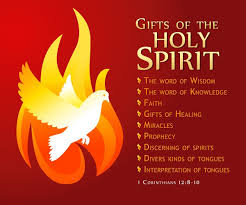
Today we celebrate the decent of the Holy Spirit upon the Apostles and the beginning of the apostolic mission to bring the Church to the world. The readings for the Pentecost clearly tell us that we need to be willing to receive the Holy Spirit and then use the gifts we receive. In the first reading we hear how the Holy Spirit came to the disciples and empowered them to share the gospel with people from different nations as a result of this we are able to hear the word of God spoken in our own language. The second reading tells us that it is the Holy Spirit who enables us to proclaim the gospel in unity. By the time John wrote his gospel, Jewish Christians had been excommunicated for their belief in the Messiah. Ostracized and socially persecuted, some Christians reacted in fear, while others boldly proclaimed the gospel. Early Christians needed a sense of stability, a sense of divine peace.

Through the words of Jesus, “Peace” was John’s prayer for his readers as we listen to this gospel reading. With the sight of Jesus, fear turned into great joy. Anxiety turned into relief.  Desperation turned into vindication. And the lack of spiritual direction turned into a real sense of deep spiritual grounding. The divine presence stood close to them and with the divine presence came divine peace. We too have the divine presence in the Blessed Sacrament and it brings Joy and spiritual grounding to all those who come and Jesus says to each and every one of us you are welcome. We can’t ignore the problems that are there and there are many in our own lives and the lives of those around us church and otherwise.  If we pray through the problems as well as thinking them through we will find that they are much easier to get through the tough times.   Gathered at Mass week in week out we bring our prayers to God. We each have our own needs. Family and friends may be sick.  People we know need work. The person who has been central to our lives for so long has passed on.   

We bring all our concerns in prayer to church because they remind us of our need and they raise our hopes in the power of God made real to every generation through the Holy Spirit.  Through the Holy Spirit our relationship with God is fruitful, satisfies our longings, and brings us peace.  Because of God’s faithfulness to all of us, we give thanks and once again present our needs as we remember the presence of God and the Holy Spirit who are with us. The feast of Pentecost is a day of thanksgiving for the beginning of the Church, in which are contained all the treasures of spiritual grace. Pentecost is also the day of thanksgiving for the coming of the Holy Spirit firstly to  the Apostles as well as all of us. It is a day on which we renew our trust in the working  of the Holy Spirit within us and the Church in the world and  we thank Him for His inspiration and guidance in all the good and bad times and things that are part of our lives.

Ascension of the Lord

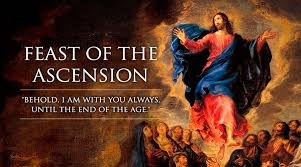
This Sunday  we celebrate the feast of Ascension.  In our lives we have seen the departure of so many people, Perhaps it is a son or daughter leaving for university or maybe it was someone leaving to go to another country or the hardest departure of all someone close to us dying. Our lives are made up of so many different times and places of departure or leave-taking and that is what Ascension is really about as Jesus returns to the Father. Jesus leaves us but remains with us through the gift of the Spirit that came at Pentecost.  The readings for the  Ascension of the Lord encourage us to be open to the Holy Spirit and be willing to spread the Good News.  In the first reading from the Acts of the ApostlesJesus, after His resurrection, instructed the apostles to await the Holy Spirit in Jerusalem, promising them power to witness globally. He then ascended into heaven, affirming His eventual return. In the Second Reading Saint  Paul prays for believers to receive wisdom and revelation to know God fully, understanding their hope, inheritance, and the immense power granted to them, the same power that raised Christ.

The words of the Gospel for Ascension day strike me in a particular way Jesus tells us ‘go therefore make disciples of all the nations and know that I am with you to the end of time.  Jesus has called the ragged, group of disciples, scattered after his crucifixion, back to himself to form them, fragile and doubtful as they are, into a community for mission in the name of God. The task of the historical Jesus is complete; the task of the church as the living Body of Christ has just begun. It is comforting to recognise that Jesus doesn’t insist on perfection before he calls us and entrusts us with his mission. Jesus is definite about what he has to say when he speaks and calls his disciples to be the first missionaries. This is in sharp contrast to the fact that, their feelings were varied. Some of them worshipped him, while some of them still doubted.  Jesus didn’t seem to have any great problem with that, because he knew that, when the Spirit came, all of those doubts would be ended. It would seem, indeed, that he was in a hurry to take his leave of them, so that the next  part of his salvation plan could get underway.  The mission of the apostles was simple to understand; difficult to carry out. It was to teach others all that Jesus had taught them.

Just as he asked his disciples to follow him, they were to ask that others would follow him and was so hard for them then and it is hard for us to do in the world of today.  So many things have changed in the Church and society. However the two things that have not changed are Jesus himself and his message as they are always new for each generation.  Again and again we need to ask ourselves what we are doing to make disciples of the people around us . The feasts of the Ascension and Pentecost help us to realize that we are part of a long tradition of faithful people who have taken up the challenge to pass on the faith . We have our faults and failings, but our call is to witness to and teach the way of Jesus by the kind of people we are, the values and attitudes we hold, in thought, word and deeds our calling is to be the living presence of God in the world where we are today.

6th Sunday of Easter

This Sunday is the 6th Sunday of Easter. it is also the beginning of the month of May. May is the month in  which we venerate the Mother of Jesus in a special way and in our parish we are hosting the annual Novena to our Lady of Perpetual Help.

In the first reading from the Acts of the Apostles, we see a remarkable event where Peter, a Jew, realizes that God does not favour one group of people over another. As Peter spoke to a gathering that included both Jews and Gentiles, the Holy Spirit came upon everyone present. This was a clear sign that God’s love and salvation were available to all, not just a select few. Moved by this understanding, Peter baptized the Gentiles, officially welcoming them into the Christian community. This passage teaches us that God’s love knows no boundaries and that we, too, are called to transcend our prejudices and share God’s love with all.

The second reading, from the first letter of John, tells us straightforwardly: “God is love.” This profound truth is at the heart of Christian life. It means that loving others is not just a command from God, but a reflection of God Himself. When we love one another, we are participating in God’s own life.John goes on to explain that God showed this love most clearly by sending His Son, Jesus, to save us from our sins. This act of sending His only Son as a sacrifice is the ultimate example of love. Every act of love we show to others is a reflection of God’s love for us and an encounter with Him. In the Gospel for this Sunday Jesus tells us ‘As the Father has loved me, so I have loved you. Remain in my love. This is my commandment: love one another, as I have loved you.  The teaching about love is not a recent innovation, or a new-age trend as many people seem to think. Jesus does lay down a commandment for us today, but he does so, not as the master talking to servants, but as a friend speaking intimately  to other friends. Servants follow rules, their lives are dictated by the one who holds authority over them. Jesus’ religion isn’t based on such a model though many in the church today seem to think otherwise. Instead, love is the foundation of our faith. Jesus is asking us to live out of the realization of that love. We are his friends, he tells us, so now we are asked to go out and live like friends with one another. “Friends,” in this context, means “beloved ones.” We need to live out of that description for we are the beloved disciples. The instructions that Jesus gives are valuable  lessons by which we will master the love of God our Father in what we say and what we do. Jesus chose his followers to carry out God’s plan of salvation in every age he chooses us today in our turn to do the same.  

Love is the best way to become his “co-worker,” since it reveals the reason he made the world and affirms our friendship with the creator. Love changes everything it touches. It tells us to stop bragging about this or that. It enhances our reputation. It denies the power of position and wealth which we sometimes feel is ours by right, it raises us up as true leaders. It connects us to God and to one another. Divine love transcends mere emotion. It becomes our lifeline to God. And it forms the basis of real community where everyone is valued and none are left out. It is inexplicable in theory, yet easily seen in action. Wherever God loves, he acts. Wherever he acts, he is there with us. HE IS WITH US simply because he loves us and the love of God knows no bounds; we remember the love that God has for each and every one of us each time we look at the Cross. There was no greater love than the Cross of Good Friday. We are called to bring the love of God into our own lives as well as the lives of those around us remembering that the Love of God lasts forever.Jesus assures us that whatever we ask the Father in His name will be granted, emphasizing the power of living in accordance with His command to love. We experience God’s presence through the love we give and receive in our everyday interactions. Through His words and example, Jesus has equipped us to bring this divine love into the world.

As followers of Christ, we are called to live out the love of God in a real way, showing love to everyone we meet without partiality. When we show love genuinely, we make the truth that “God is love” visible and active in the world. Let us strive to embody this love in all that we do, bringing the light of Christ into every corner of our lives and our world.

5th Sunday of Easter

This Sunday we hear the gospel  story of the Vine and the Vinedresser. Jesus uses the  Old Testament image of the vine and branches to help his disciples to understand the closeness of their relationship with him and the necessity of their maintaining it.  They are not simply teacher and disciples.  Their lives are mutually dependent as close as a vine and its branches.  In fact, in using this image, Jesus is explaining to them and to us what our relationship with him should become. The first reading, taken from the Acts of the Apostles, testifies to the abundance of spiritual fruits yielded by the apostles because of their close bond with the risen Lord.  The reading tells us how the Lord pruned the former fanatical Pharisee, Saul of Tarsus, who had persecuted the Church, to produce a fruit-bearing branch called Paul the zealous Apostle to the Gentiles, a man now entirely dedicated to the proclamation of the Gospel.  Even Paul’s forced return to Tarsus for a brief period is an example of God’s pruning of the vine to bring forth a greater harvest, namely, the mission to the Gentiles.

Our task is in fact to continue the work of Christ in the world. In order to know what to do we must look at his life and imitate him as best we can.  He taught the truth, he spoke words of comfort, he healed the sick, he brought sight to the blind, he spent much time in prayer in communion with the Father. And ultimately he laid down his life for our salvation. We must find ways to translate his actions and his words into our actions and our words We are meant to live in the peace and joy of the Easter gospel not in fear and uncertainty. “Without me you can do nothing,” Jesus tells us. But with him we can do everything. If we remain in his love, we can ask anything of the Father in his name and it will be given to us. The life of faith in Christ and what he teaches us  is a gift freely given and accepted by we also have the freedom to reject the life of faith  and the  love of Christ.  God calls us through Jesus his Son to make His message real in the world he asks us to make his actions and words our own as we bring His Love to the world wherever we are within it.

4th Sunday of Easter

This weekend we celebrate the 4th Sunday of Easter also known as Good Shepherd Sunday. The image of the good shepherd is a deep revelation of Christ’s sacrificial love and commitment towards us. Unlike the hired hand who might flee at the first sign of danger, Jesus stands firm, ready to lay down His life for His sheep. This act of ultimate sacrifice is a testament to the depth of His care and concern for us you only have to look at the cross to realise this it’s a love that goes beyond duty or obligation. Jesus wants to be our shepherd, guiding us, protecting us, and leading us to pastures of eternal life.  In the Old Testament, the shepherd was a metaphor for the leaders of the  people of God. Most often those leaders failed in their responsibilities and many were corrupt. God excoriates the incompetent and sinful leaders who were appointed to shepherd the people which they did not do. With the failures of the leaders of the people, God decided to take on the shepherding role. “For thus says the Lord: I myself will look after and tend my sheep. (Ezekiel 34:11).

In the First Reading – from the acts of the Apostles Peter declared the healing of a man came through Jesus Christ of Nazareth, whom they crucified but God raised. He emphasized that salvation can only come through Jesus, the stone the builders rejected that became the cornerstone.  In the Responsorial Psalm we acknowledge God’s unfailing kindness, we find solace in His shelter, surpassing human reliance. The once-rejected stone now underpins our faith, a divine act that fills us with awe. Blessed by God’s response and rescue, we celebrate and give thanks for his eternal love and mercy. In the Second Reading we are told that  we are already God’s children, loved deeply by the Father. The world doesn’t know us, as it didn’t know Him. In the future, we’ll fully become like Him, seeing Him as He truly is. In this Sundays gospel Jesus likens Israel’s corrupt shepherds to the “hired man who deserts the sheep when danger approaches, leaving them in peril. The hired shepherd may leave the sheep behind but Jesus the Good shepherd the Son of the Father does not leave his sheep. One of the most comforting Psalms which is also a hymn begins with the line: “The Lord is my shepherd.”

It ends with this line: “Goodness and mercy shall follow me all the days of my life.” Goodness and mercy, in the person of Jesus the good Shepherd are with us even now. The Gospel of the Good Shepherd teaches us how to embrace the gift of redemption by hearing and recognizing the voice of Jesus the Good Shepherd. There are numerous voices calling us to believe and practice things that might seem nice, but those voices are not of or from the Lord. We need to tune our ears and hearts into recognizing the voice of truth that comes from the Good Shepherd through the preaching and teaching of the Church. We are his people the sheep of his flock means that we are people who are able to recognize the voice of the Lord and faithfully follow him.  On Good shepherd Sunday the Church also invites us to think about and pray for vocations. We pray in a special way for all those young and not so young who have a vocation to the priesthood, Permanent diaconate or the religious life. We pray that in their lives they may be like Christ the Good shepherd who came to give his life as a ransom for many shepherding  his people into the sheepfold of God the Father  .

Post Navigation