Fullerton T

RELIGION LITURGY AND LIFE

Archive for the tag “advent”

4th Sunday of Advent
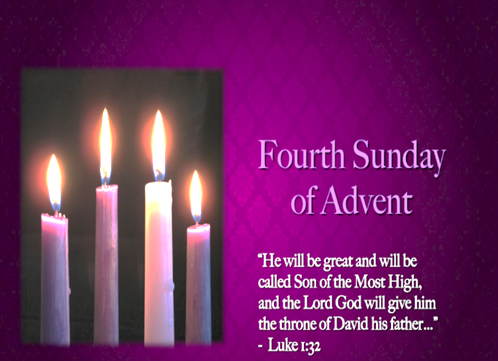
In the first reading Ahaz sounds like the great model of faith. We are taught not to tempt God by asking for signs to prove our faith. If we got those signs, we wouldn’t have faith! God, speaking through Isaiah, invites Ahaz to ask for a sign any sign from God: “Let it be deep as the nether world, or high as the sky!” Ahaz refuses saying, “I will not ask! I will not tempt the Lord.” Ahaz is showing great faith in God. He doesn’t want any proofs from God; he doesn’t want to test God or so it seems. He will not ask for the sign; he will not put his and the nation’s security in God’s hands. But God decides to give a sign anyway: “The virgin shall conceive and bear a son and shall name him Emmanuel.” The promise found in Scripture will be fulfilled.  By referring his readers to the scriptures, Isaiah reminds us that believers do well to put confidence in the word of God to sustain our hope and strengthen our faith in discouraging times such as we are in these days with so many people suffering in war and so many other avoidable crises. In the second reading Paul, a servant of Jesus, greets the believers in Rome. He emphasizes Jesus’ divine and human natures and wishes them grace and peace.

We meet Mary in the Gospel who had been prepared for the coming of the Messiah. She has received the angel’s greeting, and his strange news, and accepted her role in God’s plan Matthew is well planted in his Jewish tradition. He shows that from the very beginning of his gospel. Joseph was betrothed to Mary; Mary’s pregnancy turns Joseph’s world and his plans upside down.  Instead of exposing her, he “decided to divorce her quietly.” He was a “righteous man”, and he will protect Mary from being publicly dishonoured. He is not vengeful and, though wronged, displays mercy. After his dream when the angel told him do not be afraid Joseph took his wife into his home. The world God chose to enter was one of poverty, hard labour and political and military oppression. God took a big chance being born among us especially in those circumstances. Surely there must have been neater options for God, to make the saviour’s path and work a bit smoother. But none of us has a “smooth path” through life.  It’s good to know that Jesus, Emmanuel, “God with us,” chose to be with his people who live in the real and messy world. We began Advent with the cry, ‘Come, Lord Jesus’. We will end it with the joyful Christmas call, ‘God is with us!

Throughout our Advent journey we were told to stay awake for the coming of the Lord. As we go forward to the Christmas Celebration there is much to be thankful even in our messy world with all its problems. The message of Christmas is about God’s loving kindness, his compassion, his mercy, and his abiding, living love and presence with us in his Son Jesus the son of God Emmanuel who is God with us.
Third Sunday of Advent

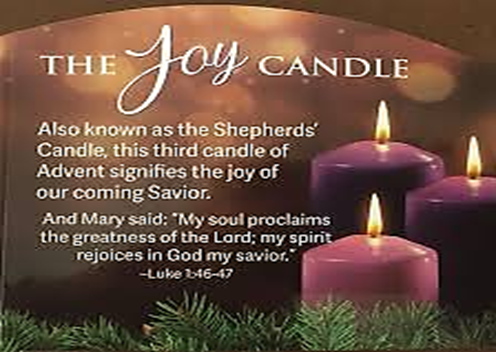
The third Sunday of Advent is also known as Gaudete Sunday. The term Gaudete refers to the Entrance Antiphon, “Rejoice in the Lord always again I say rejoice for the lord is very near.” Rose vestments are worn in many churches to emphasize our joy that Christmas is near, and we also light the rose candle on the Advent wreath. In many places the Parishes celebrate Bambinelli Sunday when the Children are asked to bring the baby Jesus Crib Figure to get a special blessing and then they place the baby Jesus in the Crib on Christmas Morning.  As Christmas draws near, the Church emphasizes the joy which should be in our hearts over all that the birth of our Saviour means for us or all that it should mean for us, especially in our world where so many have little or nothing at all.

The readings for this Sunday are full of life. Isaiah tells us the desert will bloom. James encourages us to wait with patience. Jesus reminds us of the signs that God’s kingdom is near. These words give strength to those who are tired or uncertain and in our world these days there are many people who are tired of the present and uncertain about the future.  In the First Reading –Isaiah tells us that the desert will bloom and rejoice. God will strengthen the weak and bring justice. The blind will see, the deaf will hear, and the saved will enter Zion with joy. In the Second Reading – James tells us to be patient for the Lord’s coming, like a farmer waiting for crops. Strengthen your hearts, avoid complaining, and follow the example of patient prophets. All four Gospels testify to an important truth: that John the Baptist stands at the beginning of the Gospel. He is the one who marks the end of the time of waiting and the beginning of the new age in Jesus. He is the last of the great prophets, the one who came after a long period when no prophet spoke to the people.  John the Baptist has an unusual address as he lived in the wilderness. But that was the traditional place associated with the growth of Israel’s religion. It was in the desert that Israel first met God, and the story of the people’s wanderings through the wilderness became the story of their growth from crisis to settlement in the promised land.

In the desert the people were tested, and later, when they failed God, they were told that they would be taken back into the desert where God would speak again to their heart (Hosea 2:16).   In today’s gospel we meet John the Baptist in prison, sending his disciples to ask Jesus, “Are you the one who is to come, or should we look for another?” This is a poignant moment in the gospel. John was the fiery prophet who had proclaimed the coming of the Messiah. Jesus had come, but he doesn’t seem to be what John expected. John sounds like he is wrestling uncertainty; might even be wondering if he had gotten God’s message right. He lives in a state we know as well: between promise and fulfilment; between what has begun in Christ and what we still await and hope. John voices our own questions in Advent when we ask, “Lord, where are you? Are you really present at this time in our world with all that is going on within it?” The delay in God’s promises being fulfilled can cause us to wonder if God and the kingdom are near.  That is our Advent question and besides raising the question we are also invited to listen to Jesus’ gentle reply. Here is the answer Jesus gives to John’s disciples about himself. “The blind regain their sight, the lame walk, lepers are cleansed, the deaf hear, the dead are raised hands the poor have the good news proclaimed to them.”

Jesus does not argue or explain. He points to what’s happening: healing mercy and transformation. Aren’t those signs of God’s kingdom? Advent faith invites us to look for those same signs. They may be small and hidden, or right before our eyes, hard to miss. These signs announce to us to God’s saving power is still at work among us. Do we not see? How can we participate in them? We note the beatitude in today’s gospel, “Blessed is the one who takes no offense at me.” This is an Advent challenge because God’s ways can surprise or unsettle us. We can’t stumble when Christ comes to us in a form we do not expect in the poor, and suffering, in the slow process of grace. Faith means trusting that even when we do not see everything clearly, God’s promises being fulfilled. John the Baptist is a reminder to us that even the prophet of fiery conviction struggles to understand how God is working. Like him, we too may wonder: where is God’s kingdom? Why does it seem delayed when the world needs it to come in its fullness? We wait with hope in our hearts for the culmination of all things in Christ and the prayer that is on our lips is ‘thy kingdom come!’ As we continue our Advent journeys let us prepare the way for the Lord in our own lives remembering that in the words of the psalm the lord keeps faith forever and he won’t let us down. Gaudete Sunday gives the strength for the present and hope for the future as we look forward to Christmas.

1st Sunday of Advent

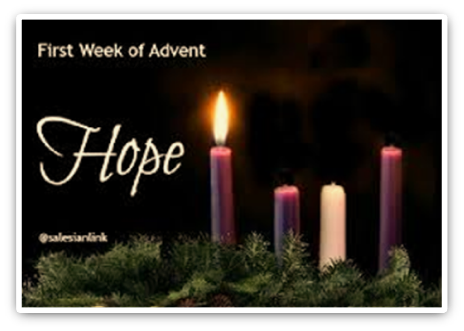
This weekend we celebrate the first Sunday of Advent. As we light the first purple candle on the advent wreath we recall the faith of the people who looked out for Jesus and prepared the way for him, and said he was coming to us. We look to the writings of the Old Testament to see what they say about the promise of God to visit his people and during these coming weeks we will read much from the prophet Isaiah; we also think about all those who prepared the way for his coming and we think about the work of John the Baptist who was the lords herald. As we reflect, we also think about Mary whose faith and acceptance of the invitation of God brought about the whole Christian era.

The readings for this Sunday speak about peace, joy, and staying awake. In the first reading Isaiah gives a picture of all nations coming to God’s mountain to learn his ways. In the future, the Lord’s mountain will be the highest. All nations will come to learn His ways, and there will be peace. In the Second Reading Paul tells us to wake up for our sleep as our salvation is near. We are called to live properly, putting aside darkness and putting on the light of Jesus Christ. This week’s Gospel we are told to “Stay awake”, to be vigilant and attentive to the signs of the times so that we do not miss the moment when God breaks into human history once again. The God who came among us is still among us. In Advent we try to see the reign of God more clearly so that we may be totally caught up in God’s action in the world as we wait for the final manifestation of God’s glory. We continually work for a peaceful and just world, so that Christ may have room in that world, our homes and our hearts. Moreover, we must change our conduct abandoning the works of darkness and put on the ‘armor of light’. (cf. Rm 13:12-14). Jesus, through the story in the parable this weekend outlines the Christian lifestyle that must not be distracted and indifferent but must be vigilant and recognize even the smallest sign of the Lord’s coming because we don’t know the hour in which He will arrive. (cf. Mt 24:39-44)  Saint John Henry Newman reminded us in a homily for the Advent Season: “Advent is a time of waiting; it is a time of joy because the coming of Christ is not only a gift of grace and salvation It is also a time of commitment because it motivates us to live in the present as a time of responsibility and vigilance.  This ‘vigilance’ means the urgency of an industrious, living ‘wait’ We need to take Advent seriously, for the coming of the Lord is not just about Christmas, but the actual day of judgment.

The real tragedy of this season of preparation is that we have been programmed to believe it’s all about buying things, about gift giving, and frenetic activity that leaves us exhausted and happy, it’s all over the time Christmas arrives. So then because of all the hustle and bustle we forget the 12 days of Christmas. So, what are we really waiting for this Advent? May we be vigilant, hopeful, and ready to welcome Christ our king at Christmas making room for Him not only in the celebrations, but in our hearts, our homes, and our world. In doing that, we embrace the true spirit of Advent the season of waiting, in joyful and hope filled anticipation as we live as people of the light.

4th Sunday of Advent

This weekend we light the third purple candle on the Advent wreath as the anticipation grows to a crescendo as we  draw closer to the celebration of the Christmas mysteries. Christmas is almost upon us: yet are we ready in the true sense of the word remembering that Jesus is the reason for the season? Christmas we are told is a time for so many things  yet for many it is a time of stress and pressure with all the extra work to sort out every­thing that needs to be done.  For many it is a time when we are fearful that the children won’t be disappointed or that there will be tension in relationships or there will be a breakdown in the ceasefire with the in-laws.  

In the first reading from Micah Jerusalem was under siege and Davids dynasty was in peril. The prophet said that salvation would come from an insignificant place and that was Bethlehem from there a new leader would gather the nations together into one people.  In the second reading from Hebrews the sacrifices mosaic law were unable to purify the people from sin. Only Christ himself was able to bring the reconciliation between  god and his people. We  meet Mary and her cousin Elisabeth in our Gospel reading. Mary, who herself had been prepared for the coming of the Messiah. She has heard the angel’s greeting, and his strange news, and has accepted her role in God’s plan.  Now she hurries to her kinswoman, Elizabeth, who herself bears John the Baptist in her womb. John, alerts us to the presence of the Lord, as he leaps for joy in his mother’s womb. His joy is that God has kept his promise, and is with his people.  That two women were chosen to play such a role in the story of salvation is remarkable, as women were often marginalized in the society of their time.

In all these events we see the great mission that Mary undertook as a privileged instrument in the hands of God. Mary is not only the mother of the source of grace; she is the very model of what a Christian heart should look like. We look to Mary to see our fullest Christian dig­nity. In Lumen Gentium 68, Vatican II describes our contem­plation of Mary as an act of entering our own deepest mystery, catching a glimpse of what we shall he at the end of our faith journey. Over the next few days the journey to Christmas will have many pressures for everyone especially those who are worried about so many things family and otherwise.  Mary in her calm gentle way encourages us to trust in God’s word and to believe in God’s promises as she did. The great Christmas feast is almost here. As always in Advent, what is promised in the first reading is brought to fulfilment in the Gospel reading. We began Advent with the cry, ‘Come, Lord Jesus’. We will end it at Christmas with the joyful shout, ‘God is with us!’

3rd Sunday of Advent

On this the 3rd Sunday of advent we light the rose coloured candle on the advent wreath and the vestments at mass may be Rose as well. This Sunday is also known as Gaudete Sunday as we rejoice that the Lord is near.  Last week we heard about John’s ministry of preaching repentance and baptism for the forgiveness of sins. The idea of repentance is about turning around and facing in a new direction. John’s call to the people was to turn away from the old ways of life and to turn towards God. The Gospel opens with the people, the tax collectors and some soldiers, having heard the call to change their lives, all asking John, ‘What must we do?” We should also be asking ourselves what must we do?

 Both John the Baptist and Paul share one belief: that the Lord is very near. God’s nearness didn’t act as a threat to them, but gave them a infectious  source of joy that no one could take away  from them. Their joy in the closeness of God gave an edge to their preaching and teaching. It gave them a vision to see the far side of disaster; it moved them to draw others into that sense of joy.  None of them was closed in his own joy they moved out going round in the hope their  inner joy would be caught by the people of their time and place and many people were caught by the joy they had to pass on to them. The picture of John the Baptist as a man of joy is not one you hear about very often. John is usually portrayed as a lonesome figure, with a weird wardrobe and weirder diet, who rants and raves at anyone with ears  to hear. But John was a character who intrigued people and as a result they would seek him out and follow him. People don’t journey into the wilderness just to get insulted; you don’t become disciples for the wardrobe and diet.Here was a man who cared nothing at all for comfort, money or fame, who could not be bought, and who would speak the truth without fear. In John people could see something of God.

John spoke in words they could grasp when he told them exactly what they should be doing.  He made such a deep impression on the crowd that word goes around that he might be the Christ. That expectant feeling is a measure of John’s effect on people around him. John did not  claim to know who the Messiah was going to be instead he tells the people that he is not that person. That role is for someone else, someone greater and more powerful than he was.  And as we know that person was Jesus the Son of the Father. We are called to be joyful witnesses to Jesus but as we know with all that is going on around us these days that is not easy. There are many things that continue to block the presence of the Lord within us. It’s time for us to answer the question what must we do and that is to  prepare the way so that we will be able to welcome Jesus  into our lives our hearts and our homes at Christmas. Let us  Rejoice in the lord always because the Lord is near.

2Nd Sunday of Advent

This Sunday we light the second purple candle on the Advent Wreath The sense of preparing is very strong in our readings this weekend. The Gospel highlights the role of John the Baptist as the one who prepares the way for Jesus. The first reading from the prophet Baruch is a call to do the same. It talks about taking off the dress of sorrow and distress and putting on the beauty and glory of God. It’s a call for the people to become God’s people.  In the Responsorial Psalm we hear about the  marvels the Lord worked for us! When the Lord restored Zion, they were overjoyed. Nations acknowledged God’s great deeds as they rejoiced, knowing that their sorrow would turn into joy.  

In the Second Reading  from St Pauls letter to the Philippians Paul says I joyfully pray for you, confident that God will complete His work in you. He goes on to say I pray your love grows in knowledge, so you can discern what is best and be righteous in Christ. John was  the herald of the Lord calling the people of his time and ours to  repentance John the Baptist plays a prominent role in all the gospels, but particularly in Luke. John hears the word in the desert and preaches throughout the whole region of the Jordan prepare the way for the Lord make straight his paths. The Jordan was another important place in the faith life of the Jewish believers. After their desert wanderings the people crossed over the Jordan river into the promised land. They left behind slavery, came to know God in the desert and were finally prepared by God to cross into new life.  Blessed John Henry Newman reminds us that “Advent is a time of waiting; it is a time of joy because the coming of Christ is not only a gift of grace and salvation it is also a time for commitment because it motivates us to live the present as a time of responsibility and vigilance.  

We all need help and encouragement to leave behind all the things that have become destructive in our lives. We need help in thinking about ourselves differently. We have to take time to reflect on the kind of person God wants us to be and what God’s plan is for us as we prepare the way for the Lord in 2024. This  means as we prepare the way for the Lord we prune away all that hinders us from making Jesus welcome when he comes at Christmas .  Our Advent journey is showing us how to prepare our hearts for a fresh discovery of God’s presence in our lives; how to recognise the presence of Jesus among and around us; showing us how to turn around and face towards God with faith, hope and love; and how to be the living presence of Jesus in our moment of history. As we continue our  advent  journey we ask ourselves what are we waiting for. Are we waiting for the presents and razzmatazz that the secular part of Christmas bring or are  we preparing spiritually for the greatest gift of God, his Son, Jesus the light in the darkness who John the Baptist foretold.

1St Sunday of Advent

This weekend we begin our advent journey for 2024, everything goes from hopeful green of ordinary time to the penitential purple of Advent. Last Sunday we celebrated the end of the Church’s year with the Feast of Christ the King. Now one week later we start all over again as we bless the advent wreath and light the first purple candle. Advent is the season that brings us back to the ancient longing of the human race for the coming of one who would bring to this world liberation from sadness and the fulfillment of perfect peace. As we know in our world there is so much sadness and very little peace as a result of this we continue our prayers for peace in the world.

In the first reading this Sunday Jeremiah looks forward to the coming of one who will save God’s people, one who acts with honesty and integrity Jesus was the one he was talking about . In the second reading St Paul encourages the people of Thessalonica in their following of Christ. He prays that their love will grow and that their hearts will be ‘confirmed in holiness’  so that they would be blameless in the sight of God. In the gospel reading   Jesus is clearly fretful about the future as he paints a bleak picture of the end of the world. There is talk of nations in agony, of bewilderment, of people dying of fear, of the power which menaces the world.   It is a nightmare view of total disaster that “will come down on every living man on the face of the earth”.  Given that vision of ultimate collapse, it is hardly surprising that it might drive people to drink! Being sober and awake might not seem very attractive in the face of such catastrophe.  Yet that is Jesus advice to us: “Stay awake, and be ready praying at all times for the strength to survive all that is going to happen” so that we will have  confidence before the Son of Man.   

This Gospel is for our time as much as any other when we have so many countries at war as well as all the crazy things that are going on in world politics. The Gospel also encourages us to do two things which are difficult to hold together: to be honest with ourselves about the way things are going, and at the same time not to lose hope in the future. The danger is that we see the terror clearly, and don’t see the reason for the hope that is within us at all. Given the muddle we’re often in, Jesus has to convince us as he tells us about the future that is really liberating. The way he does that best is through the example of his own life. Advent reminds us that we don’t walk alone into the future whatever it holds for us. We look to the past to reassure ourselves here and now as we go forward. When we look we see how far-reaching God’s love is for all of us no matter who we are.  The Advent readings are a rich tapestry of images cantered on the truth that God has come among us and will come again. Our Advent invitation is to prepare the way for  the lord so we can welcome him as Emmanuel – God with us at Christmas.

Post Navigation