Fullerton T

RELIGION LITURGY AND LIFE

Archive for the tag “bible”

5th Sunday in Ordinary Time

This Sunday we celebrate the 5th Sunday in Ordinary time and we remember and pray for all those who are sick as we celebrate the world day for the Sick on 11th February. We ask God through the intercession of Our Lady of Lourdes to bless our sick and all those who look after them. The 5th Sunday in Ordinary Time readings highlight important themes. These themes help us understand our faith and God’s call in our lives. In the  First Reading from Isaiah  Isaiah saw the Lord on His throne, felt unworthy, but was cleansed by a seraphim. When God asked for a messenger, Isaiah offered to go. In the Responsorial Psalm I will thank and praise God for His kindness and truth. He answers me and gives me strength. All will praise Him for His great glory and enduring kindness.

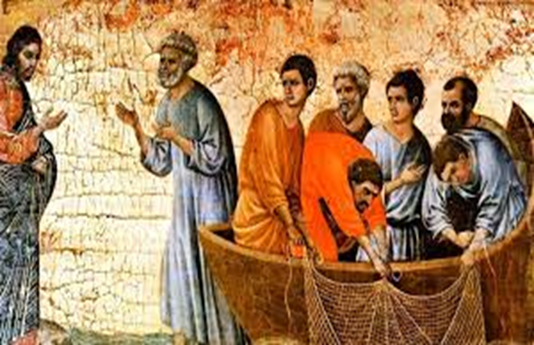
The Second Reading from Corinthians tells us that Christ died for our sins, was buried, and rose on the third day. Saint Paul says He appeared to many, including me. By God’s grace, I preach, and you believed. Our Gospel story for this Sunday recounts the story of the of Peter’s calling to be a fisher of men. After a fruitless night’s fishing, Peter obeys the word of Jesus and catches a huge number of fish. He feels unworthy before Jesus; but he is now called to be a fisher of men. Peter recognises the hand of God in what has happened and at the same time realises his own sinfulness but Jesus comes to show us the mercy of his Father. Jesus did not come to be a hermit with an unreachable address in the desert; rather, his whole mission moves in the opposite direction, for he has come “to seek out and save the lost” (Luke 19:10). So Jesus travels into our lives not away from them.  He entertains sinners he enters their homes, meets their families, eats at their table, listens to their stories, and calls all of us to a new way of life when he says follow me. Throughout his life Jesus is never far from sinners he is not far from all of us as well for are sinners too. Jesus doesn’t write us off because we are sinners; Jesus has other plans because he knows that we sinners have a future, not just a past. Simon Peter received his call while he was doing his work. He said, “Yes,” and responded by changing his life.

Every day, in the midst of our routines, at work, home, school there are opportunities to respond to Jesus’ call to follow him. In innumerable ways our Christian vocation must guide what we say and what we do. In all  our decisions big and small, we are asked to live what we profess as Jesus’ followers; to be attentive to what God may be asking of us at that moment of our lives. This may entail being faithful to the commitments we already have; responding to a need we see, or taking the opportunity to witness to what we believe. Our responses may seem small and insignificant. They may be small, but they are never insignificant! In addition, who knows where the next “Yes” we say to Christ may lead us?  Our call as disciples is not only to personal holiness but also to partnership with Christ in transforming the world with words and actions of  justice, peace, integrity, forgiveness, mercy, tolerance, hope and love. We must allow ourselves to be caught and taught by Jesus. The response that is asked for, is to be prepared to give up everything in our quest to know Jesus. In spite of our sense of sinfulness, unworthiness and lack of faith in ourselves, we are called to trust in God’s choice of us and in God’s faith in us who are his beloved daughters and sons.

The Presentation of the Lord

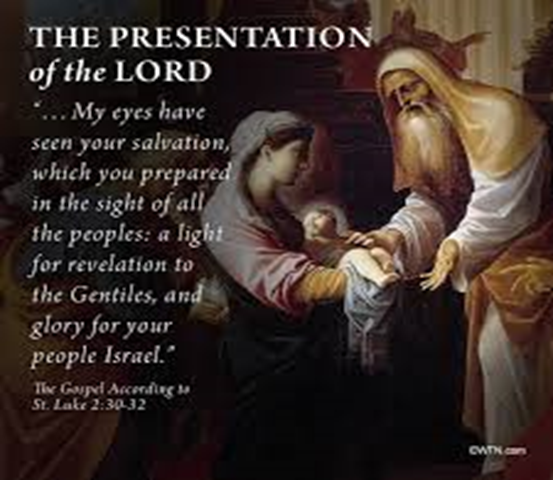
The Feast of the Presentation of the Lord is an ancient celebration in the Church. It is also called Candlemas because, on this day, candles are blessed in many parishes. The feast is celebrated on February 2nd  forty days after Christmas. It recalls the day when Mary and Joseph brought Jesus to the Temple in Jerusalem to present Him to God. This event is rooted in Jewish tradition. According to the Law of Moses, every firstborn son belonged to God. Jewish parents were to bring their son to the Temple and offer a small sacrifice in thanksgiving. By bringing Jesus to the Temple, Mary and Joseph followed God’s law faithfully. This act shows their humility and obedience to God.

The Church has celebrated the Presentation of the Lord for many centuries. In the early Church, people gathered in the evening for a candlelit procession, honouring Christ as the Light. February 2, exactly 40 days after Christmas, was chosen because of this tradition in Jewish law. It also marks the end of the Christmas season for some Catholic communities.   In the First Reading the text, taken from the Prophet Malachi tells us, “I am sending my messenger to prepare the way before me; and suddenly there will come to the temple the Lord who you seek” (Mal 3:1). From the Gospels, we know  that the precursor was John the Baptist who was born 6 months before Jesus, we also know that God sent John to prepare His way. So, soon after the Baptist’s birth, God entered His temple. Jesus’ presentation signifies God’s entrance to His temple. God made man entered the temple, presenting Himself to those who were really searching for Him. In the Gospel reading  from Luke we are introduced to different people and events that in themselves provide numerous pointers  for  reflection. First of all, Mary and Joseph respect the Mosaic Law by offering the sacrifice prescribed for the poor: a pair of turtledoves or two young pigeons. Simeon and Anna were two venerable elderly people dedicated to prayer and fasting their strong religious spirit rendered them able to recognize the Messiah when they saw him.

  Simeon blessed God and said “Now, Master, you may let your servant go in peace, according to your word, for my eyes have seen your salvation, which you prepared in the sight of all the peoples: a light to the Gentiles, and glory for your people Israel.” We are familiar with the beautiful symbolism associated with light. Light in the spiritual sense means Christ and the supernatural life of grace. The Presentation of the Lord connects the Old Covenant with the New. In the Old Covenant, people followed the law to be close to God. But Jesus brings the New Covenant, where people are saved by faith in Him as the Son of God and what he teaches. By being presented in the Temple, Jesus shows respect for the Old Covenant while also opening a new way for the people to follow.  In the Presentation of the Lord, we see that Jesus came to bring light, hope, and salvation to the world. Through Mary and Joseph’s faithfulness, Jesus’ mission begins humbly but with great purpose. This feast invites us to embrace the light of Jesus and to trust in His saving plan for us and for the world. It also prompts us to ask ourselves how can we, as the Body of Christ be Light and Hope for others especially in the darkness of our current times.  

We are also invited to present ourselves to God, offering our lives in joyful hope filled service and love. We remember the call to live as “children of the light,” walking in hope, faith and trust lighting the path for those around us to follow the god of hope and joy.

3rd Sunday of Ordinary Time

This Sunday we celebrate the 3rd Sunday of ordinary time as well as Word of God Sunday. Today’s readings make an unmistakable directive that we are to seek joy that comes from faith.  They provide insight  to how we are to go about instilling joy into our the core of our being.  In our first reading from Nehemiah,  we find ourselves at the Feast of Tabernacles at a time of true revival.  God had intervened and had brought the Israelites back to Jerusalem.  Not only had they returned home from captivity in Babylon, but God had miraculously provided all the resources needed to rebuild the temple and the walls of the inner city. In the Psalm we are reminded again of the power of God’s Word as it “refreshes the soul”.  His Words bring “Spirit and Life.”  They provide “rejoicing to the heart,” “enlightenment”, a “fear of the Lord which is pure, enduring forever”. 

All of these reminders point us to God’s Holy Word, which is the ultimate source of the overflowing joy we need to not only rejoice, but to effectively point others to our Lord and Savior the reason for the hope and joy that is within us. In our Second Reading from 1 Corinthians, we see how our joy is to be lived out.  We are reminded that our church the  body of Christ is made up of many  unique individuals, all with unique talents & purposes.  We are instructed that there can be no divisions, but rather shared concern for one another.  True joy is found only when we focus upon others, allowing our joy  to flow into their lives both in their good times and their challenges. In the Gospels for this Sunday and next, Luke tells the story of Jesus’ visit to his hometown of Nazareth. Luke wants to make very clear to his readers what drives Jesus the Prophet from Galilee and what is the goal of his action. We as Christians need to know in what direction the Spirit pushes Jesus, since following him means that we are walking down the same path as he did and often times it will be in opposition to what is going on in the world.  With the Spirit poured upon him at his baptism, Jesus would proclaim freedom for captives, sight for the  blind, and help for those who are oppressed.  When Jesus spoke, hearts and minds turned to God and health of mind, body and spirit were restored.

There is an immediate life implication in this gospel passage  that is easy to overlook and that is the Spirit of the Lord came upon Jesus and the Church in order to bring the good news of hope and joy to us and we are called to bring it to the people of our time and place. The “today” of Jesus that the Gospel speaks about is not only the day he was speaking. It is our “today” as well here  right where we are in 2025. As pilgrims of hope in this Holy Year we are called to bring the joy of Christ that we have as people of faith into the lives of others. Wherever we are that is our challenge it is the challenge of hope filled joyful people who proclaim freedom for captives, sight for the  blind, and help for those who are oppressed.   

The Baptism of the Lord

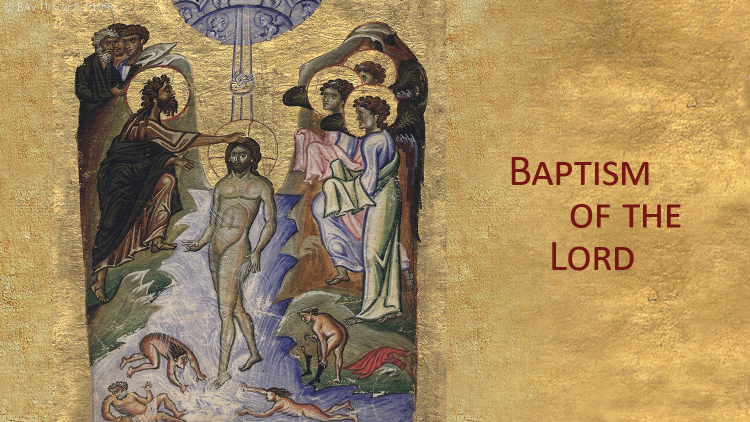
This weekend we celebrate the baptism of Jesus in the Jordan by John. This celebration is also a reminder of our own Baptism which for many of us took place a long time ago when we were babies but I am sure we have been to a baptism of a child. Some of us  may have been to the baptism of an adult during the Easter season as part of the RCIA process where people come into the faith communities where they live after a time of preparation during Lent. In the First reading from Isaiah We hear an ancient description of the mysterious “servant” who is endowed with the spirit of God. His mission is to bring true justice to the nations, and he will accomplish this in quietness and gentleness. In the Second reading  from the Acts of the apostles Peter addresses the household of Cornelius and tells them how Jesus began his public ministry after John the Baptist’s preaching when he was anointed with power by the Holy Spirit coming down from heaven upon Jesus.

The gospel for this Sunday uses the simple phrase that “the heavens were opened,” the voice of the Father was heard saying this is my Son in whom I am well pleased and it is a powerful statement. This particular gospel story is the beginning of the journey that Jesus was to undertake and it brought him to Calvary and the cross.  Through our own baptism, each of us is asked to travel a spiritual journey of hope and faith though we won’t end up on the Cross. The sacrament of Baptism is the is the foundational sacrament key to all the other sacraments. Baptism has three essential results, firstly it wipes us clean from original sin and secondly it makes us members of the Church. It also opens up the opportunity for us to receive the other sacraments, most particularly the Eucharist which is the sacrament that we most frequently experience and which is the main way that our souls are nourished by God’s grace. We remember that John foretold Jesus  coming and he is acclaimed on earth by John and Jesus links himself to John by being baptized by him.  Jesus is acclaimed from heaven by the voice of the Father with  the presence of the Spirit.   Most of us rarely think about our own baptism, Through our baptism we died with Christ and have been reborn into a whole new life (Romans 6). We, the baptized, are made a part of the body of Christ.  We are called to imitate Jesus, who St. Paul says, “went about doing good.” We don’t need a detailed rule book to know how we should act in each situation of our lives, for in baptism, we have the companionship of the Spirit who is our wisdom, our help and our guide to do good and enable us to do what is right in all the situations we may find ourselves in.

Our personal faith journeys have one great purpose and the purpose is to try and live our lives as sons and daughters of the living God brothers and sisters of Jesus enlivened by the Holy Spirit. Today we are invited to renew that first encounter of our own baptism and look at it  in a new light. In baptism Christ has made all of us his own. He invites all of us to a deeper relationship with Him, a relationship that throws new and perhaps unexpected light on the grace of that first encounter in the baptismal font.

Second Sunday after Christmas

Here we are at the second Sunday after Christmas as we look forward to the arrival of the three wise men on the feast of the Epiphany which takes place on Monday 6th January.  By long standing  tradition Christians celebrate Christmas as a season, with the twelve days between Christmas and the Epiphany as one long “Christmas feast.” The season ends with the Baptism of the Lord which is also the first Sunday of ordinary time and that takes place next Sunday.  In the first reading this weekend we hear that  wisdom speaks her own praises in the great assembly, this reading tells us  how Wisdom personified as a woman speaks about her role as she glories in herself in the presence of the mighty one. The reading goes on to tell us  from eternity in the beginning he created wisdom and for all eternity wisdom will remain.

In the Second Reading Paul begins his letter to the Ephesians with a hymn which praises God for choosing us in Christ. He prays that all will be blessed with the spirit of the heavenly blessings `so that through wisdom we will get to know God, so that we can see the hope that his call holds for us. In the Gospel we hear the magnificent Prologue to John’s Gospel: how in the beginning there was the Word and through the word all things came to be and then in the fulness of time god sent his Son. When John comes to speak about Jesus notice how he goes back beyond the time of Jesus’ birth and conception to the very beginning of time itself. He sees Jesus as the Word that was with God, the Word that was God. John rejoices in his Gospel that this Word which made the beginning now comes into the world.   The Word is not only had a great power that makes all things; the Word became flesh and dwelt among us. The Incarnate Word comes among his own people in the person of Jesus the Son of God the only Son of the Father.  At Christmas we celebrate the humility of Emanuel  God with us who came to be one with us in the good and bad times that are part of our lives.

As Christians, we will very often find ourselves living in contradiction of so many things that are part and parcel of this present age.  Regrettably we have to get used to the fact that we will face conflict among friends, and even at times within families, as we seek to live out and the Christian life more generously and we know that if our words fail, the Word of God never fails. May we not be afraid in the Holy Year of Hope that has just begun to seek  and find the wisdom that God wants to give us, so that we can see the hope that his call holds for us so that we will have the wisdom to follow Jesus the light for the world the hope of all who believe.

CHRISTMAS 2024

This Christmas we begin the Holy Year of 2025 with the opening of the Holy Door is St Peters in Rome. The theme of the year is Pilgrims of Hope and Christmas is all about Hope and Joy. At Christmas the Christian Churches throughout the world celebrate the Birth of Jesus Christ,  as we remember “The Word was made flesh and dwelt among us.” The Son of God became man to give us a share in that divine life which is eternally His in the Blessed Trinity. Throughout the Advent season we have waited for the coming of our Savior. Now on the 25th of December we celebrate His birth with unrestrained joy.

The readings for the Nativity of the Lord emphasize the joyous celebration of the incarnation of Jesus Christ, God becoming one of us. Christmas is all about  the saving grace of Jesus, and the light and salvation brought by the birth of our Savior. During the Christmas season there is an extensive exchange of greetings, gifts and good wishes among friends. These greetings are a reminder of those “good tidings of great joy that shall be to all the people, for this day is born to you a Savior Who is Christ the Lord” (Lk. 2:11). They are a reminder, too, that all blessings and graces come to us from Christ. With the exchange of gifts comes the responsibility to remember those who have little or nothing at all in terms of a roof over their heads and food in the cupboard. During Christmas we are reminded  of the mystery of Mary as Mother of God, mother of the Incarnate Word, and mother of His mystical body, the Church. Christmas encourages us to contemplate Jesus together with Mary and Joseph reflecting on Jesus with ‘His mother’, as recounted many times in the Gospels.

Our faith cannot neglect a profound devotion to the Mother of God, as she shows us the easiest way to reach Jesus. Christmas reminds us of the great mystery of God’s people, the Church animated by the life giving Spirit. So, why do we celebrate Christmas? It is more than the birth of Jesus. It is a celebration of God with us. It is the realization that God’s love for us and faithfulness to us dwells among us. It is a sign that we are to carry that love and faithfulness to other people. Like the Baptist, we, too, are to witness to God’s living, breathing Word and we are called to be faithful so let us adore the Lord Jesus in the manger the reason for the season and bring his love and joy to those we meet in the days ahead as we begin the Holy Year as Pilgrims of Hope.

3rd Sunday of Advent

On this the 3rd Sunday of advent we light the rose coloured candle on the advent wreath and the vestments at mass may be Rose as well. This Sunday is also known as Gaudete Sunday as we rejoice that the Lord is near.  Last week we heard about John’s ministry of preaching repentance and baptism for the forgiveness of sins. The idea of repentance is about turning around and facing in a new direction. John’s call to the people was to turn away from the old ways of life and to turn towards God. The Gospel opens with the people, the tax collectors and some soldiers, having heard the call to change their lives, all asking John, ‘What must we do?” We should also be asking ourselves what must we do?

 Both John the Baptist and Paul share one belief: that the Lord is very near. God’s nearness didn’t act as a threat to them, but gave them a infectious  source of joy that no one could take away  from them. Their joy in the closeness of God gave an edge to their preaching and teaching. It gave them a vision to see the far side of disaster; it moved them to draw others into that sense of joy.  None of them was closed in his own joy they moved out going round in the hope their  inner joy would be caught by the people of their time and place and many people were caught by the joy they had to pass on to them. The picture of John the Baptist as a man of joy is not one you hear about very often. John is usually portrayed as a lonesome figure, with a weird wardrobe and weirder diet, who rants and raves at anyone with ears  to hear. But John was a character who intrigued people and as a result they would seek him out and follow him. People don’t journey into the wilderness just to get insulted; you don’t become disciples for the wardrobe and diet.Here was a man who cared nothing at all for comfort, money or fame, who could not be bought, and who would speak the truth without fear. In John people could see something of God.

John spoke in words they could grasp when he told them exactly what they should be doing.  He made such a deep impression on the crowd that word goes around that he might be the Christ. That expectant feeling is a measure of John’s effect on people around him. John did not  claim to know who the Messiah was going to be instead he tells the people that he is not that person. That role is for someone else, someone greater and more powerful than he was.  And as we know that person was Jesus the Son of the Father. We are called to be joyful witnesses to Jesus but as we know with all that is going on around us these days that is not easy. There are many things that continue to block the presence of the Lord within us. It’s time for us to answer the question what must we do and that is to  prepare the way so that we will be able to welcome Jesus  into our lives our hearts and our homes at Christmas. Let us  Rejoice in the lord always because the Lord is near.

2Nd Sunday of Advent

This Sunday we light the second purple candle on the Advent Wreath The sense of preparing is very strong in our readings this weekend. The Gospel highlights the role of John the Baptist as the one who prepares the way for Jesus. The first reading from the prophet Baruch is a call to do the same. It talks about taking off the dress of sorrow and distress and putting on the beauty and glory of God. It’s a call for the people to become God’s people.  In the Responsorial Psalm we hear about the  marvels the Lord worked for us! When the Lord restored Zion, they were overjoyed. Nations acknowledged God’s great deeds as they rejoiced, knowing that their sorrow would turn into joy.  

In the Second Reading  from St Pauls letter to the Philippians Paul says I joyfully pray for you, confident that God will complete His work in you. He goes on to say I pray your love grows in knowledge, so you can discern what is best and be righteous in Christ. John was  the herald of the Lord calling the people of his time and ours to  repentance John the Baptist plays a prominent role in all the gospels, but particularly in Luke. John hears the word in the desert and preaches throughout the whole region of the Jordan prepare the way for the Lord make straight his paths. The Jordan was another important place in the faith life of the Jewish believers. After their desert wanderings the people crossed over the Jordan river into the promised land. They left behind slavery, came to know God in the desert and were finally prepared by God to cross into new life.  Blessed John Henry Newman reminds us that “Advent is a time of waiting; it is a time of joy because the coming of Christ is not only a gift of grace and salvation it is also a time for commitment because it motivates us to live the present as a time of responsibility and vigilance.  

We all need help and encouragement to leave behind all the things that have become destructive in our lives. We need help in thinking about ourselves differently. We have to take time to reflect on the kind of person God wants us to be and what God’s plan is for us as we prepare the way for the Lord in 2024. This  means as we prepare the way for the Lord we prune away all that hinders us from making Jesus welcome when he comes at Christmas .  Our Advent journey is showing us how to prepare our hearts for a fresh discovery of God’s presence in our lives; how to recognise the presence of Jesus among and around us; showing us how to turn around and face towards God with faith, hope and love; and how to be the living presence of Jesus in our moment of history. As we continue our  advent  journey we ask ourselves what are we waiting for. Are we waiting for the presents and razzmatazz that the secular part of Christmas bring or are  we preparing spiritually for the greatest gift of God, his Son, Jesus the light in the darkness who John the Baptist foretold.

1St Sunday of Advent

This weekend we begin our advent journey for 2024, everything goes from hopeful green of ordinary time to the penitential purple of Advent. Last Sunday we celebrated the end of the Church’s year with the Feast of Christ the King. Now one week later we start all over again as we bless the advent wreath and light the first purple candle. Advent is the season that brings us back to the ancient longing of the human race for the coming of one who would bring to this world liberation from sadness and the fulfillment of perfect peace. As we know in our world there is so much sadness and very little peace as a result of this we continue our prayers for peace in the world.

In the first reading this Sunday Jeremiah looks forward to the coming of one who will save God’s people, one who acts with honesty and integrity Jesus was the one he was talking about . In the second reading St Paul encourages the people of Thessalonica in their following of Christ. He prays that their love will grow and that their hearts will be ‘confirmed in holiness’  so that they would be blameless in the sight of God. In the gospel reading   Jesus is clearly fretful about the future as he paints a bleak picture of the end of the world. There is talk of nations in agony, of bewilderment, of people dying of fear, of the power which menaces the world.   It is a nightmare view of total disaster that “will come down on every living man on the face of the earth”.  Given that vision of ultimate collapse, it is hardly surprising that it might drive people to drink! Being sober and awake might not seem very attractive in the face of such catastrophe.  Yet that is Jesus advice to us: “Stay awake, and be ready praying at all times for the strength to survive all that is going to happen” so that we will have  confidence before the Son of Man.   

This Gospel is for our time as much as any other when we have so many countries at war as well as all the crazy things that are going on in world politics. The Gospel also encourages us to do two things which are difficult to hold together: to be honest with ourselves about the way things are going, and at the same time not to lose hope in the future. The danger is that we see the terror clearly, and don’t see the reason for the hope that is within us at all. Given the muddle we’re often in, Jesus has to convince us as he tells us about the future that is really liberating. The way he does that best is through the example of his own life. Advent reminds us that we don’t walk alone into the future whatever it holds for us. We look to the past to reassure ourselves here and now as we go forward. When we look we see how far-reaching God’s love is for all of us no matter who we are.  The Advent readings are a rich tapestry of images cantered on the truth that God has come among us and will come again. Our Advent invitation is to prepare the way for  the lord so we can welcome him as Emmanuel – God with us at Christmas.

Feast of Christ the King

This weekend we celebrate the feast of Christ the King on the last Sunday of the Churches year. The Feast of Christ the King was established by Pope Pius XI in 1925 as an antidote to secularism, that is a way of life which leaves God out of a person’s thinking and has us living life as if God did not exist as we all know God does exist and we see this throughout history. In this feast  we profess our common belief: Christ is King to the glory of god the Father.. Our Gospel reading for this Sunday has Jesus before Pilate. Jesus turns his interrogation into a meeting of souls. It is an encounter that impresses Pilate deeply; encounters with Christ are bound to change us in some way.  Jesus refuses to answer Pilate’s charge of kingship directly. He states that his kingdom is “not from here” (John 18:36), which Pilate interprets to be an affirmation that Jesus is a king.

Jesus also puts the question aside as something Pilate claims, and instead offers the idea that he is a witness to the truth (18:37).In the reading from John’s Gospel  which is also part of the Good Friday Passion Narrative we see  this conflict is described in terms of the “truth” that Jesus  has brought from his Father: “It is because I speak the truth that you cannot believe me”.  Jesus urged the people of his time as he encourages all of us in our time to find the truth of our calling to be “a light to the nations,” showing the world the life and joy of people who are living according to all they have learned from Jesus.  The kingdom of Christ, is  a kingdom of charity and peace. We remember that the Kingdom of God exists in every home where parents and children love each other. It exists in every region and country that cares for its weak and vulnerable people. It exists in every parish that reaches out to the people of the parish without looking at who they are or what they can contribute .  The King we celebrate this weekend is the Son of God who walks the dusty roads of our daily lives finding the weak, the ill, the oppressed, the ones whose hearts are wounded, the ones whose minds are confused by the things that they see going on around them.

Jesus finds all kinds of people as he journeys with us along the dusty roads of life, he finds ordinary folk as well as the elite, the powerful as well as the weak and he invites all of us to walk in his ways as we prepare to start again as we begin the churches new year next Sunday. We remember that the kind of kingship that Jesus talks about places a different emphasis on all earthly kingdoms and empires, from Imperial Rome right to today. It topples the world’s values and overturns the concepts of power and majesty and replaces them with a kingship of service of god and one another. Sometimes we fall short, but Jesus always calls us back with forgiveness. He asks us to recommit ourselves to service wholeheartedly as we prepare spiritually  in  Advent for Christmas .

Post Navigation