Fullerton T

RELIGION LITURGY AND LIFE

Archive for the tag “bible”

15th Sunday in Ordinary Time

On the 15th Sunday of Ordinary Time our  readings focus on God’s call and mission. We see how God chooses ordinary people to carry out His work. In the First ReadingAmaziah orders Amos to leave Bethel and prophesy elsewhere. Amos responds he was called by God from his life as a shepherd to prophesy to Israel and that was were he stayed. In the Second Reading from  Ephesians we are told that we are blessed in Christ with spiritual riches, chosen to be holy, redeemed by his sacrifice, and sealed with the Holy Spirit, fulfilling God’s plan in the church for unity and glory.

The Gospel reading is all about Mission. Jesus summons the twelve apostles and sends them out on a missionary tour.  The chosen followers of Jesus have to carry the word of God as a challenge to others. In that mission the apostles have the authority and the power of Jesus. They have to travel on that.  They are not to rely on their own resources but on the authority that has been given to them and the hospitality that will be offered them. With no bread and no money, they have to depend on the kindness of others: that vulnerability makes their message their real resource. If they have bread to eat, it also means that people are not only hospitable they are also listening to the word they preach. If they are not accepted, they have no option but to move on. And when a town rejects their message, the apostles are to shake the dust from their feet – a symbolic act performed by Jews returning to Palestine after journeying abroad. The Twelve went out and preached that God would adopt humanity, making its members which include you and me “sons” and “daughters” of the Father. This was Good News then just as it is now!  I think we need to be like the twelve who were sent out with the message of Jesus but with one difference we need to seek out those who do not want to hear the message instead of shaking the dust off our feet we really need to let our feet get dirty.  We have to have carry the word of God and see it as a challenge to ourselves and to others. In telling us about the beginning of the church in so dramatic a fashion, Mark, wants to be certain that disciples in his church and in the church  of our time will be mindful of some important implications. We, like the first disciples, are inadequate for the task; yet Christ’s mission for God’s kingdom is given to us.  If we labor under the illusion that we can bring about God’s reign on our own, we will be advancing something other than God’s kingdom on earth. Paul refers to his experience of preaching the gospel as foolishness. He relishes saying “we are fools for Christ’s sake?   Because he understands that it is because of his weakness that the power of Christ can dwell in him .       

The message of hope from today’s Gospel is that we don’t have to spend years of study before we can explain what Christ means; we can do it quite easily using actions and words we all understand. The crucial point in the Gospel is that by doing things Jesus’ way the Apostles get close to the people, they understand their concerns and they share their life. We are called to do the same today as we try to do things Jesus way by helping the people to get close to Jesus and what he teaches all of us.

14th Sunday in Ordinary Time

The readings for the 14th Sunday in Ordinary Time are a call to listen to God and follow Him even when those around us do not. These readings make us think of how we can persist as disciples in times of adversity and how to handle rejection. In the First Reading God empowers Ezekiel to speak to rebellious Israel, ensuring that whether or not they listen, they will recognize the presence of a prophet among them. In the Second Reading Paul embraces his weaknesses and hardships, seeing them as opportunities for Christ’s power to shine, affirming that divine strength is perfected through human weakness. This Sundays  Gospel sees Jesus going back home to Nazareth. This is not a social visit like everyone else in the other towns in Galilee, Nazareth and its people have to hear the Good News of the kingdom. When Jesus teaches in the local synagogue, many of the townspeople are astonished at the things he is saying. They wonder at the origin of Jesus’ teaching and the nature of his wisdom, as well as the miracles that are done through him.

From the unanswered questions about Jesus’ wisdom, the neighbours move to more familiar territory and focus on what they do know about Jesus. Whatever their wonder, they are not going to allow the wisdom of Jesus  to interfere with their memories of him as the son of Joesph the carpenter. Prior to this section in Mark’s gospel, Jesus has been doing some extraordinary things. His baptism by John in the river Jordan was accompanied by an affirming voice of the Father from the heavens, “You are my beloved Son. On you my favor rests.” After his desert testing Jesus called his first disciples, cured the man in the synagogue with the unclean spirit and the paralytic in Capernaum; expelled the legion of devils from the Gerasene man, you may remember last week Jesus raised the daughter of Jairus and then cured the woman with hemorrhage, Jesus is doing wonderful things in what he says and what he does as he proclaims the coming of the reign of God. Though he did all the wonderful things the people still had little faith which also seems to be the case these days for so many in our own time.

The people wanted the powerful signs of God’s final coming with a strong right arm to rescue them. But when Jesus spoke about the signs of the kingdom’s presence, he spoke of scattered seeds and, to emphasize the kingdoms small beginnings, he compared it to a mustard seed, “the smallest of all of the seeds of the earth” Where was God’s show of power and mighty arm in a tiny mustard seed? Mark sums up their reaction, “And they took offense at him. And so it is today as many take offense at the values of Christianity and the good it makes for all of us in our world. A world which in many respects is so faithless with many  people taking offense at Jesus and his teaching. Jesus revealed God’s presence to the people of Nazareth as a different kind of power: the power used only to help others, not ourselves; a gentle power that does not force or coerce people to do our will; the power of compassion and gentleness, when others are expecting force. All of us know from our own experience that when we admit our failures and limitations, that honesty can mark the beginning of a new understanding. If our Lord and God can take failure in his stride, we might even end up boasting about God’s fantastic message!

What is the fantastic message of the wisdom of Jesus? Jesus message is really about using whatever power that we might have in a positive way to help others and the greater our weakness the more powerful we will be that is powerful with the power of compassion and gentleness that we are called to show to everyone around us as we go forward at this time.

13th Sunday in Ordinary Time

The readings for the 13th Sunday in Ordinary Time show us that God wants nothing but life and goodness for us. The first reading explains that God desires life not death for us, God created life and intended it to be eternal. The second reading tells us that God wants an abundance of good things for all of his children.  We should strive to excel in generosity, following Christ’s example. We are called to  Share all we have in order to create equality ensuring everyone’s needs are met.  

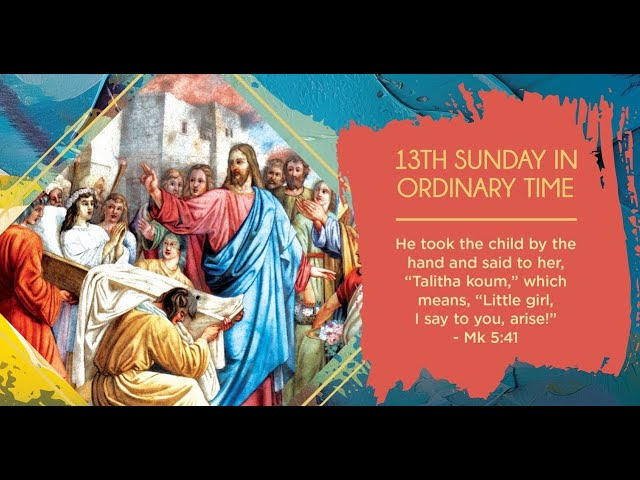
In the Gospel reading we hear about the woman who had the hemorrhage and we also hear about the official’s daughter. Whilst the stories are about the faith of the people involved they are also about the mercy of Jesus towards  them both. Jairus, the synagogue official and loving father of a ‘desperately sick’ daughter, is convinced that if  Jesus would place his hands on her ‘to make her better and save her life’ she will surely recover. The unnamed woman, suffering for twelve years from a condition for which she has gone from one doctor to another, has one last hope. She is convinced that ‘if she can touch even the hem of his clothes’, she will ‘be well again’ and then she was able to get near to Jesus and touched his garments. The poor woman and Jesus know that healing power has gone forth. Jesus turns around, inquiring who is the one who had touched him. Fearfully, the woman admits that she is the one. Jesus immediately calms her fear, telling her to go home in peace, for she is healed.

Then, He proceeds to the house of Jairus, where He learns that the little girl has died. Quieting all the commotion going on He goes in with the child’s parents as well as Peter, James, and John Taking the hand of the girl, He brings her from death to life, ordering that some food be brought to her. This gospel reading speaks of two things the faith and mercy. So, the story of the woman and Jairus daughter is also our story. When we are afraid; when we face death, we can feel Jesus’ touch, as the girl felt Jesus’ hand in hers we feel his hand in ours.  Jesus has shown that, in his hands, we are imperishable. Jesus responds to desperate need with love, empathy and compassion. He shares our pain and our burdens. He boldly shatters prejudice and breaks conventions. He is not afraid to enter the place where death seems to have its way and breaks in open with his light. Over the last few Sundays Mark has been showing us how God’s grace is at work through the person of Jesus.

Last Sunday In the calming of the storm Mark insisted that it is necessary to have faith in Jesus in order to enter into the Kingdom. As we navigate the challenges of our daily lives, we are asked to reflect on Jairus’s response. How will we choose to act? Will we, like Jairus, turn to Jesus in faith, trusting in the wisdom and faith we have received from God? Remember, faith and wisdom are not meant to be hoarded but shared. Just as wisdom aids others in finding answers for their present lives, faith offers the promise of eternal life. Therefore, we are called to embrace the wisdom and faith we have received and, in turn, generously share them with those around us as we go forward.

12th Sunday in Ordinary Time

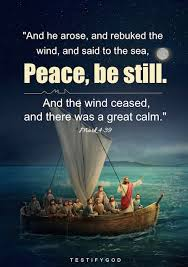
The readings for the 12th Sunday show us God’s power and our need to trust Him. In the first reading, God reminds Job of His control over the sea. He set boundaries for the waters and commands the waves. This shows God’s authority over creation. Even the mighty sea, which can be so powerful and frightening, obeys God’s commands.  Our gospel reading for this week is all about being Calm amid the storms of life that sometimes come our way. The context of this passage is the calming of the storm when Jesus rebuked the wind and said to the sea, ‘Quiet now! Be calm!’ And he says the same to us now in all our trials ‘Quiet now! Be calm!  Jesus understood that all would be well even if he and the disciples perished or if the storm subsided. Mark’s original audience was a community undergoing persecution. Their leaders had been martyred and, they questioned what was happening to them. The church was undergoing internal strife as they struggled to bring Jews and Gentiles into their new Christian community.  Mark’s church was hardly sailing on calm waters not unlike our church today.

Jesus’ previous parables of sowing, growth and harvest showed God’s control over the land. This passage also shows that God is in charge and has control over the chaos we often see and hear about exemplified for us today by the calming of the storm.  Jesus asks the disciples in the midst of the storm, why are you so frightened and why do you have so little faith. He could be saying the same thing to us today as many lack faith in God and mankind.  Amongst all the hurt and devastation in our lives Jesus changes the darkness that is in our daily lives into the sunshine of everlasting life, and replaces our distress with comfort and peace. When we don’t know the best way forward or the best way out Jesus gives us peace of mind and heart to make the right decision. At such a crossroads of life, we can ask him, ‘Lord, what road should I take what way should I Go?’ The best way will become so much clearer, and bring us calmness and peace as well as the knowledge of a decision well made.  We have so many things to occupy our minds these days with all the things that are going on in  our world.  If we stop and look around us we see the signs of Jesus in people trying their best to look after others, to provide meals and shelter, to keep themselves and their loved ones safe, to work for peace in the midst of conflict to bring comfort and to pray.  The disciples’ fear during the storm teaches us about our own fears and who we should trust. We often feel overwhelmed by life’s challenges and there are many. But Jesus shows us that He is greater than any storm. We remember that Jesus is with us in the good times and bad as a gentle calming presence as we go through the storms of life that affect all of us from time to time and we should trust him to be our helper and guide as we go forward.

11Th Sunday in Ordinary Time

This weekend we celebrate the 11th Sunday of ordinary time The readings for the 11th Sunday in Ordinary Time Year B are filled with images of growth. In the First Reading –  from Ezekiel the Lord promises to take a shoot from a cedar, plant it on a high mountain, and make it a great tree where birds will find shelter.. In the Second Reading – from 2 Corinthians 5:6-10: We are told that we walk by faith, not sight, aiming to please the Lord. We will be judged by Christ for our deeds. In the Gospel  we hear once again the story of the mustard seed. Jesus seemed especially fond of using parables. Parables are meant to leave the hearers wondering. They are not straight-forward answers to questions. They are food for thought. By using parables Jesus is trying to engage his listeners at a deeper level. He wants his teaching to seize their hearts. He wants them to discover the truth of what he is saying for themselves. It is part of the business of conversion – coming to see with new eyes

The faith that we have handed down to us through the generations is represented in this Sundays Gospel by the mustard seed and our faith is something that all of us need to nourish When the seed that is the Word of God takes root within us the Kingdom grows.  We are called upon hearing the Word to meditate upon it in prayer so that it may take root in us and bear fruit in joy and hope.  We are usually helped by books, and Christians do not want for them: the Sacred Scriptures, particularly the Gospels, liturgical texts of the day or season, writings of the spiritual fathers, works of spirituality, the great book of creation, and that of history the page on which the ‘today’ of God is written. (CCC 2705) The Kingdom of God is like a tiny seed within each of us. It’s a strong seed, like those that push their way through the hard ground  in order to grow toward the light. Sometimes we nurture it and have expectations. Sometimes our expectations are fulfilled, sometimes not. Other times, we don’t know how, but we find ourselves bearing the fruits of joy, compassion, peace, generosity, faith-fullness, gentleness with thanksgiving for the wonder of it all.  

Then we know our growth is a partnership with god the father and, while we can care for the seed, we can’t make it grow or flower or reproduce on our own. The parable of the seed growing of itself which we hear this Sunday shows us that there is an almighty power working with and for us.  Our part is to do a good job preparing the soil of our hearts and minds as we  sow the seed. When we think of the small beginnings of Jesus’ ministry in Galilee to the spread of his message throughout the world, we appreciate the vast growth from the small mustard seed that has taken place over the years. We have reason to rejoice that the kingdom still attracts and welcomes so many different people as they respond to the mustard seed of faith that someone has planted for them. So let us rejoice and be glad for the lord has done great things for us in our time and place  and helped us to nurture and grow our own faith.

6th Sunday of Easter

This Sunday is the 6th Sunday of Easter. it is also the beginning of the month of May. May is the month in  which we venerate the Mother of Jesus in a special way and in our parish we are hosting the annual Novena to our Lady of Perpetual Help.

In the first reading from the Acts of the Apostles, we see a remarkable event where Peter, a Jew, realizes that God does not favour one group of people over another. As Peter spoke to a gathering that included both Jews and Gentiles, the Holy Spirit came upon everyone present. This was a clear sign that God’s love and salvation were available to all, not just a select few. Moved by this understanding, Peter baptized the Gentiles, officially welcoming them into the Christian community. This passage teaches us that God’s love knows no boundaries and that we, too, are called to transcend our prejudices and share God’s love with all.

The second reading, from the first letter of John, tells us straightforwardly: “God is love.” This profound truth is at the heart of Christian life. It means that loving others is not just a command from God, but a reflection of God Himself. When we love one another, we are participating in God’s own life.John goes on to explain that God showed this love most clearly by sending His Son, Jesus, to save us from our sins. This act of sending His only Son as a sacrifice is the ultimate example of love. Every act of love we show to others is a reflection of God’s love for us and an encounter with Him. In the Gospel for this Sunday Jesus tells us ‘As the Father has loved me, so I have loved you. Remain in my love. This is my commandment: love one another, as I have loved you.  The teaching about love is not a recent innovation, or a new-age trend as many people seem to think. Jesus does lay down a commandment for us today, but he does so, not as the master talking to servants, but as a friend speaking intimately  to other friends. Servants follow rules, their lives are dictated by the one who holds authority over them. Jesus’ religion isn’t based on such a model though many in the church today seem to think otherwise. Instead, love is the foundation of our faith. Jesus is asking us to live out of the realization of that love. We are his friends, he tells us, so now we are asked to go out and live like friends with one another. “Friends,” in this context, means “beloved ones.” We need to live out of that description for we are the beloved disciples. The instructions that Jesus gives are valuable  lessons by which we will master the love of God our Father in what we say and what we do. Jesus chose his followers to carry out God’s plan of salvation in every age he chooses us today in our turn to do the same.  

Love is the best way to become his “co-worker,” since it reveals the reason he made the world and affirms our friendship with the creator. Love changes everything it touches. It tells us to stop bragging about this or that. It enhances our reputation. It denies the power of position and wealth which we sometimes feel is ours by right, it raises us up as true leaders. It connects us to God and to one another. Divine love transcends mere emotion. It becomes our lifeline to God. And it forms the basis of real community where everyone is valued and none are left out. It is inexplicable in theory, yet easily seen in action. Wherever God loves, he acts. Wherever he acts, he is there with us. HE IS WITH US simply because he loves us and the love of God knows no bounds; we remember the love that God has for each and every one of us each time we look at the Cross. There was no greater love than the Cross of Good Friday. We are called to bring the love of God into our own lives as well as the lives of those around us remembering that the Love of God lasts forever.Jesus assures us that whatever we ask the Father in His name will be granted, emphasizing the power of living in accordance with His command to love. We experience God’s presence through the love we give and receive in our everyday interactions. Through His words and example, Jesus has equipped us to bring this divine love into the world.

As followers of Christ, we are called to live out the love of God in a real way, showing love to everyone we meet without partiality. When we show love genuinely, we make the truth that “God is love” visible and active in the world. Let us strive to embody this love in all that we do, bringing the light of Christ into every corner of our lives and our world.

HolyThursday

On this day  we recall Jesus’ commandment to love one another, his washing of the disciples’ feet and the breaking of the bread. The liturgy on Holy Thursday is a meditation on the essential connection between the Eucharist and Christian love expressed in serving one another. In the 1st Reading we hear  The Lordcommands Moses and Aaron to mark the new year and prepare for Passover. Each Israelite family is to select a flawless lamb, share as needed, and eat it with unleavened bread and bitter herbs. The lamb’s blood will protect them from the impending plague, signifying the LORD’s mercy as He strikes Egypt but spares His people, establishing an eternal commemoration. The Second Reading tells us  how Jesus established the Eucharist.Breaking bread, He offered it as His body, and the cup as the new covenant in His blood, instructing us to commemorate His sacrifice in this act until He comes again.

The Gospel  tells us that Before Passover, aware of his imminent departure, Jesus demonstrated his love by washing his disciples’ feet, a task for servants. Peter initially resisted but accepted upon understanding its necessity for fellowship with Jesus. Jesus used this act to teach humility and service, emphasizing that followers should emulate his example of serving others. Christ is not only present in the Eucharist but also in the deeds of loving kindness offered to others through us. We are the ones who make ‘real’ the presence of Jesus in the world today in what we do and say as Christians. The theme running throughout this day is one of humble service of God and his people.  The Evening Mass commemorates the Last Supper with the theme of service and sacrifice both of these are aspects of the same mystery.  We see Jesus as one who serves, who gives himself.  Just as he freely gives himself in washing the feet of his disciples, so too he gives himself  in the bread and wine he takes, blesses and hands to the disciples.  

In the same way we receive Jesus in the form of Bread and wine from the hands of our priests. All these acts of self-giving are the same act that of the Son of Man who came ‘not to be served, but to serve, and to give his life as a ransom for many.’ The action of the Church that is our action  as the body of Christ on this night also witnesses to the Church’s respect for Christ’s Body present in the consecrated Host in the Adoration of the Blessed Sacrament, carried in solemn procession to the  Altar of Repose. No Mass will be celebrated again in the Church throughout the world until the Easter Vigil on Saturday evening when we proclaim the Resurrection of Christ.  As people who are Christians that is followers of Christ We should embrace all those who are in need of any kind as Christ did. We should be leading lives of generous service to all those who need our help wherever they are and there are many people around who may need our help and care.    When we serve our brothers and sisters we are called them that our God is an all-loving and caring father in heaven then the Eucharist whenever we partake of this great sacrament will bring us joy and peace.May we take up the mantle of humble service giving a helping hand to others and not counting the cost to ourselves. Many people over the years have given much at great personal cost and have not failed in their example of humble service and that for me  is what  Holy Thursday is all about  Humble service for others and not being afraid of being the presence of Christ for others in our world.

Post Navigation