Fullerton T

RELIGION LITURGY AND LIFE

Archive for the tag “christianity”

19th Sunday in Ordinary Time
This Sunday we continue our prayer for peace in the world. The pictures and the stories of starvation coming out of Gaza are a constant reminder of the need for peace of heart, mind and soul. With  the current state of the world we  pray  that  the politicians will come together to work for peace. The readings for 19th Sunday advise us to be prepared for we do not know when our time to move from this world to the next will come. Spiritual readiness is the theme for this Sunday and we should ask ourselves are we prepared for our lives in the world to come.    In the first Reading  from Wisdom the ancestors had foreknowledge of the Passover, giving them courage. The salvation of the just and destruction of foes were awaited. The Responsorial Psalm tells us that the righteous are urged to rejoice in the Lord. The people chosen by God are blessed, and the Lord’s gaze is upon those who respect Him. They await His mercy and protection.   In the  Second Reading   from Hebrews Abraham’s unwavering faith in God’s promise led him to a foreign land, where he and his descendants flourished.

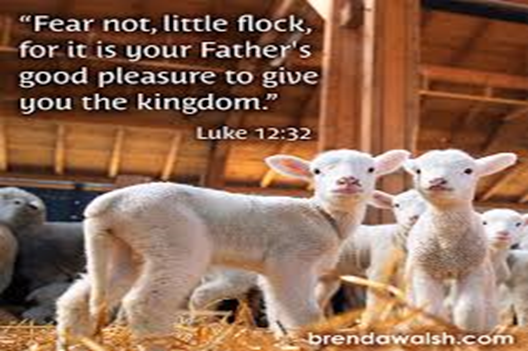
This Gospel reading begins with some of the most beautiful of Jesus’ words: “There is no need to be afraid, little flock, for it is your Father’s good pleasure to give you the kingdom. These particular words fear not little flock are so full of meaning especially these days when there is so much fear and distrust around in many different countries and spheres of life. The words of our Lord should make us all sit up and take notice. He has taken us into his household. He has made us his “little flock.” We are invited guests in his house rather than just being mere servants. Jesus also warns us that we must always be busy about our vocation and there are many vocations in life. We also remember the reason why he invited us into his home. We are Christians, we are members of his Church, God, through Christ’s Incarnation, has put us on the road to heaven. He is always there with us helping us along the way.  We don’t know in advance what God may do with us and our own oftentimes selfish plans a friend of mine always said that Man proposes and God disposes in other words the will of God will happen no matter what we might want or do.  To those who have faith, all things are possible there is an  old saying that faith moves mountains but we should keep on climbing  and it certainly is true.

Faith helps us to rely on the infinite power of God, not on our own limited power. We don’t know when personal circumstances will put us to the test. But we do know that our lives will be a success if we set our hearts and minds on values that go beyond all the goods and chattels of this world. Our faith, is leading us onward, always pointing to something still to come, and at the end of our pilgrimage on earth we will find where our true treasure is and that is in heaven with the Father in his house. The gospel words do not fear little flock are a call for us to place our trust in God and he will help us when we come to the trials and tribulations of life especially these days when the world seems to be  in turmoil.  The Holy Year of Hope encourages us to remain hopeful, even in the face of adversity. Again and again, the Gospel assures us: we need not fear the future. Instead, we are called to place our hope and trust in God our refuge, our strength, our help, and our shield. In doing so, we journey together, trusting that God’s love will see us through all of life’s trials and lead us to our eternal home.
18th Sunday in Ordinary Time

The readings for 18th Sunday in Ordinary Time are a warning for us not to become too attached to worldly goods and temporary pleasures. Detachment from the things of this world and enriching our spiritual lives is really what  need to be doing. In the first Reading – The preacher declares everything meaningless. Working hard only to leave the results to someone else is futile. Life is full of pain and worry, and this is also meaningless. Psalm 90  offers a prayerful response to the fleeting nature of life. The psalmist does not despair but turns to God, asking for wisdom, compassion, and blessing. In the Second Reading  Paul urges the Church to set their hearts on what is above. The letter to the Colossians emphasizes the full sufficiency of Christ. This reading reminds us that our life in Christ is a new reality.

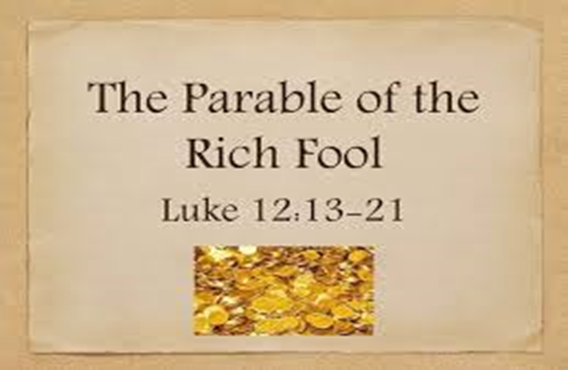
Earthly attachments and sinful habits are part of the old self, which must be left behind. Paul calls the community to live out their baptismal identity in practical ways. This reading shifts the focus from earthly gain to spiritual renewal of oneself and the community. The gospel is the story of the rich man who foolishly stored up his wealth for a future that he thought would be in his own hands instead the future was in the hands  of God.  Luke  tells us the man is foolish for his planning and for believing that he was immune to life’s tragedies. The lesson of this Sundays parable is obvious and it is perhaps as difficult to put into practice.  To be in this world and not of it, to collect the necessary goods of this world by honest labor and yet remain detached from them, to possess but not be possessed by the worldly riches we may have, this is an ideal to which our weak human nature responds very reluctantly. However some Christians, do respond to the challenge. They earn and use the goods of this world for the good and wellbeing of everyone, while at the same time they keep God’s laws and earn spiritual wealth putting their riches into their spiritual bank. Some renounce the right to possess the things of this world, by entering religious life taking on the vows of poverty, chastity and obedience. Thus they free themselves to devote their whole time and energy to the service of God and neighbor trough living the spiritual life.

Many people own the world’s goods in order to provide for themselves and their families, but, while so doing they never let their temporal possessions come between them and their spiritual life. To do this is not easy, but God’s grace is always available to help the willing heart.  The message of the Jesus is one of hope, and compassion, it is not the achievement of great influence or wealth, it is not the power over others that prove our greatness in gods eyes.  What proves our greatness is the humble service freely given to those who need the help and friendship we offer them . The last sentence of the parable is stark and clear: Do not store up treasure for yourself, but seek to be rich in the sight of God. That means that we “Seek the Kingdom of God. As Christians we know that the values of this world do not last and that they cannot bring true fulfillment. A successful life in God’s eyes is not about storing up material treasure for ourselves  but about being a source of spiritual treasure for others. In this Holy Year of Hope, we are called to renew our trust in God’s wisdom and embrace the path of spiritual generosity. That means that we use our time, talents, and resources to benefit others, knowing that in doing so, we enrich our own lives with real meaning and joy. `

16th Sunday in Ordinary Time

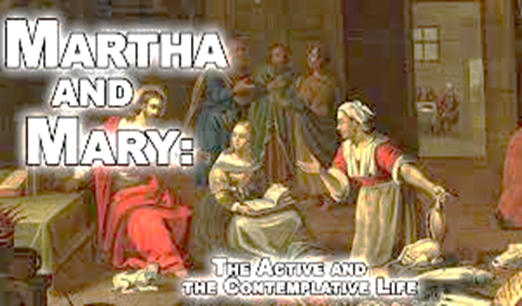
The readings for this Sunday have a focus on hospitality. What are some ways we can provide hospitality for others? Do we only care for their physical needs or do we also take the time to listen to them as St benedict says with the ear of our hearts?  In the First Reading  The Lord appeared to Abraham, who welcomed three visitors with hospitality. One of them promised that Sarah would have a son within a year. In Second Reading  Saint Paul tells the Colossians I suffer for you to share Christ’s afflictions and reveal the mystery of Christ in you, our hope of glory.In our Gospel reading this Sunday we hear all about Martha and Mary. On his way to Jerusalem, Jesus led his entourage into the village to call at  the home of Martha. As the good host, she served them but, her sister, Mary, sat listening to Jesus.

Martha tried to shame Mary into helping with the work but Jesus would have none of it. Instead, he praised Mary’s choice when he said leave her alone for she has chosen the better part.  Martha loved Jesus as much as Mary did, and it is clear that he treasured them both. Her mistake was in not trying to find out how Jesus wanted to be entertained, while visiting her house. Her sister senses that when Jesus comes on a visit the last thing he wants is to have people fussing over how to feed him. So, while Martha makes the greater housekeeping effort, Mary understands better what is expected of her by him. Her contemplative intuition grasps instinctively the real reason for Jesus’ visit.  He is there not to receive but to give, not to be served but to serve. He has something he needs to say and the one thing necessary is to listen to his voice. There is a whole theology of contemplation in this gospel reading, on how to receive the Lord’s visit. It starts off from the basis that, no matter who our visitors may be, there is always something to be learned, something from them. When Jesus comes to us he wants to talk to us in the quiet of the evening or the freshness of the morning, in the quietness of  our hearts and he wants to share with us the Word that brings salvation. He comes to us in the quiet moments not because he needs us but because we need him.

We too can be “distracted with all the serving;” we also “worry and fret about so many things.” As a result of all the worry and wonder we may, like Martha, miss the better part, for all of us the one thing that is necessary, is to listen to the Word of God with the ear of our hearts in the quiet moments of life. let us not be afraid of being like Mary and be attentive to what Jesus is telling each of us today. Let us listen again to what god is saying to us in the quiet and still moments of our lives and we will be surprised by what we hear for we will know that we  have chosen the better part like Mary in the Gospel.

15th Sunday in Ordinary Time

This Sunday we celebrate the 15th Sunday of Ordinary Time. In our First Reading  Moses told the people that God’s commandments are not beyond their reach; they are close and in their hearts, ready to be followed with all their heart and soul. In the Second Reading Christ shows us God, created everything, holds everything together, leads the church, and reconciles all things through his death on the cross. In our Gospel reading Jesus is asked the question ‘who is my neighbor” and this is a good question to ask ourselves in the current situation of Immigration with the resulting opportunities and problems that arise . 

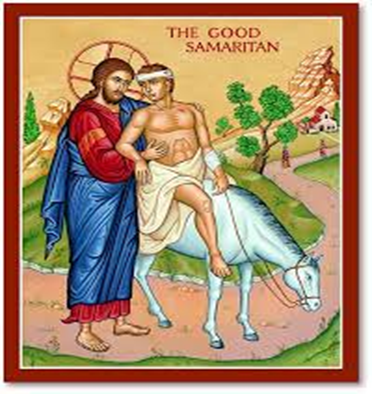
When I was a youngster your neighbors were the people that lived next door to you or those who lived in your street or road they were the families you would go to when you ran out of milk or sugar to borrow some or to share the news about the people and happenings in the area. Sadly this is not the case today as we live in a world where you might not know your neighbour or who they are.  The Gospel story tells us about the Good Samaritan it is a story that all of us are familiar with.  It was the Samaritan who stopped with the man who was lying on the side of the road it was the Samaritan who was moved with compassion to help him. The Priest and the Levite walked on and passed by on the other side of the road because they felt that it was beneath their dignity to help the man when they should have been doing exactly that. Our Gospel story tells us what we should be doing in 2025 to show our love for our neighbors. First, it tells us that we must be willing to help even if others brought trouble on themselves for whatever reason. Second, our concern to help others must be practical. And lastly, our love for others must be as wide and as inclusive as God’s all encompassing love for us.  

We remember that God excludes no one from his love and care. At all times we must be ready to do good to others just as God is good to us we must be good to others. Jesus not only taught God’s way of love, he also showed how far God was willing to go to share in our suffering and to restore our wholeness in life and happiness. Jesus overcame sin, suffering, and death through his victory on the cross on Good Friday. True compassion not only identifies and empathizes with the one who is in pain, it also takes that pain on in order to bring freedom and restoration.  Our world is moving towards ways of doing things that hurt more and more people time after time instead of restoring them. We are in this world so we cannot pretend that it’s got nothing to do with us for it has everything to do with us as we are Christians. In these days with a lot of turmoil and confusion going on around us the words  of the first reading ring in our ears obey the voice of the Lord and we ask ourselves what is the Lord asking us to do? We are being asked to reach out in order to show friendship to our neighbors and those who have come to be our neighbors as migrants from other countries.

At the end of the Gospel Jesus askes the Lawyer Which of these three, do you think, proved himself a neighbor to the man who fell into the brigands‘ hands?’ ‘The one who took pity on him’ the lawyer replied. Jesus said to him, ‘Go, and do the same yourself.’ And he says exactly the same to us today here and now in 2025, so let us go now and do the same.

14Th Sunday in Ordinary Time

The 14th Sunday in Ordinary Time invites us to reflect on themes of peace, joy, and discipleship. The readings remind us of God’s blessings, our call to share the Gospel, and the hope we find in Christ and his message. The readings also highlight God’s gift of peace. Jesus tells His disciples to bring peace wherever they go, showing that peace is central to Christian life. This is so necessary for all of us in our very troubled world where so many countries and people are at war with each other. In the First Reading  from Issiah we hear about the joy and comfort that the Lord will bring to his people, using metaphors of a nursing mother, a comforting mother, and a flowing river. The Lord promises to extend peace to his people like a river, and his people will rejoice and be glad, with their hearts flourishing like grass.

In the Second Reading  from Galatians we are told that The cross of Christ is important as the means of salvation and new life for believers. Paul declares that he will boast only in the cross of Christ, which has made him a new creation, and he encourages the Galatians to avoid the false teachers instead urging them to embrace the new creation in Christ. This Sunday’s Gospel tells us about Jesus appointing the 72 others and then sending them out in pairs to the towns he was going to visit. As he gives his missionary instruction Jesus is under no illusion about the territory compared to the wolves roaming around, his own crowds are like lambs. He tells the 72 to lead the radical lifestyle of the wandering preacher who must face homelessness and renunciation of family and property. When they enter a house they should bless it with peace. The Gospel also tells us about the practical things to direct the seventy-two as they proclaim the Good News of the Kingdom. Jesus told them to carry no purse, no haversack, and no sandals. Proclaiming the Good News of the Kingdom and rebuilding community life are two sides of the same coin. One does not exist and cannot make sense without the other there is a clear urgency about the task in hand with urgency in his voice Jesus says, “Start off now”. On their return the disciples were delighted that their mission has actually worked!  

Their joy demonstrates that the people welcome the word of God and that the word of God is their real resource for mission. There will be a time of crisis with the wolves roaming around and currently we seem to be  living in a time of crisis with so many things that are wrong in the world.  Jesus speaks to us to reassure us and tells us to hold on to all that is good. The Gospel, of course, is not about an historical 72 people being sent out. It is about the mission of every disciple of Jesus. Spreading the message of the Gospel is always done by winning over hearts and minds through the example what we say and do. The fullness of life is the message and the mission of Jesus  who empowers us in our time and place to work in his name to build up the kingdom.  Real rejoicing is not to be had in the conversion of great numbers of people, but in knowing that we  have done the will of God. Our mission where we are today  is to proclaim to others the hope that is in the good news of salvation so that the world will believe May our hearts be open to his words! May our hearts direct our minds! And may our minds direct our hands in the work of the Lord as we go forward in faith and hope.

Saints Peter and Paul

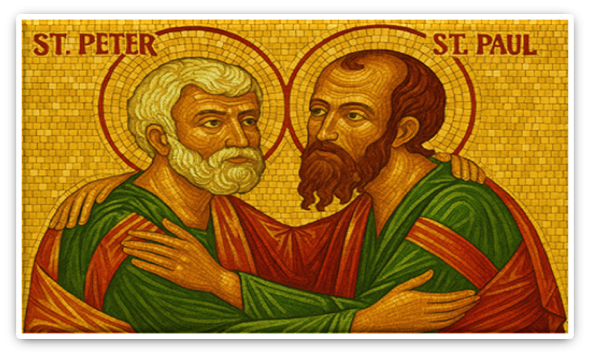
This Sunday June 29 is the feast day of Saints Peter and Paul. These were the two men that  God used to spread the gospel and lead the early Church despite terrible persecution. In the Gospels Peter stands our as apostle who most frequently took  the initiative when they were with Jesus. The Acts of the Apostles portray him as the undisputed leader of the early Church, undergoing enormous hardships and fearlessly facing persecution for the sake of Christ. He was a man of action. He spent his last years in Rome, where tradition tells us he was martyred during the persecution of Nero, in 64 0r 65 AD. St Paul who was well versed in rabbinical learning, at first persecuted the Christians, he has a vision of Christ on the road to Damascus which changed his life. After three years in solitary retirement in the dessert of Arabia , he plunged into a life of intense missionary activity, Tradition says that the was martyred in Rome around the year 67.

The Jews of Jesus’ time were not a free people. They lived under harsh Roman occupation. Yet they held fast to the belief that God would send a king to liberate them a Messiah who would overthrow their oppressors and bring justice and peace to the world. They had waited a long time, trusting in God’s promise. But no one knew exactly who the Messiah would be, what he would be like, or when he would come. Many expected a warrior-king who would lead a revolt against the Romans. Others hoped for a religious reformer who would purify the Temple and restore true worship. Some even claimed to be the Messiah, but the Romans quickly eliminated them, and their followers scattered. In the First Reading  from the acts of the apostles  we are told that Herod imprisoned Peter to appease the Jews. With the Church praying fervently for Peter, an angel appeared, shining light into his cell. Unchained, Peter followed the angel past guards, through self-opening gates, to freedom. In the Second Reading we hear that Paul, seeing his end was near, tells us  I’ve run the race, I have kept the faith. A crown of righteousness awaits me. The Lord gave me strength, protection, and he will guide me to His heavenly Kingdom.

In the reading from Matthews gospel  Jesus asks His disciples about the people’s opinions regarding His identity. Simon Peter declares that Jesus is the Christ, the Son of the living God. Jesus acknowledges Peter’s revelation, affirming that upon him, whom He calls Peter, to be the rock that he will build His Church on, and the powers of death will not overcome it. Jesus entrusts Peter with the keys of the Kingdom, granting him authority to bind and loose matters on earth and in heaven. Jesus then asks the disciples, “But, who do you say I am?” It is Peter who adds to the title ‘Son of Man’ by recognising Jesus as ‘the Christ, the Son of the living God’. Jesus names Peter as a happy man. This same Peter whose faith faltered when he was buffeted by the wind and waves of change now shows his openness to God and recognises Jesus for who he is. But this is not the end of Peter’s story. There are ups and downs in his response, as we see that in Matthew 16:21-23 when this ‘rock’ of faith becomes a ‘stumbling block’ to God’s purpose.  In spite of that, Jesus names Peter as the ‘rock’ on which he will build the church. Throughout the centuries Peter is our Holy Father the Pope , Peter the fisherman was the first pope and pope Leo is his successor as the living embodiment of Peter the  rock of faith who is called to build up the church in 2025.

Peter and Paul so different in background and temperament each met Jesus and responded in faith to what they heard and saw. Both Peter and Paul show us how to be courageous in sharing our faith. They faced prison, hardship, and death because they loved Jesus and wanted others to know Him. Their courage encourages us to think about how we live our faith. Do we share it with others? Do we trust God when things get hard?  Peter’s job at the beginning of the church is the same  as it  is today for Pope Leo that is to use the ‘keys of the kingdom’ to unlock the reign of God’s grace and send it out into the world. Are we prepared to be his coworkers where we are right now ? This Holy Year is all about hope often times we feel hopeless and helpless when we see all that is going on in the world around us. Our Prayer and support for one another and our faith leaders is always important.  Our hope filled prayer is that we will be courageous like Peter and Paul as we live and share our faith as they did at the beginning of the Church.

Corpus Christi

As  we gather for the feast of Corpus Christi we remember all those places at war this weekend sadly we add Iran to the list of countries at war. With all that is going on it would be very easy to loose hope or at least be a lot less hopeful that things will improve but I am reminded of the saying that hope springs eternal. Even though things seem to be hopeless for so many we have to continue our prayer for peace and not loose our hope.  Our prayer for peace as well as praying for the leaders of the nations to have the wisdom to do the right thing are indispensable and we have to keep on praying  especially in the current world situation.  

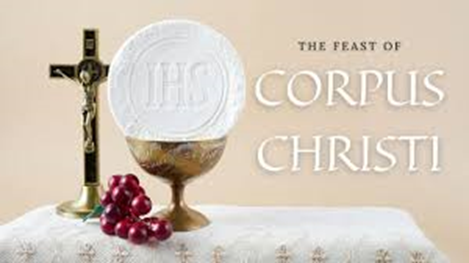
In the First Reading  Melchizedek, king of Salem and priest of God, brought bread and wine and blessed Abram. Abram gave Melchizedek a tenth of everything. In the Second Reading Jesus instituted the Eucharist at the Last Supper, saying the bread is his body and the cup is the new covenant in his blood, to be done in remembrance of him. In the gospel we hear the story of the feeding of the five thousand. The reading and the feast itself are filled  with the richness of faith. Jesus fills us with nourishing food both spiritual and physical. Then we are sent out to proclaim the good news of God’s kingdom to all around us, in doing this we provide spiritual food for others through the Word of God and the Eucharist. The Eucharist  is the sacrament of thanksgiving. When we see the Eucharistic Bread, we believe that it is Jesus who is there before us in the real presence such is our faith in the Blessed Sacrament. The Church tells us that the Eucharist is “the source and summit of the Christian life.” (CCC 1324)  

At the Eucharist God sees our hunger and feeds us through Word and Sacrament. Remember, the crowd in our gospel story was first taught, healed and then fed. Their hungers were both spiritual and physical . Now it is our turn, as well-nourished disciples, to find ways to address the physical and spiritual needs of the people we have noticed along the way who may be hungry. These needs can seem overwhelming. But, as with the bread and fish in the gospel story we take what the Lord has given us and give it freely to others. He will do the rest and all will be satisfied. The eucharistic meal is also a promise: one day we will sit at the banquet feast where there will be no more hunger,  no more illness and our satisfaction in God will be complete.  Corpus Christi is the solemn commemoration of the institution of the Eucharist on the first Holy Thursday in the upper room.  It is the Church’s act of homage and thanksgiving to Christ, who by instituting the Holy Eucharist gave us the members of the Church the body of Christ our greatest treasure.

The  feast of Corpus Christi celebrates the enduring sign of Christ’s presence with us personally in the Bread and Wine. It also celebrates Christ’s presence with us in the community of faith where we are. The Eucharist is our sacrament of communion, not only with Christ and God, but also with all those called into the Christian faith. Our communion binds us to one another in a sacred union of mind and heart with Jesus the Son of God our hope in an often times hopeless world.

PENTECOST SUNDAY

Ascension

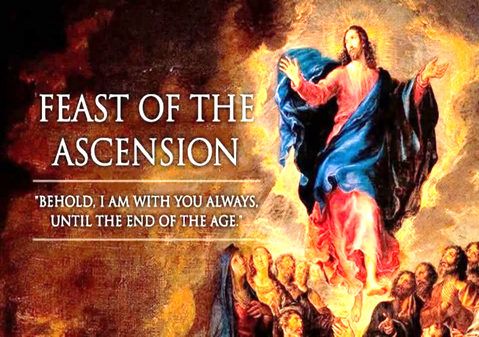
This weekend we celebrate the ascension. In this feast we celebrate Christ ascending into heaven and then taking his seat at the right hand of the Father. Our lives are made up of so many different times and places of leave-taking and that is what Ascension is really about Jesus leaving the Apostles to return to the Father. Jesus has called the ragged, group of disciples, scattered after his crucifixion, back to himself to form them, fragile and doubtful as they were, into a community for mission to go out into the world  in the name of God.

The Apostles must have felt awful as  Jesus  was leaving them even though he told them that I am with you yes to the end of time.  In the First Reading  Jesus instructed the apostles to wait for the Holy Spirit the paraclete and then ascended to heaven to the right hand of the father. In the Second Reading : we are told that Christ entered heaven to appear before God for us, sacrificing himself once to remove sin. We are called to  trust and approach God with sincere hearts, holding firmly to the hope that is within us. This Gospel reading is all about the past the present and the future. Jesus has little to say, but he is definite about what he has to say when he speaks. The disciples did what he told them to do. He asked them to meet him on the mountain, and they did that. Like any gathering of people, their feelings were varied. Some of them worshipped him, while some of them still doubted.

Jesus didn’t seem to have any great problem with that, because he knew that, when the Spirit came, all of those doubts would be ended. The redemption and salvation off the world was to begin at Pentecost and continue through the generations, until the end of time. It would seem, that he was in a hurry to take his leave of them, so that his plan for  our salvation could get underway. The mission of the apostles was simple to understand; difficult to carry out. It was to teach others all that Jesus had taught them. Just as he asked his disciples to follow him, they were to ask that others should follow him as well which was so hard then and especially hard in the world of today. Over the years so many things have changed in the Church and society. However two things that have not changed are the person of Jesus himself and his message as they are ever old and always new.

At  Easter and in  the weeks since we have been remembering the great events that have brought salvation to the world as we proclaim that Jesus is alive and  with us where we are in 2025. The feasts of the Ascension and Pentecost help us to realize that we are part of a long tradition of faithful faith filled disciples. All of us have our faults and failings, but our call is to be faithful witnesses to Jesus and what he teaches us. As a result of the actions we take and the things we say the people around us will know that we are followers of Jesus who are called to be the hope filled presence of God in the world today.

6th Sunday of Easter

This weekend we celebrate the 6th Sunday of Easter and soon we will celebrate Ascension and Pentecost Sunday. At the council of Jerusalem Paul and Barnabas receive endorsement of their policy of admitting Greeks and other pagans to the Church without requiring them to observe the law of Moses. Paul sees clearly that Christs coming means freedom for us. We are no longer bound by restrictions and laws if we observe the commandment of Jesus to love, Love God and others. The love of Christ will be the light illuminating our whole lives.  

In the First Reading from Acts the Apostles decided not to burden Gentile believers with the Jewish law and what it required from them instead they asked them to avoid certain things.  In the Second Reading  from the book of Revelation we are told that the angel showed John Jerusalem, shining with the glory of god. It had twelve gates and foundations named after the tribes of Israel.  In the Gospel we continue to read the Farewell Discourse as Jesus makes a number of promises to the disciples. Throughout John’s Gospel Jesus speaks about his boundless affection for the Father and the disciples. Another favourite theme of John is that, just as the Father and Jesus abide together in love, they will also come to abide in the heart of the disciple. Jesus does not speak these words in the sense of foretelling the future, but rather to prepare the disciples for their daily ‘remembering’ of, and making his words and actions present, in their own lives. Jesus promises to send the Holy Spirit to the apostles as the advocate.  

Although Jesus had spoken to the Apostles and told them many different things, he knew them well and realized that they wouldn’t remember everything he said Jesus also knew that they would have to endure many struggles, difference and disagreement.  The Apostles would not see eye to eye on everything; they would have different memories of Jesus; they would emphasise different things. In the conflicts that would arise they would have to put their faith to work.  That is why he told them that the Advocate, the Holy Spirit, whom the Father will send in his name, will teach you everything and remind you of all I have said to you. These words are a direct pointer towards Pentecost and the gifts that the Holy Spirit would bring to them as well as us.  We don’t have the physical presence of Jesus with us the way his first disciples did when he talked with them around the table at the Last Supper, washed their feet, and gave them his reassuring promises. His farewell to them was a real farewell he was going, he would no longer be with them. But he assured them and us that he is present in a different way, through his gift of the Holy Spirit.

Jesus also promised the Apostles Peace  ‘A peace that the world cannot give.’ Sometimes we mistake this peace for our idea of quietness or tranquility, but the peace the Jesus gives is a peace that can be found even in the midst of turmoil. This peace is not something we can manufacture ourselves by our own power. It’s a gift that comes from Jesus, who doesn’t want to lose touch with us. Jesus chose his followers to carry out God’s plan of salvation. He chooses us today to do the same, he gives us a personal stake in the Kingdom of God.  We remember the great gift that the Holy spirit is it is the breath of God that unites us. If we keep on trusting in the presence of the Spirit of God in our lives we will have peace in the midst of any personal, family, or community turmoil that comes our way as well as someone who will keep us going along the right Road !

Post Navigation