Fullerton T

RELIGION LITURGY AND LIFE

Archive for the tag “communion”

CORPUS CHRISTI

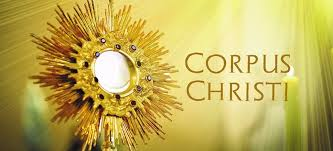
This Sunday we celebrate the feast of the Body and Blood of Christ also known as Corpus Christi. The readings for the Solemnity of Corpus Christi Year B give background for the notion of sacrifice and explain why we call Jesus the Lamb of God. The first reading describes how the Israelites sacrificed animals to seal their covenant with God. Moses relayed God’s laws to Israel, recorded them, and confirmed the covenant by sprinkling blood on the people, symbolizing their commitment to God’s commands. The second reading explains Christ is our high priest, but he also demonstrates sacrificial love. Christ, the perfect high priest, entered heaven with his own blood, not that of animals, offering us eternal redemption and mediating a new covenant. in the gospel Jesus instructs his disciples to prepare the Passover in a designated room, where he institutes the Eucharist and predicts he will not drink any more wine until he drinks the new wine in the kingdom of god.

 When we see the Eucharistic Bread, we believe that it is Jesus who is there before us what is known as the real presence such is our faith in the Eucharist.  We are thus in the presence of Jesus who has risen and conquered death and is now in Heaven, in the Glory of the Father!  The Church teaches that the Eucharist is “the source and summit of the Christian life.” (CCC 1324) This means that, because Christ is really, truly and substantially present in the Eucharist, we recognize that all the graces we enjoy come from this great Sacrament, and all we aspire to, the fullness of the life of God. Corpus Christi is a Eucharistic solemnity that is, the solemn commemoration of the institution of the eucharist. It is, moreover, the Church’s official act of homage and gratitude to Christ, who by instituting the Holy Eucharist gave to the Church and to us as members of the Church our greatest treasure the bread of life.  Each time we celebrate the mass we embody the covenant of Christ, wherein God sees in us anew the flesh of Jesus. It was not by the “blood of goats and calves that we hear about in the first reading but by the blood of Jesus that our sins were forgiven and our redemption was achieved.

Jesus Christ, “body, blood, soul, and divinity,” becomes substantially one with us as our food and sustenance. Thus God beholds each of us and sees in us the beloved Son he sent to save us. But it is not only God’s vision of us that is affected. Our own vision of ourselves and of each other is transformed. If we fully enter into the eucharistic mystery of Jesus we will  see each other as God sees us. By following in our Lord’s footsteps. Christians over the centuries have sacrificed greatly, in a labor of love, for their faith, their Christian way of life and their families. Then as now, it begins with each individual humbly asking God to show the way and to provide the eucharistic food needed to follow in His footsteps. This strength comes from the Eucharist the Bread of Life which is the body of Christ.
HolyThursday

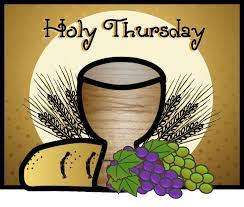
On this day  we recall Jesus’ commandment to love one another, his washing of the disciples’ feet and the breaking of the bread. The liturgy on Holy Thursday is a meditation on the essential connection between the Eucharist and Christian love expressed in serving one another. In the 1st Reading we hear  The Lordcommands Moses and Aaron to mark the new year and prepare for Passover. Each Israelite family is to select a flawless lamb, share as needed, and eat it with unleavened bread and bitter herbs. The lamb’s blood will protect them from the impending plague, signifying the LORD’s mercy as He strikes Egypt but spares His people, establishing an eternal commemoration. The Second Reading tells us  how Jesus established the Eucharist.Breaking bread, He offered it as His body, and the cup as the new covenant in His blood, instructing us to commemorate His sacrifice in this act until He comes again.

The Gospel  tells us that Before Passover, aware of his imminent departure, Jesus demonstrated his love by washing his disciples’ feet, a task for servants. Peter initially resisted but accepted upon understanding its necessity for fellowship with Jesus. Jesus used this act to teach humility and service, emphasizing that followers should emulate his example of serving others. Christ is not only present in the Eucharist but also in the deeds of loving kindness offered to others through us. We are the ones who make ‘real’ the presence of Jesus in the world today in what we do and say as Christians. The theme running throughout this day is one of humble service of God and his people.  The Evening Mass commemorates the Last Supper with the theme of service and sacrifice both of these are aspects of the same mystery.  We see Jesus as one who serves, who gives himself.  Just as he freely gives himself in washing the feet of his disciples, so too he gives himself  in the bread and wine he takes, blesses and hands to the disciples.  

In the same way we receive Jesus in the form of Bread and wine from the hands of our priests. All these acts of self-giving are the same act that of the Son of Man who came ‘not to be served, but to serve, and to give his life as a ransom for many.’ The action of the Church that is our action  as the body of Christ on this night also witnesses to the Church’s respect for Christ’s Body present in the consecrated Host in the Adoration of the Blessed Sacrament, carried in solemn procession to the  Altar of Repose. No Mass will be celebrated again in the Church throughout the world until the Easter Vigil on Saturday evening when we proclaim the Resurrection of Christ.  As people who are Christians that is followers of Christ We should embrace all those who are in need of any kind as Christ did. We should be leading lives of generous service to all those who need our help wherever they are and there are many people around who may need our help and care.    When we serve our brothers and sisters we are called them that our God is an all-loving and caring father in heaven then the Eucharist whenever we partake of this great sacrament will bring us joy and peace.May we take up the mantle of humble service giving a helping hand to others and not counting the cost to ourselves. Many people over the years have given much at great personal cost and have not failed in their example of humble service and that for me  is what  Holy Thursday is all about  Humble service for others and not being afraid of being the presence of Christ for others in our world.

Post Navigation