Fullerton T

RELIGION LITURGY AND LIFE

Archive for the tag “prayer”

All Saints & All Souls
This weekend we celebrate two feasts All Saints on Saturday and All Souls on Sunday.  These feasts are rich in tradition and spiritual significance and they invite us to reflect on the universal call to holiness that we see in the lives of the Saints and the enduring bond between the living and the dead. It is important not to confuse All Saints’ Day with All Souls’ Day. While All Saints’ Day honours those who are Saints in heaven, All Souls is dedicated to praying for all the faithful departed. On November 1st the Church celebrates all saints the great multitude of those who are in heaven enjoying the beatific vision. During the early centuries the Saints venerated by the Church were all martyrs. Later November 1st   was set  as the day for commemorating all the Saints.

What must we to do in order to join the company of the saints in heaven? We “must follow Jesus footsteps as we seek  to do  the will of the Father in all things.  In this way, the holiness of the People of God will grow into an abundant harvest of good, as is admirably shown by the life of so many saints in Church history” (Lumen Gentium)  The feast of All Saints should inspire us with tremendous hope.  Among the saints in heaven are some  people who we have heard of such as Pope Saint John Paul, Padre Pio and more recently  Carlo Acutis .  But there are so many more ordinary people who show us how to be saints by the way they lead their lives and we try to follow their example. All Saints Day is a time to thank God for the saints. We pray to them for their help as we believe they are with God in heaven and will intercede for us. On the 2nd Novemberafter rejoicing  with the saints in heaven we  pray for all those souls in purgatory as they  await the day when they will join the company of saints. The Feast of All Souls serves as a poignant reminder of the connection  between life and death, love and loss. It invites us to reflect on the lives of those who have gone before us in faith, to pray for their eternal peace, and to cherish the memory as we remember their presence with us.  

In a special Part of  the eucharistic prayer the priest remembers all those who have fallen asleep in the Lord, imploring God to grant them a place of happiness, light and peace in the kingdom of the father. Through prayer, remembrance, and tradition, All Souls’ Day offers comfort and hope to the faithful, uniting the generations in spiritual communion with one another. In a special way during November we remember our families and friends who have died. We also remember all those faithful people who have passed on and we pray for them during the whole month which is known as the month of the Holy Souls. The two days work together. All Saints’ Day is a celebration of those already in Heaven, while All Souls’ Day is a day of prayer for those still waiting to get there. Both days help us remember the importance of eternal life and our connection to the whole Church, in Heaven and on earth. So this weekend we pray with the saints in heaven as we remember all  the holy souls who need our prayers  may they rest in the peace of the kingdom of God.
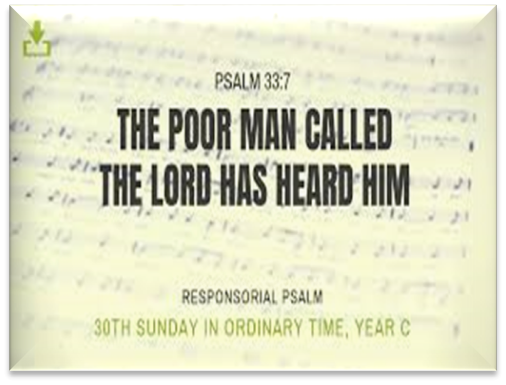
30th Sunday in Ordinary Time

It is hard to believe that we are almost at the end of October with the schools having the midterm break for Halloween next week. It is also hard to believe that next Saturday we celebrate the feast of All Saints closely followed by all souls the next day. The readings in our Liturgy for this weekend are all about the HUMBLE person of faith. The readings for this Sunday also remind us that God sees the heart. He listens to those who are humble and cries out for justice. He does not turn away from the poor or the weak. Instead, He cares for those who trust Him. In the First Reading  God, who is no respecter of personages who is just and impartial, listens to the cries of the oppressed the poor and the humble, ensuring their prayers are answered and justice is swiftly delivered.

In the second reading Paul speaks about his struggles. He has stayed faithful to his mission even when others abandoned him. He knows that God is with him and will bring him safely into His kingdom. Paul’s words show that faith does not mean life will be easy. He faced many hardships, yet he never gave up. He trusted that God would give him strength. Even when people turned away from him, he knew he was not alone. The Gospel reading teaches that humility is necessary to be with God. Jesus tells a parable about a Pharisee and a tax collector. The Pharisee stands confidently, thanking God that he is better than others. He lists his good deeds, believing they make him righteous of course they don’t. The tax collector, however, stands at a distance, unwilling to lift his eyes. He simply prays for mercy. Jesus says it is the tax collector who goes home justified. What does the Gospel Reading about the tax collector and the Pharisee say to us today ? Also and more importantly what about the words of the Tax Collector who said in a simple humble way  God be merciful to me a sinner what do these humble words  say to us? I think that the Tax Collector despised by the people because of the job he does  is saying to us that we need to have the humility to be humble before God who knows that we are sinners even before we say it and we also have to be humble with other people dealing with them with real humility.

 Real humility is about facing  the truth  about the truth about ourselves we are and often times we don’t like to hear the truth about ourselves or any situations we might be in.  The person who is truly humble will always see pride in him or herself as a bad thing.  The person who is humble believes him/herself to have nothing, when in fact he has God, who is all and everything for him!   The person who knows  how to be dependent on God humbles himself so much,  putting himself in his proper place before his Creator, and  the Lord lifts him up to his own Glory in order to make him his adopted child.  In a word, he who humbles himself, God justifies! The more someone makes himself small in the eyes of god, the more the Lord is pleased to come and live in him and to make him shine with his divine light before other people.  In our modern world, Pride which was very strong in the words the Pharisee spoke dominates the world, and it is this pride which often leads many people the world over down a long lonely path.  The old saying rings true that pride comes before a fall and we see this  in so many places and situations we might find ourselves or perhaps we have seen other people in. Today, We shall approach the altar of the Lord with humble hearts and minds. This approach testifies at once to our humility and to our grandeur.  It testifies to our humility, for we humble in believing that what we see as bread is not bread but rather the Body of Christ. 

It testifies to our grandeur, for, in communion, we truly become the Body of Christ, adoptive sons and daughters in the only Son of God!  May this approach be our justification, for the salvation of the world! I finish with these words from Micah which really sum up the gospel reading for this Sunday and what does the Lord require of us? He requires us To do justice, and to love kindness, and to walk humbly with our God. So let us go into the world with true humility in our hearts and minds so we are able to serve those who need us most where we are.

29th SUNDAY OF ORDINARY TIME MISSION SUNDAY

This Weekend  we celebrate the international missionary effort of the Church throughout the world. Here in Ireland for many centuries there have been so many great Irishmen and women  who have gone to foreign lands to bring the faith of our fathers to those who might not have got the faith otherwise. Today as we celebrate Mission we ask ourselves what is our mission where we are today what are we doing to promote the kingdom of god?  Mission Sunday gives us the opportunity to thank god for the faith that we have as well as acknowledging and thanking god for all those faithful missionary men and women who left everything in order to bring the faith and the light of Christ to the far corners of the world.

The readings for this Sunday speak about prayer, faith, and trusting God’s help. They show that God listens to His people and gives them strength. Even when life is hard, God does not leave us alone to bear the burden. In the First Reading – Amalek attacked Israel. While Joshua fought, Moses stood on a hill with God’s staff. As long as Moses’ hands were raised, Israel prevailed. Aaron and Hur supported Moses’ hands, and Joshua defeated Amalek. In the Second Reading  we are told to Stay faithful to the Scriptures, which provide wisdom for salvation. All Scripture is inspired by God. We are called to proclaim the word persistently, with patience and encouragement. In our Gospel for this Sunday Jesus tells us about our need to pray and not to lose heart when we don’t get what we pray for straight away. Over a long period of time many people have prayed for various things for example family concerns for healing of body mind or spirit or whatever. Some people ask me why god is not answering their prayers straight away in the here and now of the present moment and I tell them that their prayers will be answered when God sees that they really need whatever they have been praying for. My own experience is that we often pray for things and don’t get them straight away but we get the things we prayed for when we really need them.

Remember that No great work can ever be achieved without long and patient effort and this is the same for us in our prayer lives. The work of patient persistent prayer will yield results as God helps us to get through all our problems big and small. Remember the saying that nothing is impossible for those who have faith and even if our faith is the size of mustard seed it can move mountains.  The prayer in today’s gospel is the prayer of petition. If our prayers are always prayers of petition, we run the risk of being selfish and self-centered; except, of course, when the prayers of petition are for others. Like one of the ten lepers in last weeks gospel, we ask, and then when our prayers are answered, we return to give thanks to God. When we meet the judge and the widow in this Sundays Gospel passage we meet them at a crisis point. We have no case history for the widow but we do for the judge. He is a hard man who isn’t influenced by religious principle or by public opinion. Both justice and compassion are absent from his dealings with the widow. She has no influential friends to bring pressure on the judge and she has no money to bribe him: all she has is the justice of her cause and her own persistence. Jesus encourages us to be persistent in our prayer and never lose heart.

We live In an age where we have become accustomed to instant results all the time and we are impatient with what appear to be endless delays in god’s response to us. The danger is that we give up too quickly, that we rest our case too easily and then move on to something else. We have to be persistent; we have to invest time in our faith and prayer will help us to do this. Through this parable, Jesus teaches us the need for perseverance in prayer. This perseverance develops our trust and confidence in God. It helps us to  to realize how weak we are when left to ourselves. It keeps us close to God, as we learn how dependent we are on His generous love. If we would realize that God is perhaps closer to us than we realise when we think He is forgetting us for he never forgets us! As we continue the Holy Year of Hope let us continue to be people of faith grounded in patient persistent prayer.

REFLECTION AS WE PRAY FOR PEACE IN GAZA

Throughout the Catholic Church in Ireland on Sunday 24th August we have  being asked to pray for peace in Gaza. There seems to be no real concrete way for the ordinary man in the street to contribute to the peace efforts but that is not true . Here in Northern Ireland we began the journey into our Peace Process then after a lot of hope filled prayer this process began to have results with ceasefires and then on the 22nd May 1998 the Good Friday agreement was signed. I am sure you are asking yourself wherever you are reading this what has this got to do with Gaza and peace there. It has a great deal to do with Gaza and peace because if you do not bring the waring factions and countries together to find some sort of common ground you will have little or nothing you will only continue the war with all its horrible consequences and there will be a day of reckoning for those who did and said nothing.

The reflections of older Germans who lived through the era of Hitler and the Holocaust serve as a sobering reminder. Many questioned their own actions or lack of action  during those dark years, asking themselves whether their ignorance was wilful or simply a matter of indifference. The burden of conscience is one they carried to their graves, knowing more could have been said and should have been done. We  must consider what our response will be and what future generations will say about our response to the violence that is currently taking place in Gaza. Considering what is going on there currently will we be able to say that we did all we could, that we prayed for peace, and that we rejected the violence and the injustice that is going on all sides? Or will we admit to sympathising with it, justifying it, or simply turning a blind eye saying it doesn’t concern me so why should I bother? As individuals, especially those who identify as Christians, we hold a profound responsibility to be men and women of peace doing all we can to promote and maintain peace.  The teachings of Christ emphasise the importance of bringing peace into every home and heart. If peace is not welcomed, it returns to us but it is our duty to continue offering it. The peace of Christ spreads only through our  personal willingness to accept and share it.  This is the vocation of every believer: to regard all people as brothers and sisters, reconciled through Christ who sacrificed himself for the world on the cross.

The real question for us a we pray for peace in Gaza is can we move out of our comfortable lives and say what needs to be said and do what we has to be done for the powerless masses of people in Gaza who face injustice and war everyday. In praying and working for peace we may have to suffer in some way  because we profess the name of Jesus.  It could simply be that we will be ignored by many people dismissed by those who consider themselves more worldly wise. But we take courage from those on the margins who, in the footsteps of Jesus have challenged the structures of intolerance and war.  Ultimately, our responsibility and our call  is clear: to be people of peace, to reject violence, and to live the values of the Gospel  in our lives. We must not allow ourselves to become complacent or indifferent to what is going on but instead, we should act as agents of peace and reconciliation wherever we are. In doing so, we contribute to the possibility of peace in our communities and across the world. Recently the Latin Patriarch of Jerusalem, Cardinal Pierbattista Pizzaballa said  the pain and dismay at what is happening is great. Once again we find ourselves in the midst of a political and military crisis. We have suddenly been catapulted into a sea of unprecedented violence.  The hatred, which we have unfortunately already been experiencing for too long, will increase even more, and the ensuing spiral of violence will create more destruction. Everything seems to speak of death.  Yet, in this time of sorrow and dismay, we do not want to remain helpless. We cannot let death and its sting (1 Cor 15:55) be the only word we hear. That is why we feel the need to pray, to turn our hearts to God the Father. Only in this way we can draw the strength and serenity needed to endure these hard times, by turning to Him, in prayer and intercession, to implore and cry out to God amidst this anguish.

This Sunday we turn to God in prayer for Gaza for the relief of the suffering of its people that those hardened hearts may turn away from the violence and become people of peace. In Down and Connor diocese where I live in Ireland our Bishop issued a pastoral letter suggesting that we might do some of  the following during the day of prayer for peace in Gaza Light a candle in your family home or local parish church; attend Mass, spend time before the Blessed Sacrament; pray the Rosary; make some small personal penance or sacrifice, so that the light of hope will radiate out from the island of Ireland for peace, for Gaza and for the future of its people. As we Pray for Gaza and the end of the conflict there we remember all the other conflicts that are ongoing at the moment as we rededicate ourselves to pray for peace in Gaza and the world. We pray that the peace of Christ that passes all understanding will dwell in our hearts and souls so we may see the hope that his call holds for us.

17th Sunday of Ordinary Time

As we continue our journey during the year of Hope we pray for peace in the war torn places in the world. our readings for this Sunday encourage us to pray and ask God for good things and he always answers but not in the ways we might want. In the First Reading God tells Abraham He will check on Sodom and Gomorrah’s sin. Abraham asks God to spare the city if innocent people are found and ten innocent people are found, and God dopes not destroy the city. In the second reading  we are told that In baptism, we were buried and raised with Christ. The reading goes on to say that God forgave our sins, cancelled our debt, and made us alive with Christ by nailing our sins to the Cross.

 In  this Sundays Gospel  one of the disciples, having seen Jesus at prayer, asks him to teach them how to pray. In response to this request Jesus teaches them how to pray in the words of the our Father. He also encourages them to be unwearied in their prayer because the Father who loves them will hear their pleas. My experience of praying to god for something is that we often get the thing that we pray for not when we think we need it but when god knows that we really need it.  The greatest example of prayer that has been passed down to us through the generations is the Mass. Each time we gather as a community of believers to take part in the Mass we reaffirm our belief that God is made incarnate in Jesus his Son. We also bring all our intentions with us and we leave them for god to answer in his own time. Persistence in prayer is a worthwhile exercise because the God we believe in is not some sulky, withdrawn figure who is unmoved by what he hears and sees remember that our God is with us who knows us and gives us what is good. The message of Jesus in the our Father is that our God is one who cares for us as well as concerned about us and those who are close to us.

The most important part of our human life is what we become through faith in the will of God the Father. When things don’t go the way they should, we benefit from our prayers. Think of Jesus in the Garden of Olives. He prayed what was coming his way would not happen. He also added he would abide by God’s will when he said Abba, Father let it be done as you not I would have it. If we continue to look for the will of God we will grow, despite the good and  bad things that come our way we will know that God is for us our  refuge and our strength in all things. As we reflect on the readings this Sunday we are invited to engage in prayer with boldness and trust. Like Abraham, we are encouraged to pray constantly for others, persistently asking God for what is good and just, even if we do not understand why things happen the way they do especially in our world today.  Like the disciples in the Gospel, we are taught to pray with confidence, knowing that our Father will give us what we need for us to live as faithful hope filled children of God.

16th Sunday in Ordinary Time

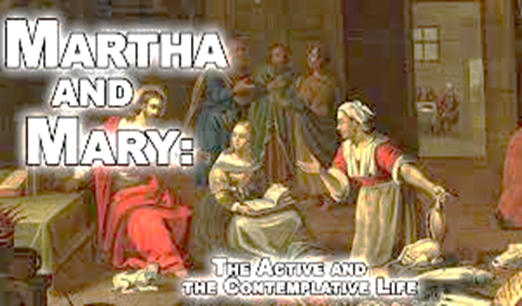
The readings for this Sunday have a focus on hospitality. What are some ways we can provide hospitality for others? Do we only care for their physical needs or do we also take the time to listen to them as St benedict says with the ear of our hearts?  In the First Reading  The Lord appeared to Abraham, who welcomed three visitors with hospitality. One of them promised that Sarah would have a son within a year. In Second Reading  Saint Paul tells the Colossians I suffer for you to share Christ’s afflictions and reveal the mystery of Christ in you, our hope of glory.In our Gospel reading this Sunday we hear all about Martha and Mary. On his way to Jerusalem, Jesus led his entourage into the village to call at  the home of Martha. As the good host, she served them but, her sister, Mary, sat listening to Jesus.

Martha tried to shame Mary into helping with the work but Jesus would have none of it. Instead, he praised Mary’s choice when he said leave her alone for she has chosen the better part.  Martha loved Jesus as much as Mary did, and it is clear that he treasured them both. Her mistake was in not trying to find out how Jesus wanted to be entertained, while visiting her house. Her sister senses that when Jesus comes on a visit the last thing he wants is to have people fussing over how to feed him. So, while Martha makes the greater housekeeping effort, Mary understands better what is expected of her by him. Her contemplative intuition grasps instinctively the real reason for Jesus’ visit.  He is there not to receive but to give, not to be served but to serve. He has something he needs to say and the one thing necessary is to listen to his voice. There is a whole theology of contemplation in this gospel reading, on how to receive the Lord’s visit. It starts off from the basis that, no matter who our visitors may be, there is always something to be learned, something from them. When Jesus comes to us he wants to talk to us in the quiet of the evening or the freshness of the morning, in the quietness of  our hearts and he wants to share with us the Word that brings salvation. He comes to us in the quiet moments not because he needs us but because we need him.

We too can be “distracted with all the serving;” we also “worry and fret about so many things.” As a result of all the worry and wonder we may, like Martha, miss the better part, for all of us the one thing that is necessary, is to listen to the Word of God with the ear of our hearts in the quiet moments of life. let us not be afraid of being like Mary and be attentive to what Jesus is telling each of us today. Let us listen again to what god is saying to us in the quiet and still moments of our lives and we will be surprised by what we hear for we will know that we  have chosen the better part like Mary in the Gospel.

GOOD FRIDAY

The origin of this day is traced back to Jerusalem and the veneration of the relic of the true cross.  This act of veneration stressed the cross as a symbol of victory.  In our good Friday Liturgy it is not the veneration of a crucifix, which would narrow it down to the historical moment of Jesus’ suffering and death.  Instead we venerate the Cross it is the sign of Jesus death on Good Friday.  On this day in the liturgy we read St. Johns account of the passion, we pray for the needs of the Church and the world, we venerate the Cross and we receive the blessed Eucharist.  When we think of the death of Jesus on the cross we realise that his death was a result of the courage of his convictions. He lived his life with a message of compassion and love, Jesus was often critical of those who lorded it over those who were less well off or who had little or even nothing at all.

The cross of Good Friday is a sign that all of us recognise, it is a sign of the completeness of the love that God has for each one of us faults and failings included.  It is not accidental that the Passion according to John is always read on this day.  This account shows that Jesus is always in charge, in total command of his situation.  John’s Passion is an extended commentary on an earlier statement of Jesus found in John 10:17-18:  “I lay down my life that I may take it up again.  No one takes it from me, but I lay it down of my own accord.”    The focus of the liturgy of Good Friday, is not primarily a meditation on Jesus’ pain, nor on our sinfulness, or our imitation of Jesus’ humility.  Instead  the focus on the cross as a reminder that we are beneficiaries of this event here and now in our own time. The final words of Jesus from the cross say it all for us, “It is accomplished!”  Jesus was not overcome. On the contrary!  He has overcome and the fact that we are celebrating Good Friday in 2025 bears witness to this.  When we go up to venerate the cross we should allow the cross to move us to be better people. Consoling, comforting and challenging the people we meet with the hope filled values of Jesus and the Cross.

2nd Sunday of Lent

1St Sunday of Lent

ASH WEDNESDAY

We start our annual  journey of repentance and conversion for 2025 with the Ashes of Ash Wednesday. The readings and the ashes call on us to change our lives in the spirit of conversion and renewal. There is a big question for all of us as we begin lent will the ashes of today help us to realise that we should have a change of heart and mind as we seek spiritual renewal in Lent, each individual will have the answer to that question for themselves. All of us will have many opportunities to strengthen our spiritual lives during  the 6 weeks of lent as we ponder what our faith really means to us as individuals and as a community.  Ashes hold deep symbolism in the Church, representing both our mortality and the need for repentance. This powerful symbol finds its roots in the Scriptures, where ashes were used as a sign of mourning and repentance. In the Old Testament, ashes were often associated with expressions of grief and sorrow. Job, for example, sat in ashes as a sign of his deep mourning and repentance before God.

The prophet Daniel also fasted and covered himself in ashes as a way of seeking God’s mercy and forgiveness for the sins of his people. These practices served as a visible reminder of our need to turn away from sin and return to God. On Ash Wednesday, we receive ashes on our foreheads as a sign of our own personal need of conversion and renewal of heart  and spirit. As the priest or minister applies the ashes, they say the words, “Remember that you are dust, and to dust you shall return.” This solemn reminder prompts us to reflect on the brevity of life and the importance of living in accordance with God’s will. The ashes are a call to return to god and let go of the things that hinder our relationship with God and embrace a life of holiness.

In the First Reading –Joel 2:12-18: The Lord urges a heartfelt return to him with fasting and repentance, highlighting His gracious and compassionate nature, Slow to anger abounding in love. A communal fast is called, involving everyone, with priests pleading for mercy, leading to God’s compassionate response as he had mercy on the people. In The Responsorial Psalm – Psalm 51  we hear that each person in acknowledging their own sinfulness, implores God’s mercy. As all of us seek a renewed heart and spirit, with God’s presence in our lives and the restoration of the joy found in salvation. The Second Reading  tells us that we are called to be reconciled with God. Christ bore our sins to make us righteous as we  Embrace God’s grace, for now is the time of salvation. As ambassadors of Christ we are called to be reconciled to him and through this reconciliation we are called to be reconciled to one another.

In the Gospel reading from  Matthew  Jesus emphasizes the importance of sincerity in the practice of faith. He advised against performing acts of charity, prayer, and fasting for public admiration, as such actions lack true spiritual value.  Instead, he encouraged discreet and private expressions of faith, assuring that God, who sees everything that is done  in a quiet prayerful way, will duly reward genuine devotion. Lent is all about moving forward in a spirit of conversion and prayerful return to god that is the spirit of metanoia. So the Church asks us at the beginning of Lent to renew our own lives through the great spiritual works of prayer, fasting and almsgiving, and to listen to Jesus’ advice in today’s Gospel. On ash Wednesday the ashes are a call for us to change our lives and how we live them. We begin our journey for lent 2025 and we receive the ashes as a sign that we are willing to return to god who says return to me with all your heart and we do that in a special way during this holy  year of hope.

Post Navigation