This weekend we stop and say a prayer for all those who are doing exams at the moment A levels GCSE’S or University exams, Our world puts great store on education and sometimes it forgets the pressure that this puts on our young people especially at exam time and not all of them are able to deal with that pressure. During this exam season we remember all those who are finding the exams hard to get through and we pray for all those who are doing exams in the days ahead that they may be inspired to do their best and know that there are people out there family, friends teachers and lecturers who value them no matter about the exam results.
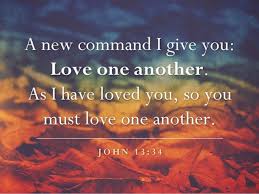
In this Sundays Gospel Jesus calls us to a new way of living when he tells us to love one another as I have loved you. At one level this is a simple call to love, at another it is a big challenge for us to be Christ like to others in this sometimes horrible world. This means that we should love as Jesus loves, in order to be the face and heart of Christ to a wounded and hurting world.
It seems to me that our faith should constantly challenge us to live lives of love, love of God and love of one another and this ideal is so very hard to achieve. The love Jesus speaks of seems to be narrow and restrictive. He is addressing his disciples when he says, “love one another.” This love may seem insular and applicable just to an inner circle of his followers. Is he telling us that the sacrificial love he calls us to applies only to those around us in the Church? No, of course he is not saying that because we know from other parts of John’s gospel that Jesus’ mission of love includes an outreach to the world That outreach in our modern times must include all those who have left the Church for many reasons we should not leave them behind as many people might want to do. Jesus wants us to be united with him and one another in A loving and caring community. A loving and caring community that has a great effect on others bringing those who might be doubtful with it. What more articulate proclamation of the gospel can there be than a group of diverse people drawn together, not by similarities in education, economic status, neighborhood, citizenship, race, etc., but by the love that God has for them and their bringing that love for one another to other people? A community such as this couldn’t help but draw others into it and to one who is the source of their universal love. We are called to be that community showing the love of God to those around us and this is not easy to do but we should try and not be afraid to do that as we go forward.
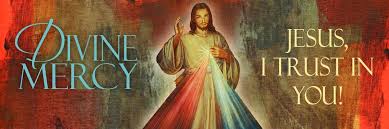
This Sunday we celebrate the great Mercy of God on the second Sunday of Easter that has come to be known as Divine Mercy Sunday. We celebrate the mercy of God made known to us in a particular way by Saint Faustina the polish nun.
I was sitting here a few days ago thinking that the season of Lent, Holy Week and Easter Sunday have come and gone so quickly this year and are now a distant memory. Many people think that Easter begins and ends on Easter Sunday but it doesn’t end there, the celebration of the season of Easter goes on for 50 days and ends on Pentecost Sunday. I wonder what the Apostles would think if they were to come down to us these days and find that we are celebrating the Death and Resurrection of Jesus that took place over 2000 years ago, they would be amazed especially as they thought everything was over with the Crucifixion on Good Friday.
In this Sundays Gospel reading the Apostles were still huddled together behind locked doors, pondering the shocking experience from the week before when all seemed to be lost. Then we are told that Jesus appeared to them and to assure them that He was alive. His message must have troubled them as well when he told them: “As the Father has sent me, so I am sending you.” In the same way as the apostles were sent out we are sent out to bring his message of god’s mercy and love to other people wherever we are. Then of course there is doubting Thomas who heard the witness of the those who saw Jesus but, like so many of us today he wanted more proof. Jesus says to Thomas, “Have you come to believe because you have seen me? Blessed are those who have not seen and have believed.” That is a favorite quote for many of us, who have not “seen” the risen Christ in person as the disciples did. We have come to believe though we have not seen him in the flesh but he is with us in the midst of our communities through so many different people. When Jesus says to the Apostles Peace be with you the Peace he is talking about is much more than the lack of conflict.
True peace, gives us happiness, since it is built on trust in God and one another. The gospel tells us how Jesus gave his followers peace because they trusted him. In spite of the skepticism of Thomas and so many others, Jesus offers us the same peace of heart mind and soul. As we celebrate Divine Mercy Sunday we remember the joy, the hope, the grief and the anxieties of the people in our time those we know and those unknown to us and we bring them to the merciful Lord. Our world is hurting so much because of the things that are happening within it with so many people at each other’s throats for so many reasons. May all of us be witnesses to the love and mercy of the Gospel as we bring the caring face of God’s mercy to the people in our own communities wherever we are called to be.
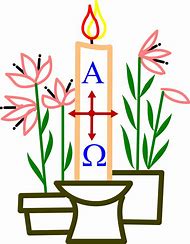
The Forty Days of Lent are over. We have celebrated the beginning of the priesthood and the Eucharist on Holy Thursday. We have also celebrated The Passion and Death of the Lamb of God and the tomb is now empty as we wait on the joyful call that Christ has risen from the dead. The darkness of good Friday is gone and the flowers in our churches symbolize the New Life that has come into the world. Jesus Christ lives! He has Risen as he said he would and his light lights up our world. During the Easter Vigil we lit the Easter fire and from that fire we have lit the Paschal Candle that will be used over the next year.
Our Gospel story for the vigil tells us that we should not look for Jesus among the dead for he has risen and the light of Christ lights up the darkness of our lives and our world. The Easter celebration is an invitation to come out of darkness into the light of the risen Christ. In that light we see him and recognise each other as brothers and sisters in the Lord. It is that light which summons us to leave the darkness of our lives behind and all of us have some of those dark places. As a result of Jesus conquering death on the cross nobody can be written off as a lost cause ever again. Year after year when we celebrate Easter we hold as holy the memory of God’s great love for us when he raised Jesus from the dead. We believe that God’s graciousness will be extended to ourselves and that our own death will not be the final word. Our faith tells us that we will participate in Jesus resurrection on the last day. But a question raises itself: is our faith in the resurrection limited to remembering Jesus’ resurrection and hoping for our own on the last day? Hopefully it will mean more to us than that.
The resurrection of Jesus is a proclamation that this outcast from Galilee is the beloved Son of God who cannot be held in the darkness of death because someone else takes action. Jesus did not raise himself; he was raised by God his father. All of us believe that God’s work continues not least because we believe Jesus’ words: “I am the resurrection and the life.” Our celebration of the Easter Season begins with our celebration of the Resurrection of Jesus on Easter Sunday with the Vigil on Holy Saturday evening during which we welcome and baptise Adult converts to the faith Then on Easter morning we celebrate our Easter masses as we renew our baptismal promises and don’t forget that the feast of Easter continues for 50 days until Pentecost. So full of gratitude for Christ’s passion, with joy in his resurrection and, strengthened by the Spirit, we continue our Christian journey this Easter time.
We await the resurrection at the tomb in the quietness of Holy Saturday. All seems to have ended yet this is only the beginning As we wait at the tomb we think about Mary the mother of Jesus and the disciples who were the witnesses to Good Friday how must they feel? As we think about them we also remember that we are the inheritors of this great salvation event and we pray:
Almighty, ever-living God, whose Only-begotten Son
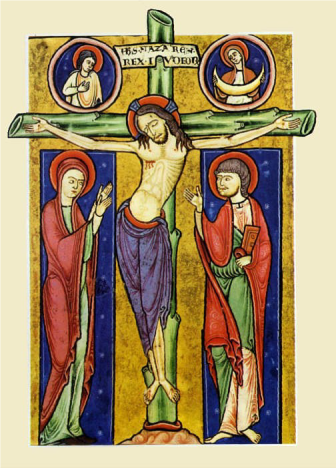
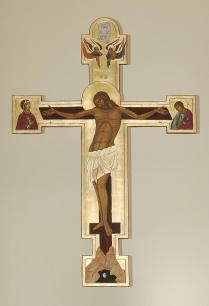
On this day in the liturgy we read St. Johns account of the passion, we pray for the needs of the Church and the world, we venerate the Cross and we receive the blessed Eucharist. We think of the death of Jesus on the cross, his death was a result of the courage of his convictions. He lived his life with a message of compassion, of equality and love, Jesus was often critical of those who lorded it over those who were less well off or who had little or even nothing at all. The cross of Good Friday is a sign and a symbol that all of us recognise, it is a sign of the completeness of the love that God has for each one of us faults and failings included.
It is not accidental that the Passion according to John is always read on this day. This account shows that Jesus is always in charge, in total command of his situation. John’s Passion is an extended commentary on an earlier statement of Jesus found in John 10:17-18: “I lay down my life that I may take it up again. No one takes it from me, but I lay it down of my own accord.” The focus of the liturgy of Good Friday, is not primarily a meditation on Jesus’ pain, nor on our sinfulness, or our imitation of Jesus’ humility. Instead the focus on the cross is a reminder to us that we are beneficiaries of this event and so we call the Friday “Good” by thanking God for what God has done for us . The final words of Jesus from the cross say it all for us, “It is accomplished!” Jesus is not overcome. On the contrary! He has overcome and the fact that we are celebrating Good Friday in 2019 bears witness to this. When we go up to venerate the cross on Good Friday we should allow the cross to move us to be better people. Consoling, comforting and challenging the people we meet with the values of Jesus and the Cross.
How splendid is the Cross- of Christ! It brings life,
not death;
Light not darkness; Paradise, not its loss.
It is the wood on which the Lord, like a great warrior;
was wounded in hands, and feet and side,
but healed thereby our wounds.A tree had destroyed us,
Lent has ended and now we begin the Holy Week Triduum. The word Triduum is the Latin for three days that is Holy Thursday, Good Friday and Holy Saturday. The Church celebrates one liturgy each day. We should not think of the liturgies of Holy Thursday, Good Friday and the Easter Vigil as three separate events, all three form part of one single extended liturgy. In fact at the end of the Mass on Holy Thursday there is no dismissal and blessing instead we accompany Jesus to the Altar of repose and then leave in silence. In the same way there is no formal beginning and end to the Good Friday liturgy we enter in silence and again we leave in silence. This three-day liturgy concludes with the solemn blessing at the end of the Easter Vigil or at the morning Mass on Easter Sunday.
On Holy Thursday morning the sacramental oils of the sick and catechumens are blessed and the Chrism is consecrated. Also during the Chrism Mass the priests renew their commitment to serve the people of God. If we think about our priests they bring the love of God into the lives of so many people through their work in the parishes, in the chaplaincies to Hospitals, schools and so many other places as well. We pray in a special way for our diocesan priests as well as those who are members of religious and Missionary Orders that God will uphold them in their ministry. We also remember in a special way the Archbishop Bishops priests deacons religious and people of the Archdiocese of Paris today as they would have been having this Mass in Notre Dame this morning and we pray that god will get them through these days safe in the knowledge that many people are praying for them throughout the world.
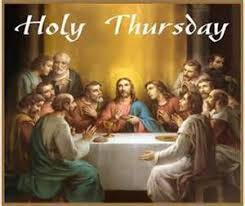
During the celebration of the Mass of the Lords Supper on Holy Thursday evening we hear two readings, Paul’s account of the institution of the Eucharist and John’s account of the washing of the feet during the last supper. John’s Gospel is full of signs of the Eucharist which are not read. Instead, we hear about Jesus washing the feet of the disciples. In the loving act of washing feet, Jesus demonstrates that one’s love of another is humble service, a bond of charity filled with grace and love. When supper had ended, Jesus took water in a basin and a towel and began to wash his disciples’ feet. He then commanded his disciples to follow his example by giving such loving service to others. On this night we act out Jesus’ command by participating in the foot washing. We are invited to have our feet washed and to watch the feet of others being washed. These readings make us aware that the institution of the Eucharist is tied to the demand of mutual love for one another.
Following the celebration of the Eucharist, we move in procession with the Blessed Sacrament to the chapel Of reservation there parishioners keep a watch through the night up to midnight. The custom of spending some time with our Lord on this night comes from the desire to give an affirmative answer to Jesus’ question, “Could you not watch with me one hour?” Participating in the Holy Thursday liturgy prepares us for the events of the next days in which we see betrayal ,death and resurrection.
As we continue our Holy Week journey we have come to the Wednesday of Holy Week and it is called Spy Wednesday, it was the day when Judas made his bargain with the high priest to betray Jesus for 30 silver pieces (Matt 26:14-16; Mark 14:10-11; Luke 22:1-6). Early Christians also used to fast on Wednesdays throughout the year in remembrance of the betrayal of Jesus. The name ‘Spy Wednesday’ is said to be of Irish origin, although the Bible never refers to Judas as a spy. His surname, Iscariot, is believed by some to be a corruption of the Latin ‘sicarius’, meaning “murderer” or “assassin”. Matthew narrates everything, not to criticize or to condemn, or discourage the readers, but in order to underline that acceptance and the love of Jesus exceed the defeat and the failure of the people of God! Because of the frequent persecutions, many were discouraged and had abandoned the community and asked themselves: “Will it be possible to return? Will God accept and forgive us?” Matthew responds by suggesting that we can break the relationship with Jesus, but Jesus never breaks it with us. His love is greater than our infidelity. As we look towards the three great days of the Easter Triduum we know that it is possible to return and that God will accept and forgive us remember the prodigal son and the woman caught in adultery whose stories we heard recently in our Gospel readings at our Sunday Masses.
Tonight we heard the sad news that Notre Dame de Paris was burning and I imagine at this stage nothing is left. As we continue our Holy Week journey we think of the French people and in particular we think of the people of Paris especially the Catholic Community there. It particularly poignant that this is happening during Holy Week as well as all that has been happening with the vandalism that has taken place in other French catholic churches in recent times. At times like these there is nothing that can be done except to express solidarity with our brothers and sisters in the faith that are affected by the tragedy of this fire especially at this time when we celebrate Holy Week. In holy week we celebrate life death and resurrection and tonight we witnessed the death of Notre Dame as it was and I feel certain that we will witness its resurrection in the future just as we will witness Christs death and resurrection later in the week.
This Sunday in our Gospel story we hear the story of the woman who was caught in adultery and we hear Jesus telling us ‘If there is one of you who has not sinned, let him be the first to throw a stone at her.’ Jesus did not deny the Scribes and Pharisees the right to carry out this prescription of the Law, but he insisted on one condition, namely, that they have no sin on their consciences. “Let the one among you who is without sin be the first to throw a stone at her.” So many of us today are like the Pharisees in that we are prepared to lift the stone and be the first person to throw it despite our own shortcomings. This story is about so much more that throwing the stones it is really about God’s mercy towards the woman and by association God’s mercy to us. When Jesus and the woman were left alone, he looked up and said, “Woman, where are they?” Ironically, the self-righteous observers of the Law, so eager to throw stones, could not measure up to the requirement that Jesus had laid down and all of them had left.
After they had gone, Jesus lifted up his eyes to the woman looking at her with the eyes of gentleness; he asks her, ‘Has no one condemned you?’ She replies, ‘No one, Lord.’ And he says, ‘Neither do I condemn you. What does this say to you and me today as so many of us are prepared to throw stones of condemnation at so many people and of course there are also people who would throw stones at us as well. This gospel story says to me that we should consider what we say and do and its effect on other people sometimes the things that we say can be more hurtful than any stones we might throw especially in today’s world of Facebook, Twitter and instant communication. If we remember what Jesus tells us when he says let the one among you who is without sin be the first to throw the stone then we won’t go far wrong. The simple truth whether we like it or not is a truth that some people just don’t want to know and that is all of us are sinners and none of us are in a position to throw the stone even though we might think we are!! As we continue our Lenten Journey let us ask the Lord to show us his way especially as we head towards Palm Sunday and Holy Week.
This weekend we celebrate the fourth Sunday of Lent which is also called Laetare Sunday. For us in the UK With all the madness of Brexit and the politics around that issue it is good to stop and reflect on this fourth Sunday of Lent. In the Gospel we hear the story of the Prodigal Son, the contrast between the two brothers is quite sharp. After wasting his share of his father’s fortune the younger brother recognizes the mistakes he has made and returns home looking for the mercy of his father when he says: “Father, I have sinned against heaven and against you. I no longer deserve to be called your son” (Lk 15: 18-19, 21). The older brother takes a different sort of attitude one of arrogance not only towards his brother but also towards his father! His scolding is in great contrast with the tenderness of the father who comes out of the house and goes to meet him to ask him to go into the house (Lk 15: 20, 28)
The big question that we should ask ourselves when we hear this story is what does God do when we turn away from him like the younger son in the Gospel? He does exactly the same as the Father in the gospel story did he waits and when we return he goes out to meet the returning Son or Daughter with endless love as the psalms put it great is his love, love without end. The gospel story of the Prodigal Son is an image of God the Father who invites us to experience his love and return when we go far away from him as he gives us a second chance, Of course being given a second chance is not always fair or just and we see this from the reaction of the older son who complains in a big way about his Father not giving him something to celebrate with his friends.
We remember that second chances are invitations to move forward leaving our old selves behind. Leaving our old selves behind and getting another chance is why we have the Sacrament of Reconciliation or confession. This sacrament is a chance to the wipe the spiritual slate clean, a time to start anew as a child of the Father. May we like the Prodigal Son not be afraid to come back for we will be received with open arms like the Father in the Gospel story god will come out to meet us for his compassion and love is without measure.