This Sunday everyone is back in the swing of things with the schools, colleges and various clubs and societies back in full swing with the summer holidays a now distant memory. Many people are asking themselves where did the summer go it seems like a blink of an eye since the end of June and many things have happened all over the world since then. For us here in Ireland the highlight was the visit of the pope to the world meeting of families in Dublin and it was a grace filled time for everybody whether you went to Dublin or not.
In this Sunday’s Gospel Jesus comes face to face with a deaf man who has a speech impediment. The man is doubly afflicted: he is a Gentile, regarded by the Jews as unclean, and is also physically disabled. Jesus takes him aside, away from the crowd, and cures his deafness and his stutter. Mark emphasises the response of the crowd, who publish their judgement that Jesus has done all things well. Thus the messianic prophecy of Isaiah heard in the first reading is seen to be fulfilled: “the ears of the deaf [are] unsealed… and the eyes of the blind are opened”.
Jesus’s love is available to everyone, without any conditions attached. He is not disconcerted by the disabled; neither is he prejudiced against those weren’t members of his own race or religion as we see with this man. The uniqueness of Jesus was not employed to lord it over others, but to be of service to them. In his presence there is no need to hide one’s disability, no one has to remain isolated in a godless world, and no one has to be rejected. Jesus’ acceptance and love open up new possibilities; for him, nothing is settled. Prejudice, on the other hand, tries to settle everything and in reality settles nothing and causes so much hurt and anxiety. We are people of faith, but our spiritual focus is often based on what we want. Many times we struggle between our “real needs” where god works through us and what we think we need. These shortcomings can lead us to discouragement many say that the “church does not fulfill my needs anymore”. On the other hand those same shortcomings can be turned around into a challenge for us to grow. Through growth in faith, we begin to listen and understand. Then, we can speak clearly. Our ears are no longer blocked. Our tongue is no longer held bound. Despite our shortcomings and weaknesses and all of us have many shortcomings, Jesus will touch our lives and call out to us.
Are we prepared to open our ears to the call of Jesus and open our eyes to see the needs of all those around us as we are asked to do, so that people around us may say that united to Jesus in faith we have done all things well.
Pope Francis has Landed. I am in shock as I write this I didn’t think that nearly 40 years after the visit of Pope John Paul to Ireland I would be writing about another pope visiting Ireland with the visit of Pope Francis to Ireland for the world meeting of families. I remember as a 12 year old the anticipation of the visit and even now the excitement is there as the pope comes to Ireland. So much has changed in terms of faith and people and it would be easy to be critical and many are with good reason but we need to stop for a while and bask in spiritual sunshine that the world meeting of families and the pope’s visit bring to us and the world. There is much that has changed in my lifetime in relation to the faith that we profess and family life and I am sure that much will change if the future. But the words of Oscar Romero who will be made a saint in October sum up what we are about we are workers, not master builders, ministers, not messiahs. We are prophets of a future that is not our own. So as we go forward we thank God that we are at this point and we acknowledge that we are not perfect as the Church is not perfect as we look to the future that is gods not ours to own.
In this Sundays Gospel, Jesus puts the choice to His apostles of following Him, or of leaving Him. Many of the Lord’s followers had left Him because of His teaching that He Himself is the Bread of Life. After hearing Jesus’ teaching on the bread of life, many of the people find Jesus’ language intolerable. As a result of this intolerable language some of them choose to leave him. Today in a similar way so many people find the words of Jesus to be intolerable language as many Christians have got up and left their faith behind them and some may never return again. When Simon Peter answered Christ’s challenge—”will you too go away?”—he spoke not only for his fellow-Apostles that day with: “Lord to whom shall we go? You have the words of eternal life.” but for all of us in our own time and place as well, people who really believe that Christ was the incarnate Son of God.
Peter made his act of faith before he was fully convinced of the divinity of Christ, but he was already convinced that Christ was close to God and spoke nothing but the truth. We have the proofs of Christ’s divinity which Peter and the Apostles later got. We have also the faith of two thousand years of Christian people whose belief in the bread of life as a sacrifice and sacrament was at the very center of their Christian lives. This belief was passed down to us through each generation. We have also the noble example of many martyrs who gladly gave their lives in defense of this truth. “Lord to whom shall we go? You have the words of eternal life.” Lord we will go to you for you have the message of eternal life now as in the past and will lead us into the future by your grace and hope.
It is now just a week to the visit of Pope Francis to the World Meeting of families here in Ireland. It is against the backdrop of the recent abuse allegations against the retired archbishop of Washington and the grand jury report into the dioceses of Pennsylvania that the Holy Father will visit us. The sense of betrayal that I feel is awful each time I hear about these events is nothing compared to how the victims must feel. We pray in a special way for all the victims of those priests and bishops who have let the people of god down in doing such horrible deeds.
Our Gospel Reading for this Sunday suggests when we take Communion we really are taking real Food and real Drink. The receiving of this gift becomes the acceptance and acknowledgment of the Lord’s care for us and thus, ultimately, the nourishment we need to continue the journey. Sometimes it is not easy to put one foot in front of the other, let alone continue on the journey of faith.
In His book To Live Is to Love, Ernesto Cardenal says, “If in everything you fulfil God’s will rather than your own, every encounter in the street, every telephone call, every letter you receive, will be full of meaning, and you will find that everything has its good reason and obeys a providential design. To “live in love” requires us to be connected to the Love of God. There is one concrete way that the Lord helps us to make this connection that is by providing the Eucharist the bread of Life. In the bread and wine offered at the Eucharist, the risen Lord makes himself present. While the priest invokes the words of blessing (thus acting as the instrument of Christ or “in persona Christi”), the conversion of the bread and wine into the blood into the Body and Blood of Christ remains the initiative of God (specifically, the Holy Spirit). The offer to partake in the “living bread” is God’s offer of unity with Christ and his followers (his “body,” the Church). The attraction of the Eucharist or Blessed Sacrament is dynamic. Jesus is dynamic.
When we receive communion or when we come to pray before the Blessed Sacrament, we don’t receive an inanimate object. We don’t kneel before a static entity. This is not a crucifix or a statue that reminds us of something. This is Jesus. The One Who Is who was and will be in the future. When we receive communion or come to adoration, we take within ourselves or we come before the dynamic, powerful Presence who speaks to us through the life He has given us. How great is our God. He has found a way for each of us to have continual, intimate encounters with Him. Let us pray, for those whose access to the Gift of the Eucharist or Blessed Sacrament is not so easy whether they have left the faith or perhaps they might be struggling with it or for many they may not yet found it as we remember that Jesus has said ‘I am the Bread of life he who comes to me will never be hungry.’
We are now in the final countdown for the world meeting of Families and the visit of Pope Francis to Ireland. There are many voices out there saying many things with the southern politicians giving it the full measure of political cheap shots instead of trying to work with one of the world’s great leaders. However we have to get on with preparing ourselves for the great event and its hard to believe that it is nearly here.
The Gospel reading for this Sunday deals with a doubting audience, they were shocked and critical of Jesus’ claim to have come down from heaven as the Bread of Life. Despite the miracles they had witnessed, and the words of wisdom they have heard preached with such convincing authority, they could not take the extra step to accept His claim. We are able to take that extra step because our Christian faith has come to us from Jesus passed down through the apostles and many others who accepted the message for what it was and is God’s message.
we know where he came from, we know where we are going and we know how to reach that destination. Of all the knowledge a human being can acquire on this earth, the above facts are the most essential and important that through Jesus we hear god’s message of salvation. Our Christian faith and its message gives us certainty about eternity and our journey toward it. The personal faith that we have has passed down to us through each generation and this means that God out of the abundance of his love, speaks to us as friends and lives among us as the living bread which came down from heaven. The Gospel lesson for today tells us that we can’t do it by ourselves. We need Jesus. And we find Jesus through the teachings and Word of God. It is through our communion with him, in him, and through him in the eating of the bread of life that his flesh becomes the life of the world. It is in our relationships of love with each other and our listening to God and learning from God that we experience Jesus among us. In living simple lives of being kind to one another, compassionate, and forgiving one another, we are empowered to be imitators of God.
So, at the end of each day, when we give thanks for all of our blessings, most of all, we should give thanks to God for the presence of Jesus in our lives.
Well here we are nearly at the end of July and for us here in Ireland the summer break is almost at the half way mark. We are looking forward to the World Meeting of Families in at the end of August to be held in Dublin and we also look forward to the visit of Pope Francis as part of this event.
In the Gospel reading for this Sunday we hear the story of the feeding of the five thousand. The crowd is huge can you imagine five thousand people and all of them are hungry: for physical food in a deserted place and hungry for still more. They are hungry to be acknowledged, to feel counted and recognized. Like those of us gathered for Eucharist each Sunday, they are also hungry for what Jesus had to say about God. They hunger to know that God is on their side, when the rest of the world considers them insignificant. How can their physical hungers be fed, there is no food around? How can their spiritual and human hungers be noticed, their need to feel important, and their hunger to know God be filled? In their Roman- occupied world they are slaves. In their religious world, a long way from the seat of their faith in Jerusalem and the religious elite, these Galileans were considered next to pagans;
ignorant and a long way from God when in truth they were nearer to God than many of the righteous people of the day. There is some food there, but almost nothing in the light of the numbers who are hungry. In this story the food of the poor barley bread counts and it is not an insignificant gift. It’s given by a boy, it’s all he has, and he makes it available.We tend to measure the size of any problem that may arise and then back away, shrugging our shoulders, “What can I do about such a big problem?” Well we in simple terms have to face the problems head on and the boy in this Gospel is a good example for us: better to do something about the situation we are in than nothing at all. The life implication of this gospel is simple: Jesus wants to work the miracle of feeding a huge number of people who are hungry; but the miracle will not happen without someone to provide five barley loaves and two fish. The end of this passage is important: “and all ate and were satisfied. And they took up what was left over, twelve baskets of broken pieces”. Jesus asked the disciples to ensure that nothing was wasted: nothing thrown out!
The people in this story realize that Jesus had something to offer them in the deserted and lonely places in their lives. Jesus wasn’t just filling their stomachs he was also nourishing their souls. They weren’t rich, famous, educated or powerful; they were the afflicted and marginalized people that Jesus went out of his way to seek out. Life may have passed them by, but Jesus didn’t. He took note of them, and they in turn saw in him a place to be nourished, a place where deep hungers and longings of life would be fulfilled. The Gospel account of the multiplication of the loaves proclaims who Jesus is and provides food for thought and prayer. This Gospel also proclaims who we are as people who are hungry for what Jesus the bread of life has to say to us about God. Are we prepared to open our ears and listen to the message of Jesus in the Gospel so that we can pass that message on in what we say and do in our lives ?
This Sunday in our Gospel story we listen to Jesus as he tells the apostles ‘You must come away all by yourselves and rest for a while’. He first planned to give his Apostles a well-earned rest. They had evidently worked hard while out on their mission and a few days rest would restore their lost energy. He himself, too, must have been hard pressed, preaching and dealing with the crowds. In the absence of the Apostles he had no one to help him he too needed a rest. He, therefore, planned that he and they should go to a quiet corner of the Sea of Galilee where there was no village and where they would not be disturbed. As we all know sometimes the best laid plans go astray as the people got to the quiet spot first. He could have sent them away, but again his human compassion took over. Seeing these simple people of Galilee so anxious to hear about God and his mercy, he let them stay and began to preach the good news of forgiveness and hope to them.
Jesus cares for us and all those needing rest and spiritual nourishment as he did his apostles and crowd in our Gospel story for this Sunday! We have only to listen to Jesus speaking within our hearts to hear where we will find him. In addition to that blessing, we all know someone in our midst who mirrors the Lord’s unselfish care for others. Often we are the recipient of that care and attention. We might take those people for granted whether they be in our family, community, work place or parish. The widespread problems of so many are symptoms of deep unsatisfied longings to be loved and to love. Can we be a little more caring towards the lost and lonely people we know? And will we let Jesus say to us: ‘I was a stranger and you made me welcome, lacking clothes and you clothed me, sick and you visited me, in prison and you came to see me? Jesus has clearly identified himself with people in physical, emotional and spiritual need. To meet them is to meet him especially these days where so many have little or almost nothing and the few have so much.
Jesus has the answers to our questions; and they all come down to living a life deeply in harmony with God. And he not only tells us but shows us the way. He talks the talk but he also walks the walk. And his walk takes him eventually to Jerusalem and up the hill to Golgotha where he gave his life for us. And he invites us to walk with him; to walk with him as we listen to his teaching and experience his healing ministry, and then to walk with him on that last journey to the Cross to suffer and die and rise to new life with him. No wonder they wanted to hear more. So the call to us this weekend is that we should come apart and rest for a while and as we rest we should recharge our spiritual batteries as we look for and listen to Jesus.
This Sundays Gospel sees Jesus going back to his roots in Nazareth. This is not a social visit: like other towns in Galilee, Nazareth and its people have to hear the Good News of the kingdom. When Jesus teaches in the local synagogue, many of the townspeople are astonished at the performance. They wonder at the origin of Jesus’ teaching and the nature of his wisdom, as well as the miracles that are done through him. From the unanswered questions about Jesus’ wisdom, the neighbours move to more familiar territory and focus on what they do know about Jesus. Whatever their wonder, they are not going to allow the wisdom of Jesus to interfere with their memories of him. Prior to this section in Mark’s gospel, Jesus has been doing some extraordinary things. His baptism by John in the river Jordan was accompanied by an affirming voice of the Father from the heavens, “You are my beloved Son. On you my favor rests.”
After his desert testing Jesus called his first disciples, cured the man in the synagogue with the unclean spirit and the paralytic in Capernaum; expelled the legion of devils from the Gerasene man, you may remember last week in our Gospel Reading Jesus raised the daughter of Jairus, cured the woman with hemorrhage, Jesus is doing wonderful things as he proclaims, in word and deed, the coming of the reign of God. Though he did all the wonderful things the people still had little faith which also seems to be the case these days. The people wanted the powerful signs of God’s final coming with a strong right arm to rescue them. But when Jesus spoke about the signs of the kingdom’s presence, he spoke of scattered seeds and, to emphasize the kingdoms small beginnings, he compared it to a mustard seed, “the smallest of all of the seeds of the earth” Where was God’s show of power and mighty arm in a tiny mustard seed? Mark sums up their reaction, “And they took offence at him.”
And so it is today as many take offence at the values of Christianity and the good it makes for all of us in our world. A world which in many respects is so faithless with many people taking offense at Jesus and his teaching. Jesus revealed God’s presence to the people of Nazareth as a different kind of power: the power used only to help others, not ourselves; a gentle power that does not force or coerce people to do our will; the power of compassion and gentleness, when others are expecting force. All of us know from our own experience that when we admit our failures and limitations, that exercise in honesty can mark the beginning of a new understanding. If our Lord and God can take failure in his stride, we might even end up boasting about God’s fantastic message! What is the message of the wisdom of Jesus? Jesus message is really about using whatever power that we might have in a positive way to help others and the greater our weakness the more powerful we will be that is powerful with the power of compassion and gentleness.
This weekend we celebrate the 13th Sunday of Ordinary Time after the celebration of the Feast of St. John the Baptist. Though nothing about our lives in the present time is really ordinary especially as we in Ireland are preparing for the visit of Pope Francis in about 7 week’s time.
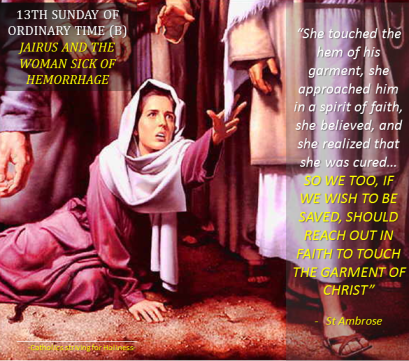
In the Gospel reading for this Sunday we hear about the woman who had the hemorrhage and we also hear about the official’s daughter. Whilst the stories are about the faith of the people involved they are also about the mercy of Jesus towards them both. Jairus, the synagogue official and loving father of a ‘desperately sick’ twelve-year old daughter, is convinced that if only Jesus would place his hands on her ‘to make her better and save her life’ she will surely recover. The unnamed woman, suffering for twelve years from a condition for which she has spent her life-savings on one doctor after another, has one last hope. She is convinced that ‘if she can touch even his clothes’, surely she will ‘be well again’ and then she was able to get near to Jesus and touched his garments.
The poor woman and Jesus know that healing power has gone forth. Jesus turns around, inquiring who is the one who had touched him. Fearfully, the woman admits that she is the one. Jesus immediately calms her fear, telling her to go home in peace, for she is healed. Then, He proceeds to the house of Jairus, where He learns that the little girl has died. Quieting all the commotion, He goes in with the child’s parents and Peter, James, and John. Taking the hand of the girl, He brings her from death to life, ordering that some food be brought to her.
It is worth dwelling on the detail of the stories because they give us an insight into the mystery of Jesus. They tell us about a man who has a fierce kinship with those who suffer, who does not disappoint those who look to him for help. Like Jairus, there are many people who suffer on behalf of their loved ones and who feel powerless when they are confronted by the pain of those they love The Gospel story of Jairus’ daughter is given to all of us as Good News. It is offered to us today to nourish our faith in Jesus, to enliven our hope in his power over death itself. We know there are those who mock that belief, professional mourners who believe that death must have the last word in every human story. There is no place for that attitude in the community that gathers in the Lord’s name. In the Eucharist we support each other in our shared faith, we confront real loss with Jesus at our side. And when the loss is deeply felt, we too need to hear the words of Jesus:
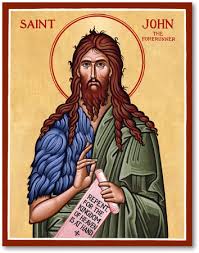
This Sunday we celebrate the feast of the birthday of St. John the Baptist also known as the forerunner who pointed the people of his time to the coming of Jesus. A desert prophet, he was outstanding for vigour, discipline and humility
The narrative of the Baptist’s birth revolved around the miraculous. An elderly couple could not have children, yet an angel told Zechariah, that his prayer had been answered. Zechariah was incredulous, so he was struck incapable of speech. But the couple did conceive a son. When Mary visited the boy’s mother, Elizabeth, the Spirit filled the boy when in the womb. Now, with the birth of the child, miracles would happen again. With the proclamation of the boy’s name, Zechariah regained his power of speech, only to praise God over and over. When speech was restored to Zechariah, he praised God to affirm his faith in the heavenly message he was given. In other words, Luke highlighted the movement of the Spirit over the parochial concerns of the immediate community. God, not humans, would guide events.
When John began final preparations for his mission, he withdrew into the harsh, rocky desert beyond the Jordan to fast and pray. When he came back to start preaching in the villages of Judaea, he was haggard and uncouth, but his eyes burned with zeal and his voice carried deep conviction. The Jews were accustomed to preachers and prophets who gave no thought to outward appearances, and they accepted John at once. So great was the power emanating from the holy man that after hearing him many believed he was indeed the long-awaited Messiah. John quickly put them right, saying he had come only to prepare the way, and that he was not worthy to unloose the Master’s sandals. His humility remained incorruptible even when his fame spread to Jerusalem and members of the higher priesthood came to make inquiries and to hear him. “Repent, for the Kingdom of Heaven is at hand,”-this was John’s oft-repeated theme. John the Baptist was the first of the New Testament Prophets, the very first of the witnesses to Christ. There is always a need for prophets in the Church and God has not been neglectful in providing them. There are people in our own day who speak up for Christ.
We may not consider ourselves saints but each of us can make a great impression on the world in our own way guided by the faith we profess. The message of salvation that John the Baptist preached to his people is meant for us too. We receive the salvation Christ won for us but we are also called like John to be heralds of salvation as we live lives of faith. May we be the people who point towards Jesus and tell those around us there is the Son of God let us follow him for he is the way the truth and the life.
This week we had the formal announcement of the timetable of Pope Francis visit to the World Meeting of Families in Dublin in August. The world meeting should be a reaffirmation of what it means to be a Catholic family in today’s world. Of course many people will have their own interpretation of this and in todays world of equality and peoples rights the whole idea of the Christian family is constantly under attack by those who say family is something different to what it really is. If we look at the Holy Family of Nazareth we need look no further to see what we as Catholics mean when we talk about family. Also this Sunday in one of our neighbouring parishes we have an ordination to the priesthood and we pray for Deacon Tony McAleese as he begins his priestly ministry in our diocese.
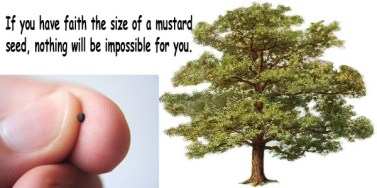
In this weekend’s Gospel we hear the story of the mustard seed the faith that we have is represented by the mustard seed and that faith is something all of us need to nourish. The Kingdom of God is like a tiny seed planted within each of us. It’s a strong seed, like those seeds that push their way through the clay in order to grow toward the light.
Gardeners out there will know that as we nurture the small mustard seed we have expectations for it and this is true for the seed of faith too. Sometimes our expectations are fulfilled, sometimes not. Other times, we don’t know how, but we find ourselves bearing the fruits of joy, compassion, peace, generosity, faith-fullness, gentleness, and thanksgiving for the wonder of it all. Then we know our growth in faith is a partnership with god and, while we can care for the seed, we can’t make it grow or flower or reproduce without nurturing it. The parable of the seed shows us that there is an almighty power working for us through the smallest thing the mustard seed. Our part is to do a good job preparing the soil of our hearts and then when we plant the seed we let God take over. As we see the Church continues to grow; for the Lord, not people, gives the spiritual growth. The Church will adjust and flourish in the future just as it has in the past. And when we are confronted with all kinds of things that run against what we believe in we should not despair, the Church not only lives on through the muddle and the mire of the world, it actually grows.
We also grow like the mustard seed as long as we do everything possible to stay united in faith with the Church. For in the face of turmoil, outside and within us, God is with us.


 Fullerton T