Fullerton T

RELIGION LITURGY AND LIFE

Archive for the category “LITURGY”

HOLY SATURDAY AND EASTER SUNDAY

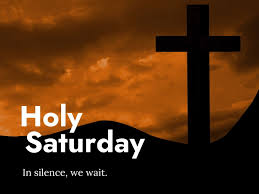
Having  completed our Lenten observance and after the liturgies of Holy Thursday and Good Friday we  are now getting ready to celebrate the Easter Vigil on the day of resurrection that is Easter Sunday. The Church and its people have  only one thing to do today: to pray through the emptiness of Holy Saturday. Holy Saturday is the day when we experience watching and waiting at the tomb as we await the celebration of the Resurrection which we celebrate in the Easter Vigil, easter Sunday and the season of Easter.Holy Saturday is about emptiness, the cross is empty and Jesus lies in the tomb everything around us is still.  It’s not hard for us to share Mary’s sense of emptiness and bewilderment when she arrives at the tomb.

If we were to read the next few verses from John’s Gospel, we would read a story of overwhelming joy as Mary Magdalen meets the risen Jesus. When Jesus speaks her name, Mary recognises him and sadness and emptiness give way to joyful reunion. It’s a story of transformation   how things can change when we meet the risen Jesus. The Psalm for Easter Sunday says, “This is the day the Lord has made; let us rejoice and be glad in it.” Above all days, Easter Sunday   is a day of hope filled joy. At Easter and throughout the Easter season we celebrate the kind of hopeful joy each of us longs for, when every tear is wiped away, and there is no sorrow and no more suffering. When we ourselves rise to meet our risen Lord, in that bright morning we will hear him say, “Come away, beloved. The winter is past; the rain is gone, and the flowers return to the earth” (Song of Songs 2:10-12).

In the loving union of that encounter, all the  brokenness  of our lives will be redeemed. That will be the perfect  joy we hope for.  Let us take fresh hope,  with Christ our Passover everything is possible!  Jesus Christ lives! He has Risen as he said he would and his light lights up our world.  During the Easter Vigil we light the Easter fire and from that fire we have light the Paschal Candle.  Our Gospel story for the vigil tells us that we should not look for Jesus among the dead for he has risen and the light of Christ lights up the darkness of our lives and our world.  The resurrection of Jesus is a proclamation that this outcast from Galilee is the beloved Son of God who cannot be held in the darkness of death because he was raised by God his father.

All of us believe that God’s work continues not least because we believe Jesus’ words: “I am the resurrection and the life.” Our celebration of the Easter Season begins with our celebration of the Resurrection of Jesus on Easter Sunday with the Vigil on Holy Saturday evening during which we welcome and baptize Adult converts to the faith   Then  on Easter morning  we celebrate our Easter masses as we renew our baptismal promises and don’t forget that the feast of Easter continues until Pentecost.  So full of gratitude for Christ’s passion, with joy in his resurrection and, strengthened by the Spirit, we continue our Christian journey of joyful hope this Easter time.

GOOD FRIDAY

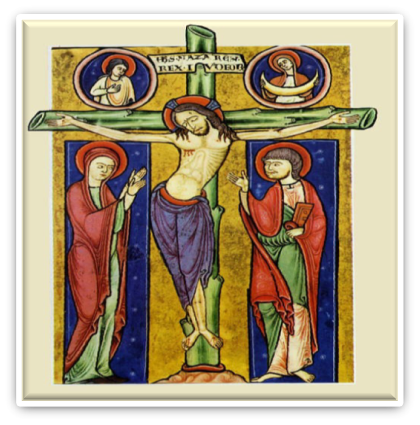
The origin of this day is traced back to Jerusalem and the veneration of the relic of the true cross.  This act of veneration stressed the cross as a symbol of victory.  In our good Friday Liturgy it is not the veneration of a crucifix, which would narrow it down to the historical moment of Jesus’ suffering and death.  Instead we venerate the Cross it is the sign of Jesus death on Good Friday.  On this day in the liturgy we read St. Johns account of the passion, we pray for the needs of the Church and the world, we venerate the Cross and we receive the blessed Eucharist.  When we think of the death of Jesus on the cross we realise that his death was a result of the courage of his convictions. He lived his life with a message of compassion and love, Jesus was often critical of those who lorded it over those who were less well off or who had little or even nothing at all.

The cross of Good Friday is a sign that all of us recognise, it is a sign of the completeness of the love that God has for each one of us faults and failings included.  It is not accidental that the Passion according to John is always read on this day.  This account shows that Jesus is always in charge, in total command of his situation.  John’s Passion is an extended commentary on an earlier statement of Jesus found in John 10:17-18:  “I lay down my life that I may take it up again.  No one takes it from me, but I lay it down of my own accord.”    The focus of the liturgy of Good Friday, is not primarily a meditation on Jesus’ pain, nor on our sinfulness, or our imitation of Jesus’ humility.  Instead  the focus on the cross as a reminder that we are beneficiaries of this event here and now in our own time. The final words of Jesus from the cross say it all for us, “It is accomplished!”  Jesus was not overcome. On the contrary!  He has overcome and the fact that we are celebrating Good Friday in 2025 bears witness to this.  When we go up to venerate the cross we should allow the cross to move us to be better people. Consoling, comforting and challenging the people we meet with the hope filled values of Jesus and the Cross.

Mass of the Lords Supper

Lent has ended and now we begin the Holy Week Triduum for the Holy Year of Hope. There is a saying that hope springs eternal and in the Holy Week Triduum we celebrate  the hope of Holy Thursday we go to the despair of Good Friday and then on Easter Sunday we  go back to the greatest hope that all of us have that is the resurrection. The word Triduum is the Latin for the three days Holy Thursday, Good Friday and Holy Saturday. We should not think of the liturgies of Holy Thursday, Good Friday and the Easter Vigil as three separate events, all three form part of one single extended liturgy. In fact at the end of the Mass on Holy Thursday there is no dismissal and blessing instead we accompany Jesus to the Altar of repose and then leave in silence. In the same way there is no formal beginning and end to the Good Friday liturgy we enter in silence and again we leave in silence.

This three-day liturgy concludes with the solemn blessing at the end of the Easter Vigil or at the morning Mass on Easter Sunday.  On Holy Thursday In the first reading from exodus we hear about the blood sacrifice on the door posts a sign that the people inside would be spared, freed from slavery and death. The death of Jesus becomes the Christian Passover, the sign of gods liberating love. We hear Paul’s account of the institution of the Eucharist in the second reading when he tells us this is what I have learned from the Lord and I am passing it on to you.  These readings make us aware that the institution of the Eucharist is tied to the demand of mutual love  and respect for one another.  On this day  we act out Jesus’ command by participating in the foot washing.  When supper had ended, Jesus took water in a basin and a towel and began to wash his disciples’ feet. He then commanded his disciples to follow his example by giving such loving service to others. Following the celebration of the Eucharist, we move in procession  with the Blessed Sacrament to the  chapel Of reservation there we keep watch up to midnight.  

On Holy Thursday we all bring our different stories here to the table of the Lord.  And we know there will be times when we will be sore, hurt and wounded; when there will be no one to talk away the terrors of the night; when we will occupy the garden of grief alone.  But Jesus has already travelled that road and stands with us. The liturgy on Holy Thursday evening is a meditation on the essential connection between the Eucharist and Christian love expressed in serving one another. Christ is not only present in the Eucharist but also in the deeds of loving kindness offered to others through us. We are the ones who make ‘real’ the presence of Jesus in every smile, kind word and loving action. As I said at the beginning hope springs eternal and we are called to be people of hope filled faith who look out for one another, people who follow Jesus  example by giving such loving service to others. It’s not just about “me” It’s about “us” and our hopeful journey of faith during these days of Holy Week and Easter and beyond as we go on into the future.  

PALM SUNDAY

5th Sunday of Lent

4th Sunday of Lent

3rd Sunday of Lent

2nd Sunday of Lent

1St Sunday of Lent

ASH WEDNESDAY

We start our annual  journey of repentance and conversion for 2025 with the Ashes of Ash Wednesday. The readings and the ashes call on us to change our lives in the spirit of conversion and renewal. There is a big question for all of us as we begin lent will the ashes of today help us to realise that we should have a change of heart and mind as we seek spiritual renewal in Lent, each individual will have the answer to that question for themselves. All of us will have many opportunities to strengthen our spiritual lives during  the 6 weeks of lent as we ponder what our faith really means to us as individuals and as a community.  Ashes hold deep symbolism in the Church, representing both our mortality and the need for repentance. This powerful symbol finds its roots in the Scriptures, where ashes were used as a sign of mourning and repentance. In the Old Testament, ashes were often associated with expressions of grief and sorrow. Job, for example, sat in ashes as a sign of his deep mourning and repentance before God.

The prophet Daniel also fasted and covered himself in ashes as a way of seeking God’s mercy and forgiveness for the sins of his people. These practices served as a visible reminder of our need to turn away from sin and return to God. On Ash Wednesday, we receive ashes on our foreheads as a sign of our own personal need of conversion and renewal of heart  and spirit. As the priest or minister applies the ashes, they say the words, “Remember that you are dust, and to dust you shall return.” This solemn reminder prompts us to reflect on the brevity of life and the importance of living in accordance with God’s will. The ashes are a call to return to god and let go of the things that hinder our relationship with God and embrace a life of holiness.

In the First Reading –Joel 2:12-18: The Lord urges a heartfelt return to him with fasting and repentance, highlighting His gracious and compassionate nature, Slow to anger abounding in love. A communal fast is called, involving everyone, with priests pleading for mercy, leading to God’s compassionate response as he had mercy on the people. In The Responsorial Psalm – Psalm 51  we hear that each person in acknowledging their own sinfulness, implores God’s mercy. As all of us seek a renewed heart and spirit, with God’s presence in our lives and the restoration of the joy found in salvation. The Second Reading  tells us that we are called to be reconciled with God. Christ bore our sins to make us righteous as we  Embrace God’s grace, for now is the time of salvation. As ambassadors of Christ we are called to be reconciled to him and through this reconciliation we are called to be reconciled to one another.

In the Gospel reading from  Matthew  Jesus emphasizes the importance of sincerity in the practice of faith. He advised against performing acts of charity, prayer, and fasting for public admiration, as such actions lack true spiritual value.  Instead, he encouraged discreet and private expressions of faith, assuring that God, who sees everything that is done  in a quiet prayerful way, will duly reward genuine devotion. Lent is all about moving forward in a spirit of conversion and prayerful return to god that is the spirit of metanoia. So the Church asks us at the beginning of Lent to renew our own lives through the great spiritual works of prayer, fasting and almsgiving, and to listen to Jesus’ advice in today’s Gospel. On ash Wednesday the ashes are a call for us to change our lives and how we live them. We begin our journey for lent 2025 and we receive the ashes as a sign that we are willing to return to god who says return to me with all your heart and we do that in a special way during this holy  year of hope.

Post Navigation