Fullerton T

RELIGION LITURGY AND LIFE

Archive for the category “LITURGY”

23RD SUNDAY OF ORDINARY TIME

Art Ordinary 23A


Well we are now at the end of the summer holiday months of July and August  and all the schools in our locality are back in full swing and all the various clubs and societies that closed for the holidays are now gearing up for the new season. It seems to me that time waits for no one and this must be true enough when my nephew who is 22 years old was wondering why his life was passing by him so quickly. It is very true that life is passing by all of us both young and old along with all the other age groups in-between and the question to be asked of all of us is am I doing what god wants me to do with my life?  

In our Gospel passage for this Sunday St Matthew recounts Jesus’ instructions to the disciples about how they should deal with a brother who does something wrong. This same instruction applies to us and our dealings with other people in the here and now of today. This passage is very different from those of the two previous Sundays. They were dramatic stories, marked by deep emotions and with deep implications for the characters involved. This is a little gem of a passage but with little drama, a very practical, common-sense teaching on that most common and most prosaic of community problems – conflict.

It is a great wisdom teaching which continues to be valid for us in our own time. Management has become a science today, and Jesus’ teaching stands up well as a model of how to “manage” conflict in any situation.  It is the duty of the disciple we are told  to point out the error and even if our correction might not be well received. St Matthew wants to let the Christians in his community know how to deal with those who drift away from the teaching of Christ or blatantly contravene the commandments. And he chooses those words of Jesus which most stress the authority and the competence of the Christian community, the Church, to deal with these cases: Whatever you bind on earth shall be considered bound in heaven; whatever you loose on earth shall be considered loosed in heaven.  However, there are some safeguards built into this teaching on reproving those who go astray. Jesus says that first of all you must have it out with him alone. This might lead to a speedy solution and the person’s good name is preserved. Yet it seems  from the gospel reading that the only sanction is that the person be excluded from the community of the Church. That is surely the meaning of the words: treat him like a pagan or a tax collector treat him as an outsider. But in considering such matters we must be very careful; for getting all worked up about the behavior of someone else  can frequently be a sign of something else, something much closer to home.  Encountering the truth about another person and ourselves is daunting  because it makes us face up to the other person and ourselves and the weaknesses that are part of us and all we are.

We may try to make others a function of our egos, but it fails. Rather than enter the struggle, in many cases we ignore it. Our human relationships mirror our relationship with God sometimes good  often times not so good. Whenever we encounter each other—not only in prayer—Jesus is in our midst let us remember this as we go forward as people of faith.



19TH SUNDAY OF ORDINARY TIME

GREEN CROSS1`


At the beginning of this week we had the centenary of the start of the First World War which was called the war to end all wars. As we know all too well the great war of 1914 did not  stop the world going to war many times after it ended in 1918. We only have to look at the modern world that we live in  to see so many places at war and Syria, Israel and Gaza, and the Ukraine all come to mind this weekend. We pray for those who have died or are being persecuted and we pray for peace.

The gospel reading this weekend is all about  Jesus  walking on water but if you look beyond the walking on water this story is really about trust and faith in God. We have no problem identifying with Peter he is so like ourselves . He is confident one moment and then, when things get difficult and he has bitten off more than he can chew, he falls apart. By then it is too late and he needs help. Life is like that, we start at something like a new job, college, marriage, or a project to help others, but then it gets complex and beyond what we are capable of. We didn’t realize it was going to require so much time and effort! We are sinking, we are drowning. Not an uncommon experience in so many situations of life and in the way we deal with them.

God doesn’t always give us an immediate cure or a fast solution when we bring ourselves in prayer  as well as  the problems of the day to God.  God, through Jesus, is not a distant Father aloof from our problems. Jesus shows us that when he reaches out a hand to Peter and to us he is companion with us in the storms of life.

At times we may well be floundering, like Peter, but Jesus reaches out to help us, to rescue us. What better image of salvation could there be than Jesus reaching out to Peter to save him from drowning. What better analogy could there be of our own lives and relationship with Jesus. We live messy lives, we doubt and we lack faith but nevertheless we are still moving towards the Lord. In the days ahead when we flounder and start to sink Jesus will be  there for us, reaching out with his saving hand ready to raise us up.

18TH SUNDAY OF ORDINARY TIME

eu06

Well here we are at the beginning of August its seems no time since the schools closed for the long summer break at the end of June and yet here we are halfway through the holidays!! It will be no time until the new uniforms etc will have to be bought and the schools will reopen at the beginning of September and the summer holidays for 2014 will be a distant but hopefully a  good memory.

In our Gospel story for this Sunday we hear about the feeding of the five thousand. The gestures and words of Jesus in the Gospel bring to mind the Last Supper The Gospel writer is making clear references in this miracle story to the Eucharist.

The people in this story are a crowd that realize Jesus had something to offer them in their “deserted places.” Jesus wasn’t just filling their stomachs. They were not the rich, the famous, the educated or the powerful; they were the afflicted and the marginalized people that Jesus went out of his way to seek out.  Life may have passed them by, but Jesus didn’t.  He took note of them, and they in turn saw in him a place to be nourished, a place where deep hungers and longings would be fulfilled.

The physical bread of the miracle story was of temporary value. It could not satisfy deeper spiritual hungers, but it was a sign that Jesus can and that his heart is moved with pity for us. Notice how he handled the food with reverence, the same reverence he felt for the crowd whom he knew were the beloved of God. The sign for us today  is that we too are the beloved of God and we will not be left hungry or alone for God is with us in the good and bad and happy and sad things that are part and parcel  of our daily life.


17TH SUNDAY OF ORDINARY TIME

1240649_10151794295986112_1848925939_n

Well here we are at the last weekend of July and the summer holidays are now at the half way stage for our local children. I’m sure there are many parents out there wondering when will the long holidays end but that said it will be no time until the beginning of the new school term in September. Despite all of our own worries and preoccupations we see the ongoing war with the Israelis and the Palestinians and the war between Russia and Ukraine. Not forgetting the ongoing Syrian conflict. Whilst many people will debate the rights and the wrongs of what is going on we have to remember that we have to constantly pray for peace. last Sunday 20th July, Pope Francis called on all the faithful to pray for Christians fleeing the Iraqi city of Mosul, and to “persevere in prayer for those situations of tension and conflict that continue in different parts of the world, especially in the Middle East and in the Ukraine” The only way that anything positive will happen in all of this will be when the opposing sides of the conflicts sit down face to face and talk. Our experience of the past 20 years in Northern Ireland certainly bears this out. We have an imperfect peace process but after a long time we have seen opposing sides talking with a view of trying to sort the problems out and it continues to be a work in progress.

This week we also stop to pray for all those who perished in the downing of the plane over Ukraine. We pray  in a special way for the families of those who died from so many different countries that they may find peace of heart and mind and that their loved ones will rest in peace.

In this Sundays Gospel we hear the story of the treasure hidden in the field. The kingdom of heaven is like a treasure buried in a field or a pearl of great price. When its great value is recognized, one gladly does all that is necessary to obtain it. The kingdom of heaven is also like a net that collects all sorts of fish. Just as the useless fish are eventually thrown away, at the end of the age the wicked will be rejected. To possess the Kingdom means to share our knowledge of it with others. To truly believe in Christ means leading other people to the same knowledge; for secret faith is no faith at all. We need to be like the householder, mentioned at the end of our Gospel reading for this Sunday, who brings out of his house things both new and old. We should be happy to bring out of the house that is our life all kinds of treasures to share with our neighbours.

But these treasures are not physical things like clocks and pearls but attitudes spiritual and otherwise that is virtues like love and justice and truth and hope and so on. What we bring out from our treasure store are the values of the Kingdom, the attitudes of Jesus and the knowledge of the one true God. God loves us just the way we are, but He refuses to leave us that way. He wants us to become just like Him. He wants us to become treasure for other people so that they can discover the faith which is the pearl of great price the treasure hidden in the fields of our hearts.


16th Sunday of Ordinary Time


This weekend  we hear the reading  from the first section from Chapter 23 of St. Matthews gospel, the story is the parable of the darnel in the field the seed and the weeds.  In the parable of the wheat and weeds, Jesus recognized good’s co-existence with evil. He also held out the hope that the Kingdom would right all wrongs. I think that there is the potential in each of us to be either wheat or darnel that is good and bad.

Looking back over the  notable events of the Twentieth Century we are reminded  that evil takes root even in the greatest good. National powers have fought two World Wars and several regional conflicts to protect the innocent. Yet, the death and destruction those struggles have produced staggers the imagination. Fighting evil seems, in a perverse way, to promote evil. It is difficult to listen to the daily stories about Syria, Israel and Gaza these days where so many innocent people are losing their lives. We are tempted to become very angry with one side or the other, or to turn away in despair. Seeing others argue and struggle can tire our hearts  and minds so that we might become cynical or unkind to those around us but if we are true to ourfaith we shouldn’t hurt the people around us even though we might be tired and want to be cynical.

We  often say ‘wouldn’t life be easier if everything were black and white’ as if there are ‘totally good people’ and ‘totally evil people’.  Of course life is never that simple.  If we are really honest nothing is ever that straightforward to be black and white. We need to ask ourselves Who are we called to be in a world where weeds and seeds grow side by side and we often find it hard to distinguish the difference between them.  We are called to be the body of Christ the Church which is a church of Saints and sinners a Church of Seeds and Weeds a church in which very little is black and white but that is the life we live as faith filled people of God. As people of faith  we have to constantly ask ourselves  3 questions :  Should we hide from the messiness and make religion a privatized personal relationship with God?   Should we insulate ourselves – sharing with those  we think are worthy of our love, deciding who is worthy? Where is God in all this concern, worry and judgment?  If we pray about  these three questions and our problems and those of others we will see god is there in the middle of everything and his hand will guide us and as a result we will be the seeds that flourish and not the weeds.

Jesus used parables to challenge his audience to think and he uses the parables in our world of today to  challenge you and me and make us think as well. The images and symbols in the stories allowed for various interpretations, depending upon the audience and their circumstances. Interpreting symbolic stories in this way is called allegory. To help relieve anxiety among his persecuted followers, Jesus told this parable as an allegory of good and evil. Obviously, Jesus recognized good and evil lived together in his time as we recognize the same today. But, when Jesus made that co-existence part of God’s Kingdom, he must have shocked his own followers. How could God allow such evil in the world? Shouldn’t God act to save his people? Why did he delay? These are questions that were asked in the time of Jesus and we still ask ourselves even in these days of rational so called clear minded thinking.

In authentic truth and charity we must speak to others and teach them about the great responsibility they have to choose either Life or Death to be weeds or seeds to be good or bad.God ‘s perfect love for us shows itself in the gift of our free will. We have the power to freely choose Him or to reject Him. Choose the Lord and His law that you may have life and live it to the full. Earlier I mentioned briefly the two world wars, in the next few weeks we remember the beginning of the First World War 100 years ago, it was known as the war to end all wars even though it was one of many and these days we think of the ongoing conflicts in many parts of the world. May we redouble of efforts to promote and pray for peace in our world, our hearts and in our minds.

May we see the seeds of the Kingdom of Heaven grow and flourish in our midst. Let us notice too that which is not fruitful or good.  But with and in all Let us bring everything and everyone to God, in prayer and reflective action – trusting that God who is good will care for us and for all he  has created.  Our calling then  is to participate as best we can in building up a world where God is King! God will decide on its membership, not us and he will guide us along the roads that lead to Salvation and he will help us to be the seeds that flourish.

15th Sunday of ordinary Time


THE SOWER IN THE FIELD

This weekend we arrive at the fifteenth Sunday of ordinary time. Lent and Easter are but a distant memory and we are now gearing up for the July holidays. This Sunday we hear the Gospel story of the sower who went out to sow the seed. For me the story  is really about the seed of faith with Jesus the sower and you and me as the soil on which the seed that is the word of God lands.

The context of today’s parable provides some insight into its interpretation and application The parable is located between stories of confrontation and rejection. As the early church faced opposition and a seeming lack of success, the parable must have given encouragement to the first preachers and members of the early church a promise of fruit not yet visible to them. Jesus is speaking to a large crowd. They may be listening to what he says, but as it is today some will follow him  and others will leave it all behind and go their own way.

He is realistic as he seems to randomly cast his words out upon the crowd. What he says will not seem to bear fruit – not straight away. Often that wee seed of faith may take root many years after it has been planted and today we see many people returning to the faith or coming to the faith for the first time after someone or some event in their lives planted that first seed with others helping nourishing the seed and helping it to grow.

What is striking about the parable is the amount of waste I’m sure those who are reading this who are recyclers will be horrified. The bulk of the details are about wasted effort and lost seed. Why wasn’t the sower more careful, after all farmers were poor and the seed was precious? Sometimes, we wonder if all our efforts and words are worth it when things are falling down around us. But if we stop for a moment and think about it anything done for God in faith is never lost.  

Very often things that are happening  in our lives don’t seem to be the way we might want  them to be but when we look at the problems with eyes of faith we see that things around us are the way they are meant to be for the good of all. We also  get the strength to  deal with the problems that go on through and in faith. Nobody really knows what’s beneath the surface of the soil we cast the seed of the word of god upon. Who knows the potential of the good soil? Do good and poor soil both exist in the same person I think that it most probably does much in the same way that a person can do good or be bad. Is there something we might say that will land on the interior good soil in a person and bear the “hundredfold, or sixty or thirtyfold” Jesus promises? who knows only God knows.

While the gospel parable begins with and spends time on hardships and failure it ends in surprise and abundance. What was the source of this abundance? We look to what Isaiah told us today in the reading about the fertile, life-giving nature of God’s Word. Our God is a God of surprises and our faith is also filled with so many surprises as well.

Despite any discouragement we might feel because our efforts on God’s behalf in many things seem futile and draining, we put our trust in the one who speaks to us a living word who sows the seed. The message of Jesus may not always be welcome especially in our modern world were faith and religion are constantly under assault by those who oppose the Christian faith based outlook on life. That said we still have to sow the seed of faith by what we do and say and then we leave the rest up to God our efforts are never futile and we don’t always see the fruit of the seed that s sown. Let us remember that tall oaks from little acorns grow.  and Our God is a God of surprises and our faith is also has many surprises as well. 


14th Sunday of Ordinary time


Lumen_Christ_fc_fcbd1b87d7564e20744f447023067804


THE LIGHT OF CHRIST

Well here we are at the end of another week at the beginning of July with all the local schools closed for the summer vacation with all the opportunities that this provides to get away from the hum drum coming and goings of daily life.  We also celebrate the 14th Sunday of the year on Sunday 6th July back to the hum drum of ordinary time after the various feasts that have taken place over the last few weeks since Easter including the feast of Saints Peter and Paul last weekend.

One of the most wonderful things about the person of Jesus has been and continues to be, his special love for ordinary people ­ for people like us with all our faults and failings. It comes out in a particular way within the two statements that he makes in this Sundays Gospel reading. The first is in his prayer to God: ‘I bless you, Father, Lord of heaven and earth, for hiding these things from the learned and the clever and revealing them to mere children.’ The second is in his Invitation to all of us: ‘Come to me, all you who labour and are overburdened and I will give you rest.’

Why did he say this? The answer comes across very clearly so many times in the gospels, and may be summed up in just one word – COMPASSION. For example: – The plight and tears of the widow of Nain touches his heart to the core: ‘Don’t cry,’ he says to her, before bringing her son back to life. He is moved with compassion at the plight of a leper begging for help (Mk 4:41), for two blind men sitting at the side of a road and pleading for mercy (Mt 20:29-34), and for a crowd of people with nothing to eat (Mk 8:2). In each case he responds to their sufferings with the power, love, compassion and care of God. All through the gospels, even when the word is not used, we sense the surge of compassion rising within his heart. ‘Don’t cry,’ he says, ‘Don’t worry’, ‘Don’t be afraid’ (e.g. Mk5:36; 6:50; Mt 6:25-34). He is not moved by the grandeur and beauty of the great Temple buildings (Mk 13:1-2), but by the generosity of a poor widow who puts her last coin  into the Temple treasury to assist others (Mk 12:41-44). When everyone else around him is jumping for joy about Jairus’ daughter come back to life, Jesus is concerned that she be given something to eat (Mk 5:42-43). Also in the second reading we are called to lead spiritual lives that is lives enlivened by our faith in God and what is taught by the Church inspired by the Holy Spirit.

Today in our world we see so many people constantly searching for new idols and these  idols are so easy to find, It is a world which has left the path marked out by God it is a world where so many have little or nothing and the few have so much. To be a Christian and to have the light of faith to guide our steps in the neo-pagan darkness of today’s world, is a gift, and a blessing from God, for which we can never thank Him enough.

So, in the here And now of our daily lives  the big question for each and everyone of us has to be whose side are we on? Are we  on the side of Jesus, that is the side of compassion, kindness, help, healing, and mercy? Or on the side of the scribes and Pharisees who are  amongst us even today  and they are – fierce, fault-finding, heartless, critical, and merciless people without much compassion. Will we take our cue from their cruel, harsh, and insensitive judgments and actions? Or will we take our inspiration from what we see in Jesus, and from his touching  compassionate outreach to the poor and the broken:  ‘Come to me, all you who labour and are overburdened and I will give you rest’?


Saints Peter and Paul

images (59)


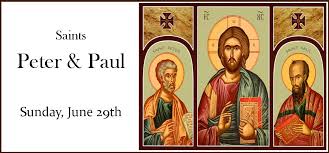
This Sunday we celebrate the feast of two of the greatest saints of the Catholic world, Saints Peter and Paul. Simon Peter, the fisherman, strong and sturdy of build with thick curly hair (as we know from an early medallion), was outgoing, generous, and impetuous. Paul, the intellectual, was thin-faced and balding, with deep-set piercing eyes.

The question Jesus puts to Peter in our Gospel reading is one he asks each us of today who do you say I am, who do we say Jesus is? At various times in our lives our response will differ, depending on the circumstances that confront us. During our broken times we might need Jesus to be our healer. When we must stand up for our faith against the actions or views of others we want Jesus to be the strong one for us. When our prayer feels dry and our perseverance in faith threatened as often times they will, Jesus must be “living water” in our desert. When we must be constant for a troubled member of our family Jesus, “the living bread,” must be our nourishment. Thankfully Jesus isn’t just a plaster statue, Jesus is the concrete sign and reminder to us of our “living God.”

Jesus is with us when we are broken and weak, he is with us when we stand up for our faith and he is with us when our prayer life seems dry he is the water in the desert of our daily lives. He is also the constant who is with us and our families in good times and in bad.  What brings us together this Sunday and every Sunday isn’t what binds other individuals into a community. It isn’t our common ancestry, race, language, nationality or economic sameness though these may well be important. The common thread drawing us is our shared faith in God and one another. With Peter we profess Jesus as “the Christ, the Son of the living God.” We may express that in different languages and varied cultural expressions but, in one way or another, we proclaim the same thing: Jesus is our Lord, the Son of the living God.
Today’s episode is a key turning point in Matthews gospel. Jesus praises Peter’s response as one of a true disciple who understands Jesus’ uniqueness and importance. Was Matthew trying to show how insightful Peter was? No, because while Jesus affirms Peter’s response, he also names how Peter came to it. It was a gift of God.  We celebrate Peter and Paul, our great heroes of faith. But we remember that is not how they started out. Through these very limited humans God has done a great thing. Once they expressed their faith, God could begin building the church of those who witness in Jesus’ name. Like Peter and Paul all of us are required to witness to Christ and some may even have to give their lives in his name. Jesus is at work in the church, building us up, healing our wounds, helping us resist the forces of sin and death. Jesus assures us that  the church, built on the faith Peter will prevail against all the evil the world can throw against it and here we are over 2,000 years later expressing the faith that Peter expressed all those years ago when he said ‘You are the Christ the Son of the living God.’


Corpus Christi


79AA94E9


This Sunday we celebrate the feast of the Body and Blood of Christ also known as Corpus Christi.In many places throughout the world the Feast of Corpus Christi would have been celebrated last Thursday but we in Ireland and many other places in the world  celebrate this feast on the weekend after Trinity Sunday.  When we see the Eucharistic Bread, we believe that it is Jesus who is there before us:  such is our faith in the Eucharist.  We are thus in the presence of the Resurrected One, He who has conquered death and who is now in Heaven, in the Glory of the Father!  The Church teaches that the Eucharist is “the source and summit of the Christian life.” (CCC 1324) This means that, because Christ is really, truly and substantially present in the Eucharist, we recognize that all the graces we enjoy as Catholic Christians come from this great Sacrament, and all we aspire to, the fullness of the life of God, is contained in this Sacrament.

Gathered at the Eucharist we bring ourselves and our prayers to God. We each have our own needs. People we know may be sick. we know people who need work but cant find it. The person who has been in our lives for so long has died.We bring these prayers for our needs and the needs of others to church because they raise our hopes in the power and love of God. We have those hopes because God is with us and continues to be with us in good and bad times through the sacramental life of the Church and through the Eucharist in particular.

Our relationship with God has produced fruitfulness, satisfied our longings, and brings us peace of mind and spirit. Because of God’s faithfulness, we give thanks, offer sacrifice, and once again present our needs. Sadly, in our modern world we are witnessing the institutionalization of moral decay. The legalization of abortion and same-sex marriage have dire consequences for the family, the core component of any society. In order to survive with faith intact and to live the truths of faith, Christian men and women today must fight against the idolatries of career, money, materialism, in short, “having it all.” Of all the things we “have” do we place first that which alone will last? So many people have chased after fame, only to have it elude their grasp. Others have given all in search of wealth only to find they had purchased many things but were dissatisfied without the “pearl of great price”. Some have burned themselves out pursuing pleasure divorced from authentic love and then fallen into the dark despair that emptiness and loneliness bring.And some have triumphed over the world by giving body and soul for the one thing necessary: the Lord Jesus Christ.

Today we celebrate the greatest gift our Lord has left us: His Body and Blood in the Eucharist or in Latin, “Corpus Christi” By following in our Lord’s footsteps, Christians over the centuries have sacrificed greatly, in a labor of love, for their faith, their Christian way of life and their families. Then as now, it begins with each individual humbly asking God to show the way and to provide the strength needed to follow in His footsteps. This strength comes from the Eucharist the Bread of Life which is the body of Christ.


TRINITY SUNDAY 2014


This weekend we celebrate Trinity Sunday which is all about the triune god Father, son and Holy Spirit. When my Father was alive he  often had a small tin of oil which was called three in one oil and it reminded me what the trinity was about  that is three divine persons in one. The Father is equal to the Son and the Son is equal to the Spirit three in one and one in three we hear this in the breastplate of St. Patrick. The 4th century St Patrick, with a brilliance that we Irish are justly celebrate found in the three leaf shamrock rising from the one stem an image of the Trinity..


The feast of the Trinity goes back to 12th century England and St Thomas a Becket, Archbishop of Canterbury. Historians say the great Thomas celebrated a Liturgy in honor of the Trinity in his cathedral. So was born the observance. In the 14th century, the feast came to be observed by the universal Church.  The belief in the Trinity goes back to the New Testament. There it is mentioned about forty times.
We open each Liturgy especially the Mass invoking the Trinity . We close Mass and so many other liturgies by calling upon those same Persons (Father Son and Spirit)  in blessing us as we go out into the world. Throughout the Christian world infants will be received into our faith communities  through Baptism in the name of the Trinity

Trinity Sunday is the day when we stand back from the extraordinary sequence of events that we’ve been celebrating for the previous five months—Advent, Christmas, Lent, Holy Week, Easter, Ascension and  Pentecost  it is the day when we  are asked to rub the sleep from our eyes and discover what the word ‘god’ might actually mean. 

How do we understand the Trinity? We don’t! God, by definition, is ineffable, beyond conceptualization, beyond imagination, beyond language. The Christian belief that God is a trinity helps underscore how rich the mystery of God is and how our experience of God is always richer than our concepts and language about God.

The doctrine of the Trinity affirms God as loving and knowing, giving and receiving. We profess that God could not be God without the “other” (the Son) and the eternal bond of their relationship (the Spirit).

 
While some may think that the doctrine of the Trinity is negotiable, it is actually central to our faith. If we lose it, we lose all we are. Moses’ personal God, “merciful and gracious, slow to anger, rich in kindness and fidelity,” emerges in St. Paul as the interpersonal Trinity that models true human relationship. Thus Paul prays: “The grace of the Lord Jesus Christ, the love of God and the fellowship of the Spirit be with you all.” When the Church celebrates the Feast of the Most Holy Trinity, it is an attempt to summarize the whole mystery of our God into one day. This is not just a “theological feast” ` but a feast which should speak to us of this simple fact of faith: the Father loves us, has revealed that love in his Son, and has called into a relationship sustained by the Spirit. It is our joy that, as baptized members of the Church, we can somehow share in that divine life and love which is the Trinity – becoming children of God. God has chosen us, and we are his own people, just as he chose the people of Israel long ago.

Each Trinity Sunday, we only scratch the surface of this great mystery of our faith. In gratitude and faith, let us begin and end every prayer with greater faith and reverence “In the name of the Father, and of the Son, and of the Holy Spirit. Amen.”


Post Navigation