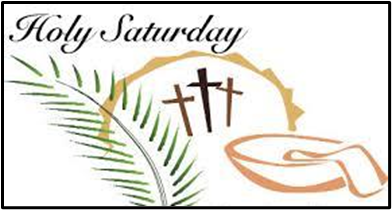
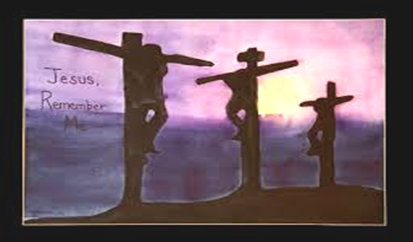
The cross is empty now Jesus lies in the tomb and everything around us is still.’ The heavens and the earth cry out with longing for the sinless one who is not to be found, if we stop to think for a moment we remember that Jesus died and rose again on the third day. We wait, as mourners beside a grave, unsettled, ill at ease, almost not knowing what to do with ourselves. The Church has only one thing to do today: to pray through the emptiness of Holy Saturday. Holy Saturday then is the day when we experience watching and waiting at the tomb as we await the celebration of the Resurrection which we celebrate in the Easter Vigil and then the season of Easter that lasts until Pentecost Sunday. The Jewish people have been celebrating Passover annually for thousands of years, commemorating the night in which God brought them out of slavery in Egypt to begin the journey to the promised land.At the Last Supper, Jesus also celebrated the Passover but gave ita new meaning. No longer a remembrance of passing from slavery to freedom, but through his own passion, death and resurrection we too pass from death to life with him. Until the fourth century, Easter was the only feast of the Church’s year, and to this day it remains the most important. As the Catechism says: “Easter is not simply one feast among others, but the ‘Feast of feasts’, the ‘Solemnity of solemnities’.” Every Sunday Eucharist echoes the Sunday of the Resurrection and Easter.
Today in the liturgy, we read St. Johns account of the passion, we pray for the needs of the Church and the world, we venerate the Cross and we receive the blessed Eucharist. As we reflect on the events of Good Friday we are invited to examine our own lives and attitudes. When we think of the death of Jesus on the cross, we realise that his death was a result of the courage of his convictions. He lived his life with a message of compassion, and love, Jesus was often critical of those who lorded it over those who were less well off or who had little or even nothing at all. The cross of Good Friday is a sign and a symbol that all of us recognise, it is a sign of the completeness of the love that God has for each one of us faults and failings included.
We need to show the love of God to all those whose lives are loveless to all who have nobody to care for them we must show them that ours is an all loving and caring God. In reaching out to others, especially those who feel isolated or abandoned, we embody the spirit of Christ and become instruments of his love in the world. Today when we go up to venerate the cross, we should allow the cross to move us to be better people. Consoling, and comforting the people we meet with the values of Jesus and the Cross.
On this day we celebrate the Sacraments of Priesthood and Eucharist. In every diocese the priests who have given their lives in generous service of the people of God gather with the Bishop for the Chrism Mass and then in front of their brothers and sisters they renew their commitment to priestly service. Also, at this Mass the oils of Chrism, Catechumens and the Oil of the Sick are blessed by the bishop, these holy oils will be used in the Baptisms, Confirmations and anointing of the sick in the local parishes over the next 12 months. The theme running throughout this day is one of service, service to God and his people. The theme running throughout this day is one of service, service to God and one another.
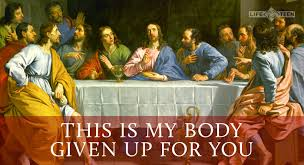
The Evening Mass on Holy Thursday commemorates the Last Supper it has as its theme, service and sacrifice which are aspects of the same mystery. In the washing of the feet in this mass we see Jesus as one who serves, who gives himself. Just as he freely gives himself in washing the feet of his disciples, so too he gives himself in the bread and wine he takes, blesses and hands to them as he does through the priests down through the generations to us, And in the same way he will give himself on the cross tomorrow. All these acts of self-giving are the same act – that of the Son of Man who came ‘not to be served, but to serve, and to give his life as a ransom for many.’The gospel of the evening mass clearly indicates a life of love, serving the community and helping out those who are in any need. On Holy Thursday we commemorate the first Eucharist when Jesus gave us the gift of himself to be with us in the here and now of today and for all time.
The action of the Church is our action as the body of Christ on this night we also witness the Church’s respect for Christ’s Body present in the consecrated Host in the Adoration of the Blessed Sacrament, carried in solemn procession to the Altar of Repose. No Mass will be celebrated again in the Church throughout the world until the Easter Vigil on Saturday evening proclaims the Resurrection that is the light of Christ.
As people who are Christians that is followers of Christ We should embrace all those who are in need of any kind as Christ did. We should be leading lives of generous service to all those who need our help wherever they are and there are many people around who may need our help and care. Each of us is called to show that we are a caring people showing the love of God to all those whose lives are loveless to all who have nobody to care for them we have to show them that ours is an all loving and caring God. When we serve our brothers and sisters in whatever way we are called showing them that our God is an all-loving and caring father in heaven then the Eucharist whenever we partake of this great sacrament will bring us joy and peace. In the words of the liturgy let us go forth to meet the Lord in peace and thanksgiving as we celebrate the three days of the Easter Triduum
On Ash Wednesday we placed the ashes on our foreheads as a sign of our humility as we began our Journey for Lent. Today on Palm Sunday, we remember Jesus entrance into Jerusalem on a donkey as the people raised their voices in joyful acclamation as they sang hosanna to the Son of David. We stop and reflect for a moment on how we began our journey on Ash Wednesday and where we are now as we approach the life changing and life-giving events of Holy Week. The first reading from Isaiah, speaks of a courageous and obedient messiah-figure, who says, “I have set my face like flint” against the beatings and scourging that lie ahead, “knowing that I shall not be put to shame.” The second reading from Philippians reminds us of Jesus’ total emptying of His divinity in order that He might identify Himself with the lowest criminal being led to His execution, “obedient to the point of death, even death on a cross.” And the reading continues but God raised him high and gave him the name above all other names.
The entrance into Jerusalem is one of the very few events in Jesus’ life which is mentioned in all four gospels. It is the only time that Jesus accepts and encourages public acclaim as Messiah. He even goes as far as organising his entrance by telling the disciples to go and fetch the donkey. The key moment in God’s plan of salvation is about to begin, and Jesus knows exactly how it will unfold as he understood what the will of the father would mean for him. The full drama of the Gospel begins with the crowd’s fickle acclamation of Jesus as King. It reminds us of our own fickle responses and our lack of courage as we respond to His love and truth. Palm Sunday is about Jesus’s suffering for our inadequacies and our own sins. Our journey during Holy Week is a journey about god’s love for all of us that is manifest in the cross of Good Friday. In just three years of his public ministry, Jesus set in motion a change in the hearts of many people. Just three years of walking around healing the broken, freeing person’s enslaved spirits, bringing hope, purpose, and meaning to the poor. Those “poor” included people with wealth, with power, with influence. As we enter Holy Week, let us pause from the rush of daily life and open our hearts to the transformative power of Christ’s example. In doing so, we honour the journey Jesus made for us on the first Good Friday and allow ourselves to be renewed in faith, hope, and love. The Church leaves us in no doubt on Palm Sunday that we have now set out on the solemn journey of Holy Week.
How will we mark this journey in the coming days? Will we let it pass by with little interruption to our normal routines? Or will we walk prayerfully with Jesus through Holy Thursday to the cross of Good Friday and then to the Feast of the resurrection at Easter. We move towards the heavenly Jerusalem because Christ himself made the journey to the Cross for us and now he offers to make it with us here and now in 2026. May the passion story inspire all of us to try to imitate in some small way the all loving all forgiving Jesus who went through betrayal to the cross and finally came to the resurrection for us so that we will have life and have it to the full. Over the next few days let us prepare well as we walk through Holy Thursday, Good Friday and Holy Saturday and then we will really be able to enjoy the Easter feast which we have been preparing for since Ash Wednesday.
It seems no time since we began Lent with the ashes of Ash Wednesday and now, we have come to the 5th Sunday of lent. We look forward to Palm Sunday and Holy Week and all the opportunities that they give us to prepare for the Easter Feast. in the 1st Reading Ezekiel tells us that our God is the God of Life, able to bring life even to dry, scattered bones. He can do the same with our broken lives and shattered communities—this is the powerful promise He made to the people of Israel.in our 2nd Reading from St. Paul’s letter to the Romans we are told that 8:8-11 Living according to the flesh brings death, but life in the Spirit brings eternal life through Jesus’ resurrection, the firstborn of the dead. This is our calling, nurturing both body and soul.
In this weekend’s gospel reading we listen to the story of Lazarus, and we hear about the compassion that Jesus had towards him and his sisters Martha and Mary. This story is also the faith that Martha and Mary had in Jesus when they sent the message to him that Lazarus was sick; indeed, he had died and was in the tomb for four days when Jesus arrived and called him to come out from the tomb. When Lazarus was called from the tomb, it was the last sign worked by the Lord before his triumphant entrance into Jerusalem, everything seems to flow to that ‘new reality’ inaugurated by Jesus who is Emmanuel, God with us. Sharing our lives and our existence, Jesus loves us with a supreme passion right up to sacrificing Himself for us on the cross of Good Friday. He was moved by those who were linked to him by ties of the most profound friendship who understood that jesus could not be anything but God’s presence amongst them. John’s message for us today is that Jesus raises us to new life even with all the wars that are going on in the world at the present time. This raising to new life does not mean that we no longer suffer. As a matter of fact, this new life leads through pain and suffering before it reaches fullness of resurrection. Jesus demonstrates this to us as it leads to his painful death on the Cross on Good Friday.
But the new life we live leads us to a new way of living. The proof of this is Christ who rose from the dead on Easter Sunday. After his resurrection he appears to those at the beginning of their new life in Christ. We ask the Lord for the courage to listen to the voice that is calling us. The story of Lazarus invites us to look at our own lives and ask what might need to be brought back to life. Lent for 2026 may be winding down as next Sunday is Palm Sunday, but there is still time for us to do a bit spiritual spring cleaning. As we prepare for Holy Week, let us embrace these remaining days of lent trusting that, with God’s grace, even the most hidden parts of our hearts can be made new. So that when we come to the Easter celebration, we will be able to accept the invitation of Jesus to be his people and walk in his light.
On the Fourth Sunday of Lent the Church celebrates Laetare Sunday, a moment of joy in the middle of the penitential season. With the Iran war continuing and the Middle East and other countries in turmoil there does not seem to be a lot to happy about this weekend however as people of faith we continue to pray for the Peace of the world. Peace should be at the heart of anything we do but sadly for some peace is not an option, and war is the easy way out of doing the right thing. As we continue our Lenten journey this week, we are at the midpoint of Lent as we celebrate laetare Sunday at the midpoint of Advent in the same way we celebrate Gaudete Sunday these are the 2 days in the annual penitential seasons when we rejoice because the Lord is near. Hopefully, the things that we have given up or taken up have not been as stressful as we thought. Lent is a time for giving things up that might not be as good as we think it is also a time for taking up other more meaningful spiritual things. Things that lead us out of the darkness into the light of Christ that we celebrate at Easter.
In the first reading we hear about Young David’s selection as Israel’s king, and it shows God’s plan unfolding and we are reminded that he values the heart over outward appearances. In the second reading, St. Paul reminds us that baptism makes us “light in the Lord,” calling us to live as “children of light” in a world shadowed by false values and mis-placed priorities we are called to be a light to the nations. Our gospel is the story of the blind man, in this story we have another example of God’s choice, one which confuses the religious leaders of the day. John’s beautifully crafted story tells how a blind man comes to see the light in Jesus, both physically and spiritually. When Jesus’ disciples first see the blind man, they presume that his affliction is a result of sin. But Jesus sees in the blind man something else: this roadside beggar who has always inhabited a world of darkness will be the one to display the work of God and point to who Jesus really is. If we are to really see clearly, we need to let Jesus heal us of our blindness and open our eyes as He did the man born blind in this weekend’s Gospel. This is a challenging gospel story for all of us even today because so many people are spiritually blind. It is possible that the places and things we think we are seeing clearly are not as clear as they should be. Remember that the ones, who were 100% sure they knew what was going on, the Pharisees, were blind to God. They were religious experts, like other experts they missed the truth staring them in the face. The one who is turning their world upside down was the Son of God who was trying to open their eyes and send them along the right road. There may be things that raise questions and upset our routines these may be the very places God is trying to open our eyes and give us the vision to set things in the right light for our lives.
The story of the blind man getting his sight gives us the opportunity to pause and ask ourselves: How well do I see? Do I see what is really going on in my life? Has the road I have taken made me lose my way? What is dulling our appreciation of life and gods place within it? As we remember the Blind spots in our own lives, we also remember that faith always remains a choice that we make that helps us to see with great clarity of vision. When we choose to trust in God and believe in what he reveals to us, we exercise our freedom to believe. Our hearts and minds freely cooperate with God’s grace. Faith in God and each other is a journey that we take during our Lent. The 6 weeks of Lent lead us to Jesus the light of the world at Easter. The question we should ask ourselves this weekend is this: will we continue to be blind, or will we let our faith in God heal the blindness of our lives and our world so that we will be a light to the nations.
As we gather this weekend to celebrate the Third Sunday of Lent, all of us are troubled by the news of the conflict in Iran. The United States and Israel initiated military action against Iran, resulting in the deaths of that nation’s leadership and many other people mostly civilians. This operation, called Operation Epic Fury, has drawn widespread criticism from the international community, as many nations have condemned the lack of proper consultation and authorisation for this act of war. In these uncertain times, we unite in prayer for peace not only in the Middle East, Ukraine, and all places afflicted by violence, but also within our own hearts that we may be people of peace as we journey towards Holy Week and Easter. In the First Reading we hear about the Israelites, thirsty and doubting God’s presence, quarrel with Moses. God instructs Moses to strike a rock at Horeb, miraculously providing water, and the place is named “Massah” and “Meribah.” In the Second Reading – we are told that Through faith, we are made right with God, gaining peace and the hope of sharing His glory. God’s love, given through the Holy Spirit, affirms this hope, shown in Christ dying forus.
The gospel reading from Johns Gospel tells us about the Samaritan woman. One of the responses for the Easter Vigil is with joy you will draw water from the wells of salvation, and this sums up what this reading from john’s gospel is about. Jesus breaks the law to speak to a Samaritan woman who had come to Jacob’s well to draw water. What a surprise it must have been to her, when Jesus, tired, hungry and thirsty, asks her for a drink of water! He broke all the rules in speaking to her. Now, he keeps on talking, ignoring her hostility, aware that, in this unexpected encounter, the Father has provided Him with an opportunity for piercing the heart of this sinful woman with his love leaving an example for all those who thirst. Jesus suggests that He can give her living water that is far superior to anything she had ever tasted. We know that she had tried cheap love, and we presume she was no stranger to intoxication, power, and money! This isn’t a gentle lady who comes to draw water from the well, but a toughened cynic. Cynical with the world around her in her time as so many are cynical in our modern world for many different reasons. Jesus forgets His own needs and offers this woman living water that is spiritual grace. Finding her heart curious and open to this miraculous water, He proceeds to raise her vision. He asks her to go back and bring her husband to the well with her. Of course, this is the turning point of the story. When He confronts her with the truth, she could have flounced off in righteous indignation and denial as many people do when confronted with the truth, but she doesn’t. In true humility, she accepts the reality of her life. Because of her humility, Jesus floods her soul with grace. Dropping the bucket, she runs back to spread the good news. “I’ve found the Messiah!” And she had!
Lent is a time for us to let Jesus satisfy our thirst for the truth and life. Like that woman, we too have tried the wrong kinds of water to quench our thirst for happiness, satisfaction, and peace of mind without really finding it. The psalm in the Easter Vigil tells us that with joy we will draw water from the wells of salvation, and this is the time for us to find real joy and satisfaction of letting the Lord fill us with the grace during the season of Lent so that we will be able to enjoy the season of Easter. We will find that our joy is greatest when we share the gift of salvation with others by really listening to them, praying from the heart in a quiet place, reflecting on the Word privately or at Mass, and letting the Eucharist change us into the Body of Christ. The Samaritan woman reminds those who doubt, or struggle with faith that we are asked to stay in a conversation with Christ. It’s all about shunning the type of thirst-quencher that doesn’t really satisfy and actively seek the Living Water that wells up to salvation that Jesus gives us.
This weekend we continue our Lenten journey and hopefully the various aspects of penance, alms giving and fasting that we are undertaking are not too hard. The readings for the 2nd Sunday of Lent show us how God calls people to trust Him. In each reading, we see someone stepping forward with faith. Abram leaves his home. The disciples follow Jesus up the mountain. Paul tells Timothy to keep going even when life is hard. These readings help us see that Lent is a time to listen and follow God. We are not meant to stay in one place. Just like Abram and the disciples, we are called to move forward with hope.
In the First Reading the Lord commands Abram to leave his homeland and go to a new land that God will show him. God promises to bless Abram and make him the father of a great nation, and Abram obeys, leaving his home as directed. In the Second Reading Paul encourages Timothy to join in suffering for the gospel, reminding him that God has saved and called them to a holy life, not because of their own deeds, but because of God’s grace. In the Gospel, we get further advice for the journey when we hear the voice of the father saying, “This is My beloved Son, with whom I am well pleased; listen to Him!”. On the mountain, Peter, James, and John catch a glimpse of the glory of God. As they approach the summit, the three suddenly notice a change in the garments Jesus is wearing. They become dazzlingly white. The disciples then recognize Moses the Lawgiver, and Elijah the Prophet. They are both discussing something with Jesus. Then their joy is turned to fear when suddenly a cloud comes between them and the sun, and the Voice of the father thunders out, “This is My beloved Son, with whom I am well pleased; listen to Him!”
As the disciples fall to the ground, Jesus calms them and tells them not to be afraid. The glory fades and then they proceed down the mountain as they continue their spiritual journey. What does all this mean for us on our own spiritual journeys? If we’re really serious about Lent, we’ll take the Transfiguration experience as Jesus intended. As He taught a lesson in patience and hope to Peter, James, and John, so he teaches us to listen and wait, to listen intently to Jesus and His message and wait and see where God will lead us. We have the advantage of knowing and believing in the Resurrection. The Transfiguration reminds us that there is more to the story of Jesus on the mountain. Just as Jesus rose from the dead, we are called to a new life with Him as we continue the story of faith as Jesus leads us through the suffering of Holy Week to the resurrection of easter Sunday. Lent is a time to prepare our hearts for Easter, remembering that no matter what we face, God’s plan leads to new life as he tells us, “This is My beloved Son, with whom I am well pleased; listen to Him!”.
With the ashes of Ash Wednesday and the call to repent and believe the gospel ringing in our ears we now come to the 1st Sunday of Lent. In the same way that Jesus went out into the dessert God asks us to go out into the dessert during the 40 days of Lent to undertake a time of renewal. So why Lent? Lent is the time for seeing and correcting our faults and raising our minds and hearts to God. Lent is a time for personal and community conversion of heart and renewal! A time for coming face-to-face with God – our origin, our purpose and our destiny it is also the time to be changed for the better by that encounter! The main thing for all of us to do during Lent is that we should try to get to know God better by works of faith and charity so that those lines separating good and evil will become more apparent to all of us.
In the First Reading we hear that God formed man and placed him in the Garden of Eden. The serpent deceived the woman into eating the forbidden fruit. She and her husband ate it and realized they were naked. in the Second Reading: St Paul in this extract from his letter to the Romans tells us that one man’s sin brought death to all, but God’s grace through Jesus brings life and righteousness to many. Christ’s obedience will make many righteous the gospel for this weekend was first addressed to the Church as it coped with divisions, weakening of faith and scandals. The image of the wilderness evoked many memories for them. In the time of Moses God had led his people out if Egypt to begin a long and trying wilderness experience. Our own experience of Church today is, in ways, very similar. God is leading us. We continue to be humbled and tested. What is crucial is the hope that we have from dealing with events through eyes of faith. The Church teaches that prayer, fasting, and almsgiving are significant ways to become closer to God. The decision for each of us is to determine what form of those three things to make our own Lent. The temptations, to which our Lord submitted himself, are a source of encouragement and consolation for all of us. If our Lord and master underwent temptation, we cannot and must not expect to live a Christian life without experiencing temptations and trials.
The three temptations Satan put to our Lord were suggestions that he should forget his messianic mission of redemption. He was urged to get all the comforts of life, all the self-glory and all the possessions and power this world has to offer but that was not what it was about. In the same way all the comforts of life are put before us including the self-indulgence and glory which is the exact opposite of our calling as followers of Christ. During Lent we are called not to give in to the temptations of this life instead we are called to renewal of heart mind and Spirit so that we can live in God and God can live in us through faith so that others may see and believe. Jesus trusted the Spirit to take him into the desert to be tempted. Jesus knew the Father completely. As we begin Lent It is Jesus who is the way, the truth and the life that we seek. As we begin our six-week journey on the road to Holy Week and then the joy of the resurrection at Easter we pray that God may give us his grace to make a good Lent for 2026.
We begin our annual observance of Lent with the Ashes of Ash Wednesday and once again we take up our annual campaign of spiritual renewal. The cry of today is repent and believe the Good News as we prepare for Holy Week and Easter. As we place the ashes on our foreheads and listen to the words repent and believe in the good news, we remember that the Church teaches that prayer, fasting, and almsgiving are significant ways to become closer to God. In the First Reading the Lord urges a heartfelt return with fasting and repentance, highlighting his gracious and compassionate nature. A communal fast is called, involving all, with priests pleading for mercy, leading to God’s compassionate response to His people. in the Responsorial Psalm acknowledging our sins, we implore God’s mercy and cleansing. We seek a renewed heart and spirit, and then we will find God’s presence and the restoration of the joy found in His salvation.
In the Second Reading St Paul tells us We implore you on Christ’s behalf to reconcile with God. Christ bore our sins to make us righteous. Embrace God’s grace, for now is the time of salvation. In the reading from Matthews Gospel Jesus emphasizes the importance of sincerity in faith practices. He advises against performing acts of charity, prayer, and fasting for public admiration, as such actions lack true spiritual value. Instead, he encourages discreet and private expressions of faith, assuring that God, who sees what we do in secret, will duly reward genuine devotion. The question for each of us on Ash Wednesday is how we will celebrate Lent this year as individuals and as members of the local community. Over the next six weeks there will be a packed programme of activities providing many opportunities for spiritual renewal coupled with fasting and alms giving and I encourage you wherever you are reading this to try and take up some of the opportunities provided in your area for Lent. May God give us the grace to make a good Lent as we begin our journey on the road to Holy Week and Easter.