Fullerton T

RELIGION LITURGY AND LIFE

14th Sunday of Ordinary time
FAITH


When we think of Jesus preaching we think of people flocking to hear him, But in today’s gospel we hear of people being sent out from Jesus to prepare his way before him.  We also think of John the Baptist who went to prepare  a way for the lord making his paths straight so that all of us can see the salvation of the Lord. We gather  as Christians in the here and now of our daily lives in 2013  as we remember that  we are also the people that Jesus  has charged to prepare his way in the world today by the living of our faith in every situation we find ourselves. To be a disciple is not only to follow, but to go ahead of the Lord announcing his presence. with this in mind this weekend we reflect on these twin aspects of being Christians: following the Lord, and presenting the Lord to the world through  what we do and in what we say. We are called not only to be ‘disciples’ but ‘apostles’. But there is a constant danger: we often think that ‘the apostolic life’ is something that we can delegate to a few specialists: full time ‘apostles’ or ‘missionaries in foreign lands’ or those who live ‘the religious life’. Every individual and that includes you and I  are called in a specific way to spread the word and to bring the pres­ence of Christ into the world where we are remembering that only a few people are called to do so in a ‘high profile’ way. We are called to be apostles by our baptism; we cannot delegate the responsibility. Rather we must search out the precise way that each of us is called to be an apostle – whether it is high or low profile – and how we each can make ourselves better fitted to the precise place and moment in the history of salvation where we are called to be the rippling presence of God.

There are a number of things that are striking in the  gospel story for this Sunday: one is the simple urgency of the task of proclaiming the message. Some will accept it, others will not, but their rejection of the message should not be on account of any failing on the part of the messengers. It is encouraging to listen to the enthusiasm of the disciples when they returned. They rejoice on their return because they know that are participating in the ultimate struggle of good over evil. In sharing their joy, however, Jesus reminds them that it is not about them but about God working through them and that should be the source of their joy. It is a call to humility. They had obeyed Jesus, and it worked. His promise to them was vindicated.  They discovered that the call to mission contained the power to effect that mission. Jesus went even further in assuring them that he had given them full authority over all the power of the evil one, and that their names were registered as citizens of heaven.

The words at the end of this Sundays  gospel are addressed to each and every one of us. Jesus does give us his power we are empowered to do his work, and to work in his name. We have the power if we are willing to supply the goodwill. Community support is essential to living the gospel. Even a hermit has to be commissioned by a Christian Community, and must continue to be in touch with that group.

Today Jesus, present among us , continues to call us, send us, and empower us. Perhaps this coming week, in our quiet times, when we have the opportunity to reflect, or even to pray, it might be good to consider what task, seemingly beyond of strength or talents, our comfort zone, God wants us to take on and embrace, in the strength of the Holy Spirit, who has lived within us, often unrecognized, since the day we were adopted by God in Baptism.   We remember the words of  Jesus in the Gospel for this Sunday‘So I say to you: Ask, and it will be given to you; search, and you will find; knock, and the door will be opened to you. For the one who asks always receives; the one who searches always finds; the one who knocks will always have the door opened to him. May the door of faith open wide for us as we continue our journey of faith together.
 

13th SUNDAY OF ORDINARY TIME

FOLLOW ME

FOLLOW ME

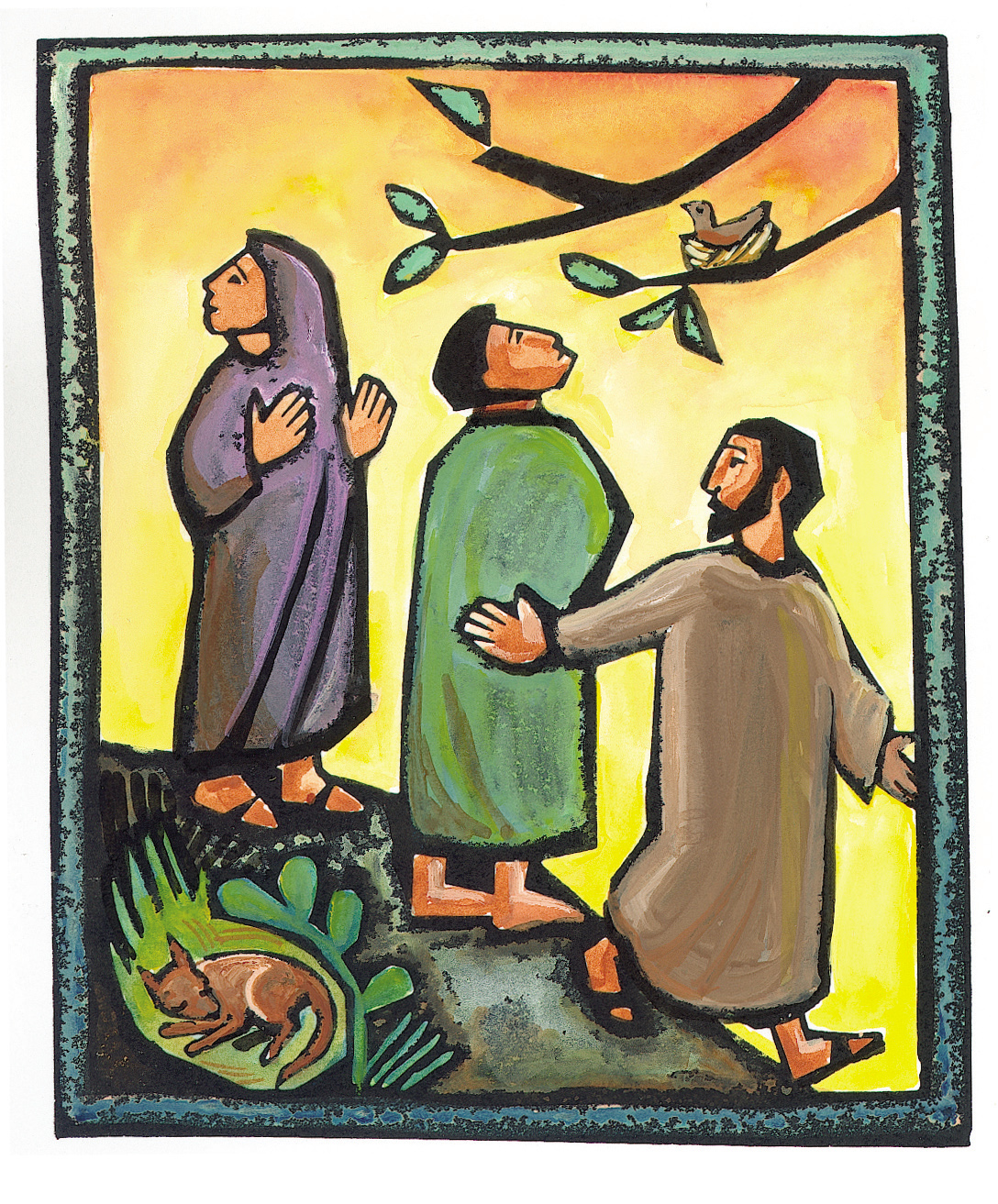
Most of us will not have said to Jesus explicitly: ‘I will follow you wherever you go.’ Nonetheless, we gave that commitment on several occasions. One such time was the commitment made on behalf of each one of us by our parents and god-parents when we were baptized. Similarly, we ourselves renewed that commitment when we celebrated the sacrament of confirmation. Those of us who are married committed ourselves completely to the person and teaching of Jesus again when we committed ourselves to our spouses ‘for better for worse, for richer for poorer, in sickness and in health, all the days of our lives’.

The commitment we make at baptism, confirmation and marriage — which, if we are faithful, is total and life-long — parallels the irrevocable commitment that God has made to us, especially in sending his Son into the world. Jesus’ commitment to us was so complete that he suffered and died on the cross to save us from the consequences of our sins. Regrettably, we break our commitment to Jesus every time we sin. At the heart of Christ’s teaching is the invitation to make a commitment to him. ‘Follow me’ (Luke 5:27):
Jesus says this to us every day of our lives. Do we follow Christ at all times, even when colleagues and friends confront us with ideas and lifestyles that contradict his teaching? Furthermore, do we follow Christ in our daily relationships by challenging the cultural changes that have become accepted in our society despite the fact that they flout his great commandments to love God and to love our neighbour? Our baptismal commitment requires us to renounce the Devil and his temptations.

When Jesus goes to Jerusalem, this means, first of all, that he is resolutely going to face his executioners, those who will put him to death and make sure that, in accordance with the divine plan, the Saviour of men is taken away from this world: “When the days drew near for him to be received up, Jesus set his face to go to Jerusalem.” But, for Jesus, going to Jerusalem is, above all, the fulfilment of his mission as the one who brings peace to souls, beginning with his own. For, once he is dead, Jesus enters, with his soul, into heaven in order to eternally enjoy true peace, the Peace of God which passes all understanding! For Jerusalem means “Vision of Peace”! Jesus is the great peacemaker par excellence: he came into the world to bring peace, but his own Peace! The Peace of the Lord is that which establishes the soul in a perfect harmony with the body, a body that is entirely dominated by the spirit and that obeys it in all things. This is the Peace of God. It is not the peace of men, the peace of the world, which is never anything other than a relative equilibrium between the intention of not attacking others, provided that they do not attack us, and the intention of not doing too much good to others, for to do otherwise could be taken by others as a sign of our weakness and could be seen as an opportunity to attack us. The Peace of God is not like that of men and the world: “Peace I leave with you; my peace I give to you; not as the world gives do I give to you.” (Jn. 14:27)

 Jesus stayed faithful to his being raised on the cross. He remains faithful to us with our turning toward our own personal little kingdoms and all that they mean good and bad. Our faithfulness is not supposed to be totally to our own commitments, but to his faithful commitment to being our Saviour. He saves us from ourselves, our attempts at perfection which we will never achieve in our world. How can we live with ourselves who so constantly are inconstant?

With Paul we moan that we do not do all the good we want to do which is the nature of our lives, and those things we would rather not do, well, we easily do them and sometimes the hard things we should be doing are not easily done.. Our baptismal promises centre around Jesus being our personal and universal Saviour. We live with ourselves, because he lives in us and we are supposed to live in him. To be a follower of Christ, we must be prepared to travel light. Our possessions may distract us from keeping Christ as the center of our being. We may also be distracted by too many interests, too many commitments, too much food, or too much play. When we decide to follow Christ, we will leave some things behind. With faith let us continue our faith journeys as we follow Christ in our daily lives knowing that the peace of Christ is with us as in this year of faith 


Twelfth Sunday of the year

Image


TAKE UP YOUR CROSS AND FOLLOW ME

In our Gospel Reading for this Sunday we hear the immortal words of Jesus when he asks the disciples WHO DO YOU SAY I AM?  That is a very good question to ask ourselves during the year of faith who do we say that Christ is. Peter put it very well when he said: “You are the Christ, the Son of the living God.” (Mt. 16:16) This profession of faith belongs to the heritage of the Church: Peter said it once and for all of us and as a result of his words from that time, and for all time entered into the history of the Church, the mystical Body of Christ!  Like a living body, a body which is always growing, whose members live forever in God even when they have ceased to live on earth? We also see that Jesus tells us that we must take up our cross every day and follow Jesus. During Sunday Masses, we may be tempted to “turn off” when we hear the Gospel especially when the message that Jesus tell us says, “If anyone wishes to come after Me, he must deny himself and take up his cross daily and follow Me.” Many people do not want to deny themselves in our world where so few have so much and so many have little or nothing at all Yet, Jesus insists on this qualification for being His follower. As experience of living teaches us over and over, “biting the bullet” and facing the hard things that come our way has rich rewards from the point of view of faith. Enduring pain from illness, accident, or loss can transform us to a richer level of living. How can we possibly measure up to this kind of living? We know the answer very well. It’s our decision (inspired by prayer and God’s grace) to love God more and more.

 All of us want to be followers of Jesus, but many refuse to pay the price of discipleship we cannot forget Good Friday and the Cross the greatest example of love and discipleship that Jesus gave us. We won’t go through the Calvary that Jesus went through and there is no consolation at all in being a half-hearted disciple. There is no freedom in that. Even though we all want to live  a pain- and trouble-free existence and I don’t think anyone anywhere really gets to live in a a pain- and trouble-free existence. Religion is a two-sided coin. On the one hand, it comforts us with the security of God’s love and protection. On the other hand, it makes demands of us that are frightening in their consequences. Jesus, the Good Shepherd, represents a combination of the two aspects of religion. “I give my life for my sheep, ” . Those of us who follow Jesus must rely on God’s protection and must “endure many sufferings.” We must care for God’s people  our brothers and sisters and many people have given their lives for them over many years. So in this year dedicated to the Faith let us remember the words of Jesus “If anyone wishes to come after me, he must deny himself and take up his cross daily and follow me. Let us follow the Lord by taking up the crosses that he places before us so that we may grow in faith and be able to say in answer to the question that Jesus asks us who do you say I am You are the Christ, the Son of the living God.”


11TH SUNDAY OF THE YEAR

Copy (2) of Project32

Here we are at the 11th Sunday of ordinary time and for us here in Ireland we are right bang in the middle of the schools college and university examination season. It is a time of anxiety and annoyance with a lot of frayed nerves with moms and dads trying to get the youngsters to do the revision and they not wanting to do it.  We all have been through the exams and we all have got out the other side unscathed and hopefully with reasonable results. In all of this I think that we have to remember that it is not always the exams that count but that we produce well rounded young people who are not afraid of the world and all it will throw at them good bad and in-between.

 The “theme” of the First Reading, Psalm and Gospel today is “forgiveness of sins”. We hear the touching Gospel story, of the “woman with a bad name in the town” coming to anoint Jesus’ feet. Living inspired by the love of Jesus is the key to our discipleship – his crucifixion is the sign of his love, which is in itself the forgiveness of sins. A sinner among sinners, Mary Magdalene was greatly loved by Jesus. How could it have been otherwise? If Jesus loves sinners, he does so to love his Father in them and through them. Jesus loves his Father in us and through us! For we are but creatures But, as every man or woman was created in the image of God  (cf. Gen. 1:27), Jesus, in loving his Father, also loves every man and woman in Him. So Jesus loved Mary Magdalene in loving his Father, that is to say divinely. Mary, the Mother of Jesus, followed the same path as her Son. Indeed, she imitated him, while preceding him in time, having contemplated in advance, in the Old Covenant, the unique model who is the Saviour of men! Thus Mary also loved God above all, in loving he who became her mystical Spouse, the Holy Spirit, during the Incarnation of the Word.

Mary gave herself to God from the first instant of her existence, enlightened and strengthened by the fullness of grace in her. May today’s Holy Communion teach us and help us to love God above all things, through the intercession of Mary Mediatrix We are challenged by the Good News of salvation to imitate God’s desire to forgive. As people who are forgiven, we are called to be forgiving towards ourselves and others. If we refuse to forgive, then we will be unable to value forgiveness when it is offered to us from other people and God. We pray that we will be gracious in accepting forgiveness when it is offered and that we will be generous in forgiving others. Sometimes we think that, unless we forget whatever was said or done that hurt us, we have not forgiven. But forgiveness is about an act of the will — it has nothing to do with the emotions which may remain. And it is not necessarily about forgetting the hurt caused. Forgiveness is about deciding not to be controlled any longer by the effects of the hurt, and not to nurture the grievance which only makes us bitter and angry. On a spiritual level forgiving means recognising that nothing we suffer in this life is equivalent to what Christ, who was totally innocent, suffered and died to secure our salvation. By uniting our sufferings with his suffering, we strengthen our character and our souls. Only then will we be really free people, because only then will we be able to think about or be in the presence of those who have offended us without allowing their damaging behaviour to cause further hurt. The reality is that it is easy for God to forgive sinners because he loves us. The readings for this Sunday underline the importance of our faith–faith in the dying and rising of Jesus Christ for our sins, and faith in the mercy of God toward sinners. God is much more concerned about our faith than He is about our sins! Without faith, David would never have asked for God’s forgiveness. Neither would have the penitent woman of this Gospel, whose great faith and love so pleased Jesus. Without faith, we cannot expect to enter heaven so in faith let us continue our faith journey as the beloved people of God forgiven and restored .


PRAY FOR OUR PRIESTS

1_0_684181

I normally don’t Blog during the week but this week I think that I should say something about a sad event that took place here in Belfast last Friday. The sad event was the death of one of the Parish Priests in the west of the city by suicide. Fr. Matt Wallace was a well respected and loved priest who was originally from County Wexford in the south and it will be very hard for the people in the west of the city and our local diocese in general to get over this. As you see above the little picture sums it all up  as we are asked to pray for our priests and religious. We need to support our priests and religious because at this time they are scarce on the ground and are to use simple terms a valuable  spiritual commodity that we simply cannot do without.  Let us pray for our priests wherever they are in the days ahead  that we may be true friends to them whenever they may need us.

Tenth Sunday Of Ordinary Time

conquerers_cross_wegast

As we return to “Sundays in Ordinary Time,” the liturgy begins with the tenth week! Why I hear you ask? Well by beginning here after Lent, Easter and the various feast days that are held on a Sunday the numbering will come out right at the 34th and last week at the end of the church year. Then, on December 1 this year, we’ll begin another church year with the First Sunday of Advent! (Now you know why this Sunday is the “Tenth Sunday”!) So As you can see it can be a bit of a jump to get back into the pattern of readings for the season of ordinary time. Readings chosen  are not the particular ones to celebrate a particular feast or mystery such as Corpus Christi or Pentecost, but the Sunday by Sunday continuous reading of the Gospel and Apostolic Letters. So this Sunday we get back into Saint Luke’s Gospel with the dramatic story of the raising of the widow’s son in the town of Nain.

 The ‘theme’ that unites the scriptures today is found in the psalm: “For me you have changed my mourning into dancing.” Our faith  tells us that the death and resurrection of Jesus has changed death forever – just as both Jesus and Elijah changed it in the stories read today. Christians will always mourn the death of loved one mother, father brother sister or whatever  just as Jesus himself wept over his friend Lazarus: but Christian mourning, while acknowledging grief, will also contain the hope of life and the hope of resurrection, as revealed in the stories we hear today.

 We look to Jesus as the Lord: he is the Son of the Father, the conqueror of death, who has visited us from on high to redeem us. In today’s gospel we see this in his raising a young man from the dead in Nain. We recall this incident from our memory of Jesus not because we expect miracles to happen like this every day, but because they remind us that the life Jesus gives us is not bounded by death. He gives us a new way of living in this world and the promise of the fullness of life with the Father in the world to come. The Gospel of Luke is the Gospel of the Compassionate Lord.  The message is clear: the Lord cares for each of us as individuals.  He is not too big for us, or too great for us.  In fact, He shows His greatness in the concern He has for each of us.And He calls us to follow. To be as He is.  In the Gospel of Matthew, we come upon the order “Be perfect as my heavenly father is perfect.”  In the Gospel of Luke the same directive is rephrased to: “Be compassionate as my heavenly father is compassionate.” It is impossible for us to be too caring, too giving, or too concerned about others.  It’s just difficult.  We have busy schedules.  We can’t handle additional emotional grief.  We find excuses why we can’t spend time with a family with a sick child, or with the elderly lady down the block. Many times people have said to me, “My child came down with cancer, and all my friends became strangers.” We were surrounded with help at first, but as the weeks became months and he became sicker and sicker, many people seemed to disappear.  Perhaps that’s because it hurts to expose ourselves to another’s grief.  But this hurt can bring support, this hurt can bring healing.  Sure, we are busy.   Jesus was busy too.  But He didn’t look for excuses to stop everything and reach out to the hurting. His heart went out to those in need.  He was compassionate. 

 The practical challenge, from reflecting on this miracle story, is to be convinced about God’s merciful love and to be sensitive to the difficulties of those who are less fortunate than ourselves. God is indeed compassionate, and Jesus is proof that God has visited his people. Just as the crowd who witnessed the widow’s dead son being brought back to life instantly recognised that this was the work of God, so we, too, strive to recognise God working, albeit perhaps less dramatically, in the events of our own daily lives. God was close to the widow of Nain and he is also close to each one of us. His heart goes out to us too.  He cares about every one of us.  And He calls us to be like him, to be compassionate. We remember what He said after He washed His disciples feet before the Last Supper: “What you have seen me do, you must do.” We have to allow the compassion of the Lord to flow through us to others. may god change our mourning into dancing as we  go forward in Peace as we continue our faith Journey 

CORPUS CHRISTI 2013


Art Corpus Christi


In many places throughout the world the Feast of Corpus Christi would have been celebrated last Thursday but we in Ireland and many other places celebrate this feast on the weekend after Trinity Sunday. Gathered at the Eucharist we bring our prayers to God. We each have our own needs. Friends are sick. Neighbours are losing their home. Kids need work. The person who has been in our lives for so long has died. We bring these prayers to church because they remind us of our need and they raise our hopes in the power of God. We have those hopes because God has rescued us and continues to rescue us time after time. Our relationship with God has produced fruitfulness, satisfied our longings, and brought us peace. Because of God’s faithfulness, we give thanks, offer sacrifice, and once again present our needs. In the story of the five loaves and the two fish, we learn that Jesus fed the hungry crowd by multiplying five barley loaves and two fish. He did this because he was concerned for the people who had stayed with him, listening to him and watching him cure the sick. In a sense, he was acknowledging their commitment to spending time with him.

 Initially, Jesus tested his disciples by asking them where they might get something for the hungry crowd to eat. They had no practical answer to his question, because Jesus always practised what he preached. He never asked other people to do what he was unwilling to do himself. He satisfied the crowd’s physical hunger and, in doing so, he enhanced the authority of what he had already said to them and of what he had already done when he cured the sick.

 The love and generosity of Jesus in tending to the needs of the hungry crowd offer us an insight into his own total self-giving for others at the Last Supper and in his suffering and death. Corpus Christi is an occasion for us to celebrate the sacrament of the Eucharist sacrament of Sacraments. It should be an occasion when we enter into the symbolism of this sacrament, letting it teach us deep lessons about life, our relationship with God and with one another. Since the very first days of the church before St Paul had set out on his journeys or any of the gospels were written — our brothers and sisters have been gathering every week for this sacred meal. But when we routinely do anything, we often lose sight of just how wonderful it is. We gather for Eucharist often. We still carry out one of the oldest and certainly the richest rituals in the Christian tradition. And whenever we eat and drink the body and blood of Christ, we proclaim the death of the Lord until he comes.

 It is a privilege to share this Eucharistic meal which is the bread of life. We have inherited it from a long tradition. And with it we have also inherited a responsibility to proclaim the death of the Lord until he comes by the way we live our lives. The Sacrament brings the gift of charity and solidarity, because the Sacrament of the Altar is inseparable from the new commandment of mutual love.

 The Eucharist is the power that transforms us and strengthens us . `It spurs us on our journey through life  and plants a seed of living hope in our daily commitment to the work before us’ in the family, at work and in society. From the beginning of the second century, St. Ignatius of Antioch defined Christians as those who `live according to Sunday,’ with faith in the Lord’s resurrection and his presence in the Eucharistic celebration. By receiving the Eucharist, we are nourished, and enabled to nourish others as Jesus does. As it unites us with the one who satisfies all our yearnings for love and fulfilment, so we must let that power flow through us to a world more desperately in need of God than ever before. Let us resolve to worship the Lord in the holy Eucharist and never to offend and dishonour him by our words or deeds.


Trinity Sunday

Rublev's Trinity Icon


RUBELEV ICON OF THE TRINITY

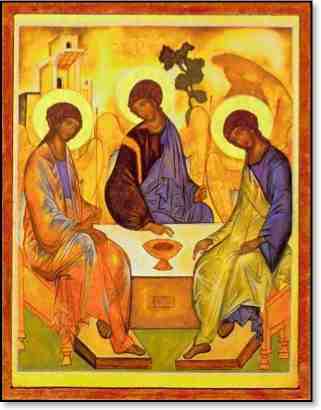
Today is Trinity Sunday and we think of the Father, Son and Spirit one. Three distinct persons within the one mystery how do we understand the trinity? We don’t! God, by definition, is beyond imagination, beyond language. The Christian belief that God is a trinity helps underscore how rich the mystery of God is and how our experience of God is always richer than our concepts and language about God.

 In the beginning was the relation of persons: Father, Son, and Spirit, so goes the Trinitarian formula. Yet this “glory be” is very different from some contemporary reformulations. Notice how “Creator, Sanctifier, and Redeemer”—a phrase sometimes used today—portrays the Trinity only in terms of its function with respect to the created world. It misses the point that God’s actual being is relational. There is otherness in God’s oneness. God is the beholder and the beheld, the lover and beloved. Eternal relationship is expressed in space and time. And the created world, thought and loved into being, is empowered to reciprocate. The human creation—“let us create man in our own image and likeness, God said: male and female God created them”—can love the creator back. With faith and hope in the otherness of God, we mirror the personal mutuality of the Trinity and reaffirm the order of all reality.

 When the Church celebrates the Feast of the Most Holy Trinity, it is an attempt to summarise the whole mystery of our God into one day. This is not just a “theological feast” ` but a feast which should speak to us of this simple fact of faith: the Father loves us, has revealed that love in his Son, and has called into a relationship sustained by the Spirit. It is our joy that, as baptised members of the Church, we can somehow share in that divine life and love which is the Trinity – becoming children of God. God has chosen us, and we are his own people, just as he chose the people of Israel long ago.

 In the remarkable Gospel story we heard a few moments ago, Jesus reveals to His apostles and to us, the very intimate relationship that He holds with both the Father and the Holy Spirit, making God a Trinity of Persons. He urges them and us  to “let go” of their narrow focus on His physical presence and to be prepared for their astounding new role of life “in the Holy Spirit” that will expand their minds and hearts to “all truth.” The Holy Trinity is not a distant truth, for we are temples of the Holy Spirit and possessed of the truth, the power, and the love of the Trinity. May we be caught up even now in the dance and joy of that life

Each Trinity Sunday, we only scratch the surface of this great mystery of our faith. In gratitude and faith, let us begin and end every prayer with greater faith and reverence “In the name of the Father, and of the Son, and of the Holy Spirit. Amen.”

Pentecost Sunday


penecost


Last Sunday we celebrated the Ascension when Jesus ascended to the Father  and in ordinary terms returned home. This Sunday we celebrate the feast of Pentecost which was the start of the Church. We arrive at the fiftieth day ‑ the completion of the Easter Season, and the completion of the Paschal Mystery: the Lord has died, is risen, has ascended to heaven and now gives birth to his Church, by sending the Spirit upon the apostles. This feast of the gift of the Spirit is so significant for us, because it marks the handing on of Jesus’ ministry to the Church ‑ in the Church we are guaranteed the presence of the Lord, in his sacraments  in his ministers, in the Blessed Sacrament and in his Celebrated Word. It also marks the fulfilment of our thoughts about baptism throughout this season: the gift of the Spirit which we receive in Confirmation is the `seal’ of our baptism, guaranteeing and confirming all that baptism achieves.

 The gospel reading for the feast of Pentecost has already been read, in a more extended form, on the Second Sunday of Easter. It was read then to include Jesus’ encounter with Thomas ‘eight days later’. On the feast of Pentecost we have the opportunity to focus on the earlier verses, in which Jesus brings the gift of peace and the gift of the Holy Spirit. The account of the day of Pentecost is found in our first reading, from the second chapter of the Acts of the Apostles. Fifty days after the resurrection there was a spectacular manifestation of the power of the Spirit. Jews and proselytes, gathered from the nations for the Jewish feast of Pentecost, witness the power of the Spirit and hear the preaching of the apostles each in his own tongue. This event launches the mission to the whole world.

Our gospel teaches that the Holy Spirit was also given by the risen Christ before the events of Pentecost. This is a quieter and more intimate demonstration of the power of the Spirit. It is related to the preaching of forgiveness and the possibility of new life for those who ask for it. The disciples are empowered to bring the forgiveness of Christ, but it is possible for people to reject this forgiveness. This seems to be the sense of the final verse, that some have their sins retained. This is the final day of the Easter period. The Lord who died on the cross has shown himself in his risen body. He has taken our humanity into the presence of the Father. He is no longer visibly present, but his Spirit is with us to remind us of Jesus and to lead us into all truth. That Spirit, as St Paul writes to the Corinthians, bestows gifts in abundance for the benefit of the whole Church.

 The apostles used the gifts of the Holy Spirit as they encouraged people to turn away from sin and as they transformed the world so that the kingdom of God could emerge in people’s lives. Although in earlier days they had deserted Jesus, most of them were eventually martyred because of their later faithfulness to his teaching. Pentecost was certainly a turning point in their lives. Applying this truth to ourselves, the sacrament of confirmation is our personal Pentecost event. It is the great sacrament of transformation. In confirmation we are ‘filled’ with the Holy Spirit and we receive the gifts of the Holy Spirit. Our lives are transformed so that, like the apostles, we can be courageous witnesses for Christ. But also like them, we must choose daily to welcome and accept the Spirit.When we are responsive to the Holy Spirit in our lives, we joyfully proclaim the truth of God’s word in every situation whatever the consequences.

Every Pentecost is an exultant celebration of the gift and presence of the third person of the Blessed Trinity and a deep invitation to live out his guidance and purpose in every area of our lives. Pentecost reminds us that we are called and emboldened by the Holy Spirit to bring him into each moment of our lives and every interaction with others. The Holy Spirit gives us his gifts to dwell in and his fruits to bear to the world. In Acts 2 we read that people from every nation were gathered, yet with the coming of the Holy Spirit they all heard each other in their own language. How the Holy Spirit enabled the apostles to do this is a mystery – and yet, in a real way we are also called to “speak” to the world with a similarly unifying language as we share our faith: the language of love, joy, peace, kindness, goodness, faithfulness, self-control, gentleness, wisdom, understanding, wonder, awe, right judgement  knowledge, courage and reverence. We remain committed to the Church as the guardian and teacher of the faith. We turn away from sin. By doing so, we begin to transform the world so that God’s presence is always glorified and many of the effects of the gifts of the Holy Spirit (what we call the fruits of the Holy Spirit) become evident in our lives. Among these effects are charity, joy, peace, patience, kindness, goodness, generosity, gentleness, faithfulness, modesty, self-control and chastity. Pentecost emphasises the continuous outpouring of the Holy Spirit on the Church and the Church’s worldwide mission. It also reminds us about the sacrament of confirmation and the personal transformation that is possible in our lives if we are open to the promptings and guidance of the Spirit. So now let us continue our faith Journey along the roads that lead to God during this year of Faith.


CL1794


The Ascension of the Lord

PAX

Recently it was decided to move the celebration of Ascension in of the  Dioceses to this Sunday. While this moves the feast away the fortieth day after Easter Sunday it does open up  the celebration of the Ascension as part of the journey of the Easter Season. This Sunday’s gospel passage contains part of the prayer Jesus addressed to his Father following his Last Supper discourse with its the promise of the holy Spirit. Jesus prays for his disciples and for all who will believe in him through their words. The depth and poetic beauty of Jesus’ prayer defies making an adequate prose summary. Principal elements of the prayer are listed here merely as an aid to memory for the reader — communion in the life of Father and Son, desire that the world come to believe in him, desire that all may see his eternal glory, desire that the Father’s love be in all who believe. Ascension is not just a feast that “happens to fall in Eastertide”: it is an integral part of the Easter mystery. Remember the Lord’s words at the Last Supper: “I am going to prepare a place for you, and after I have gone and prepared you a place, I shall return to take you with me.” Jesus does not open the way to us just by rising from the dead: to complete the mystery presumes the Lord’s return to the Father. Ascension is therefore a feast of hope: our hope that the Lord will return, as he went. Our hope that he will take us with him, when our bodies are raised as his was. Our hope that in due course we will take our place in heaven, where he sits at the Father’s right hand.

 Our focus today is on the retelling of a story declaring that Christ has returned to the Father, and so we think of it as the ‘end’ of the Christ event or the ‘end of Easter’ – in times past there was a custom of extinguishing the Paschal Candle after the gospel to signify: ‘he is gone’. That said he is gone but at the same time we believe that he is truly here with us. The ascension is an end As well as a beginning. While it was the end of Jesus’ physical presence with his beloved disciples, it marked the beginning of Jesus’ presence with them and with us in  a new way. Jesus promised that he would be with them always to the end of time (Matthew 28:20)  and he is with us too in the Eucharist, that is also called the real presence of Jesus in the blessed Sacrament.  Now as the glorified and risen Lord and Saviour, Jesus ascended to the right hand of the Father in heaven, and he promised to send the Apostles the Holy Spirit who would give them his power on the Feast of Pentecost.

 The Feast of the Ascension is a call for us to renew our participation in the Church’s mission. We help to make disciples of others by our words and actions. When we are committed to the Church and its teaching, we teach other people about the eternal life that is offered to them whenever we speak about our faith and its relevance to our lives. This is how we participate in the Church’s mission and begin to understand more fully its nature. On the Feast of the Ascension then we focus our minds and hearts not so much on Jesus’ departure from this world but rather on his continued presence among us, albeit in   a different way. While his earthly mission concludes with the Ascension, his mission of salvation continues in the Church. We, together one and all are the Church. We are the Body of Christ which is a sign of God’s loving presence to the entire world. We are reminded to assume the responsibility that comes with baptism as we renew our commitment to being the Church and to loving the Church as a son or a daughter loves his or her Father. In this last Sunday before Pentecost, may we take courage in the vision of Jesus Himself of a world at peace, living in unity and love. May we pray today with Jesus’ prayer for unity, in local church, in our parish communities  and in the universal church. We beg God for stronger faith and stronger love and stronger courage in our own witnessing as we continue our journey of faith.

Post Navigation