Fullerton T

RELIGION LITURGY AND LIFE

Archive for the tag “bible”

5th Sunday of Lent

It seems no time since we began Lent with the ashes of Ash Wednesday and now, we have come to the 5th Sunday of lent. We look forward to Palm Sunday and Holy Week and all the opportunities that they give us to prepare for the Easter Feast. in the 1st Reading Ezekiel tells us that our God is the God of Life, able to bring life even to dry, scattered bones. He can do the same with our broken lives and shattered communities—this is the powerful promise He made to the people of Israel.in our 2nd Reading from St. Paul’s letter to the Romans we are told that 8:8-11 Living according to the flesh brings death, but life in the Spirit brings eternal life through Jesus’ resurrection, the firstborn of the dead. This is our calling, nurturing both body and soul.

In this weekend’s gospel reading we listen to the story of Lazarus, and we hear about the compassion that Jesus had towards him and his sisters Martha and Mary. This story is also the faith that Martha and Mary had in Jesus when they sent the message to him that Lazarus was sick; indeed, he had died and was in the tomb for four days when Jesus arrived and called him to come out from the tomb. When Lazarus was called from the tomb, it was the last sign worked by the Lord before his triumphant entrance into Jerusalem, everything seems to flow to that ‘new reality’ inaugurated by Jesus who is Emmanuel, God with us. Sharing our lives and our existence, Jesus loves us with a supreme passion right up to sacrificing Himself for us on the cross of Good Friday. He was moved by those who were linked to him by ties of the most profound friendship who understood that jesus could not be anything but God’s presence amongst them.  John’s message for us today is that Jesus raises us to new life even with all the wars that are going on in the world at the present time. This raising to new life does not mean that we no longer suffer. As a matter of fact, this new life leads through pain and suffering before it reaches fullness of resurrection. Jesus demonstrates this to us as it leads to his painful death on the Cross on Good Friday.

But the new life we live leads us to a new way of living. The proof of this is Christ who rose from the dead on Easter Sunday. After his resurrection he appears to those at the beginning of their new life in Christ. We ask the Lord for the courage to listen to the voice that is calling us. The story of Lazarus invites us to look at our own lives and ask what might need to be brought back to life. Lent for 2026 may be winding down as next Sunday is Palm Sunday, but there is still time for us to do a bit spiritual spring cleaning. As we prepare for Holy Week, let us embrace these remaining days of lent trusting that, with God’s grace, even the most hidden parts of our hearts can be made new. So that when we come to the Easter celebration, we will be able to accept the invitation of Jesus to be his people and walk in his light.
4Th Sunday of Lent

On the Fourth Sunday of Lent the Church celebrates Laetare Sunday, a moment of joy in the middle of the penitential season. With the Iran war continuing and the Middle East and other countries in turmoil there does not seem to be a lot to happy about this weekend however as people of faith we continue to pray for the Peace of the world. Peace should be at the heart of anything we do but sadly for some peace is not an option, and war is the easy way out of doing the right thing. As we continue our Lenten journey this week, we are at the midpoint of Lent as we celebrate laetare Sunday at the midpoint of Advent in the same way we celebrate Gaudete Sunday these are the 2 days in the annual penitential seasons when we rejoice because the Lord is near. Hopefully, the things that we have given up or taken up have not been as stressful as we thought. Lent is a time for giving things up that might not be as good as we think it is also a time for taking up other more meaningful spiritual things. Things that lead us out of the darkness into the light of Christ that we celebrate at Easter.

In the first reading we hear about Young David’s selection as Israel’s king, and it shows God’s plan unfolding and we are reminded that he values the heart over outward appearances. In the second reading, St. Paul reminds us that baptism makes us “light in the Lord,” calling us to live as “children of light” in a world shadowed by false values and mis-placed priorities we are called to be a light to the nations. Our gospel is the story of the blind man, in this story we have another example of God’s choice, one which confuses the religious leaders of the day. John’s beautifully crafted story tells how a blind man comes to see the light in Jesus, both physically and spiritually. When Jesus’ disciples first see the blind man, they presume that his affliction is a result of sin. But Jesus sees in the blind man something else: this roadside beggar who has always inhabited a world of darkness will be the one to display the work of God and point to who Jesus really is. If we are to really see clearly, we need to let Jesus heal us of our blindness and open our eyes as He did the man born blind in this weekend’s Gospel.  This is a challenging gospel story for all of us even today because so many people are spiritually blind. It is possible that the places and things we think we are seeing clearly are not as clear as they should be. Remember that the ones, who were 100% sure they knew what was going on, the Pharisees, were blind to God. They were religious experts, like other experts they missed the truth staring them in the face. The one who is turning their world upside down was the Son of God who was trying to open their eyes and send them along the right road. There may be things that raise questions and upset our routines these may be the very places God is trying to open our eyes and give us the vision to set things in the right light for our lives.

The story of the blind man getting his sight gives us the opportunity to pause and ask ourselves:  How well do I see? Do I see what is really going on in my life? Has the road I have taken made me lose my way? What is dulling our appreciation of life and gods place within it? As we remember the Blind spots in our own lives, we also remember that faith always remains a choice that we make that helps us to see with great clarity of vision. When we choose to trust in God and believe in what he reveals to us, we exercise our freedom to believe. Our hearts and minds freely cooperate with God’s grace. Faith in God and each other is a journey that we take during our Lent. The 6 weeks of Lent lead us to Jesus the light of the world at Easter. The question we should ask ourselves this weekend is this: will we continue to be blind, or will we let our faith in God heal the blindness of our lives and our world so that we will be a light to the nations.

3rd Sunday of Lent

As we gather this weekend to celebrate the Third Sunday of Lent, all of us are troubled by the news of the conflict in Iran. The United States and Israel initiated military action against Iran, resulting in the deaths of that nation’s leadership and many other people mostly civilians. This operation, called Operation Epic Fury, has drawn widespread criticism from the international community, as many nations have condemned the lack of proper consultation and authorisation for this act of war. In these uncertain times, we unite in prayer for peace not only in the Middle East, Ukraine, and all places afflicted by violence, but also within our own hearts that we may be people of peace as we journey towards Holy Week and Easter. In the First Reading we hear about the Israelites, thirsty and doubting God’s presence, quarrel with Moses. God instructs Moses to strike a rock at Horeb, miraculously providing water, and the place is named “Massah” and “Meribah.” In the Second Reading – we are told that Through faith, we are made right with God, gaining peace and the hope of sharing His glory. God’s love, given through the Holy Spirit, affirms this hope, shown in Christ dying for us.

The gospel reading from Johns Gospel tells us about the Samaritan woman. One of the responses for the Easter Vigil is with joy you will draw water from the wells of salvation, and this sums up what this reading from john’s gospel is about. Jesus breaks the law to speak to a Samaritan woman who had come to Jacob’s well to draw water. What a surprise it must have been to her, when Jesus, tired, hungry and thirsty, asks her for a drink of water! He broke all the rules in speaking to her. Now, he keeps on talking, ignoring her hostility, aware that, in this unexpected encounter, the Father has provided Him with an opportunity for piercing the heart of this sinful woman with his love leaving an example for all those who thirst. Jesus suggests that He can give her living water that is far superior to anything she had ever tasted. We know that she had tried cheap love, and we presume she was no stranger to intoxication, power, and money! This isn’t a gentle lady who comes to draw water from the well, but a toughened cynic. Cynical with the world around her in her time as so many are cynical in our modern world for many different reasons. Jesus forgets His own needs and offers this woman living water that is spiritual grace. Finding her heart curious and open to this miraculous water, He proceeds to raise her vision. He asks her to go back and bring her husband to the well with her.  Of course, this is the turning point of the story. When He confronts her with the truth, she could have flounced off in righteous indignation and denial as many people do when confronted with the truth, but she doesn’t. In true humility, she accepts the reality of her life.  Because of her humility, Jesus floods her soul with grace. Dropping the bucket, she runs back to spread the good news. “I’ve found the Messiah!” And she had!  

Lent is a time for us to let Jesus satisfy our thirst for the truth and life. Like that woman, we too have tried the wrong kinds of water to quench our thirst for happiness, satisfaction, and peace of mind without really finding it. The psalm in the Easter Vigil tells us that with joy we will draw water from the wells of salvation, and this is the time for us to find real joy and satisfaction of letting the Lord fill us with the grace during the season of Lent so that we will be able to enjoy the season of Easter. We will find that our joy is greatest when we share the gift of salvation with others by really listening to them, praying from the heart in a quiet place, reflecting on the Word privately or at Mass, and letting the Eucharist change us into the Body of Christ. The Samaritan woman reminds those who doubt, or struggle with faith that we are asked to stay in a conversation with Christ.  It’s all about shunning the type of thirst-quencher that doesn’t really satisfy and actively seek the Living Water that wells up to salvation that Jesus gives us.

6th Sunday in ordinary Time

The readings for this Sunday remind us to follow God’s commandments with our heart’s minds and our souls.  In the First Reading we are told that You can choose to keep the commandments and trust in God. God sees everything and gives you the choice between life and death, good and evil. In the Second Reading We share God’s hidden wisdom, planned for our glory, which the rulers did not understand. God’s prepared blessings for those who love him are revealed to us through the Spirit who knows everything. The gospel shows Jesus explaining the law. He does not remove it but calls us to live it fully. It is not enough to follow rules on the outside. We must also have love and goodness in our hearts. When he introduced the New Law of the Kingdom of God Jesus said something that was absolutely shocking to those heard what he told them that the holiness of the people had to surpass that of the scribes and the Pharisees.

How could anyone be holier than the Pharisees who were supposed to be holy men”! They dressed well; they fasted said their prayers loudly for all to hear. But Jesus said that his followers had to be holier than the Pharisees. How could that be possible as they were the people that everyone held up as being good. Jesus explains, our external actions must reflect what we are really like. If what we do is not a reflection of who we are, then we are hypocrites. Hypocrite is the word that Jesus uses to describe the Pharisees. They were considered the righteous and holy ones who in truth were neither righteous nor holy in so many ways.  Jesus’ challenge was not only to his followers, but to the Pharisees and scribes as well. Their religious faith was to go deeper than exterior works the right motives were supposed to support right behaviour. His demands are high indeed! They seem impossible to achieve. The Pharisee spent a lot of time and energy fulfilling the Law like so many people today the law was more important than compassion.  They were of the middle class and unlike the desperately poor, who were most of Jesus’s followers, the Pharisees had the education and leisure to pursue purity of observance. What chance did the illiterate, overworked and burdened poor followers of Jesus have? For that matter, what chance do we have in fulfilling these teachings? And yet, Jesus calls for a holiness that surpasses those people who stuck by the letter of the law instead of the compassion of God! Jesus’ demands are more radical; his vision sharper; his expectations greater.

When we set our own record of doing good against the demands of Jesus in the Gospel, we can all come away feeling helpless. Our own efforts look so shabby against the clear unambiguous demands of the larger vision. May we be courageous in taking up the challenge that Jesus gives each one of us today that is the call to holiness living our lives so that people will see that we are faith filled people who live our lives with the compassion of God in our hearts. As we prepare for Lent, let us remember that God’s grace is always available to help us rise above our limitations. Through prayer, self-examination, and acts of charity, we are given the opportunity to draw closer to God and to one another. Let us approach this season of renewal with openness and humility, trusting that, with God’s help, we can grow in holiness and compassion, becoming true witnesses to his love in our world.

5th Sunday of ORdinary Time

This weekend we pray for the sick as we celebrate the World Day of the Sick next Wednesday, we also pray for all those who care for the sick in our hospitals and care facilities, Doctors, Nurses, Care assistants and Chaplains. We also pray in a particular way for the families who care for our Sick friends that God will bless all of them.  In the First Reading from Issiah, we are told share our bread with the hungry and shelter the homeless poor that means that by sharing with the hungry, sheltering the oppressed, and clothing the naked, one finds healing and God’s presence. Helping others brings light in darkness. In the Second Reading from St Pauls letter to the Corinthians, St. Paul tells us I came to you with fear and weakness, focusing only on Jesus Christ. My message showed the Spirit’s power, so your faith would be in God’s power, not human wisdom.

In our gospel reading this Sunday Jesus tells his disciples that they are the salt of the earth and the light of the world. He adds, “your light must shine before others, that they may see your good deeds and glorify your heavenly father.”   If we were to witness the events of this passage being acted on stage, I think we would find them humorous: Jesus telling a motley group of puzzled followers, many illiterate, that they are the light of the world and when we hear the gospel passage in church on Sunday, we assume that Jesus is talking to those first disciples, surely not to us. But Jesus is talking to us in the same way he spoke the Disciples long ago. Jesus used salt as a metaphor to describe who his disciples are and how they are to be in the world. Just as salt draws out the flavour of food, so we as Jesus’ disciples we are asked to draw out goodness in the world.  As salt of the earth, we may even have to upset the way things are and how life is ordinarily carried on – the usual “salty taste” of daily life in the world these days can be so topsy turvy as recent events have shown in America and other places. Jesus tells his disciples, “You are the light of the world.” They are to be seen; not hidden away they are called to be the light overcoming the darkness of our world and its peoples. We in our own time are called to be the “light of the world,” each one of us a ray of light, dispelling darkness, living in charity toward all, including persecutors. This light is an inner light the light of faith. Its source is divine grace that becomes visible to others by our kind words, our gracious acts, our personal refusal to resort to oppression, false accusation or malicious speech that so many in the political world seem to be doing these days.

And thus, as Isaiah promised, the gloom of sin and death shall be overcome, and the psalmist declares, justice and mercy of the upright will be a light shining through the darkness. This Sunday we are invited to utilise our own special gifts and talents to inform our role of being a disciple who is the salt of the earth and the light for the world. Jesus tells us to be like salt and light. These are simple images, but they help us understand what it means to live as His followers. So let us turn to Jesus the light of life, let us pray that we might share in his life, so that we might be the salt of the earth, and light in the darkness for all the people in our world and there are many people still looking around for light in the darkness of their lives. Let us strive to be salt of the earth and beacons of light, shining brightly for those who walk in darkness, and may our faith inspire others to do the same.

4th Sunday of Ordinary Time

in the gospel we hear Jesus taught his disciples, on the mountain, outlining the Beatitudes. He declared blessings on the spiritually humble, mourners, the gentle, those yearning for righteousness, the merciful, the pure in heart, peacemakers, and those persecuted for righteousness. He encouraged joy amidst persecution for his sake, promising heavenly reward. The first Beatitude strikes the keynote also for the seven Beatitudes that follow. The decisive word in this first Beatitude is the word, poor The first recipients of the Beatitudes are, in fact, the ‘poor in spirit’, an expression that indicates those who have their hearts and consciences directed intimately to Our Lord. They are the expression of the just who are tried by moments of suffering and difficulties. However, they are called ‘blessed’ and ‘happy’ because God’s merciful and compassionate gaze rests on them. These are the poor that the Bible text really refers to. The poor in the Bible are the humble people who bear a burden on their shoulders. They are given God’s favour and because of this the Word identifies them as just, meek and humble. All kinds of attitudes are included in the eight beatitudes. This way the true significance of the ones who don’t confide mainly in themselves but in God.

The poor are those who detach themselves concretely and interiorly from the possession of people and things and above all of themselves.  The poor don’t find security in the gods of this world like success, power or pride but the true Lord God in Heaven. Those who are called “blessed” or “happy” in these beatitudes can hardly be described as fortunate or lucky people in the eyes of the world: the lowly, the mourners, those deprived of justice, those who are persecuted and abused. In structuring the beatitudes in the way he does, Matthew is not offering an unusual programme to happiness; rather, he is describing what happens to Christian discipleship when the kingdom breaks into this broken world. The beatitudes speak of a variety of experiences that disciples undergo because of their involvement in living the Gospel. The result of this involvement might appear to the world as senseless suffering, but Jesus heaps blessings on those who struggle to love the truth of the Gospel.  Discipleship is centred on Jesus. Because of who he is, others will change. Jesus alone is the source of discipleship. Without the person of Jesus, discipleship is meaningless. All of us have some experience of the cost of discipleship. Some will know what it is like to be counted as a nobody because of our fidelity to Jesus.

As Christians we are pledged to share the wisdom of Jesus who was counted a nobody himself. In doing that we will continue “to shame the wise” by declaring the foolishness of God, as we remember that gods foolishness is wiser than human wisdom.

3rd Sunday in Ordinary Time

This week as we celebrate the week of prayer for Christian Unity we continue our prayer for peace. The world seems to be in complete turmoil now however we know things really are in the hands of God and we place our trust in him. The Sundays of Ordinary Time lead us through the three years of Christ’s public ministry. We began last week with his identification as the Lamb of God by John the Baptist and this week we hear how he called the Apostles to follow him.  The readings for the third Sunday of ordinary time remind us that God brings light into darkness and hope to those who are hopeless. He is near, even in hard times and these days many things are beyond our control and are hard to think about but god is still with us.

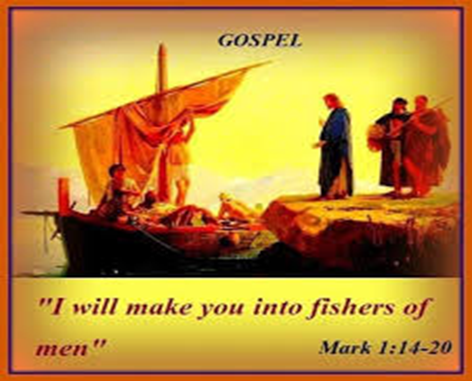
In the First Reading God transformed the fortunes of Zebulun and Naphtali, bringing light to their darkness, joy like a harvest, and breaking the bonds of oppression, reminiscent of Midian’s defeat. In our Second Reading St. Paul says I urge unity and no divisions among you, to avoid factions that claim allegiance to different leaders. Christ alone should be our focus, not human leaders. In our Gospel story we hear about Jesus calling Andrew, Simon, Peter, James son of Zebedee and his brother John to follow him. As Jesus travelled around Galilee, he actively built a following. Biblical scholars speculate that the Galileans would network and form groups around social, economic, or religious issues. Even though the Romans put down revolts with brutal efficiency, large Jewish protests did sway official decisions, especially at the local level. There was strength in numbers.  Part-time fishermen like Peter and Andrew, like James and John would easily leave their daily tasks, if the group they joined promised to protect and enhance their way of life.  Proclaiming the Kingdom was a message with political undertones for Jews and Jesus quickly amassed an audience.  This gospel story is about the call of Jesus to the first apostles to be his followers. This gospel is not just an echo from the past it is very much for us today as Christ and his message are the same yesterday today and will be the same forever. Are we listening to Jesus as he says to us today, “Come follow me and I will make you fishers of men?”  

This Gospel also asks us to remember that our own vocation is an absolutely free gift from God.  This means that we are totally free to accept or deny the invitation for us to take up the vocation that is there for us. Some are called to the Priesthood, or Consecrated Life, others to marriage, others are called to a single life there are many other vocations in life all of them are different. May we experience the beauty of accepting the vocation call we have in our lives.  In this way we will become like the first apostles who quickly responded, continued to learn during their three years walking with Jesus and then in the years afterwards with the power of the Holy Spirit, they did what they probably never imagined they would do when first called; they travelled to the ends of the earth bringing the message of Jesus with them.

2nd Sunday in Ordinary Time

This Sunday we celebrate the second Sunday in ordinary time. As we gather wherever we are there are many things to occupy our minds with many things to talk and pray about. When we look at the world around us, and we see so much war and destruction it is hard to know where we should start in our prayer for peace. We pray for those countries who are at war and those who may go to war. We pray for the leaders of the countries in the world that they will be peacemakers instead of war mongers. We pray for those stubborn people that they will move away from words and actions that may lead to war and promote the peace of the world. We also pray for ourselves that we will be people of peace with peace in our hearts. May god enable us to be people of peace bringing peace into our world.

 In our first reading for this Sunday Isaiah speaks about the task of the Messiah. He calls him a ‘servant’ of the people who will bring light and salvation not only to the tribes of Israel, but to the ends of the earth. In The Gospel reading we hear the words of John the Baptist the man who went before the Lord as his herald “Behold, the Lamb of God, who takes away the sin of the world!”  We know these words, so well for we hear them in Church when we are just about to receive the Body and Blood of Christ during the eucharistic celebration.   The first Christian communities saw a clear difference between John’s baptism that immersed people in the river Jordan and Jesus’ baptism that communicated his own Spirit, to cleanse, renew and transform the hearts of his followers. Without that Spirit, the Church would simply close up and die, but that spirit of Jesus has been the guiding light throughout the intervening years right up to this present moment. Only the Spirit of Jesus can put truth and life into today’s Christianity and lead us to recover our identity, leaving the paths that lead us further away from the Gospel and what it teaches behind. Only that Spirit of Jesus can give us light and energy to light up the fire of renewal within ourselves and the people around us so that we can also become Christ’s authoritative witnesses in the world.

Our baptism links us to Jesus as well as the long line of his followers throughout the ages who believe in Jesus as the Lamb of God and that his death and resurrection is the source of new life for all people. This is our inheritance born of them and we are called to be, “a light to the nations” like God’s servant in this Sundays first reading from Isaiah. The Love of God is made real to us through Jesus his Son, let us share our belief in Jesus and what he teaches with everyone we meet. Let us consider how we can bring Christ’s spirit of peace and reconciliation into our own communities especially these days with so much global conflict going on. Through small acts of kindness and gentle words, we contribute to building a world where peace may flourish despite the challenges, we see around us and during these uncertain times. As we remember our baptismal call, may we carry the light of Christ into all that we do, trusting that even the smallest gesture can make a difference in the world. May our prayers inspire us to be peacemakers, ever mindful of God’s presence with us and his love guiding us forward.  Then we will be able to say with John the Baptist that Jesus is the lamb of God that takes away the sin of the world, the Chosen One of God.’ Let us follow him.

Second sunday of Christmas

Yes, you did read the heading correctly it is the second Sunday after the feast of Christmas, and we are now almost at the arrival of the Three wise men on Epiphany which takes place on Tuesday 6th January. By long standing sacred tradition Christians celebrate Christmas as a season, with the twelve days between Christmas and the Epiphany as one long “Christmas feast.” The season ends with the Baptism of the Lord which is also the first Sunday of ordinary time and that takes place next Sunday.

The first reading is from the book of wisdom. In the wisdom writings we frequently find the ‘Wisdom’ that comes from God is personified. Here in chapter 24 of Ecclesiasticus’, Wisdom ‘speaks her own praises’. She is told to dwell in ‘Jacob’, among the tribes of Israel. She is described as ‘created in the beginning’ and ‘resting’ in the ‘beloved city’. In the second reading from the letter to the Christians of Ephesus begins with a hymn of praise for the plan of God, who chose us ‘from the foundation of the world’ to be his adopted children through the abundance of grace lavished on us in Christ.  In later verses from the same chapter, Paul prays for the Christians of Ephesus, that their faith may grow, and that ‘the God of our Lord Jesus Christ, the Father of glory’ may bestow on them a ‘spirit of wisdom’ and of ‘revelation. The Gospel tells us about the word who was in fact the Son of God. Jesus Christ, therefore, the Word made flesh, was sent as “a man to men.”  He “speaks the word of God” to us and completes the work of salvation which His Father gave Him to do.  

When we look for Jesus as the wise men did, we will find Christ among the “least” and this is the humble message that lies at the heart of our faith especially at this time of year. Jesus does not seek what is good and wise in the eyes of the world he seeks out the small and the humble people those who are unwise in the world’s eyes. May we not be afraid in the year that has just begun to seek the true wisdom that God wants for us, the wisdom of the Wise Men which is the wisdom to seek God and follow the star which is Jesus the light.

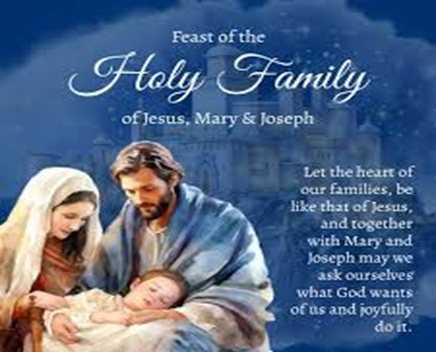
Feast of the Holy Family

This weekend we celebrate the feast of the Holy Family. We are reminded that Jesus lived in a real family. He had a mother and a father who cared for Him and protected him. Mary and Joseph did not have easy lives, but they trusted God and followed His plan. Their home was simple, but it was full of love. This feast helps us think about our own families. Every home has struggles. like the Holy Family, we are called to  care for each other with patience. Love grows in quiet moments, hard choices, and daily kindness.

The readings show how God works through family life. They speak about honouring parents, caring for others, and choosing peace. These small acts shape a strong and faithful home life. In the first Reading God values honouring one’s parents. Respecting them brings many blessings, including answered prayers, long life, and comfort for mothers. Caring for aging parents kindly and patiently. In the Second Reading we are called to embrace the virtues of compassion and kindness, forgiving each other, and allowing Christ’s peace and message guide us as we act in all things in the name of Jesus with gratitude in our hearts. The Gospel Reading tells us that Joseph, following angelic directions in dreams, fled with Mary and Jesus to Egypt to escape Herod’s threat, returned to Israel after Herod’s death, and settled in Nazareth as foretold by prophets.

Tradition says that after three years in exile, another angel informs Joseph that Herod the Great is dead. The Holy Family returns to their homeland, not to Bethlehem, since the new king who reigns in his father’s place is also a cruel and barbaric ruler. Joseph brings Mary and Jesus to his native town of Nazareth in Galilee. There, they lived a simple ordinary life, Joseph as a carpenter, and Mary as his wife and mother of Jesus. Jesus grew in holiness and in knowledge of God’s will in the same ordinary ways that families do in our day.  We also remember the care that Mary and Joseph gave to Jesus.  We recognize the sacrifice they made for Jesus, in the same way as we recognize the sacrifices our parents made for us and many more parents are making for their children today. The feast of the Holy Family represents what Family means for us as people of faith, in the guidance protection, the goodness and kindness, and the love and support of our parents! 

In the friendship of other family members. And in things that have happened to us good and not so good!  Every parent wonders about their children. Every parent is full of hope for their children. Over a period, this might turn into fear and anxiety, but the fundamental feeling of hope is still there. We hope that everything will turn out well for them; we hope that they will be successful in life; we hope that they will be safe and keep out of trouble; we hope that they will be happy.  As we honour the Holy Family, let us ask God to bless all our families with unity, peace, and faith. May we look to Mary, Joseph, and Jesus as historical figures, but as guides for our own journeys. Lord, help us to live with love, patience, and trust, so that our homes and our families  may shine with the light of Christ this Christmas time.

Post Navigation