Fullerton T

RELIGION LITURGY AND LIFE

Archive for the tag “christianity”

26th Sunday of Ordinary Time

The readings for this Sunday warn us against selfishness and ignoring those in need. God asks us to live with kindness and care, not to turn away from the poor or weak. We are reminded that faith is shown in how we act and also in what we say. In the First reading the prophet Amos speaks to the wealthy of Judah and Israel. Their crime is that they could  not care less about the plight of the poor. God condemns those living in luxury and indifference, foretelling their exile and the end of their extravagant celebrations. In the Second Reading from St Paul’s letter to Timothy we are told as Jesus was faithful to his call in the face of  the hostility that led to his death, So Christians facing persecution should be faithful to Gods call. We are encouraged to pursue virtues and keep the commandments until Christ’s return, honoring the immortal, unseen God.

This Sunday the gospel story tells us about two people, a rich man and a poor man it is a good reflection on the situation in the world at the present time where those who are rich are getting richer at the expense of the poor who are getting poorer. The rich man is wealthy in clothes and food; he is also rich in privilege and  freedom he is free from the worry that besets those who are poor even though he was poorer than the poorest man because of the way he lived his life. You can imagine Lazarus praying: “Give us this day our daily bread.” But he didn’t get  a crumb. You cannot imagine the rich man praying, “Give us this day our daily bread.” Because the privilege he has blinds him to Lazarus the man who lies at his own gate. Both men eventually died as all of us will.  Lazarus went straight to heaven to the joy  of endless happiness.  On the other hand the rich man fares very differently. His enjoyments are over. He is now in Hades and he is told that he can expect no relief. Abraham tells him why he is in his present state: he abused his time on earth he acted as though there would be no judgment day of course there was and he sees the truth of this. He knows that he has no one to blame but himself which adds to his torment. It is also a cause of additional grief to him that his bad example will lead his fellowmen to a similar fate.

This rich man is in eternal torment because he let his wealth become his master and forgot God and his neighbor and all  that leads us to eternal life. In our world today We see men and women who completely ignore their real future while they know that their stay on this earth is of very short duration and that they will have to leave it and yet they still act and live as if they had a permanent home here none of us do. For all of us there is a simple question are we going to be like the rich man and ignore those around us who are the Lazarus’s of our own time and place. There are times when our lack of compassion and action is our crime think of how we react to the homeless, the refugees or those who don’t have enough daily bread. Christ, shared his riches with everyone we should do the same and not be like the rich man in the gospel story?

This weekend Let us take the warnings of Amos, the encouragement of St Paul, and the lesson of Lazarus and the rich man to heart. May we be people of compassion, action, and faith sharing our blessings and building a community of Love ,hope  and joy where no one is left at the gate.

25th Sunday in Ordinary Time

As we gather this weekend many places in the world are still at war with each other. We continue our prayer for peace in Gaza and Ukraine as well as all the less talked about wars. This  weekend we  are asked to reflect on our use of worldly resources and our responsibilities to others. The readings challenge us to live with honesty, justice, and faithfulness to God above all else.  In the first reading we hear about Amos who was a great champion off social justice. In this short reading he depicts the religious employers waiting impatiently for the Sabath to end so that they could get on with their lucrative and dishonest trading. Psalm 113 shows that God lifts up the lowly and cares for those who are in need. This shows His love for those who trust Him. In the Second Reading Paul urges the Christian communities to pray for everyone especially those who hold public office as God wants everyone to be saved.

Our gospel reading tells us about the rich Man and his dishonest steward. The steward who looked after his master’s estates is accused of wasting his employer’s goods; he is dismissed, but before he goes he must submit the final account of his stewardship.  In this time of crisis the steward takes firm and immediate action to ensure his own future. He is praised not for his dishonesty, but for his resourcefulness in coping with an emergency with such speed. If a dishonest man can use his employer’s money to ensure there will be people to welcome him when he’s out of a job, how much more should honest people use their money in such a way that they will be welcomed into the kingdom of God when they arrive there. One of the central themes in Luke’s gospel is the suspicion Jesus conveys towards worldly wealth.  Material things can divert our attention and in some cases they can take the place of what truly matters in life. These particular words of Jesus are a warning to those who follow him on the road to heaven, the warning is that we shouldn’t get too attached earthly pocessions and wealth. Our Lord didn’t say who he was warning and his words are meant for all of us today.  What Jesus warned against was not the just acquisition of this world’s goods but their unjust acquisition, and the dishonest use of them when they were justly acquired.

In This gospel story we see an example of someone who knew what he had to do in a crisis situation and Jesus asks all of us to remember no matter what situations we might find ourselves in that we shouldn’t become slaves to pocessions or the wealth that we have and that we shouldn’t be afraid to use whatever our resources we have for the good of everyone especially those in need. The scriptures warn against idolising wealth or allowing possessions to harden our hearts. Instead, we are encouraged to use what we have whether a little or a lot  to serve, uplift, and restore. This is not a call to reckless giving, but a call to thoughtful generosity that reflects God’s own care for the poor. There are many people throughout history who have taken this gospel story  to heart and  decided to act quickly and decisively when required in order to help others and in their time of need. As we reflect on today’s readings and the state of our world, let us renew our commitment to live with honesty, justice, integrity and faithfulness. May we be people who care for the poor, pray earnestly for peace, and practise generosity not just with our resources, but with our hearts. In doing so, we align our lives more closely with God’s ways remembering that very often gods ways are not our ways and then  become true stewards of his love in a world longing for healing, peace, reconciliation and hope. Let us go forth in hope ready to pray, to serve, and to give, trusting that even in the darkest times, God is calling us to be instruments of his peace where we are.

Feast of the Exaltation of the Holy Cross

The Feast of the Exaltation of the Holy Cross that we celebrate this Sunday remembers the Cross of Jesus. It has been celebrated by the Church for centuries. The feast began in the 4th century, when the True Cross was found by St. Helena, the mother of Emperor Constantine. Tradition says she found the Cross in Jerusalem, where Jesus was crucified. This discovery made a deep impression on Christians and led to honouring the Cross in a special way.

The liturgy for this feast draws from several scriptural readings that reveal the depth of the Cross’s meaning. In the first reading, the Israelites, weary and frustrated, complain against God and Moses during their journey. In response, God allows venomous serpents to afflict them. After the people repent, God instructs Moses to craft a bronze serpent; those who look upon it are haled. This act foreshadows the healing and salvation brought through Christ’s crucifixion.The second reading presents the humility of Jesus. Though he was in the form of God, Jesus did not cling to equality with God but emptied himself, embracing humanity and obedience—even to the point of death on a cross. For this, God exalted him and gave him a name above all others. In the Gospel, Jesus speaks to Nicodemus, explaining that the Son of Man must be “lifted up” in the same way Moses lifted the serpent in the wilderness. Through this “lifting up” on the cross, Jesus brings eternal life, not condemnation, to the world. He is sent as a gift of salvation—a ransom for many. The cross as a sign of hope is a paradox. It is like the writing we can read on tombs in old graveyards: Ave crux, unica spes – Hail cross, our only hope. That is a good summary of the Christian faith: in the cross of Jesus, our hope has dawned. We say, “Where there’s life there’s hope.” As long as we live we’re able to hope and open ourselves to the future. Our hope gives direction to our lives; it gives us a reason to keep going. But we know that when we hope we become vulnerable. Hoping is always a risk because it looks to what is not here. To avoid the pain of disappointment some people give up hoping. Like the people of Israel in today’s first reading: they stop hoping in God because of the pain that goes with their new found freedom. They want freedom without wilderness; they want liberation without suffering. God sent the plague of serpents to bring the people to their senses. The God who sent the serpents later sends his beloved Son who died on the Cross for our salvation.

On the cross Jesus does what so many want to avoid: he suffers so that others might be free. To suffer and be rejected are the signs of the cross. In Jesus, God does not despise a broken humanity but takes it to himself. Jesus reveals God by making himself vulnerable. He takes on his back what we all want to avoid: responsibility for our sins. He is nailed to the cross. He does not die a natural death; he is put to death. In all this, he does not despise what is human. As Paul says, Jesus does not cling to his equality with God, he enters the deprivation of humanity becoming a servant  then God raised him high and gave him the name that is above all names . In the Cross and then in the resurrection, hope is born again. Hope is born out of realism; it is born out of love and it leads us to great joy in our lives on earth and in heaven. That is why Paul was right for in the cross there is new life and there is triumph. As we honour the Holy Cross, we recognise it as the sign  of hope especially in this Holy Year dedicated to the theme of Hope.

23rd Sunday in Ordinary Time

This week our local schools went back after the summer holidays and it doesn’t seem like 2 months since the schools closed for the summer at the end of June. Time is flying by and waiting for no one young or old. This week we also said goodbye to the Dominican Sisters who lived in the parish as their convent closed the sisters amalgamated with the other convent in the west of the city.  In this Sundays first reading the author of Wisdom reflects that it is hardly surprising that we have trouble figuring out the intentions of God. He warns: “It is hard enough for us to work out lies within our reach.” And even though God has revealed himself through his Holy Spirit, nobody can claim to fully understand the mystery that is God. We still have much to figure out in so many things especially the things that relate to God.’ In the second reading  we hear from Paul, imprisoned, for the faith who  sends Onesimus back to Philemon, not as a slave but as a beloved brother, urging Philemon to welcome him as he would welcome Paul himself. Paul challenges believers to see others with Christ’s eyes, not through human status. It is a message of reconciliation and shared dignity in the Lord.

In the Gospel there is plenty of figuring out to be done. Jesus gives people notice that they have to work out for themselves if they are equal to the demands of discipleship. That means they have to figure out the cost of discipleship, then consider whether they have the resources to meet that cost.  To drive the point home, Jesus uses twin parables Anyone intending to build a tower would “first sit down and work out the cost”. If he started without finishing, the sum of his achievement would be a monument to his own stupidity. Likewise, the king who discovers that his forces are outnumbered would “first sit down and consider”whether the opposing arithmetic is too heavy. In both instances the advice is clear: take the time; sit down; look at the demands; figure out whether you can honestly meet them.  Much of our lives involve figuring out what is within our reach and what we can realistically achieve. Jesus knows that his disciples must prefer following him to following in their fathers’ footsteps. He calls them away from family life  because discipleship means a new and all-consuming loyalty. Jesus is not telling us to literally hate our family or possessions. He is saying that nothing can come before Him—not our family, wealth, or comfort. If we love anything more than Him, we cannot fully follow His path. This is a hard teaching, but it is a call to be completely committed to God.  Discipleship is not about living life as usual. It is about making choices that put Jesus first, even when it costs us something. We are challenged to think about what we might be clinging to that keeps us from fully following Him.


This Gospel asks us to reflect deeply on our priorities. Are we truly committed to the path of Christ, or are we holding back? Jesus invites us to trust Him and to let go of anything that keeps us from walking fully in His way. When we come to make life changing decisions we need to stop and do what this gospel tells us and that is to take our time; look at the demands the decision to be made will make on us as individuals and communities; and figure out what we can realistically achieve as people who are committed to the path of Christ and that will help us to go forward in faith and hope rather than backwards in fear and mistrust.

21st Sunday in Ordinary Time

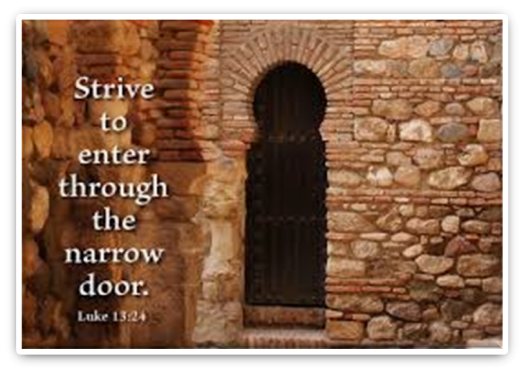
 In the first Reading  from Isaiah The Lord gathers people from all nations to see his glory and spread it among the people They will bring offerings and some will become priests and Levites. For Isaiah, a faithful band of witnesses will announce the news of God’s restoring love and invite all people to Jerusalem to see the manifestation of God’s power and fidelity. In the Second Reading  from Hebrews God disciplines those he loves, just as a father disciplines his children. We endure trials a they will later bring righteousness and healing. In this Sundays  Gospel Luke tells us about the door policy of the kingdom of God and how there is no such thing as automatic membership. While Jesus is making his way to Jerusalem, someone asks him about the number of those who will be saved. Rather than speculate about the arithmetic of salvation, Jesus gives practical advice about the present time:  “Try your best to enter by the narrow door, because, I tell you, many will try to enter and will not succeed.” Those who wait until the door is shut try knocking, the householder will regard them as strangers. Thus, they are distressed because they are being excluded, the people in the story “prove” they are part of the group by saying “We ate and drank with you, and you taught in our streets.”  Jesus is not impressed with this type of superficial acquaintance: people who eat and drink in the same restaurants and bars, read the same papers, watch the same TV programmes, don’t always  share the same commitment to God.   Through Jesus we come to know the faithfulness of God. For us, Jesus is the “sign” of God’s faithfulness. The God who raised Jesus from the dead offers us that same new life through him.

Pope Saint Paul VI said in his famous encyclical, “Evangelii Nuntiandi” that people listen more to witnesses than to teachers. Pope Paul was also right  when he said that the most convincing messengers of our faith are those who speak from their experience of God they are viable witnesses. Perhaps, they were sick and God healed them, or gave them strength and endurance for the trials of life. Today we are called to be authentic witnesses to the Gospel message. Our lives must be changed by our faith in Jesus. We are given the gift of faith  and we are asked to nurture that gift and help it grow. So let us not be afraid to change the things in our lives that we need to change in the light of faith remembering to give thanks for  the gift of faith that gives us the hope  that we will be able to enter through the Narrow Door.

20th Sunday in ordinary time

The Gospel Reading for the 20th Sunday in Ordinary Time  is not easy to hear. Jesus speaks clearly and the words of Jesus are there to afflict the comfortable and comfort the afflicted. He says He did not come to bring peace, but fire. He warns that even families will be divided because of Him. His words are bold and direct. In the first reading, he is thrown into a cistern for speaking the truth. People wanted him gone. But God sends someone to help him. Jeremiah did not stop trusting God, even in the mud. The second reading from Hebrews reminds us to keep going. We must stay strong. We should look to Jesus, who faced the cross. He did not give up. Neither should we despite the conflict and suffering that we see going on in the world. Today throughout the world many people are suffering as a result of conflict especially in Gaza and Ukraine as well as other places. We continue our prayer for peace this weekend.

In the gospel reading for this Sunday Jesus says, “I have come to set the world on fire and how I wish it were already blazing.” Jesus is ready and willing to face the hardships that lie ahead. Jesus’ words must have unsettled the people who heard them the first time. It doesn’t sound like Jesus meant that the practice of our faith should make us comfortable, guarantee harmony or tranquility. Indeed, as he predicted, belief in him would cause the most severe conflict, even in the close-knit-family world of his Mediterranean followers and this conflict continues today in many places throughout the world especially in the Holy Land. Jesus has a task to complete and will follow it through, despite the threats to his personal safety. Jesus refers to his fate as “a baptism with which I must be baptized.” He sees his passion as a baptism which he will accept and which will set a fire upon the earth here we are in 2025 talking about the fire that Jesus lit that could not be extinguished that is the fire of faith. When our lives get difficult, for any reason perhaps running low on the resources of spirit, mind and Soul at critical moments, we are tempted to think that the Holy One is asleep behind a closed door. When the truth is that Jesus is with us looking after us in our times of suffering and need.

The faith that Jesus calls his followers to is a faith that leads us to reflect a faith and hope filled life. It is much easier to follow from a safe distance and not be challenged and changed by faith in God. It is very easy to let the bitterness of others take us over but Jesus went to the Cross to overcome all the hatred and bitterness that we see around us even now in 2025. Today we are invited to lead lives less dominated by greed possessiveness and hatred. As I said at the beginning of this piece the words of Jesus are there to afflict the comfortable and comfort the afflicted and they are a direct challenge to all of us. Faith was not easy at the beginning of the Church and isn’t easy now the martyrs of faith throughout history bear witness to this. If we stop and look around us even now there are people who are prepared to give everything they have including their lives in defense of the faith.  Deciding to follow Jesus is not easy and we have to work at it for anything that is worth doing or being part off will never be easy.  We are called to follow were God leads us and he will do the rest for nothing is impossible to God our father who journeys along with us throughout our lives in the good bad and sad  times and he gives us the faith based certainty that enables us to continue our journey in faith hope and love.

19th Sunday in Ordinary Time

This Sunday we continue our prayer for peace in the world. The pictures and the stories of starvation coming out of Gaza are a constant reminder of the need for peace of heart, mind and soul. With  the current state of the world we  pray  that  the politicians will come together to work for peace. The readings for 19th Sunday advise us to be prepared for we do not know when our time to move from this world to the next will come. Spiritual readiness is the theme for this Sunday and we should ask ourselves are we prepared for our lives in the world to come.    In the first Reading  from Wisdom the ancestors had foreknowledge of the Passover, giving them courage. The salvation of the just and destruction of foes were awaited. The Responsorial Psalm tells us that the righteous are urged to rejoice in the Lord. The people chosen by God are blessed, and the Lord’s gaze is upon those who respect Him. They await His mercy and protection.   In the  Second Reading   from Hebrews Abraham’s unwavering faith in God’s promise led him to a foreign land, where he and his descendants flourished.

This Gospel reading begins with some of the most beautiful of Jesus’ words: “There is no need to be afraid, little flock, for it is your Father’s good pleasure to give you the kingdom. These particular words fear not little flock are so full of meaning especially these days when there is so much fear and distrust around in many different countries and spheres of life. The words of our Lord should make us all sit up and take notice. He has taken us into his household. He has made us his “little flock.” We are invited guests in his house rather than just being mere servants. Jesus also warns us that we must always be busy about our vocation and there are many vocations in life. We also remember the reason why he invited us into his home. We are Christians, we are members of his Church, God, through Christ’s Incarnation, has put us on the road to heaven. He is always there with us helping us along the way.  We don’t know in advance what God may do with us and our own oftentimes selfish plans a friend of mine always said that Man proposes and God disposes in other words the will of God will happen no matter what we might want or do.  To those who have faith, all things are possible there is an  old saying that faith moves mountains but we should keep on climbing  and it certainly is true.

Faith helps us to rely on the infinite power of God, not on our own limited power. We don’t know when personal circumstances will put us to the test. But we do know that our lives will be a success if we set our hearts and minds on values that go beyond all the goods and chattels of this world. Our faith, is leading us onward, always pointing to something still to come, and at the end of our pilgrimage on earth we will find where our true treasure is and that is in heaven with the Father in his house. The gospel words do not fear little flock are a call for us to place our trust in God and he will help us when we come to the trials and tribulations of life especially these days when the world seems to be  in turmoil.  The Holy Year of Hope encourages us to remain hopeful, even in the face of adversity. Again and again, the Gospel assures us: we need not fear the future. Instead, we are called to place our hope and trust in God our refuge, our strength, our help, and our shield. In doing so, we journey together, trusting that God’s love will see us through all of life’s trials and lead us to our eternal home.

18th Sunday in Ordinary Time

The readings for 18th Sunday in Ordinary Time are a warning for us not to become too attached to worldly goods and temporary pleasures. Detachment from the things of this world and enriching our spiritual lives is really what  need to be doing. In the first Reading – The preacher declares everything meaningless. Working hard only to leave the results to someone else is futile. Life is full of pain and worry, and this is also meaningless. Psalm 90  offers a prayerful response to the fleeting nature of life. The psalmist does not despair but turns to God, asking for wisdom, compassion, and blessing. In the Second Reading  Paul urges the Church to set their hearts on what is above. The letter to the Colossians emphasizes the full sufficiency of Christ. This reading reminds us that our life in Christ is a new reality.

Earthly attachments and sinful habits are part of the old self, which must be left behind. Paul calls the community to live out their baptismal identity in practical ways. This reading shifts the focus from earthly gain to spiritual renewal of oneself and the community. The gospel is the story of the rich man who foolishly stored up his wealth for a future that he thought would be in his own hands instead the future was in the hands  of God.  Luke  tells us the man is foolish for his planning and for believing that he was immune to life’s tragedies. The lesson of this Sundays parable is obvious and it is perhaps as difficult to put into practice.  To be in this world and not of it, to collect the necessary goods of this world by honest labor and yet remain detached from them, to possess but not be possessed by the worldly riches we may have, this is an ideal to which our weak human nature responds very reluctantly. However some Christians, do respond to the challenge. They earn and use the goods of this world for the good and wellbeing of everyone, while at the same time they keep God’s laws and earn spiritual wealth putting their riches into their spiritual bank. Some renounce the right to possess the things of this world, by entering religious life taking on the vows of poverty, chastity and obedience. Thus they free themselves to devote their whole time and energy to the service of God and neighbor trough living the spiritual life.

Many people own the world’s goods in order to provide for themselves and their families, but, while so doing they never let their temporal possessions come between them and their spiritual life. To do this is not easy, but God’s grace is always available to help the willing heart.  The message of the Jesus is one of hope, and compassion, it is not the achievement of great influence or wealth, it is not the power over others that prove our greatness in gods eyes.  What proves our greatness is the humble service freely given to those who need the help and friendship we offer them . The last sentence of the parable is stark and clear: Do not store up treasure for yourself, but seek to be rich in the sight of God. That means that we “Seek the Kingdom of God. As Christians we know that the values of this world do not last and that they cannot bring true fulfillment. A successful life in God’s eyes is not about storing up material treasure for ourselves  but about being a source of spiritual treasure for others. In this Holy Year of Hope, we are called to renew our trust in God’s wisdom and embrace the path of spiritual generosity. That means that we use our time, talents, and resources to benefit others, knowing that in doing so, we enrich our own lives with real meaning and joy. `

16th Sunday in Ordinary Time

The readings for this Sunday have a focus on hospitality. What are some ways we can provide hospitality for others? Do we only care for their physical needs or do we also take the time to listen to them as St benedict says with the ear of our hearts?  In the First Reading  The Lord appeared to Abraham, who welcomed three visitors with hospitality. One of them promised that Sarah would have a son within a year. In Second Reading  Saint Paul tells the Colossians I suffer for you to share Christ’s afflictions and reveal the mystery of Christ in you, our hope of glory.In our Gospel reading this Sunday we hear all about Martha and Mary. On his way to Jerusalem, Jesus led his entourage into the village to call at  the home of Martha. As the good host, she served them but, her sister, Mary, sat listening to Jesus.

Martha tried to shame Mary into helping with the work but Jesus would have none of it. Instead, he praised Mary’s choice when he said leave her alone for she has chosen the better part.  Martha loved Jesus as much as Mary did, and it is clear that he treasured them both. Her mistake was in not trying to find out how Jesus wanted to be entertained, while visiting her house. Her sister senses that when Jesus comes on a visit the last thing he wants is to have people fussing over how to feed him. So, while Martha makes the greater housekeeping effort, Mary understands better what is expected of her by him. Her contemplative intuition grasps instinctively the real reason for Jesus’ visit.  He is there not to receive but to give, not to be served but to serve. He has something he needs to say and the one thing necessary is to listen to his voice. There is a whole theology of contemplation in this gospel reading, on how to receive the Lord’s visit. It starts off from the basis that, no matter who our visitors may be, there is always something to be learned, something from them. When Jesus comes to us he wants to talk to us in the quiet of the evening or the freshness of the morning, in the quietness of  our hearts and he wants to share with us the Word that brings salvation. He comes to us in the quiet moments not because he needs us but because we need him.

We too can be “distracted with all the serving;” we also “worry and fret about so many things.” As a result of all the worry and wonder we may, like Martha, miss the better part, for all of us the one thing that is necessary, is to listen to the Word of God with the ear of our hearts in the quiet moments of life. let us not be afraid of being like Mary and be attentive to what Jesus is telling each of us today. Let us listen again to what god is saying to us in the quiet and still moments of our lives and we will be surprised by what we hear for we will know that we  have chosen the better part like Mary in the Gospel.

15th Sunday in Ordinary Time

This Sunday we celebrate the 15th Sunday of Ordinary Time. In our First Reading  Moses told the people that God’s commandments are not beyond their reach; they are close and in their hearts, ready to be followed with all their heart and soul. In the Second Reading Christ shows us God, created everything, holds everything together, leads the church, and reconciles all things through his death on the cross. In our Gospel reading Jesus is asked the question ‘who is my neighbor” and this is a good question to ask ourselves in the current situation of Immigration with the resulting opportunities and problems that arise . 

When I was a youngster your neighbors were the people that lived next door to you or those who lived in your street or road they were the families you would go to when you ran out of milk or sugar to borrow some or to share the news about the people and happenings in the area. Sadly this is not the case today as we live in a world where you might not know your neighbour or who they are.  The Gospel story tells us about the Good Samaritan it is a story that all of us are familiar with.  It was the Samaritan who stopped with the man who was lying on the side of the road it was the Samaritan who was moved with compassion to help him. The Priest and the Levite walked on and passed by on the other side of the road because they felt that it was beneath their dignity to help the man when they should have been doing exactly that. Our Gospel story tells us what we should be doing in 2025 to show our love for our neighbors. First, it tells us that we must be willing to help even if others brought trouble on themselves for whatever reason. Second, our concern to help others must be practical. And lastly, our love for others must be as wide and as inclusive as God’s all encompassing love for us.  

We remember that God excludes no one from his love and care. At all times we must be ready to do good to others just as God is good to us we must be good to others. Jesus not only taught God’s way of love, he also showed how far God was willing to go to share in our suffering and to restore our wholeness in life and happiness. Jesus overcame sin, suffering, and death through his victory on the cross on Good Friday. True compassion not only identifies and empathizes with the one who is in pain, it also takes that pain on in order to bring freedom and restoration.  Our world is moving towards ways of doing things that hurt more and more people time after time instead of restoring them. We are in this world so we cannot pretend that it’s got nothing to do with us for it has everything to do with us as we are Christians. In these days with a lot of turmoil and confusion going on around us the words  of the first reading ring in our ears obey the voice of the Lord and we ask ourselves what is the Lord asking us to do? We are being asked to reach out in order to show friendship to our neighbors and those who have come to be our neighbors as migrants from other countries.

At the end of the Gospel Jesus askes the Lawyer Which of these three, do you think, proved himself a neighbor to the man who fell into the brigands‘ hands?’ ‘The one who took pity on him’ the lawyer replied. Jesus said to him, ‘Go, and do the same yourself.’ And he says exactly the same to us today here and now in 2025, so let us go now and do the same.

Post Navigation